Initial Access Reloaded – Perimeter Breaches Beyond the Mainstream
David Fridrih (Pentester · InfoGuard), Dario Weiss (Pentester · InfoGuard)
Swiss Cyber Storm 2025 · Day 1 · Panorama
Overview
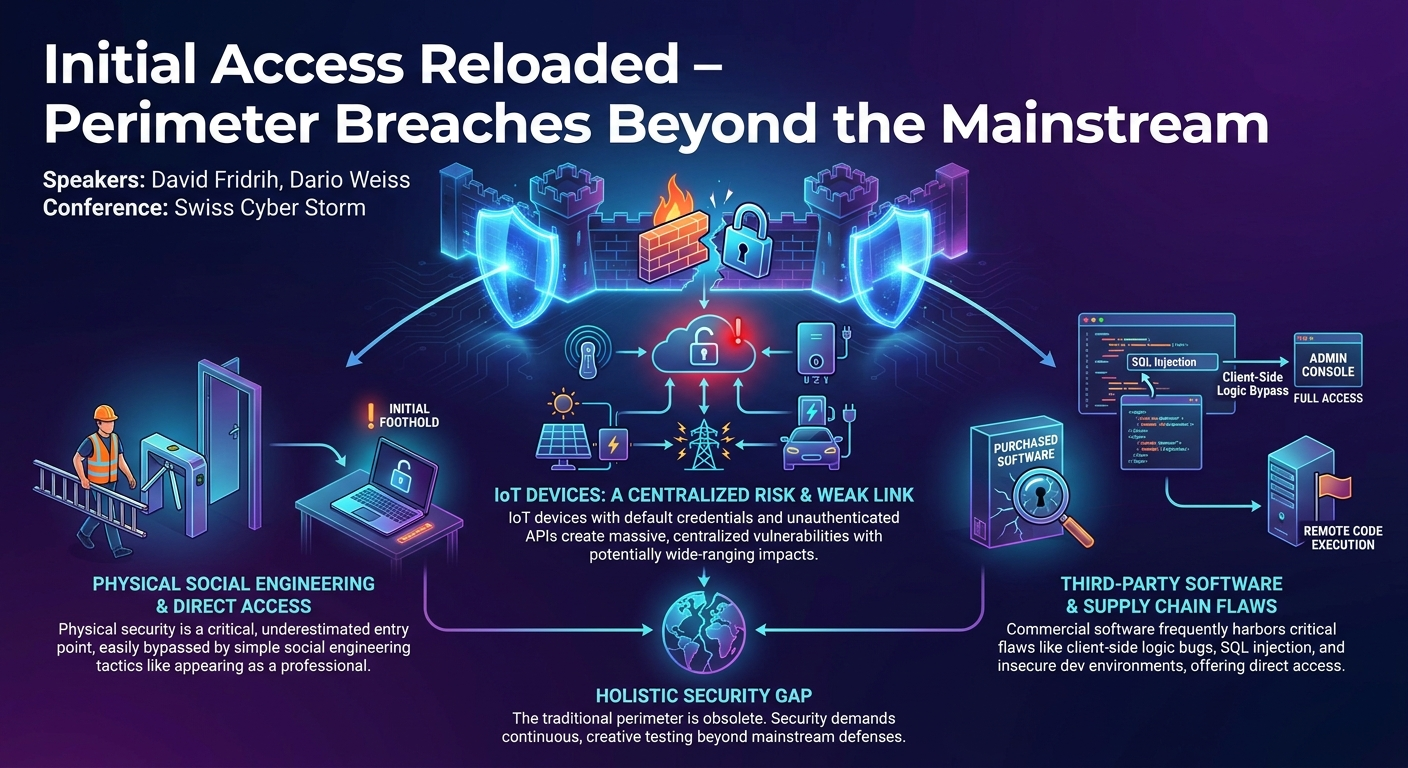
In "Initial Access Reloaded – Perimeter Breaches Beyond the Mainstream," David Fridrih and Dario Weiss, esteemed pentesters from InfoGuard's red team, presented a compelling series of real-world attack scenarios that highlight the overlooked and unconventional pathways to initial network access. Moving beyond standard server and web application vulnerabilities, their talk delves into physical social engineering, often-neglected IoT devices, and subtle flaws in third-party software that collectively form a much broader and more permeable attack surface than commonly perceived.
Key moments
- 2:20 Physical social engineering: Ladder to office access
- 5:15 Guest Wi-Fi password from window, then domain compromise
- 7:00 BitLocker bypass using TPM sniffing attack
- 8:30 IoT smart sensor root shell via war driving data
- 11:50 Solar controller cloud vulnerabilities, JWT bypass, grid risk
- 17:50 Web app client-side admin bypass and SQL injection
- 24:00 Dev test environment RCE and customer's unusual fix
- 27:50 Conclusion: The perimeter is everywhere, continuous testing
Initial Access Reloaded – Perimeter Breaches Beyond the Mainstream
Speakers: David Fridrih (Pentester, InfoGuard), Dario Weiss (Pentester, InfoGuard)
Conference: Swiss Cyber Storm
YouTube: https://www.youtube.com/watch?v=ZPfqBMqSr9U
Overview
In "Initial Access Reloaded – Perimeter Breaches Beyond the Mainstream," David Fridrih and Dario Weiss, esteemed pentesters from InfoGuard's red team, presented a compelling series of real-world attack scenarios that highlight the overlooked and unconventional pathways to initial network access. Moving beyond standard server and web application vulnerabilities, their talk delves into physical social engineering, often-neglected IoT devices, and subtle flaws in third-party software that collectively form a much broader and more permeable attack surface than commonly perceived.
The presentation underscored a critical message: the traditional definition of a network perimeter is outdated. Attackers are increasingly resourceful, targeting not just digital vulnerabilities but also human elements, physical infrastructure, and the interconnectedness of modern systems. Fridrih and Weiss demonstrated how their ethical hacking engagements frequently uncover critical security gaps in areas that clients, and even many security professionals, tend to underestimate, leading to swift and devastating compromises.
This article dissects the methodologies presented, offering a detailed look at the creative and sophisticated techniques employed by InfoGuard's red team to achieve initial access, often bypassing robust conventional defenses. It serves as a stark reminder that comprehensive security requires a holistic approach, extending beyond the digital realm to encompass physical controls, supply chain scrutiny, and continuous, imaginative testing.
Background
▶ Watch: Physical social engineering: Ladder to office access (2:20)
The landscape of cybersecurity often focuses heavily on traditional attack vectors: exploiting known vulnerabilities in public-facing servers, web applications, and network services. Organizations invest significantly in firewalls, intrusion detection systems, and regular vulnerability scanning to fortify these digital perimeters. However, as these conventional defenses mature, sophisticated attackers are compelled to seek alternative, less scrutinized entry points. This talk by InfoGuard's red team, a group of professional and ethical hackers, directly addresses this evolving threat landscape. Their mission is to identify vulnerabilities that real attackers could exploit, providing customers with actionable recommendations to enhance their security posture.
The core problem highlighted by Fridrih and Weiss is the pervasive underestimation of "non-mainstream" initial access methods. Many organizations operate under the assumption that if their external network scans come back clean, their perimeter is secure. This overlooks crucial aspects such as physical security, the burgeoning ecosystem of Internet of Things (IoT) devices, and the inherent risks associated with integrating third-party software solutions. The speakers emphasized that their real-world engagements consistently reveal significant gaps in these areas, demonstrating that even organizations with strong digital defenses can be compromised through creative, often low-tech, attack paths. Their work aims to bridge this awareness gap, pushing organizations to consider a broader definition of their attack surface and the diverse tactics employed by persistent adversaries.
Key Findings
▶ Watch: BitLocker bypass using TPM sniffing attack (7:00)
The series of real-world case studies presented by David Fridrih and Dario Weiss yielded several critical findings that challenge conventional security wisdom:
- Physical Attack Vectors are Massively Underestimated: Despite technological advancements, basic physical access remains a highly effective, yet often overlooked, initial entry point. Simple social engineering tactics, such as carrying a ladder or appearing to belong, can bypass physical controls, leading directly to internal network access via unlocked workstations or unsecured infrastructure.
- IoT Devices Represent a Significant and Centralized Risk: The proliferation of IoT devices, from smart sensors to solar controllers, introduces a vast and often poorly secured attack surface. Default credentials, unauthenticated APIs, and publicly known secrets are common vulnerabilities. Furthermore, the centralized nature of cloud-connected IoT systems means that a single vulnerability can provide control over numerous devices, potentially leading to large-scale infrastructure destabilization or widespread health risks.
- Third-Party Software and Supply Chain Weaknesses are Critical Entry Points: Organizations often assume that commercial-off-the-shelf (COTS) software or purchased solutions are inherently secure. However, the talk demonstrated how vulnerabilities within these third-party applications—ranging from client-side authentication flaws to easily discoverable SQL injection vulnerabilities and insecure dev environments—can provide direct access to sensitive data and systems, even when an organization's custom code is robust.
- Security is More Than Technology; It's About Processes and People: The most advanced technological defenses can be rendered ineffective if physical security protocols are lax, employees are not trained to identify suspicious activity, or internal processes fail to account for the full spectrum of potential threats. Human vigilance and robust operational procedures are as vital as technical controls.
- Continuous, Creative Testing is Essential: The rapidly evolving cyber threat landscape demands that security assessments go "beyond the mainstream." Attackers constantly innovate, finding novel paths. Therefore, organizations must adopt continuous testing methodologies, including red teaming exercises that simulate these creative, non-standard attack scenarios, to truly understand and mitigate their exposure.
These findings collectively underscore the need for a paradigm shift in how organizations perceive and defend their perimeter, urging a move towards a more comprehensive, threat-actor-centric security strategy.
Technical Deep Dive
▶ Watch: Solar controller cloud vulnerabilities, JWT bypass, grid risk (11:50)
The core of the "Initial Access Reloaded" talk was a series of detailed technical breakdowns of diverse attack paths, moving from physical breaches to sophisticated IoT and web application compromises. Each scenario illustrated a distinct, often underestimated, method for gaining initial access.
Physical Social Engineering and Direct Access
David Fridrih demonstrated the potent effectiveness of physical social engineering. In one instance, after conventional external scans failed to yield access, he adopted the persona of a contractor. By simply donning a hi-vis vest and carrying a ladder, he gained entry to a company's headquarters within three minutes, without needing to interact with anyone. Once inside, he located an unlocked notebook, enabling him to install an initial foothold. This highlighted that physical access controls are often lax, and the psychological effect of a "professional" appearance can bypass them entirely.
Another physical attack involved exploiting an unlocked Wi-Fi network at a production site. To avoid detection, the team drove to the location around midnight, using a Wi-Fi antenna to connect and establish a foothold under the cover of darkness. This underlined the importance of securing all Wi-Fi networks, especially those near sensitive operational environments, and considering temporal aspects of reconnaissance.
Guest Wi-Fi and Domain Compromise via Certificate Services
Dario Weiss presented a case where a client's guest Wi-Fi, initially thought to be isolated, led to full domain compromise. The initial breach was startlingly simple: the Wi-Fi password was found written on a piece of paper visible through a window in a large office complex. After gaining access to the guest Wi-Fi, the team performed network scanning and discovered an open network share. This share contained usernames, which were then used in a password spraying attack. Crucially, the common "username equals password" pattern yielded initial credentials.
With these credentials, further reconnaissance revealed that the organization's domain controller was unexpectedly reachable from the guest Wi-Fi network. The compromised account possessed the privilege to request certificates for any other user. Leveraging this, the attackers requested a certificate for a domain administrator account. This certificate was then used to authenticate against the domain controller, effectively pawning the entire domain within half a day, all without ever needing internal network access or privileged internal credentials. This scenario exposed a critical misconfiguration where the guest network was not adequately segmented from the internal production network and Active Directory certificate services were insecurely configured.
BitLocker Bypass via TPM Sniffing
Addressing a client's confidence in BitLocker encryption for stolen devices, Dario demonstrated a hardware-based attack. BitLocker relies on a Trusted Platform Module (TPM) chip on the motherboard to store and manage the disk decryption key. When the system boots, this key is loaded from the TPM into RAM. By physically attaching probes to the specific data lines on the motherboard connecting the TPM and RAM, a technique known as TPM sniffing can be performed. Dario explained that a cheap logic analyzer (available for as little as five dollars from online retailers) can capture the raw data traffic. From this traffic, the volume master key for the BitLocker-encrypted drive can be extracted. Once the key is obtained, the disk can be decrypted, allowing attackers to bypass local administrator passwords and even disable Endpoint Detection and Response (EDR) solutions, thereby gaining full access to the device and potentially the domain.
IoT Smart Sensor: Default Credentials and Root Shell
An external penetration test on a web application revealed a smart sensor used in critical infrastructure (construction, tunnels, railways). Initial reconnaissance via the server header identified the device. The documentation for this sensor revealed a critical vulnerability: the default password was not "admin" but the device's serial number (a 10-digit code). Furthermore, the default Wi-Fi network name for these devices included both the model number and the serial number.
Dario leveraged war driving data (e.g., from publicly available databases like Wigle.net) to search for Wi-Fi networks matching the sensor's model number. This allowed him to enumerate numerous serial numbers, and by cross-referencing with the client's geographical location, identify the target device's serial number. Using this as the password, he gained access to the web application. Within the application, a hidden feature—a binary script uploader—was discovered. This allowed the upload and execution of arbitrary scripts. A simple bash script was uploaded to establish a reverse shell, which connected back as the root user, providing complete control over the device.
IoT Smart Solar Controller: Unauthenticated API and JWT Weaknesses
David Fridrih detailed a vulnerability discovered during his bachelor's thesis involving a smart solar controller. This device manages solar panel output and controls connected IoT appliances like car charging stations and smart boilers, all connected to a cloud service.
The first major vulnerability was found in the solar controller's API. This API was unauthenticated and publicly exposed the configurations of all existing controllers. Crucially, these configurations included the stored credentials (usernames and passwords) for third-party IoT devices (e.g., car charging stations) that the solar controller interacted with. An attacker could simply read these configurations to gain full control over connected devices, such as remotely turning a car charging station on or off.
The second vulnerability was in the solar controller's web portal, which used JSON Web Tokens (JWTs) for authentication. JWTs are cryptographically signed to ensure their integrity. However, the server used a publicly known password (likely a default framework value that was never changed) as the secret for signing these tokens. By knowing this secret, David could forge valid JWTs, impersonating any user, including high-privilege installer accounts that had access to all devices. This allowed him to overwrite device configurations, gaining control over connected devices like smart boilers. The vendor confirmed an even greater risk: simultaneous control over numerous devices across an entire region (e.g., all boilers in Switzerland) could lead to power grid destabilization and potential blackouts due to electricity fluctuations. Furthermore, lowering boiler temperatures could disable legionella protection, posing a significant health risk. This demonstrated how centralization in IoT systems massively amplifies risk.
Web Application 1: Client-Side Logic, SQL Injection, and RCE
Dario presented a case where a client's external perimeter was minimal, with strong defenses like multi-factor authentication (MFA). However, one web application, a purchased "bot solution," proved vulnerable. Initial analysis of the static JavaScript source code revealed a glaring flaw: authentication logic was performed client-side. Specifically, if (username == 'administrator') was used to assign an administrator role. Entering "administrator" as the username, without any password, granted access to an "administrator console."
Further static code analysis uncovered a hidden "secret menu" activated by Control+Space. This menu sent an "authentication" request to the server, which responded with "fail." Using Burp Suite, Dario intercepted the response and changed "fail" to "success," unlocking a new interface. This interface offered functionalities like executing SQL queries, reading log files, and viewing configurations. Alarmingly, the configuration file contained the SQL database password: SQL.
After the vendor issued an emergency patch for the secret menu, Dario returned to the application. He found that direct access to log files via their URL was still possible. A SQL error in the logs indicated a potential SQL injection vulnerability. Exploiting this, he injected a malicious SQL query that returned all usernames and passwords from the database. Since the database was a Microsoft SQL Server and the compromised account was a SIS admin, he could re-enable the XPC cmd shell feature. This allowed him to execute arbitrary commands on the server, confirmed by a ping command to a controlled server. Although the client's EDR ultimately triggered and contained the attack, this demonstrated how deeply flawed third-party software can undermine an otherwise secure perimeter.
Web Application 2: Developer Test Environment RCE
David analyzed a second web application that displayed a "Windows window inside a website" and prominently featured "deftest" in its title, indicating a developer test environment. These environments are notoriously insecure. The application hosted .NET binaries (Windows executables) and featured "save file" (upload) and "open file" (explorer) buttons.
Initially, uploading a malicious executable and trying to open it via the explorer failed due to environment restrictions. However, David discovered that the explorer allowed files to be moved using the "send to" option. The core vulnerability was the ability to replace existing applications with uploaded files. He created a custom .NET executable that, when run, simply created a text file in the documents folder to prove execution. He then uploaded this custom executable, renamed the original application's binary (e.g., _backup), and replaced it with his malicious version. When the application was accessed and the "execute" button pressed, his output file appeared, confirming remote code execution. The customer's "fix" was to simply crash the entire application, making it unreachable, humorously concluding that "if it's not reachable, you can't exploit it." This highlighted the dangers of insecure dev environments and flawed file handling.
Demo / Proof of Concept
▶ Watch: Web app client-side admin bypass and SQL injection (17:50)
Throughout their talk, David Fridrih and Dario Weiss effectively demonstrated various proof-of-concept scenarios, illustrating the tangible impact of their findings. While not a single, continuous live demo, each case study served as a distinct demonstration of a successful attack.
For instance, the physical social engineering attack was proven by David's ability to enter a corporate headquarters within three minutes and install a foothold on an unlocked laptop. The guest Wi-Fi compromise was demonstrated by the team's ability to move from an openly displayed password to a full domain administrator compromise within half a day, culminating in the successful request of an administrator certificate.
The TPM sniffing attack, while requiring specialized hardware, was visually supported by images of the logic analyzer connected to a motherboard, showcasing the technical feasibility of extracting a BitLocker volume master key from a stolen device. The IoT smart sensor exploit was validated by the successful upload of a bash script and the establishment of a root shell, providing irrefutable evidence of remote code execution. Similarly, the solar controller vulnerabilities were concretely demonstrated by showing how an unauthenticated API could expose credentials and how a forged JWT could grant control over connected household devices, with the added context of potential grid destabilization.
On the web application front, Dario's journey through the "bot solution" served as a step-by-step demonstration: from exploiting client-side authentication to uncovering a hidden menu, using Burp Suite to manipulate server responses, then performing SQL injection to extract credentials, and finally re-enabling XPC cmd shell for remote code execution. David's exploit of the dev test environment was also a clear proof of concept, showing the replacement of a legitimate .NET binary with a malicious one to achieve command execution, evidenced by the creation of a specific output file.
In each instance, the speakers provided sufficient detail and contextual evidence, often with screenshots of code snippets, network traffic, or application interfaces, to unequivocally prove the viability and impact of their described attack vectors.
Defensive Implications
▶ Watch: Conclusion: The perimeter is everywhere, continuous testing (27:50)
The diverse attack scenarios presented by David Fridrih and Dario Weiss offer critical insights for defenders, urging a paradigm shift from a purely digital perimeter to a holistic security posture.
- Strengthen Physical Security and Social Engineering Awareness:
- Implement robust access controls: Beyond badge readers, ensure physical barriers, surveillance, and a strong culture of challenging unknown individuals.
- Employee training: Educate staff on social engineering tactics, emphasizing the importance of questioning suspicious individuals (e.g., someone with a ladder) and reporting unusual activity.
- Secure workstations: Enforce strict policies for locking computers when unattended, even for short periods. Disable USB auto-run features.
- Rethink Network Segmentation and Wi-Fi Security:
- Strict guest network isolation: Guest Wi-Fi must be completely segmented from internal production networks and critical infrastructure. No access to internal shares, Active Directory, or domain controllers.
- Strong Wi-Fi authentication: Avoid easily discoverable passwords. Implement WPA3 Enterprise where possible. Regularly audit Wi-Fi configurations.
- Environmental awareness: Scan for rogue Wi-Fi access points and ensure no sensitive information (like passwords) is publicly visible.
- Address IoT Security from Procurement to Deployment:
- Default credential management: Mandate changing all default credentials immediately upon deployment. Prioritize devices that enforce strong, unique passwords.
- API security: Conduct thorough security assessments of all IoT APIs, ensuring proper authentication, authorization, and least privilege principles. Publicly exposed, unauthenticated APIs are a critical risk.
- Supply chain vetting: Scrutinize IoT vendors for their security practices, including secure development lifecycle, vulnerability disclosure, and update mechanisms.
- Patching and updates: Implement a robust process for regularly updating IoT device firmware to address known vulnerabilities.
- Secure the Software Supply Chain and Third-Party Solutions:
- Vendor security assessments: Perform due diligence on all third-party software vendors. Request security audit reports and evidence of secure development practices.
- Internal testing of purchased software: Do not assume commercial software is secure. Integrate security testing (penetration tests, code reviews) of third-party applications into your security program, focusing on both configuration and potential underlying vulnerabilities.
- Server-side validation: Never rely on client-side logic for critical security decisions like authentication or authorization. All such checks must occur on the server.
- Secure coding practices: Implement and enforce secure coding standards to prevent common vulnerabilities like SQL injection, especially when handling user input.
- Embrace Continuous and Creative Security Testing:
- Beyond mainstream testing: Move beyond automated vulnerability scanners and standard penetration tests. Engage in red teaming exercises that simulate real-world, creative attack paths, including physical, social engineering, and IoT-focused scenarios.
- EDR deployment and response: While initial access might occur, EDR solutions are crucial for detecting, containing, and isolating breaches, limiting lateral movement and overall impact. Ensure EDR is configured for optimal detection and that response playbooks are well-rehearsed.
- Developer environment hardening: Treat developer and test environments with the same security rigor as production environments, especially if they host executable code or sensitive data. Ensure strict access controls and regular security audits.
By adopting these defensive strategies, organizations can significantly reduce their exposure to the "non-mainstream" initial access vectors that are increasingly favored by sophisticated attackers.
Key Takeaways
- The Perimeter is Everywhere: The traditional concept of a secure network perimeter is obsolete. Attack surfaces now include physical spaces, IoT devices, third-party applications, and even human elements.
- Physical Security is Paramount: Simple social engineering tactics and physical access bypasses are highly effective, yet often underestimated, routes to internal network compromise.
- IoT Devices are High-Risk & Centralized: Default credentials, unauthenticated APIs, and easily discoverable secrets in IoT devices, especially cloud-connected ones, create massive, centralized vulnerabilities with potentially wide-ranging impacts (e.g., grid destabilization, health risks).
- Third-Party Software is a Common Weak Link: Commercial or purchased software solutions frequently harbor critical vulnerabilities (client-side logic, SQL injection, insecure dev environments) that can provide direct initial access, even in otherwise well-defended networks.
- Security Requires Holistic Vigilance: Effective defense demands continuous, creative testing (red teaming) that includes physical, human, and IoT vectors, alongside robust EDR, secure coding practices, and strict network segmentation.
About the Speaker(s)
David Fridrih and Dario Weiss are both experienced pentesters working with InfoGuard's red team. As part of a diverse team of ethical hackers ranging from apprentices to PhDs, they specialize in identifying vulnerabilities by simulating real-world attack scenarios against their clients' systems. Their work encompasses a broad spectrum of security assessments, from web applications and IoT products to complex networks and critical infrastructure. They are dedicated to helping organizations understand their true security posture and providing actionable recommendations to enhance their defenses against evolving threats. David notably contributed insights from his bachelor's thesis research on IoT solar controllers, while Dario showcased his expertise in client-side web application flaws and physical bypasses.
Reviews
Dr. Zero (Offensive Security Researcher) — SOLID
A collection of perfectly executed red team war stories from InfoGuard operators who clearly do the actual work. There is zero novel research here, but it provides a highly practical run-through of how basic misconfigurations like AD CS template abuse or unauthenticated IoT APIs continue to ruin companies.
Heather Calloway (CISO) — SOLID
A competent red team highlight reel masquerading as novel research. The findings are familiar, but the AD CS escalation and TPM sniffing demonstrations are excellent practical reminders of how quickly perimeter failures become domain compromises.