Next-Gen IR: Swisscom’s Framework for Microsoft 365
Angelo Violetti (Swisscom)
Swiss Cyber Storm 2025 · Day 1 · Panorama
Overview
In an era where digital collaboration and cloud services are paramount, Microsoft 365 (M365) stands as a foundational platform for an estimated 90% of companies globally. While M365 offers unparalleled productivity and connectivity, its widespread adoption also presents an expansive attack surface that threat actors are increasingly targeting with sophisticated techniques. This talk, delivered by Angelo Violetti from Swisscom's B2B CERT, addresses this critical challenge by unveiling Swisscom's innovative framework for Next-Gen Incident Response (IR) within the Microsoft 365 ecosystem.
Key moments
- 0:00 Introduction and speaker background
- 1:56 Main and emerging M365 cyber threats
- 4:00 Swisscom's M365 Incident Response Framework overview
- 7:00 Common M365 attack scenario and kill chain
- 15:59 Key security recommendations for M365 resilience
- 20:00 Q&A: Risks of broad IR application permissions
- 24:00 Q&A: Integrating with existing SIEMs like Sentinel
Next-Gen IR: Swisscom’s Framework for Microsoft 365
Speakers: Angelo Violetti (Swisscom)
Conference: Swiss Cyber Storm
YouTube: https://www.youtube.com/watch?v=DPsvJXLtsPc
Overview
In an era where digital collaboration and cloud services are paramount, Microsoft 365 (M365) stands as a foundational platform for an estimated 90% of companies globally. While M365 offers unparalleled productivity and connectivity, its widespread adoption also presents an expansive attack surface that threat actors are increasingly targeting with sophisticated techniques. This talk, delivered by Angelo Violetti from Swisscom's B2B CERT, addresses this critical challenge by unveiling Swisscom's innovative framework for Next-Gen Incident Response (IR) within the Microsoft 365 ecosystem.
Violetti's presentation meticulously outlines a structured approach designed to enhance detection capabilities, streamline response efforts, and ultimately build greater resilience against M365-specific threats. The framework integrates advanced threat detection rules, leverages comprehensive threat intelligence, and introduces unique capabilities for deep forensic analysis within compromised customer tenants. By focusing on common attack patterns—from initial compromise via Adversary-in-the-Middle (AiTM) to data exfiltration and subsequent phishing campaigns—Swisscom provides a practical and actionable blueprint for security teams grappling with the complexities of cloud-native incident response.
The significance of this framework lies in its proactive and integrated methodology, moving beyond traditional, reactive IR. It empowers incident responders with the necessary tools and processes to rapidly identify, contain, and remediate threats within M365 environments, reducing dwell time and mitigating potential business impact. This article will delve into the technical intricacies of Swisscom’s framework, examining its core components, illustrative use cases, and the crucial defensive implications for organizations leveraging Microsoft 365.
Background
▶ Watch: Introduction and speaker background (0:00)
The pervasive adoption of Microsoft 365 as a core collaboration and productivity suite has fundamentally reshaped the enterprise IT landscape. With approximately 90% of companies relying on M365 applications like Exchange, SharePoint, OneDrive, and Teams, the platform has become an indispensable backbone for daily operations. However, this ubiquity also positions M365 as a prime target for cyber adversaries, who have rapidly adapted their techniques to exploit vulnerabilities and misconfigurations specific to cloud environments.
The talk highlights several prevalent and emerging cyber threats frequently encountered during M365 incident response cases. Adversary-in-the-Middle (AiTM) attacks are a significant concern, where threat actors position themselves between the user and M365 services to intercept communications, steal session cookies, and bypass multi-factor authentication (MFA). This allows them to gain unauthorized access to legitimate user accounts. Another common vector is internal and external spear phishing, where compromised user accounts are leveraged to launch further phishing campaigns, exploiting the trust associated with legitimate internal communication channels. Financial fraud attempts, aiming to alter transaction details or bank account information, also frequently originate from compromised M365 accounts.
Data exfiltration remains a primary objective for attackers, with Exchange, SharePoint, and OneDrive serving as rich repositories for sensitive information. Threat actors seek to download files, emails, and other critical data once they establish a foothold. Furthermore, the emergence of AI-powered features within M365, such as Copilot, introduces new attack vectors. For instance, a vulnerability discovered by AM Security allowed threat actors to exfiltrate data directly from the M365 Copilot chat interface, underscoring the continuous evolution of threats targeting new M365 functionalities.
The increasing sophistication and M365-specific nature of these attacks necessitated a dedicated, efficient, and robust incident response solution. Traditional IR approaches often fall short in the dynamic and log-intensive cloud environment. Swisscom recognized this gap and developed its framework to address the unique challenges of M365 incident response, aiming to improve detection, response capabilities, and overall efficiency in a highly targeted environment.
Key Findings
▶ Watch: Swisscom's M365 Incident Response Framework overview (4:00)
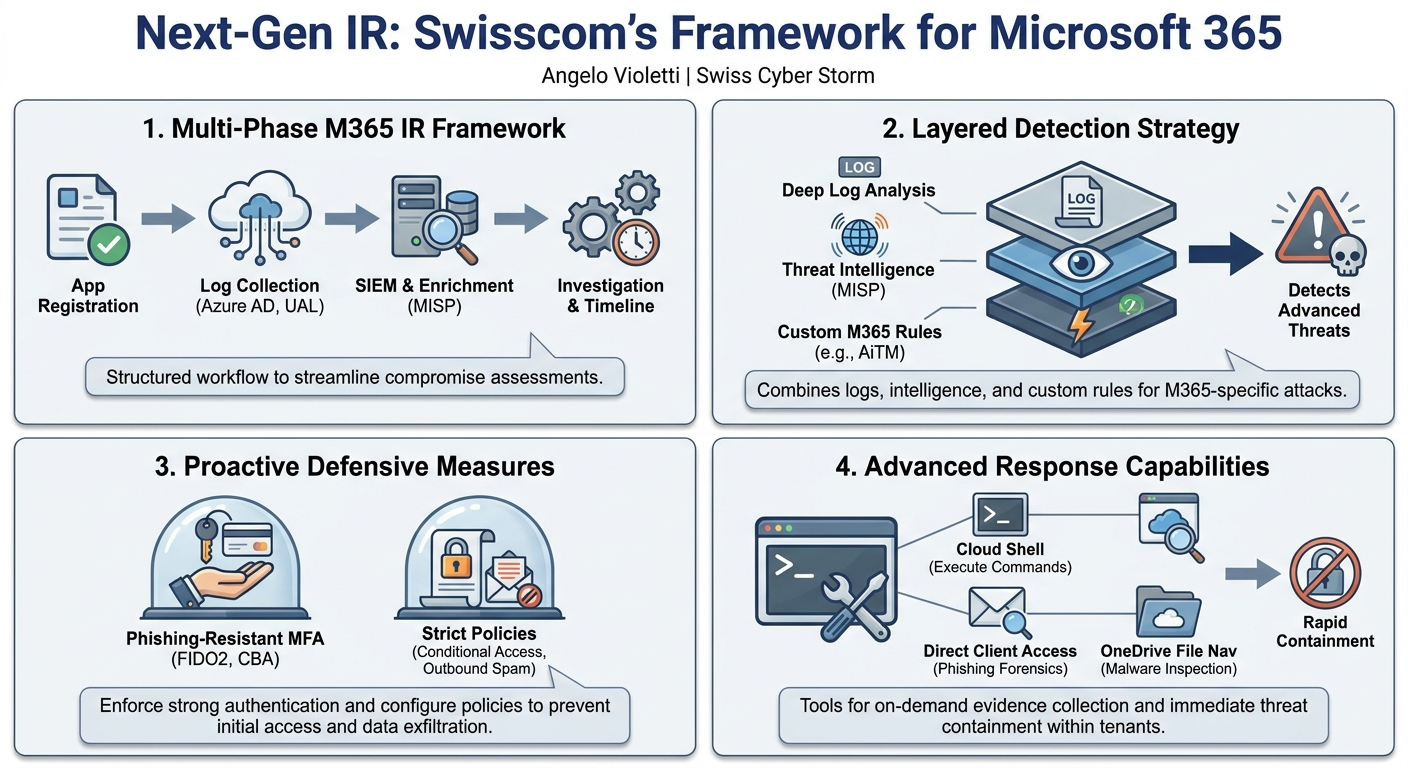
Swisscom's framework for Microsoft 365 incident response represents a significant advancement in addressing cloud-native security incidents. The core finding is the successful development and implementation of a structured, multi-phase workflow designed to streamline and enhance M365 compromise assessments. This framework integrates advanced detection capabilities with efficient response mechanisms, making the IR process more effective.
The framework is built upon a five-phase workflow:
- Application Registration: The initial step involves registering a Swisscom application within the customer's compromised M365 tenant. This application is granted specific, carefully defined permissions essential for comprehensive log collection.
- Log Collection: Leveraging the registered application, the framework systematically collects crucial logs from the M365 environment. Key log sources include Azure AD sign-in logs, Azure AD audit logs, Unified Audit Logs (from M365 applications), and Risk Detections automatically generated by M365. The flexibility to collect additional logs based on case specifics is also a critical design feature.
- SIEM Ingestion and Enrichment: Collected logs are pushed into Swisscom's central SIEM platform. Here, logs undergo an enrichment process using threat intelligence indicators stored in a MISP (Malware Information Sharing Platform) infrastructure. Concurrently, the SIEM applies custom threat detection rules developed and continuously updated by Swisscom to identify malicious activities.
- Investigation: Based on the alerts and insights generated by the SIEM, incident responders initiate a detailed investigation. This phase leverages the enriched data and detection rules to trace attacker actions and understand the scope of the compromise.
- Timeline Creation and Reporting: The final phase involves compiling a detailed timeline of identified attacker actions and generating a comprehensive incident report for the customer.
Beyond the core workflow, the talk highlights several features under active development that promise to further enhance the framework's capabilities. These include:
- MA Client Integration: Direct access to compromised user email accounts to pinpoint initial access points, particularly crucial for phishing-related compromises.
- OneDrive File Navigation: The ability to access and inspect potentially malicious files uploaded or residing within the customer's OneDrive environment.
- Cloud Shell: A powerful functionality allowing Swisscom responders to execute commands directly within the customer's tenant. This enables on-demand collection of additional logs, immediate disabling of user accounts, or revoking active sessions, providing critical real-time response capabilities.
These findings collectively demonstrate Swisscom's commitment to building a comprehensive, adaptable, and highly efficient incident response solution tailored specifically for the unique demands of Microsoft 365 security.
Technical Deep Dive
▶ Watch: Common M365 attack scenario and kill chain (7:00)
The technical core of Swisscom’s M365 incident response framework revolves around a robust process for data acquisition, analysis, and actionable response. The framework's effectiveness is rooted in its ability to harness the rich telemetry available within Microsoft 365 and integrate it with custom-built detection and response mechanisms.
The initial technical step is the application registration. Swisscom sends a unique link to the customer, who then grants consent for a Swisscom-controlled application to access their M365 tenant. This application is provisioned with specific permissions necessary for comprehensive data collection. Key log types collected include:
- Azure AD Sign-in Logs: Provide details on user authentication attempts, including source IP addresses, geographical locations, device information, and authentication methods.
- Azure AD Audit Logs: Record administrative and user management activities within Azure Active Directory, such as user creation, password changes, and permission modifications.
- Unified Audit Logs (UAL): A comprehensive source for activities across various M365 services like Exchange Online, SharePoint Online, OneDrive for Business, and Microsoft Teams. These logs are crucial for tracking actions like mailbox rule changes, file access, and data sharing.
- Risk Detections: Automatically generated indicators from Microsoft's security services, highlighting potentially suspicious activities or compromised identities.
Once collected, these logs are ingested into Swisscom's SIEM platform. The platform performs a crucial enrichment step by correlating log data with threat intelligence indicators (IOCs) stored in a MISP infrastructure. This allows for the immediate identification of known malicious IP addresses, domains, or other artifacts. Concurrently, the SIEM applies a continuously evolving set of custom threat detection rules developed by Swisscom. These rules are specifically designed to identify M365-specific attack techniques.
The talk details a classic M365 incident response scenario, illustrating how the framework detects various stages of a typical attack kill chain:
Adversary-in-the-Middle (AiTM) Detection
AiTM attacks are characterized by threat actors intercepting communication to steal session cookies and bypass MFA. Swisscom's detection rules for AiTM focus on anomalous login patterns:
- Geographical Anomaly: Detecting multiple logins from disparate geographical locations within a short timeframe. For example, the simulated user "Miriam" logged in from six different countries within one hour, with a mere seven-minute gap between a login from Zurich and another from the Netherlands. This rapid, geographically impossible sequence triggers an alert.
- Threat Intelligence Correlation: Matching source IP addresses from login attempts against known malicious IPs in the MISP. An example cited was an IP address identified as a Tor node (commonly used for anonymization by attackers) and another associated with brute-forcing and M365 compromise campaigns.
Persistence via MFA Device Addition
Threat actors often establish persistence by adding a new MFA device to a compromised account, ensuring continued access even if the original credentials are reset.
- MFA Device Change Detection: The framework monitors for changes in registered MFA devices. The example shows an account initially registered with "iPhone 14" subsequently having an "iPhone 16" added, indicating a potential unauthorized device registration.
Data Exfiltration Techniques
Exfiltration is a critical phase for attackers, and the framework targets common methods:
- Automatic Email Forwarding: Threat actors configure mailbox forwarding rules to redirect emails to external addresses (e.g., a Gmail account controlled by the attacker).
- Detection: The framework detects the
Set-Mailboxforwarding rule action, specifically when configured to forward emails to external recipients. This is a "quick win" for attackers to automatically siphon off sensitive communications. - OneDrive/SharePoint Bulk Download: Attackers often download large volumes of files from cloud storage.
- Detection: The system identifies bulk downloads of a significant number of files in a short period. The example shows a threat actor downloading 90 files from OneDrive, identifiable by a
transform zipentry in the user agent string, indicating the user clicked on a folder, and OneDrive automatically zipped its contents for faster download.
Further Phishing Campaigns
After compromising an account and exfiltrating data, attackers frequently use the legitimate account to launch further phishing campaigns, leveraging the trust of an internal sender.
- EM Client Usage Detection: Threat actors often use mail clients like EM Client to manage and send mass phishing emails, as it facilitates "marketing campaigns" that can be repurposed for phishing.
- Detection: The framework identifies specific artifacts in the client info string indicating EM Client usage. The example noted an attacker sending emails with the subject "we have received a sharepoint document," often embedding malicious links or files hosted natively within M365 (e.g., SharePoint) to appear legitimate and bypass initial security checks.
The framework's ability to correlate these diverse log sources, apply intelligent detection rules, and integrate threat intelligence provides a comprehensive and granular view of attacker activities within Microsoft 365, enabling precise and timely incident response.
Demo / Proof of Concept
▶ Watch: Q&A: Risks of broad IR application permissions (20:00)
While the talk did not feature a live, interactive demonstration in the traditional sense, Angelo Violetti effectively presented a simulated incident response scenario that served as a detailed proof of concept for Swisscom's framework. This scenario walked the audience through a typical M365 attack kill chain, illustrating how each phase of the framework (from log collection to detection) would identify and respond to specific attacker actions.
The "Miriam" user account, central to the simulated attack, showcased realistic examples of AiTM attacks, MFA device additions, data exfiltration via email forwarding and bulk OneDrive downloads, and subsequent phishing campaigns. Violetti presented screenshots of actual log entries and detection alerts, highlighting key indicators such as multiple logins from six different countries in one hour, an IP address linked to a Tor node, the addition of an "iPhone 16" MFA device, an email forwarding rule to a Gmail account, and the transform zip user agent string indicating a bulk download of 90 files. This methodical walkthrough served as a compelling demonstration of the framework's practical application and its ability to uncover sophisticated M365 compromises.
Defensive Implications
▶ Watch: Q&A: Integrating with existing SIEMs like Sentinel (24:00)
Swisscom's framework not only offers a powerful incident response capability but also provides critical insights into proactive defensive strategies for M365 environments. Based on the identified attack techniques, Angelo Violetti outlined five key recommendations for organizations to enhance their security posture:
- Enforce Phishing-Resistant MFA for Administrators: This is paramount for preventing AiTM attacks. Traditional MFA, reliant on SMS or push notifications, can be bypassed by sophisticated AiTM tools that steal session cookies. Organizations should mandate phishing-resistant MFA methods such as FIDO2 security keys, Windows Hello for Business, or certificate-based authentication (CBA). These mechanisms ensure that session information cannot be easily relayed by attackers. The enforcement of such policies should be implemented through Conditional Access Policies in Azure AD, ensuring that administrators can only authenticate using these stronger methods.
- Adopt Continuous Access Evaluation (CAE): This Microsoft 365 feature allows Azure AD to evaluate user sessions in real-time for changes in conditions. If a user's IP address or location changes drastically during an active session, or if a user account is revoked, CAE can automatically revoke access. This significantly reduces the window of opportunity for attackers who gain access via stolen session cookies or who attempt to move laterally from a compromised session.
- Implement Strict Conditional Access Policies for MFA Device Addition: To prevent attackers from establishing persistence by adding new MFA devices, organizations should configure stringent Conditional Access Policies. These policies can:
- Prompt for an additional MFA code when a user attempts to add a new MFA device.
- Block attempts to add new MFA devices if they originate from outside the company network or from unmanaged/untrusted devices.
- Ensure that such sensitive actions are only performed from managed or compliant devices.
- Configure Outbound Spam Policies: To prevent data exfiltration via automatic email forwarding, organizations must properly configure outbound spam policies in Exchange Online. These policies can:
- Restrict automatic forwarding of emails to external recipients.
- Set an external message limit, preventing a compromised account from sending a large volume of emails outside the organization.
- Alert administrators to suspicious forwarding rules, allowing for prompt investigation and remediation.
- Properly Configure M365 and Azure Activity Auditing: A foundational element for effective incident response is comprehensive logging. Not all critical logs are enabled by default in M365 and Azure. Organizations must:
- Review and customize audit policies to ensure all important activities are logged, especially those related to identity, access, mail flow, and file operations.
- Ingest these logs into a SIEM platform (like Swisscom's, or Microsoft Sentinel) with sufficient retention periods to support forensic analysis during an incident.
- Continuously monitor the SIEM platform using a 24/7 Security Operations Center (SOC), custom detection rules, and integrated threat intelligence to identify any suspicious actions promptly. Adequate logging is the bedrock upon which all detection and response capabilities are built.
By proactively implementing these recommendations, organizations can significantly harden their Microsoft 365 environments, making them more resilient against the sophisticated attack techniques demonstrated in the talk.
Key Takeaways
- Microsoft 365 Requires Specialized IR Frameworks: The widespread adoption of M365 and the unique nature of cloud-native threats necessitate dedicated incident response frameworks like Swisscom's, moving beyond generic IR approaches.
- Layered Detection is Crucial: Effective M365 IR relies on a multi-faceted detection strategy, combining deep log analysis (Azure AD, Unified Audit Logs), enrichment with threat intelligence (MISP), and custom detection rules tailored to M365 attack patterns.
- Phishing-Resistant MFA is a Preventative Imperative: Implementing strong, phishing-resistant MFA methods (FIDO2, Windows Hello for Business, CBA) for all users, especially administrators, is the most impactful defense against common initial access vectors like Adversary-in-the-Middle (AiTM) attacks.
- Proactive Configuration and Monitoring are Foundational: Proper configuration of M365 audit logging, outbound spam policies, and Conditional Access Policies, coupled with continuous SIEM monitoring, forms the bedrock for early detection and rapid response.
- Advanced Response Capabilities Enhance Efficiency: Features like direct Cloud Shell access, email client access, and OneDrive file navigation significantly empower incident responders to collect additional evidence and execute immediate containment actions within a compromised tenant.
- Continuous Evolution of Defenses: As threat actors adapt to new M365 features (e.g., Copilot vulnerabilities), security frameworks must also continuously evolve their detection rules and response capabilities.
About the Speaker(s)
Angelo Violetti is a cybersecurity expert specializing in incident response, currently serving with Swisscom's B2B CERT. With over five years of experience in the field of Forensic Incident Response (FIR), Angelo plays a crucial role in addressing complex security incidents during the day and contributes to FIR reports during the night. He holds a Master's degree in Cybersecurity and possesses various certifications in both incident response and red teaming operations, showcasing a comprehensive understanding of offensive and defensive security strategies. Angelo is a recognized speaker at prominent security conferences, having presented at events such as Def Con 32, the SANS Summit, and Swiss Cyber Storm (on two occasions, including this talk), sharing his insights and expertise with the broader cybersecurity community.
Reviews
Dr. Zero (Offensive Security Researcher) — WEAK
This isn't 'Next-Gen' IR, it's a basic SOC runbook wrapped in Swisscom marketing. Registering an Azure AD app to pull the Unified Audit Log into a SIEM is table stakes for cloud forensics, not a revolutionary framework. It's competent enough for a junior responder, but there is zero novel research here.
Heather Calloway (CISO) — SOLID
Swisscom's B2B CERT lays out a practical playbook for Microsoft 365 incident response. If your SOC is still relying on default Microsoft alerts rather than pulling Unified Audit Logs into a dedicated SIEM for token theft hunting, your head of SecOps needs to watch this. It is a solid operational baseline for a very common class of risk.