What 40 Enterprises Who Asked for Agent Governance Had, and the Control Plane That Came Out of
Josh Woodruff (Founder and CEO · MassiveScale.AI)
[un]prompted II 2026 — The AI Security Practitioner Conference · Day 3 · Stage 1
Overview
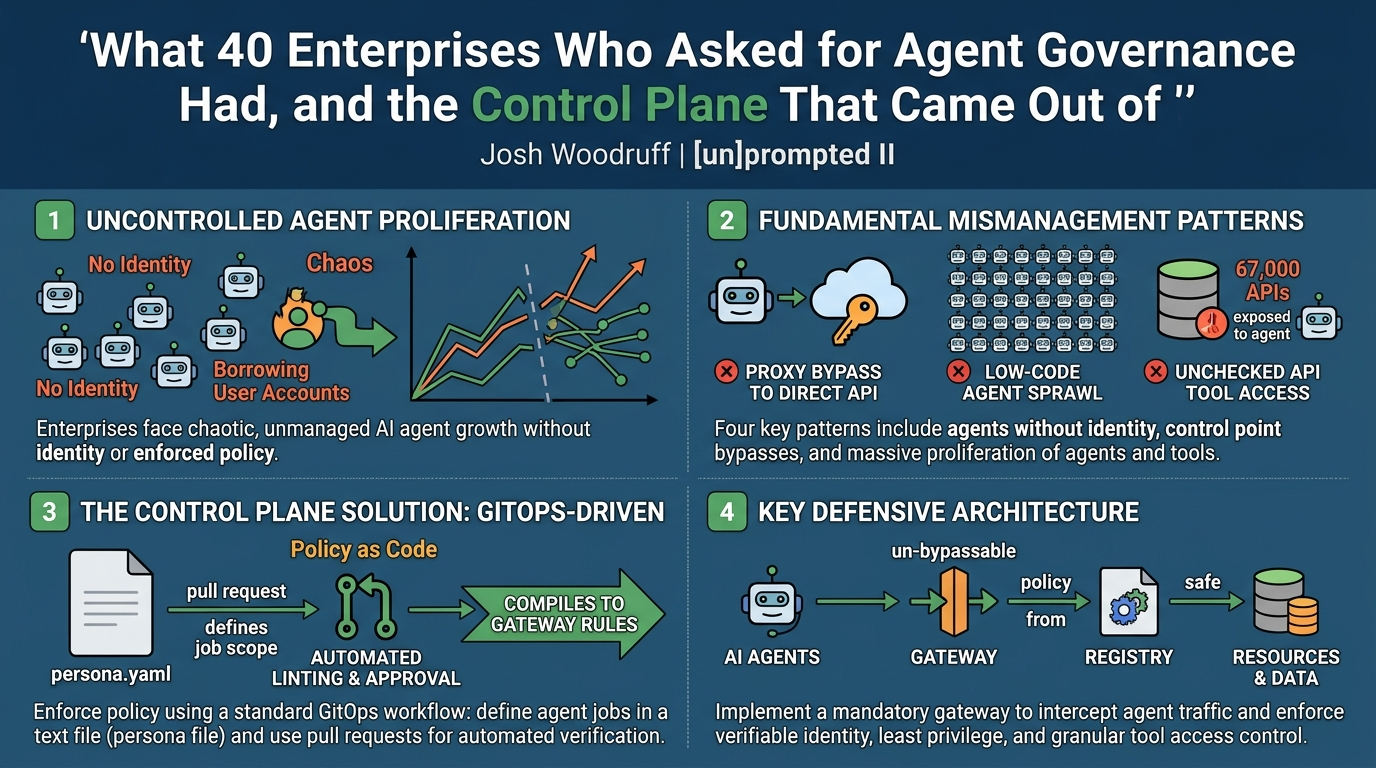
In the rapidly evolving landscape of AI, enterprises are grappling with the uncontrolled proliferation and inherent security risks of AI agents. Josh Woodruff's talk, "What 40 Enterprises Who Asked for Agent Governance Had, and the Control Plane That Came Out of," tackles this critical challenge head-on. Drawing from over 90 sessions with nearly 70 organizations—ranging from banks and insurers to hospitals and cruise lines—Woodruff exposes the "utter chaos" and "track being laid right in front of the train" mentality prevalent in many large enterprises. The presentation highlights four common patterns of agent mismanagement and offers a surprisingly simple, yet profoundly effective, solution: a GitOps-driven control plane centered around a text file and a pull request.
Key moments
- 0:00 Introduction: Governing agents with a text file & pull request
- 2:00 Problem: Agents borrow user identity, causing chaos
- 5:40 Core solution: Registry, identity, and an un-bypassable gateway
- 7:30 Persona file: Defining an agent's job description and tools
- 11:00 Automated policy enforcement: Registry, gateway, and derived rules
- 15:00 Promoting and demoting agents through Git reverts
- 17:00 Key failures: Policy without enforcement and design flaws
- 22:50 Q&A: How agents earn 'senior' autonomy status
What 40 Enterprises Who Asked for Agent Governance Had, and the Control Plane That Came Out of
Speakers: Josh Woodruff, Founder and CEO, MassiveScale.AI
Conference: [un]prompted II
YouTube: https://www.youtube.com/watch?v=SfjBNJytlZI
Overview
In the rapidly evolving landscape of AI, enterprises are grappling with the uncontrolled proliferation and inherent security risks of AI agents. Josh Woodruff's talk, "What 40 Enterprises Who Asked for Agent Governance Had, and the Control Plane That Came Out of," tackles this critical challenge head-on. Drawing from over 90 sessions with nearly 70 organizations—ranging from banks and insurers to hospitals and cruise lines—Woodruff exposes the "utter chaos" and "track being laid right in front of the train" mentality prevalent in many large enterprises. The presentation highlights four common patterns of agent mismanagement and offers a surprisingly simple, yet profoundly effective, solution: a GitOps-driven control plane centered around a text file and a pull request.
The core of the problem, as Woodruff reveals, is a fundamental lack of identity for AI agents, coupled with an absence of enforced policy. Agents often borrow human identities, bypass existing controls, and proliferate without oversight, turning every API into a potential tool call with unknown implications. This talk is a crucial wake-up call for defenders, providing a clear architectural blueprint and a practical, vendor-agnostic method to regain control over their AI agent ecosystems. It’s a call to action to move beyond mere guidelines to enforceable mandates, ensuring AI agents operate within defined boundaries and under proper governance.
Background
▶ Watch: Introduction: Governing agents with a text file & pull request (0:00)
The surge in AI agent adoption within enterprises has introduced significant security and operational challenges, largely due to a reactive rather than proactive approach to governance. Woodruff’s extensive consultations revealed a consistent set of problematic patterns, each contributing to a state of utter chaos where security teams feel overwhelmed and out of control.
The first pervasive issue, Pattern One: The Agent Has No Identity, It Borrows Yours, describes a scenario where AI helpers, such as those used by SOC analysts, run under the analyst's own account. This seemingly innocuous practice leads to four critical problems:
- Lack of Least Privilege: The agent inherits all the access of the human user, making it impossible to apply granular permissions.
- Logging Obfuscation: Security logs attribute agent actions to the human user, obscuring the true actor and making incident response difficult.
- Baseline Corruption: The human user's activity baseline is distorted by agent actions, rendering behavioral analytics less effective.
- Operational Dependency: Pulling the plug on an agent effectively locks out the human, creating a "work stoppage situation."
This isn't theoretical; Woodruff cites recent research showing coding agents running as developers pushing screenshots into public repositories at over 300 organizations, including major tech companies and Frontier AI Labs.
Pattern Two: They’d Done the Right Thing, They’d Put a Proxy in Front of the Model, Then Every App Team Kept Its Own API Key and Went Straight to the Provider, highlights a common bypass. Enterprises invest in proxies for control, but developers find "backdoors" by directly accessing model providers with individual API keys. A manufacturer's two-year-old review gate was constantly circumvented, with "tons of work" going around it. The critical takeaway here is that a control point only counts if nothing can go around it.
Pattern Three: Low-Code Agent Sprawl, illustrates the sheer scale of the problem. One company discovered 2,000 copilots on their low-code agent platform, many built by individual employees for personal use. The fundamental question became, "Which of these are even ours to manage?" Another company reported a dozen custom agents built by contractors, none with any identity. Attempting to review 2,000 agents individually is unfeasible, necessitating a shift from counting individual instances to categorizing "kinds" of agents.
Finally, Pattern Four: API Sprawl, underscores the danger of unchecked tool access. One organization's gateway revealed 67,000 APIs, with developers able to add new ones at will. Nineteen APIs performed the exact same function. While guidelines existed, the enterprise struggled to move from "should" to "must." For an AI agent, every API is a tool call. If an organization cannot definitively state which APIs are admitted, it loses control over what its agents can do.
Woodruff distills these four patterns into a single root cause: "Nobody had written down what was admitted or who was acting. And nothing sat in the path of every call." The emergent industry standard architecture, also adopted by major cloud platforms, addresses this with three core components: a registry for agents, a distinct identity for each AI agent, and a gateway that agents cannot bypass. This architecture is rooted in Zero Trust principles, extending verification from mere connection to per-action authentication and authorization. While vendors now offer these components, the crucial decision of which agents are admitted, with which tools, and under whose authority, remains an internal responsibility, forming the basis of Woodruff's proposed solution.
Key Findings
▶ Watch: Core solution: Registry, identity, and an un-bypassable gateway (5:40)
The central finding of Josh Woodruff's talk is that effective governance of AI agents in an enterprise environment does not require complex, proprietary tools, but rather a simple, GitOps-driven approach that embeds policy as code. This methodology transforms abstract guidelines into concrete, enforced rules, providing a scalable and auditable control plane.
Woodruff's primary contribution is the introduction of the persona file—a foundational text file that serves as the definitive job description for one kind of AI agent. This file meticulously defines what an agent is permitted to do, encompassing its identity, data access, tool scope, and autonomy level. By standardizing this definition, organizations can move away from the unmanageable task of governing thousands of individual agent instances.
A key insight is that policy enforcement must be tightly coupled with the execution path. A written policy, no matter how well-crafted, is ineffective if it's not compiled and enforced by a mechanism in the agent's call path, specifically a gateway. The "fix" presented is a pull request (PR) to a Git repository containing these persona files. This PR triggers automated linting checks, ensuring compliance with predefined rules (e.g., agents must run as themselves, data classifications dictate risk tiers). This shifts policy enforcement left, catching issues before deployment.
Furthermore, the talk highlights the importance of distinguishing between an agent's persona (its job description, which never runs), its instance (a running copy, often ephemeral), and its binding (the specific project or environment it's assigned to). This conceptual separation is crucial for managing agent sprawl, allowing for the reuse of personas across multiple instances and environments, similar to how a single job description applies to many employees.
Finally, the talk emphasizes the need for a graduated autonomy model, drawing from the Agentic Trust Framework (ATF). Agents can earn "promotions" from junior to senior levels, allowing them to perform more sensitive actions alone, based on verifiable evidence of reliability and performance. Conversely, "demotion" is swift, typically a simple Git revert, ensuring immediate policy enforcement in response to incidents. This framework provides a structured pathway for agent evolution under strict governance.
Technical Deep Dive
▶ Watch: Automated policy enforcement: Registry, gateway, and derived rules (11:00)
The technical solution proposed by Josh Woodruff revolves around a persona file, a YAML or similar text file that acts as the single source of truth for an AI agent's capabilities and permissions. This file, managed through standard Git processes, dictates how an agent interacts with enterprise resources and data.
Let's dissect the structure and flow:
The Persona File: Agent's Job Description
The persona file is a declarative definition that specifies an agent's operational boundaries. Key blocks within this file include:
- Owner: Explicitly names the human owner (not a team alias, as an alias "cannot be paged").
- Runs As: Defines the identity under which the agent operates. Crucially, the system enforces that agents run as themselves, not as a human user.
- Data Classes: Lists the types of data the agent can access (e.g.,
security logs,employee data). This implicitly derives a risk tier (e.g., employee data mandatestier three), preventing manual, potentially erroneous, classification. - Tool Scope: An explicit allowlist of tools (APIs) the agent is permitted to call. If a tool is not on this list, the agent cannot invoke it.
- Action Contract: A three-column matrix defining actions:
- Alone: Actions the agent can perform autonomously.
- Needs Approver: Actions requiring explicit human approval before execution.
- Never Do: Actions the agent is strictly forbidden from performing.
- Autonomy Level: Based on the Agentic Trust Framework (ATF), this specifies the agent's maturity (e.g.,
junior). - Expiration: A defined date after which the agent's permissions automatically expire.
- Project Binding: Links the agent to specific production projects or environments, preventing it from operating outside its designated scope.
The GitOps Workflow and Enforcement
The power of this approach lies in its integration with a GitOps workflow:
- Pull Request (PR): Any change to a persona file, such as adding a new tool or promoting an agent's autonomy level, is initiated via a Git PR.
- Linting: Upon PR submission, an automated linting process runs. This is where policy is enforced "left."
- Identity Check: The linter flags agents configured to "run as a user" (Pattern One), forcing them to run as their own dedicated identity.
- Tier Derivation: If a manual
risk tieris specified, the linter removes it, ensuring the tier is automatically derived from thedata classesdefined in the file, preventing human error and inconsistency. - Tool Scope Validation: Ensures all tools referenced are registered in a central tool catalog.
- Code Owner Approval: If linting passes, the PR proceeds to human review. A code owners file within Git dictates who must approve changes:
- Identity Team and Sponsor: For changes to the persona's core definition.
- Security Architecture: For any changes to the list of tools in the catalog.
This integrates approval directly into the development workflow, eliminating the need for separate ticketing systems.
- Merge and Script Execution: Once approved and merged, a script automatically executes. This script reads the persona file and performs two critical actions:
- Registry Update: Populates an agent registry with metadata like owner, derived risk tier, expiration, and the Git commit hash for auditable traceability. This registry integrates seamlessly with AI intake processes, as mentioned in other talks.
- Gateway Policy Generation: Translates the persona file's rules into a format consumable by an open policy engine like Casbin. This generates concrete
allowanddenyrules for the gateway. The speaker emphasizes that Casbin is merely an example; any policy engine supported by the organization's gateway can be used, requiring only a small translator rewrite if the gateway changes.
Gateway Enforcement and Zero Trust
The generated policy is pushed to the gateway, which acts as the mandatory enforcement point for all agent traffic. This gateway performs per-action verification, aligning with Zero Trust principles.
- Rule Application:
Aloneactions translate toallowrules.Needs Approveractions translate toallowrules only if an explicit approval token is present.Never Doactions becomedenyrules, regardless of other conditions.- Implicit Deny: Any agent not explicitly defined by a persona file, or any agent attempting to operate outside its bound project, is automatically denied. This addresses Pattern Four (API sprawl) and ensures only admitted and authorized agents can function.
- Network Architecture: While the persona file dictates what the gateway enforces, the underlying network architecture must ensure all agent traffic is steered through this gateway, preventing direct access to model providers (Pattern Two).
Managing Sprawl and Autonomy Progression
To address low-code agent sprawl (Pattern Three), Woodruff introduces a crucial distinction:
- Persona: The unchanging job description (the file).
- Instance: A running copy of an agent, often ephemeral.
- Binding: The specific assignment of a persona to a project/environment.
This allows organizations to manage policy at the "kind" level, drastically reducing the number of unique policy definitions required (e.g., 20 kinds instead of 2,000 individual copilots). A persona is reused if the tools and data it accesses remain consistent across instances.
Agent promotion (e.g., from junior to senior) is also handled via Git. Moving an action from "needs approver" to "alone" for a junior agent will trigger a linting failure, requiring the autonomy level to be explicitly upgraded to senior and undergo a formal review and approval process. Demotion is a simple git revert, instantly rolling back permissions. This relies on the Agentic Trust Framework (ATF), an open standard that defines quantitative metrics across five dimensions (e.g., security incidents, performance) to justify autonomy progression.
Addressing Weak Spots
Woodruff acknowledges critical areas:
- Policy Without Enforcement: A YAML file is just another written policy if its merge doesn't genuinely alter gateway behavior. The mechanism must compile and deploy policy.
- Design Failure: Header vs. Body Mismatch: The Managed Call Protocol (MCP) introduced headers for method/tool names, but agents write both header and body. If they don't match, a malicious agent could declare one tool in the header and execute another in the body. The fix: the gateway must check header against body and fail closed if they differ.
- Usability vs. Control: Overly strict controls can hinder developer productivity, leading to workarounds or shutdowns. The design must balance security with operational feasibility.
- Shared Policies: For scale, agents might point to shared policy names. Crucially, the agent owner must not be able to change this policy name, as a denied agent might attempt to pick a weaker policy. This field must be immutable by the agent owner.
The entire reference build, including schema, 10 lint rules, compiler, and demo run, is available in an open-source repository, allowing organizations to adopt and adapt this model.
Demo / Proof of Concept
▶ Watch: Promoting and demoting agents through Git reverts (15:00)
The core of Josh Woodruff's talk serves as a live demonstration and proof of concept for his proposed control plane. Rather than a separate segment, the technical deep dive is interwoven with a step-by-step walkthrough of the solution's implementation and enforcement.
Woodruff begins by presenting a real-world starting state: a SOC helper agent running as an analyst, capable of reading alerts, pulling context, and writing case notes. This scenario directly illustrates Pattern One (agent borrowing human identity) and sets the stage for the transformation.
The demonstration then focuses on the creation and modification of a persona file. Woodruff shows how this file explicitly defines the agent's owner, identity (initially runs as user), data access (security logs, employee data), a manually typed risk tier one, a tool scope of five specific tools, an action contract (alone, needs approver, never do), and an autonomy level of junior.
The interactive part of the demo highlights the power of linting. When a pull request is opened with the initial persona file, it fails twice:
- "Agent runs as a user": This lint rule immediately catches the security anti-pattern of agents borrowing human identities.
- "Tier one is incorrect": The linter identifies that
employee datamandates atier threeclassification, overriding the manually enteredtier one. This demonstrates how policy is derived from data, not manually assigned.
Woodruff then shows the fix:
- Changing
runs as usertoruns as itself. - Deleting the manual
tierentry, allowing the linter to derive it correctly.
Once these changes are made, the linting passes, and the pull request proceeds to the human review and approval stage, governed by a code owners file. This vividly illustrates how standard Git processes (PRs, linting, code owners) are repurposed for agent governance.
The final stage of the demonstration involves the post-merge script and gateway enforcement. Woodruff explains how the script reads the merged persona file and writes the policy to both an agent registry and a gateway policy file (using Casbin as an example). He then simulates seven questions asked to the gateway, both before and after the policy merge:
- Before Merge: All seven questions result in denials, as no policy exists. This emphasizes that without a compiled policy, the gateway defaults to a secure "deny-all" state.
- After Merge:
- "Search logs and write a note": Allowed (as defined in the persona's
aloneactions). - "Isolating a host": Allowed only with an approver (as defined in
needs approver). - "Disabling a user": Never works, even with approval (as defined in
never do). - "Same agent in the payments project": Denied, because the agent was not bound to that specific project.
- "An agent with no file at all": Denied.
This direct comparison powerfully illustrates that the merge operation is not just a documentation update but a live, enforceable change to the organization's security posture. The demonstration concludes by showing how agent promotion (e.g., allowing "isolate host" alone) would trigger new linting failures (a junior agent cannot do this alone), requiring an explicit upgrade to senior and a new review, while demotion is a simple, immediate git revert.
The entire reference build, including the schema, 10 lint rules, the compiler, and the exact run demonstrated, is made available in an open-source repository. This allows attendees to replicate the proof of concept and apply it to their own agent governance challenges.
Defensive Implications
▶ Watch: Q&A: How agents earn 'senior' autonomy status (22:50)
The insights and proposed control plane from Josh Woodruff's talk offer profound defensive implications for organizations struggling to secure their AI agent deployments. Implementing this framework can fundamentally shift an enterprise's posture from reactive firefighting to proactive, policy-driven governance.
- Enforced Policy, Not Just Guidelines: The most critical implication is the shift from "should" to "must." By integrating policy definitions directly into a GitOps workflow, where a merged persona file compiles into executable gateway rules, organizations ensure that policy is not merely documented but actively enforced. A YAML file without compilation and deployment is just another written policy that can drift; the gateway is the ultimate enforcement point. Defenders must verify that their chosen solution genuinely changes gateway behavior upon policy updates.
- Explicit Agent Identity and Least Privilege: Agents must be treated as distinct entities with their own identities, separate from human users. This enables the application of least privilege, ensuring agents only have the minimum necessary permissions. It also resolves logging ambiguities, allowing security teams to accurately attribute actions to agents for forensic analysis and incident response. This directly addresses Pattern One and the research cited about coding agents.
- Centralized Control Plane and Gateway Enforcement: Establishing a mandatory gateway for all agent traffic, combined with a central registry and identity management, creates a robust control plane. This gateway becomes the single choke point where all agent actions are authorized or denied. Network architecture must be designed to steer all agent traffic through this enforcement point, preventing direct access to model providers and effectively mitigating Pattern Two (proxy bypasses).
- Granular API Governance: The
tool scopewithin the persona file provides explicit control over which APIs an agent can call. This moves beyond broad network access to specific function-level authorization. By linking this to a central tool catalog, defenders can ensure that only admitted and vetted APIs are ever exposed to agents, tackling Pattern Four (API sprawl). Any API not in the registry or not explicitly allowed for an agent is implicitly denied.
- Mitigating Header-Body Mismatch Vulnerabilities: The talk highlights a critical design flaw where agents can manipulate headers and body content independently. Defenders must ensure their gateways implement rigorous checks to verify that the method and tool name declared in the header precisely match the actual payload. If a mismatch is detected, the gateway must fail closed, preventing potential exploits where a malicious agent attempts to bypass policy by misrepresenting its actions.
- Scalable Management of Agent Sprawl: By distinguishing between agent personas (job descriptions) and instances (running copies), organizations can manage policy at scale. Instead of reviewing thousands of individual agents, defenders can focus on defining and securing a manageable number of agent "kinds." This strategy, which addresses Pattern Three, significantly reduces the operational overhead of agent governance.
- Verifiable Autonomy Progression and Demotion: Leveraging frameworks like the Agentic Trust Framework (ATF) allows for a structured, evidence-based approach to granting agents increased autonomy. Defenders can define quantitative metrics (e.g., security incident rates, performance reliability) that an agent must meet to earn a "promotion." Crucially, the ability to instantly "demote" an agent via a simple Git revert provides an immediate and effective incident response mechanism, reverting permissions to a last-known-good state.
- Security by Default (Implicit Deny): The system defaults to denying any agent action or agent instance that is not explicitly defined and authorized. This "if it isn't written down, it doesn't run" principle is a strong security stance, minimizing the attack surface by preventing unauthorized or unknown agents from operating within the environment.
- Auditability and Traceability: The GitOps approach inherently provides a complete audit trail. Every policy change is a commit, with associated pull requests, linting results, and approvals. The agent registry's inclusion of the Git commit hash links running agents directly back to their source policy, offering unparalleled traceability for compliance and forensic purposes.
- Preventing Policy Evasion: If using shared policies, it is crucial that the agent owner cannot change the policy name an agent points to. This field must be controlled by a higher authority to prevent agents from self-selecting weaker policies when facing denials, ensuring consistent and robust enforcement across the enterprise.
Key Takeaways
- Agents Need Explicit Identity and Least Privilege: AI agents must operate with their own dedicated identities, separate from human users, to enable granular access control, accurate logging, and effective incident response.
- Centralized Gateway for Enforcement: A mandatory gateway is critical for intercepting all agent traffic, enforcing policy per action, and preventing bypasses to direct model access. Network architecture must ensure all agent traffic is steered through this control point.
- GitOps for Policy-as-Code: A GitOps-driven approach using "persona files" provides a scalable, auditable, and enforceable control plane. Policy changes, linting, and approvals are managed through standard Git workflows, compiling into live gateway rules.
- Manage Sprawl by Persona, Not Instance: Distinguish between an agent's "persona" (job description), "instance" (running copy), and "binding" (project assignment) to manage agent proliferation effectively, allowing for reuse of policies across similar agent types.
- Policy Must Be Enforced, Not Just Documented: A written policy or YAML file is ineffective unless it actively compiles into and modifies the behavior of a mandatory enforcement point like a gateway. "If it isn't written down, it doesn't run."
- Graduated Autonomy with Verifiable Evidence: Leverage frameworks like the Agentic Trust Framework (ATF) to define and manage agent autonomy levels, allowing for promotions and instant demotions based on quantifiable evidence of reliability and security performance.
About the Speaker(s)
Josh Woodruff is the Founder and CEO of MassiveScale.AI, a company dedicated to helping organizations implement robust AI governance solutions. His extensive experience includes serving as an IANS faculty member, where he conducts "ask an expert" calls with numerous enterprises, providing him with deep insights into the practical challenges organizations face with AI adoption.
Woodruff is a passionate advocate for vendor-independent and vendor-agnostic solutions, ensuring that his advice and frameworks are broadly applicable across diverse technological stacks. He is a key figure in the development and promotion of the Agentic Trust Framework (ATF), an open standard under the CSAI Foundation, which provides a structured approach to defining and managing agent autonomy and reliability. His work culminated in the organization of the Verifiable Agent Summit, focusing on cryptographically verifiable evidence for agentic AI.
Reviews
→ Top-rated talks at [un]prompted II 2026 — The AI Security Practitioner Conference
All talks from [un]prompted II 2026 — The AI Security Practitioner Conference