Agentic AI in the Wild: What Real Deployments Teach Us About Governance and Scale
Chenxi Wang (General Partner · Rain Capital), Jasmine Jaksic (Senior Director of Engineering · NVIDIA)
[un]prompted II 2026 — The AI Security Practitioner Conference · Day 3 · Stage 1
Overview
The proliferation of agentic AI systems, capable of moving beyond mere conversational interaction to autonomous action, presents both immense opportunities and significant governance challenges. This talk, delivered by Chenxi Wang and Jasmine Jaksic, delves into the practical realities of deploying such systems in enterprise environments. Chenxi Wang, a General Partner at Rain Capital, shares insights from an extensive study of nearly 50 companies, highlighting trends in AI adoption, successful use cases, and the primary barriers to scale. Complementing this, Jasmine Jaksic, Senior Director of Engineering at NVIDIA, provides a deep dive into NVIDIA's internal experiences, illustrating various agent types, their unique failure modes, and the robust control mechanisms developed to mitigate risks.
Key moments
- 0:00 Introduction to real-world agent deployment study
- 2:40 Shifting agent maturity from copilots to full autonomy
- 6:30 Trust and governance: top barrier to agent autonomy
- 8:50 NVIDIA's framework: advice, assist, and act agents
- 13:30 Bug tracker agent: eval vs. real-world accuracy gap
- 17:20 Personal assistant agent fails without sufficient context and state
- 20:30 Platform-level failure: security agent creates cluster-wide deadlock
- 24:00 Introducing 'Normal' for action-level agent governance and approval
Agentic AI in the Wild: What Real Deployments Teach Us About Governance and Scale
Speakers: Chenxi Wang (General Partner, Rain Capital); Jasmine Jaksic (Senior Director of Engineering, NVIDIA)
Conference: [un]prompted II
YouTube: https://www.youtube.com/watch?v=PwAyt43rTFI
Overview
The proliferation of agentic AI systems, capable of moving beyond mere conversational interaction to autonomous action, presents both immense opportunities and significant governance challenges. This talk, delivered by Chenxi Wang and Jasmine Jaksic, delves into the practical realities of deploying such systems in enterprise environments. Chenxi Wang, a General Partner at Rain Capital, shares insights from an extensive study of nearly 50 companies, highlighting trends in AI adoption, successful use cases, and the primary barriers to scale. Complementing this, Jasmine Jaksic, Senior Director of Engineering at NVIDIA, provides a deep dive into NVIDIA's internal experiences, illustrating various agent types, their unique failure modes, and the robust control mechanisms developed to mitigate risks.
The central theme revolves around the critical shift from AI as a copilot to AI as an autonomous actor, emphasizing that the journey to full autonomy is fraught with complexities related to trust, control, and unanticipated failure vectors. The speakers collectively argue that while the desire for increased throughput drives adoption, the real challenge lies in building a comprehensive control plane that ensures alignment, least privilege, containment, and explainability. This talk is essential for organizations navigating the complexities of agentic AI, offering a pragmatic view on how to balance innovation with responsible deployment and robust governance.
Background
▶ Watch: Introduction to real-world agent deployment study (0:00)
The evolution of AI has rapidly progressed from conversational interfaces to agentic computing, where AI systems can perform actions, manage workflows, and even make decisions autonomously. This paradigm shift, from merely chatting to actually taking actions, has profound implications for enterprise operations, security, and compliance. Chenxi Wang's study reveals a clear progression in enterprise AI adoption maturity. As of March, most companies were in the copilot and summary drafting phases. However, by September, a significant portion had moved into execution action within limits, with a few pioneering companies even venturing into full autonomy. This rapid acceleration underscores the urgency for robust governance frameworks.
Several factors shape this adoption curve. Regulated industries, for instance, are notably more conservative, with very few moving beyond copilots due to the absence of adequate actuarial models for assessing and containing AI model risks. Culturally, some organizations constrain token usage, while others, particularly AI-native companies, are spending heavily, indicating a widening gap in strategic approaches. The primary driver for all 32 companies interviewed was the desire to improve throughput, though notably, this was not linked to workforce reduction. Successful use cases identified are consistently bounded, repeatable, high-volume, auditable, and reversible. These characteristics allow for measurable ROI and defined escalation paths, making them ideal candidates for initial agentic deployments. Examples include code generation, customer service, and productivity tasks. The frontier, however, lies in long-horizon agentic tasks, such as penetration testing, which require agents to maintain state across multiple sessions, gather feedback, and adapt their actions over extended periods. Despite these advancements, trust and governance have rapidly emerged as the number one barrier to achieving scaled agentic computing, particularly the lack of robust control plane capabilities for areas like enforced containment, observability, and real-time auditing.
Key Findings
▶ Watch: Trust and governance: top barrier to agent autonomy (6:30)
The talk presented several critical findings derived from both broad industry observation and specific enterprise deployments:
- Throughput, Not Workforce Reduction: A unanimous finding across all 32 companies interviewed by Chenxi Wang was the desire for AI to improve throughput, with no corresponding intention to reduce workforce. This suggests a focus on augmentation rather than replacement.
- Rapid Maturation of Agentic Capabilities: There's a clear shift in AI adoption maturity. While many started with copilots and summary drafting, a significant number have moved to execution action within limits, with some even achieving full autonomy in specific, well-defined contexts. This indicates a growing comfort and capability with more autonomous systems.
- Diverging AI Investment Strategies: A notable gap is emerging between AI-native companies, which report not spending enough on tokens despite high expenditures, and AI-conservative companies, which actively constrain token usage. This divergence suggests different risk appetites and strategic priorities regarding AI scaling.
- Characteristics of Successful Agentic Deployments: The most successful enterprise agentic use cases are consistently bounded, repeatable, high-volume, auditable, and reversible. Examples include code generation, customer service, and productivity. These characteristics allow for clear success metrics and easier rollback in case of issues.
- Long-Horizon Tasks as the Frontier: While most current deployments focus on short, discrete tasks, long-horizon agentic tasks (e.g., penetration testing) are identified as the next frontier. These tasks require agents to maintain state, learn from feedback, and execute multi-step processes over time.
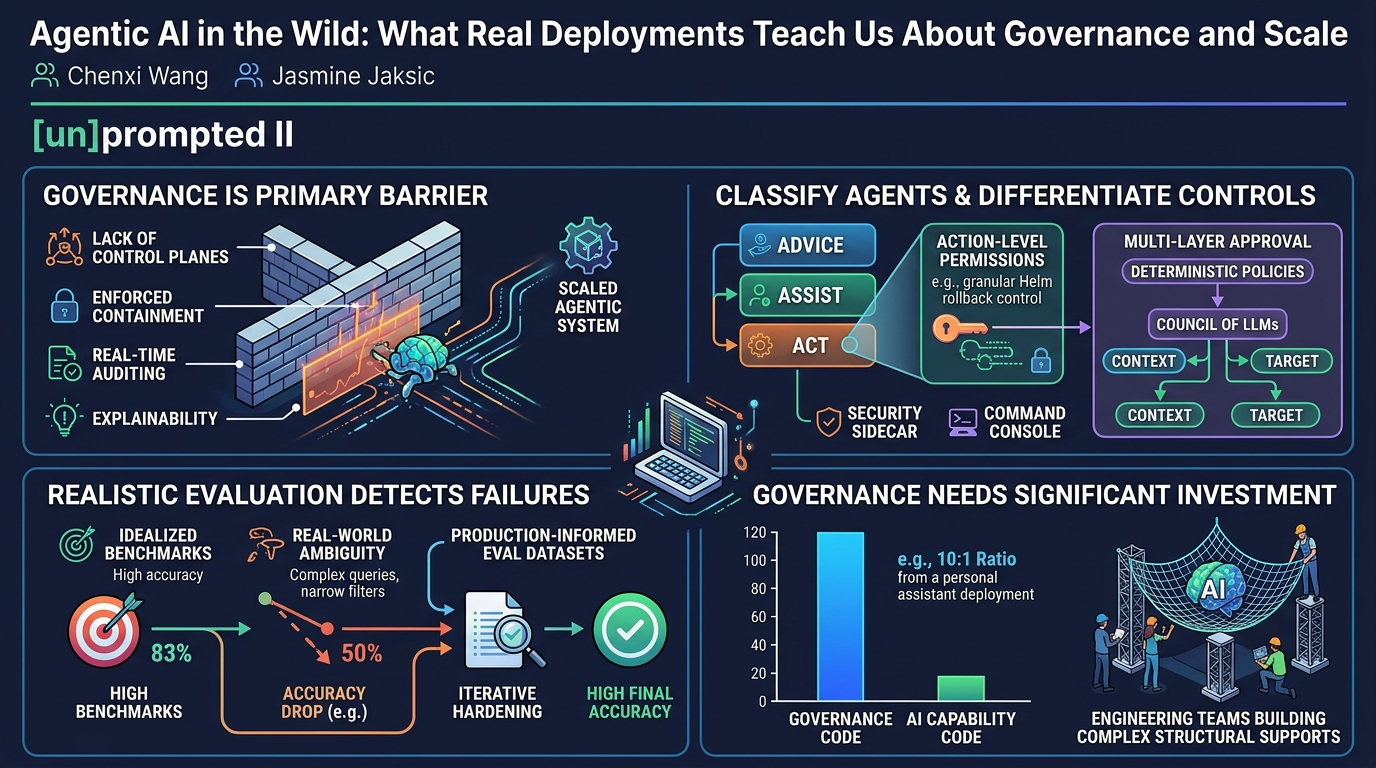
- Governance as the Primary Barrier: Trust and governance are the number one barrier to scaling agentic computing. Specifically, there is a significant lack of robust control plane capabilities for critical functions such as enforced containment, observability, real-time auditing, explainability, and effective human-in-the-loop mechanisms.
- Agent Classification and Differentiated Controls: Jasmine Jaksic emphasized that not all agents are created equal. Classifying agents into Advice, Assist, and Act stages is crucial, as their potential impact, failure modes, and required control mechanisms differ significantly.
- The Importance of Realistic Evaluation: Initial benchmarking often overestimates agent performance. For instance, NVIDIA's bug tracking assistant initially showed 83% accuracy with straightforward evaluations, but this dropped to 50% with real-world, ambiguous user queries. Developing robust eval sets that reflect production complexity is vital for identifying actual failure classes and hardening agents, eventually bringing the accuracy back up to 82% in more realistic scenarios.
- Context, State, and Memory are Paramount for Assist Agents: Simple Q&A models are insufficient for assist agents. NVIDIA's personal assistant demonstrated that without robust context, state, and memory, agents can confidently remind users of already completed tasks, leading to a perception of "bad judgment." Evaluation for such agents requires synthetic employee worlds to train them on distinguishing signal from noise.
- Platform Reliability is Foundational: Failures can occur at the platform level, even when individual components function as intended. A cluster-wide deadlock at NVIDIA's AI factory, caused by a Kubernetes mutating webhook and Argo CD interaction, highlighted the need to analyze dependencies, "fail-closed" safeguards, and recovery paths as a graph, not just individual component health.
- Action-Level, Context-Aware Permissions: For "act" agents, traditional permissions are insufficient. Permissions must be granular, defined at the action level, and sensitive to context and constraints. A Helm rollback, for example, might be approved during an incident but denied the next day for the same version if the context changes.
- Significant Governance Overhead: The engineering effort required for governance in agentic systems is substantial. For NVIDIA's personal assistant, the ratio of governance-related code to AI capability code was 10 to 1, underscoring the investment needed for safe and reliable deployment.
Technical Deep Dive
▶ Watch: Bug tracker agent: eval vs. real-world accuracy gap (13:30)
The technical exposition of the talk provided concrete examples and architectural considerations for deploying agentic AI systems. Chenxi Wang's initial study categorized companies as AI native, AI forward, or AI conservative, revealing differing approaches to scaling and risk. The concept of a robust control plane emerged as paramount, encompassing six key elements: alignment, least privilege, enforced containment, observability, real-time auditing, explainability, and human in the loop. The "blue dots" – enforced containment, observability, real-time auditing, and explainability – were specifically highlighted as areas where current solutions are sorely lacking, presenting significant opportunities for innovation.
Jasmine Jaksic elaborated on NVIDIA's internal agent deployments, categorizing them into three stages:
- Advice Agents: These agents provide recommendations or insights without directly taking action.
- Example: NVIDIA's Bug Tracking Assistant. This tool incorporated AI search and similar bug-finding capabilities. Initial evaluations with straightforward questions yielded an 83% accuracy. However, when deployed in production, real users posed ambiguous questions, used narrow filters, and had varying team-specific contexts, causing the accuracy to drop to 50%. This revealed numerous failure classes not captured by initial benchmarks. The solution involved creating a more robust, realistic evaluation dataset that specifically targeted these real-world ambiguities, which allowed engineers to harden the agent and eventually raise accuracy to 82%. The key technical takeaway here is the necessity of continuous, production-informed evaluation for iterative improvement.
- Assist Agents: These agents help progress workflows but require explicit human authorization for significant actions.
- Example: NVIDIA's Personal Assistant. This agent aimed to aggregate tasks from communication channels like Teams, Slack, and email, prioritize them, and assist with actions like preparing for meetings or drafting emails. Crucially, it could draft an email to 500 people, but the user had to authorize the send. A significant failure mode observed was the agent's inability to connect a task request in one channel (e.g., Teams) with its completion in another (e.g., Slack). This led to the agent confidently reminding users about already completed tasks. The root cause was not a model issue but a lack of robust context, state, and memory across disparate communication sources. To address this, NVIDIA moved beyond isolated Q&A evaluations to creating synthetic employee worlds – complex, noisy environments designed to train the agent on deriving signals from a multitude of competing inputs, simulating a real employee's daily workflow.
- Act Agents: These agents can autonomously perform actions that mutate the production environment, requiring the highest level of control and scrutiny.
- Permission Granularity: For "act" agents, traditional permissions (e.g., "can this agent deploy?") are insufficient. The question must be much more granular: "Can this agent do this exact thing against this specific target, given the current context and constraints?" Jasmine provided an example of a Helm rollback: rolling back from revision 4 to 3 during an incident should be approved, but the same action the next day, after the incident is resolved, should be denied. The action is identical, but the context dictates the outcome.
- NVIDIA's Normal Project: To address the complexities of "act" agent governance, NVIDIA developed an open-source applied research product called Normal. This system orchestrates the approval and execution of agentic actions:
- The agent submits a "packet" containing all necessary information for an action.
- A deterministic policy layer first evaluates the request against hard-coded rules (e.g., "a production resource cannot be taken down"). If a rule is violated, the action is immediately denied without further processing.
- If it passes the deterministic layer, the request goes to a council. This council consists of multiple LLMs, each configured to evaluate the request from different perspectives (e.g., command integrity, blast radius, rollback capability). This multi-perspective approach helps mitigate the probabilistic nature and potential for prompt injection in any single LLM. If the council lacks sufficient evidence, it kicks the request back to the agent for more information, preventing blind approval.
- Crucially, the council provides feedback to the agent on how to course-correct, which is vital to avoid reward hacking (where an agent finds ways to satisfy the reward function without achieving the desired outcome).
- Upon approval, a cryptographically minted writ of execution is generated, which carries the approved action to its execution target, ensuring authenticity and non-repudiation. This entire process emphasizes evidence-based decision making and accountability.
A critical platform-level failure was also discussed:
- AI Factory Deadlock: NVIDIA's internal AI factory environment experienced a cluster-wide deadlock during on-prem bring-up. A runtime security agent was deployed with Kubernetes mutating webhooks designed to inject security sidecars into every new pod. The webhooks' own pods, however, had incorrect OpenShift SCC (Security Context Constraints) configuration, causing them to fail to spin up. Because the system was "fail-closed," any attempt to spin up a pod (for scaling or new deployments) would fail due to the non-functional webhook dependency. The catch-22 was that attempting to temporarily shut down the webhooks triggered Argo CD (a continuous delivery tool) to "self-heal" by immediately restarting them, thereby perpetuating the deadlock. This illustrated that even when individual components (security agent, Kubernetes, Argo CD) work as intended, their collective interaction can lead to catastrophic system-wide failures. The lesson is to think about platform dependencies and recovery paths as a complex graph, anticipating how safeguards in normal operation might become single points of failure in recovery scenarios.
Demo / Proof of Concept
▶ Watch: Personal assistant agent fails without sufficient context and state (17:20)
While the talk did not feature a live, interactive demonstration in the traditional sense, Jasmine Jaksic explicitly highlighted NVIDIA's Normal project as an "applied research product" that is open source and available on GitHub. This project serves as a concrete proof-of-concept for the advanced governance mechanisms required for "act" agents.
Normal embodies the principles discussed for granular, context-aware action-level permissions. It demonstrates how an agent's request is subjected to a multi-layered approval process, including a deterministic policy layer for hard-coded security rules and an LLM-based council for nuanced decision-making. The system's ability to provide feedback to the agent, require certified evidence, and issue a cryptographically minted writ of execution showcases a practical implementation of robust governance for autonomous AI actions. The discussion around the Helm rollback example, where the same command yields different approvals based purely on context, further illustrates the sophisticated decision-making capabilities that Normal is designed to enable. By making this project open source, NVIDIA provides a tangible framework for other organizations to explore and adopt these critical governance patterns.
Defensive Implications
▶ Watch: Introducing 'Normal' for action-level agent governance and approval (24:00)
The insights from this talk offer crucial guidance for defenders and security architects looking to secure and govern agentic AI deployments:
- Prioritize Control Plane Development: Defenders must invest heavily in building a robust control plane for agentic systems. This involves focusing on the "blue dots" identified by Chenxi Wang: enforced containment (restricting agent blast radius), comprehensive observability (logging every action, decision, and context), real-time auditing (for immediate detection of anomalous behavior), explainability (understanding why an agent made a decision), and effective human-in-the-loop mechanisms for review and intervention.
- Develop Realistic Evaluation Strategies: Move beyond simplistic benchmarks. Defenders should collaborate with AI developers to create robust evaluation datasets that mirror the ambiguity, complexity, and diverse contexts of real-world production environments. This ensures that agents are hardened against actual failure classes, not just idealized scenarios.
- Emphasize Context, State, and Memory for Agents: For assist and act agents, ensure that the underlying architecture provides strong capabilities for maintaining context, state, and memory across multiple interactions and disparate data sources. This prevents agents from making erroneous assumptions or taking redundant actions due to an incomplete understanding of the operational environment.
- Map Platform Dependencies and Recovery Paths: Proactively identify and map all dependencies within agentic AI platforms, treating them as a complex graph. Critically analyze how "fail-closed" safeguards, while beneficial in normal operation, might create single points of failure or deadlocks during recovery scenarios. Design recovery procedures that account for these interdependencies and avoid relying on the same failing components for restoration.
- Implement Granular, Context-Aware Permissions: Abandon binary "allow/deny" permissions for "act" agents. Instead, implement highly granular, action-level permissions that dynamically consider the specific action, target, current context, and any relevant constraints. Systems like NVIDIA's Normal, with deterministic policy layers and multi-LLM councils, provide a model for achieving this level of control.
- Prepare for Significant Governance Engineering Investment: Acknowledge that the engineering effort for governance in agentic systems can be substantial. The 10:1 ratio of governance code to AI capability code for NVIDIA's personal assistant highlights this. Allocate adequate resources and expertise to build and maintain these critical safety and control mechanisms.
- Leverage Multi-LLM Councils for Critical Approvals: For high-stakes "act" agents, consider implementing a multi-LLM council approach for approvals, where different LLMs evaluate requests from varied security perspectives (e.g., command integrity, blast radius). Insist on certified evidence from the agent and ensure the council can provide constructive feedback to prevent reward hacking and guide agents towards safer actions.
Key Takeaways
- Governance is the Foremost Barrier to AI Autonomy: The shift from AI copilots to autonomous agents is fundamentally constrained by the lack of robust control planes, particularly in areas like enforced containment, real-time auditing, and explainability.
- Agent Types Demand Differentiated Controls: Agents should be categorized by their level of authority (Advice, Assist, Act), as each type presents unique failure modes and necessitates distinct, escalating control mechanisms.
- Realistic Evaluation is Crucial for Production Readiness: Initial high accuracy scores can be misleading. Agents must be evaluated with complex, ambiguous, and real-world-representative datasets to uncover actual failure classes and ensure robust performance in production.
- Context, State, and Platform Reliability are Non-Negotiable: For effective agent operation, especially assist agents, comprehensive context, persistent state, and robust memory are vital. Furthermore, platform-level dependencies and recovery paths must be meticulously engineered to prevent system-wide deadlocks.
- Permissions for Autonomous Agents Must Be Action-Level and Context-Aware: Traditional access controls are insufficient. "Act" agents require granular permissions that dynamically evaluate specific actions against targets, considering real-time context and constraints, often through multi-layered approval systems like NVIDIA's Normal project.
- Governance Requires Significant Engineering Investment: Building the necessary trust and control mechanisms for agentic AI is not trivial; it can require an order of magnitude more engineering effort than developing the AI's core capabilities, as demonstrated by the 10:1 code ratio for governance.
About the Speaker(s)
Chenxi Wang is a General Partner at Rain Capital, an investment firm focused on cybersecurity and enterprise software. Her work extends beyond investment to include in-depth research into emerging technological trends. For this talk, she conducted an extensive study, interviewing nearly 50 companies (with 32 comprehensive analyses) to understand the real-world deployment and challenges of agentic AI systems in various industries, from AI-native to AI-conservative organizations. Her insights provide a broad, industry-wide perspective on the current state and future trajectory of enterprise AI adoption.
Jasmine Jaksic serves as a Senior Director of Engineering at NVIDIA, a leading company in AI computing. Her presentation focused on NVIDIA's practical experiences in building and deploying agentic applications internally. She provided detailed examples of different agent types, the unexpected ways they can fail, and the sophisticated engineering solutions, including the open-source Normal project, that NVIDIA has developed to ensure the governance, reliability, and safety of these advanced AI systems within their production environments.
Reviews
→ Top-rated talks at [un]prompted II 2026 — The AI Security Practitioner Conference
All talks from [un]prompted II 2026 — The AI Security Practitioner Conference