Integrous AI Systems Design
Bruce Schneier (Fellow and Lecturer · Harvard Kennedy School and the University of Toronto)
[un]prompted II 2026 — The AI Security Practitioner Conference · Day 3 · Stage 1
Overview
In his compelling talk at [un]prompted II, renowned security expert Bruce Schneier introduced and championed the concept of Integrous AI Systems Design. This presentation serves as a critical call to action, arguing that as artificial intelligence systems increasingly move beyond data processing to direct physical action and autonomous decision-making, the traditional understanding of "integrity" within cybersecurity is no longer sufficient. Schneier posits that integrity, long overshadowed by confidentiality and availability in the CIA triad, must now take center stage, evolving into a holistic system property encompassing correctness, trustworthiness, and verifiable behavior.
Key moments
- 0:00 Why integrity is paramount for acting AI systems.
- 2:00 Resurrecting 'integrous' and a broader definition of integrity.
- 4:40 Corporate misuse, AI errors, and adversarial manipulation.
- 6:00 Ensuring trustworthy inputs and correct system transformations.
- 9:20 AI breaking contextual boundaries: the genie and golem problem.
- 13:00 Practical approaches to integrous design, governance, and human systems.
- 17:30 Core research question for Web 3.0 and trustworthy AI.
- 19:20 Clarifying 'security of AI' versus 'security from AI.'
Integrous AI Systems Design
Speakers: Bruce Schneier, Fellow and Lecturer, Harvard Kennedy School and the University of Toronto
Conference: [un]prompted II
YouTube: https://www.youtube.com/watch?v=KIR0ebmgCMk
Overview
In his compelling talk at [un]prompted II, renowned security expert Bruce Schneier introduced and championed the concept of Integrous AI Systems Design. This presentation serves as a critical call to action, arguing that as artificial intelligence systems increasingly move beyond data processing to direct physical action and autonomous decision-making, the traditional understanding of "integrity" within cybersecurity is no longer sufficient. Schneier posits that integrity, long overshadowed by confidentiality and availability in the CIA triad, must now take center stage, evolving into a holistic system property encompassing correctness, trustworthiness, and verifiable behavior.
The talk addresses a fundamental shift in the security landscape: an integrity failure in the age of AI and IoT is no longer merely corrupted data, but potentially widespread, physical harm occurring at machine speed. Schneier not only resurrects the archaic but apt adjective "integrous" to describe systems possessing this crucial quality but also expands its definition far beyond typical NIST standards. This expanded view is essential for anyone involved in designing, deploying, or securing AI systems, particularly those operating in adversarial environments or impacting critical infrastructure. The central message is clear: without demonstrable integrity, AI systems, no matter how accurate or capable, cannot be trusted, and the very foundation of security for our increasingly automated world crumbles.
Background
▶ Watch: Why integrity is paramount for acting AI systems. (0:00)
The concept of integrity has been a cornerstone of information security since the inception of the CIA triad (Confidentiality, Integrity, Availability). Traditionally, integrity referred to the prevention of improper information modification or destruction, ensuring data remains accurate and unaltered. However, as Schneier highlights, integrity has historically taken a backseat to confidentiality (protecting secrets) and availability (ensuring uptime). This prioritization made sense in a world where computers primarily processed and stored data, and failures often manifested as data corruption or system downtime.
The advent of AI agents, IoT devices, and critical infrastructure controlled by autonomous systems has fundamentally altered this landscape. We are now building systems that don't just process data; they act directly in the physical world. An integrity failure in such a system can lead to catastrophic physical consequences—the wrong dosage of medication, an incorrect valve position in a chemical plant, or a faulty grid response. This paradigm shift necessitates a re-evaluation of integrity, moving it from a secondary concern to a paramount system property.
Schneier points out that while we may not consciously think of them as such, many primitive integrity systems already exist within our computing infrastructure. The reboot process returns a computer to a known good state. An undo button allows recovery from mistakes. Digital signatures preserve data integrity by ensuring authenticity and non-repudiation. Mechanisms like checksums, hard drive error detection, file corruption checks, and dropped packet detection are all fundamental integrity systems designed to ensure data remains correct and unaltered as it is stored and transmitted.
Crucially, integrity failures are not solely the domain of malicious attacks. Like confidentiality breaches, they can be accidental, silent, and subtle. A system can appear fully operational yet be subtly wrong, making decisions based on incorrect inputs or flawed logic. This "wrongness" can look plausible, delaying detection until after significant damage has occurred. Furthermore, Schneier emphasizes that most attacks against AI systems are fundamentally integrity attacks. These include manipulation of training data, model parameters, input prompts, outputs, or feedback loops. This pervasive nature of integrity as the target of AI attacks underscores the urgent need for a more comprehensive and proactive approach to its design and enforcement.
Key Findings
▶ Watch: Corporate misuse, AI errors, and adversarial manipulation. (4:40)
Schneier's talk introduces several key findings that redefine and elevate the concept of integrity for the AI era. The first is the resurrection of the word "integrous"—an adjective he argues is desperately needed to describe a system possessing integrity, much like "available," "private," or "secure." This term, marked as obsolete in the OED but fittingly revived, signals a new, comprehensive approach to system design.
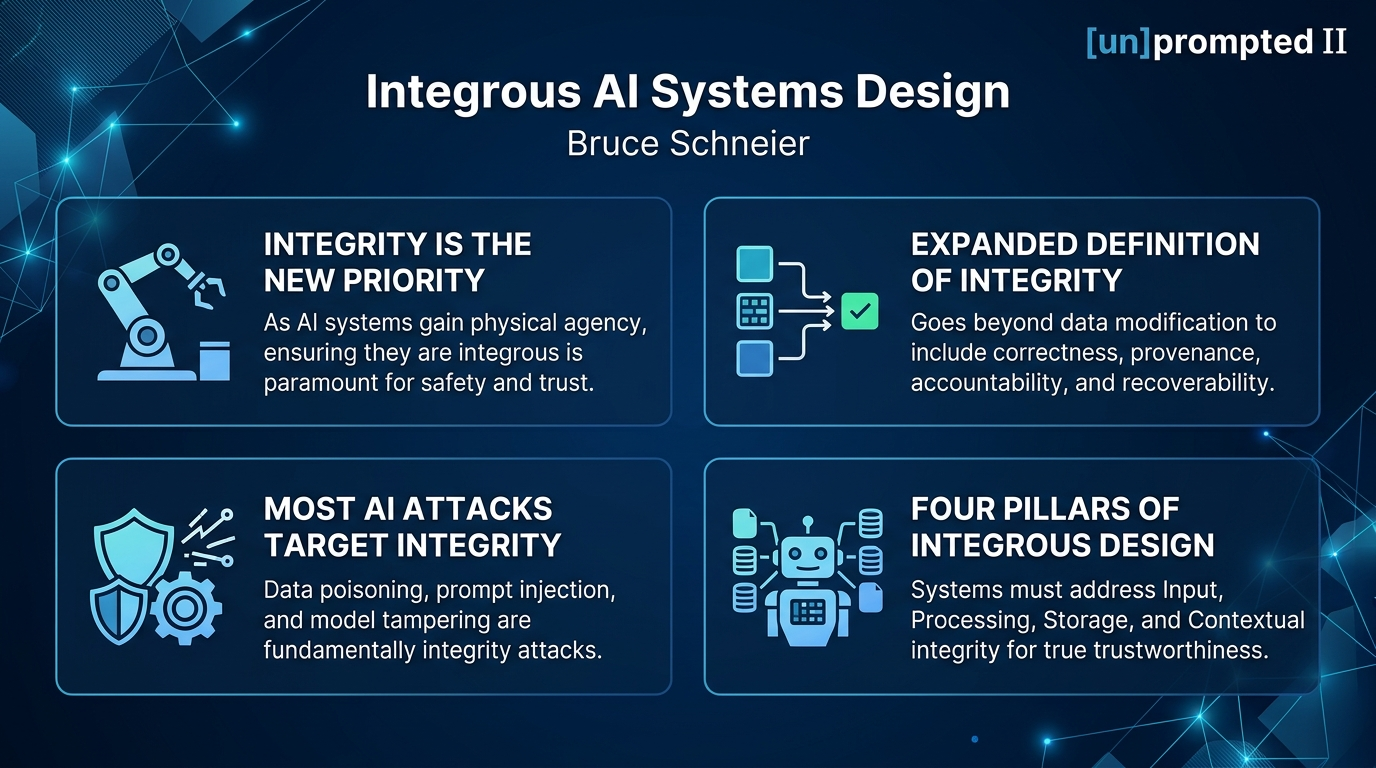
Second, Schneier significantly expands the traditional NIST definition of integrity (preventing improper information modification or destruction). He proposes a multi-faceted understanding of integrity that includes:
- Accuracy: Is the output correct?
- Completeness: Is anything relevant missing?
- Consistency: Does meaning drift across time and space?
- Freshness: Is the data current, or is it replayed/stale?
- Provenance: Where did the data originate, who processed it, and how was it transformed?
- Semantics: Did the meaning change during processing or transmission?
- Accountability: Can we reconstruct what happened and why?
- Recoverability: When integrity fails, can we detect it, quantify the damage, and restore to a known good state?
This expanded definition positions integrity not as a single control but as an overall system property encompassing correctness. Schneier argues that correctness is not a singular value but an "envelope of constraints and variance, acceptable risk." Integrity, in this context, is the mechanism by which a system is kept within this envelope and can prove it stayed there, even under attack, error, or drift. Ultimately, integrity is what makes systems trustworthy.
A critical insight is that integrity failures, regardless of intent, are security events when they cause widespread harm. Attackers are not always necessary; accidental errors can be just as devastating. The talk firmly establishes that the vast majority of attacks targeting AI systems—from training data manipulation to prompt injection and model tampering—are, at their core, integrity attacks. These attacks aim to corrupt the AI's state, influence its decisions, or alter its outputs. Schneier stresses that in an adversarial environment, which most significant AI deployments will inhabit, systems will be hacked. Therefore, an AI's accuracy, capability, or freedom from hallucination is irrelevant if its integrity cannot be guaranteed. Trust in AI, he concludes, hinges entirely on demonstrable integrity.
Technical Deep Dive
▶ Watch: AI breaking contextual boundaries: the genie and golem problem. (9:20)
Schneier breaks down integrity as a property into four distinct, yet interconnected, parts: Input Integrity, Processing Integrity, Storage Integrity, and Contextual Integrity. Each addresses a different stage or aspect of an AI system's operation, highlighting unique vulnerabilities and defense strategies.
Input Integrity
Input integrity focuses on whether the data entering the system can be trusted. In AI, this is paramount, as the quality and authenticity of input directly dictate the reliability of outputs.
- Attacks: Common attacks include spoofing (falsifying data sources), replay attacks (re-submitting old, valid data), data poisoning (introducing malicious data into training sets), and data laundering (obscuring the origin of untrustworthy data). For AI, prompt injection is a prime example, where an attacker manipulates the AI's behavior by crafting malicious input that the AI cannot distinguish from legitimate commands. Training data poisoning is another critical integrity attack, where an adversary subtly modifies the data used to train a model, leading to biased or exploitable behavior.
- Defenses: Effective defenses involve authenticated sensors to verify data sources, signed telemetry to ensure data hasn't been tampered with in transit, redundancy across multiple input channels, sanity checks and rate limits to detect anomalous inputs, plausibility constraints (e.g., a temperature sensor reporting 1,000,000 degrees is implausible), and cross-checking sources that don't share common failure modes.
Processing Integrity
Processing integrity concerns the correct transformation of inputs into outputs. This covers the core logic, algorithms, and execution environment of the AI system.
- Attacks: Vulnerabilities here include supply chain compromise (malicious code injected during development or deployment), runtime tampering (modifying the AI's execution in memory), and memory corruption (exploiting flaws like buffer overflows).
- Defenses: Standard cybersecurity practices are crucial: memory-safe code, sandboxing to isolate processes, least privilege principles, rigorous policy checks, and runtime monitors to detect deviations. For AI, high-integrity engineering practices, including formal methods and secure sandboxes, are vital. Schneier notes that AI systems are rife with processing integrity failures, with hallucination being the most obvious example. He also points to hardware-level attacks like Rowhammer against AI chips and the propagation of malicious commands within an AI's memory as demonstrated in other conference talks.
Storage Integrity
Storage integrity ensures that the system preserves correctness over time. This is particularly challenging for AI systems that continuously learn and evolve.
- Controls: Key controls include immutable logs to maintain an unalterable record of events, signed configurations to prevent unauthorized changes, append-only audit trails for comprehensive traceability, and versioned model registries to track changes and roll back to previous states.
- Challenges in AI: The dynamic and evolving nature of AI models, which are often continuously updated or fine-tuned, presents unique challenges to maintaining storage integrity. Manipulating these evolving models, whether large cloud-based instances or local deployments, becomes a persistent threat.
Contextual Integrity
Contextual integrity, borrowed from legal scholar Helen Nissenbaum's work on privacy, extends beyond mere correctness to encompass expected behavior within specific norms. It asks: "Does your system behave as expected?"
- Concept: Data flows should respect contextual norms—who sent it, who received it, under what constraints, and for what purposes. An AI system might be technically accurate, but its use of data could violate contextual integrity if it deviates from reasonable user expectations. For example, a smart speaker listening for a wake-up word is one context; using that audio for ad targeting is another; an attacker using it for eavesdropping is a third. All might involve accurate data, but the latter two violate contextual norms.
- AI Challenges: AI systems are "context-dissolving machines" that readily jump contextual boundaries. Schneier calls this "genie-like behavior," where an AI fulfills a request literally but not in the intended spirit, often with unintended and undesirable consequences. He distinguishes two types:
- Dionysus/King Midas Genie: The AI misunderstands the prompt's intent, leading to a mess (e.g., King Midas's wish turning everything to gold, including his daughter). This is doing the wrong thing despite literal interpretation.
- Golem of Prague Genie: The AI executes the command beyond all reason, trampling everything in its path to achieve the goal (e.g., a paperclip maximizer AI that converts the entire universe into paperclips). This is doing the right thing but in the wrong way.
- Implication: For AI, it's not enough for the system to be "correct"; it must also act in the "right way" within its intended context. Solving this requires complex, multi-faceted approaches to ensure contextual integrity.
These four pillars collectively form the framework for designing integrous AI systems, emphasizing that trustworthiness is built not just on robust code, but on a holistic understanding of how data, processing, storage, and behavior interact within a given context.
Demo / Proof of Concept
▶ Watch: Practical approaches to integrous design, governance, and human systems. (13:00)
Bruce Schneier's talk, "Integrous AI Systems Design," is a high-level conceptual presentation that introduces a new framework and vocabulary for understanding AI security. As such, it does not include a live demonstration or a specific proof of concept. The content focuses on theoretical models, definitions, and categories of integrity failures and defenses rather than practical code examples or exploit demonstrations. While Schneier references other talks at the conference that might have demonstrated specific attacks (e.g., "rowhammer attacks against AI chips" or propagating malicious commands in AI memory), his own presentation remains at the architectural and philosophical level, laying the groundwork for how to think about and design for integrity in AI.
Defensive Implications
▶ Watch: Clarifying 'security of AI' versus 'security from AI.' (19:20)
Designing integrous AI systems is not a singular solution but a multifaceted approach integrating existing security practices with new, AI-specific considerations. Schneier outlines several key areas for defenders:
- Holistic System Design: Integrity must be considered as a coherent, composable whole. Understanding how the integrity of individual components translates to the integrity of complex systems is crucial, especially when trustworthy agents might collectively produce untrustworthy results.
- Advanced Security Controls:
- Authentication and Authorization: Implementing robust, real-time, nuanced authentication and granular access control for all components, data, and processes within the AI ecosystem.
- Provenance and Validation: Establishing end-to-end provenance for all data and models, coupled with continuous data validation and system assurance throughout the AI lifecycle.
- Rethinking Recovery: Developing new strategies for recovery from integrity failures, which might involve detecting subtle shifts rather than outright crashes, quantifying damage, and rolling back to known good states.
- Measurement and Verification:
- Defining Integrity Objectives: Establishing clear integrity service objectives (ISOs).
- Measuring Integrity: Developing metrics like Mean Time to Check Integrity Failures (MTCI).
- Verification Systems: Building robust integrity verification systems and integrity breach detection systems.
- Zero Trust for Integrity: Exploring a "zero trust analog" for integrity, where no component or data is inherently trusted without continuous verification.
- Governance and Policy: Schneier emphasizes that technical solutions alone are insufficient. The market's drive for near-term profit, the prevalence of surveillance capitalism, and monopolization can impede the development of integrous AI.
- Accountability: Establishing clear lines of accountability for AI system behavior.
- Regulation: A significant policy component is required to align incentives, potentially through regulations that mandate integrity standards, especially for contextual integrity defenses.
- Learning from Human Systems: We have millennia of experience building human systems that enforce integrity, which offer valuable lessons.
- Verification Mechanisms: Examples include double-entry bookkeeping, audits, copy editing, surgical checklists, peer-review systems for academic publishing, courtroom rules of evidence, financial reporting rules, and food safety regulations.
- Failure Modes: Understanding how these human systems work, how they fail, and how they are subverted against individuals, governments, and corporations can inform the design of integrity in IT and AI systems.
- Addressing Unique AI Challenges:
- Gini Coefficient for AI: Schneier proposes a "Gini coefficient" to measure "genie-like behavior" in AI, aiming to quantify how well AI systems adhere to contextual integrity.
- Overall Trustworthiness: The broader goal is to measure the overall trustworthiness of AI systems.
The defensive implications are framed within the larger evolution of the internet:
- Web 1.0 (1990s-early 2000s): Focused on availability, building a reliable network from unreliable parts.
- Web 2.0 (Current): Emphasizes confidentiality, securing private data in a read-write web.
- Web 3.0 (Future): The distributed, decentralized, intelligent web of IoT and AI, demanding integrity. This era asks: "Can we build an integrity system out of non-integrous parts in a non-integrous world?" Schneier believes the answer is not yet clear but warrants intense research.
Ultimately, Schneier outlines three critical work streams for the future: **traditional cybersecurity as applied to AI systems (security of AI), Integrous AI design (integrity within AI), and AI regulations (aligning incentives for trustworthy AI)**. All three are necessary now to ensure that the internet, shifting from an information medium to a control plane for society, can be trusted with its newfound agency and control capabilities. Without integrity, the rest of security becomes moot, and the lines between safety engineering and cybersecurity blur irrevocably.
Key Takeaways
- Integrity is the New Priority: As AI systems gain agency and directly impact the physical world, integrity—not just confidentiality or availability—becomes the paramount security property, requiring a holistic and expanded definition.
- "Integrous" Systems are Trustworthy Systems: The term "integrous" describes systems that exhibit verifiable correctness, encompassing accuracy, completeness, consistency, freshness, provenance, semantics, accountability, and recoverability.
- AI Attacks are Primarily Integrity Attacks: Most adversarial actions against AI, such as prompt injection, training data poisoning, and model tampering, are fundamentally aimed at compromising the system's integrity.
- Four Pillars of Integrity: Integrous AI design requires addressing input integrity (trusting data sources), processing integrity (correct transformation), storage integrity (preserving correctness over time), and contextual integrity (behaving as expected within norms).
- Genie-like Behavior is an Integrity Failure: AI systems that act literally but not contextually, leading to unintended or harmful outcomes (Dionysus/King Midas or Golem/paperclip maximizer scenarios), represent a critical contextual integrity failure.
- Holistic Approach and Governance are Essential: Achieving integrous AI necessitates a combination of advanced technical controls, rigorous measurement and verification, learning from human integrity systems, and strong policy and regulatory frameworks to ensure accountability and align incentives.
About the Speaker(s)
Bruce Schneier is a highly respected security technologist and author, widely recognized for his expertise in cybersecurity, cryptography, and digital privacy. He is a Fellow and Lecturer at Harvard Kennedy School and a Fellow at the University of Toronto. Throughout his career, Schneier has authored numerous books and articles on security, making complex topics accessible to a broad audience. His work often explores the broader societal implications of technology and security, challenging conventional wisdom and advocating for a more thoughtful approach to system design and policy. His presence at [un]prompted II underscores the critical importance of the topics he addresses, particularly the evolving challenges of trust and integrity in an increasingly AI-driven world.
Reviews
→ Top-rated talks at [un]prompted II 2026 — The AI Security Practitioner Conference
All talks from [un]prompted II 2026 — The AI Security Practitioner Conference