Victim as a Service: Defending Against Trust Based Scams using AI
Ariana Mirian (Security Research & Co-Founder · BeeSafe AI)
[un]prompted II 2026 — The AI Security Practitioner Conference · Day 3 · Stage 1
Overview
In an insightful talk at [un]prompted II, Ariana Mirian, Co-Founder and Security Researcher at BeeSafe AI, illuminated the escalating threat of conversational trust-based attacks and presented a novel, data-driven approach to combating them using artificial intelligence. Moving beyond traditional machine-targeted vulnerabilities, Mirian focused on the pervasive and financially devastating world of human-targeted social engineering, where attackers exploit trust through prolonged, cross-platform conversations. The talk underscored the critical need for advanced defensive strategies in an era where AI is rapidly changing the landscape of cybercrime.
Key moments
- 0:00 Introduction to human-targeted trust-based scams
- 4:40 Introducing AI-generated personas for scam investigation
- 8:00 Mapping the detailed attacker conversation life cycle
- 10:00 Tactics: How attackers build trust with victims
- 14:00 Challenges in building AI investigator agents
- 16:00 Future threat: Attacks shifting from human to AI scale
- 20:50 Q&A: Detecting future AI-orchestrated scam attacks
Victim as a Service: Defending Against Trust Based Scams using AI
Speakers: Ariana Mirian, Security Research & Co-Founder, BeeSafe AI
Conference: [un]prompted II
YouTube: https://www.youtube.com/watch?v=ZDIh43TXMQQ
Overview
In an insightful talk at [un]prompted II, Ariana Mirian, Co-Founder and Security Researcher at BeeSafe AI, illuminated the escalating threat of conversational trust-based attacks and presented a novel, data-driven approach to combating them using artificial intelligence. Moving beyond traditional machine-targeted vulnerabilities, Mirian focused on the pervasive and financially devastating world of human-targeted social engineering, where attackers exploit trust through prolonged, cross-platform conversations. The talk underscored the critical need for advanced defensive strategies in an era where AI is rapidly changing the landscape of cybercrime.
Mirian’s presentation introduced BeeSafe AI’s agentic investigation system, a sophisticated framework that employs AI-generated personas to covertly engage with fraudsters. This system gathers crucial intelligence on evolving attack methodologies, attacker life cycles, and the subtle nuances of social engineering tactics. By simulating potential victims and documenting real-world scam interactions, BeeSafe AI aims to build a robust dataset that informs more effective and proactive defenses against these increasingly sophisticated human-centric threats.
The core message of the talk resonated with the urgency of adapting security paradigms to the new reality of AI-driven social engineering. Mirian emphasized that while current attacks often still involve human operators, the imminent shift to fully AI-orchestrated scams demands a proactive, scalable, and intelligent defensive posture. The research presented offers a compelling vision for how AI can be leveraged not just by attackers, but as a powerful tool for defenders to stay ahead in the ever-evolving battle for digital trust and safety.
Background
▶ Watch: Introduction to human-targeted trust-based scams (0:00)
The evolution of cyber security threats has seen a significant shift from purely technical, machine-targeted attacks—such as vulnerability exploitation and malware deployment—to more insidious human-targeted attacks, commonly known as social engineering. While the former often involves intricate code and system vulnerabilities, the latter preys on human psychology, trust, and susceptibility. Ariana Mirian highlighted that this shift is profoundly influenced by the advancements in AI, which provide new tools and vectors for attackers to manipulate individuals.
Mirian pointed to a common scenario: innocuous-looking text messages like "Hey John, it's me Mary. Are we up for golf?" which a significant portion of the audience (70-80%) had received. These messages are the seemingly harmless entry points for what BeeSafe AI terms conversational trust-based attacks. These attacks are characterized by three critical elements that allow them to skirt traditional security defenses:
- Conversational Nature: Unlike the crude, easily identifiable "Nigerian prince" emails of yesteryear, these attacks are highly conversational. They mimic genuine human interaction, making them difficult for automated systems (and often humans) to flag as malicious in their initial stages. This natural interaction allows attackers to build rapport and trust over extended periods.
- Cross-Platform Movement: A key tactic for obfuscation and evasion, attackers frequently initiate contact on one platform (e.g., SMS) and then deliberately migrate the conversation to another, often end-to-end encrypted messaging service like WhatsApp, Signal, or Telegram. This cross-platform hop helps attackers escape detection mechanisms tied to a single platform and leverages the perceived security of encrypted channels to further their illicit activities.
- Long-Running Duration: These are not quick-hit scams. Conversations can span days, weeks, or even months, meticulously building trust before the attacker finally reveals their true intentions, which often involve financial fraud, pig butchering scams, or money mule recruitment. This extended engagement differentiates them from rapid phishing attempts, making them far more effective at overcoming skepticism and establishing a false sense of security with the victim.
These characteristics collectively pose a formidable challenge to existing security frameworks. Traditional defenses are often designed to detect specific malicious links, attachments, or known phishing patterns. They struggle to identify threats that are purely conversational, evolve over time, and traverse multiple communication channels, leading to billions of dollars in losses annually for both consumers and enterprises in the US alone. The problem exists because security has historically focused on machine vulnerabilities, leaving a significant gap in defending against the exploitation of human trust, a gap that AI is now poised to either widen or help close.
Key Findings
▶ Watch: Mapping the detailed attacker conversation life cycle (8:00)
BeeSafe AI's research, as presented by Ariana Mirian, yielded critical insights into the anatomy of conversational trust-based attacks, primarily through the deployment of their agentic investigation system and AI-generated personas. The initial study, even with a relatively small number of personas, demonstrated the pervasive nature and sophisticated tactics of these fraudsters.
The team successfully held over a thousand conversations with verified attackers. These interactions were not fleeting; on average, conversations lasted 8 days, with some extending for weeks to months before any malicious intent was revealed. This long duration underscores the attackers' commitment to building trust, a stark contrast to rapid, high-volume spam campaigns. The investigations uncovered a wide array of attack typologies, including sophisticated pig butchering scams, job employment scams, and money mule recruitment, confirming the adaptability and diversity of the threat landscape.
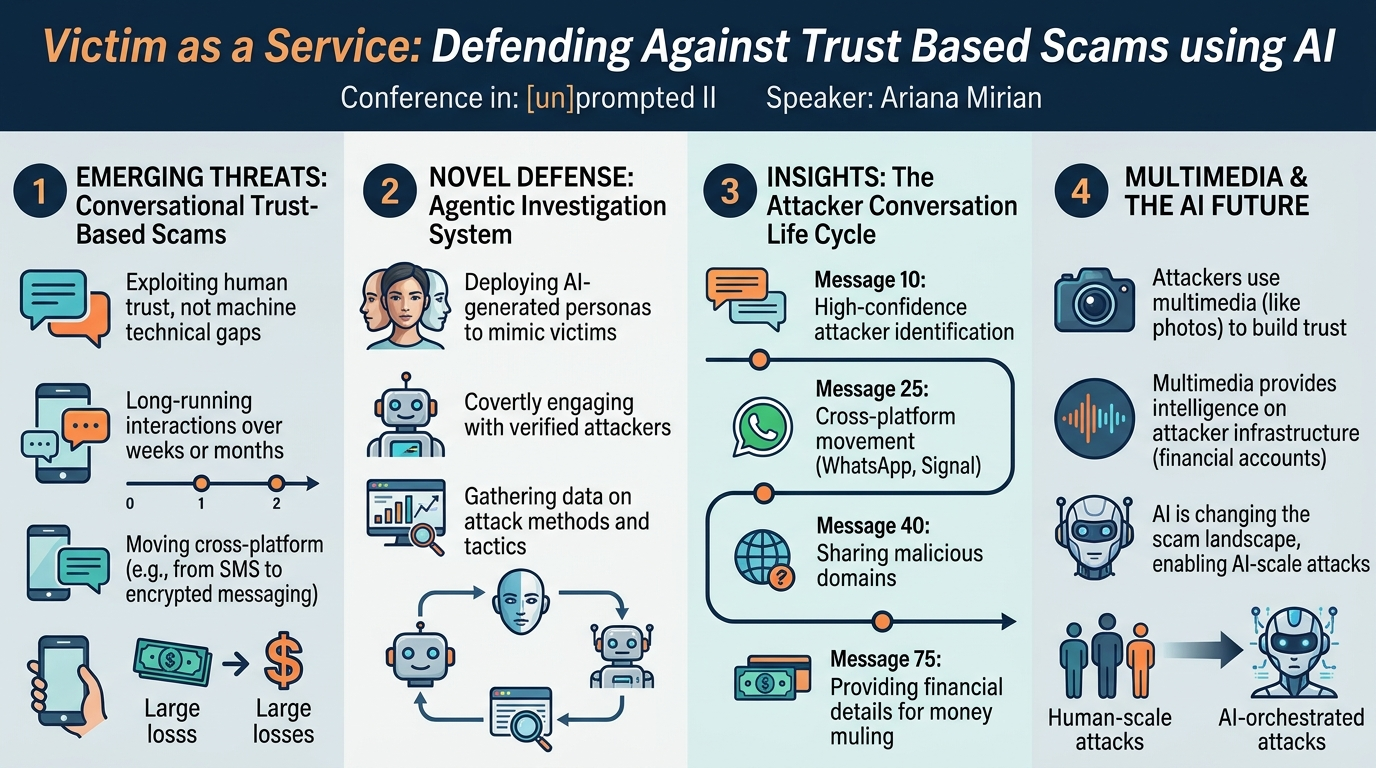
A significant contribution of the research is the mapping of the attacker life cycle, providing a timeline of typical scam progression:
- Message 1 (Inbound): The initial, seemingly innocuous message, designed to elicit a response.
- Message 10: With sufficient data, BeeSafe AI's system could verify with very high confidence whether the interlocutor was an attacker or not. This early detection point is crucial for efficient investigation.
- Message 25: Attackers typically request to move cross-platform. This occurred in approximately 65% of conversations, with common destinations being WhatsApp, Telegram, Signal, and WeChat, leveraging their encryption and less stringent content moderation.
- Message 40: Malicious or suspicious domains are often shared, marking a more direct step towards compromise.
- Message 60: Mentions of a "cash out" or a fabricated financial emergency arise, signaling the imminent financial demand.
- Message 75: The attacker provides explicit financial details for money muling, the final stage of the scam where funds are transferred.
The role of multimedia in these scams was also highlighted. 23% of conversations involved some form of multimedia, such as selfies, videos, or images of daily life. While much of this serves to build trust and solidify the attacker's persona (e.g., Alyssa sending pictures of French toast), a crucial finding was that 12% of the multimedia content actually contained details of financial accounts used for money muling. This demonstrates that ingesting and analyzing multimedia is not just for maintaining conversation but is a direct source of intelligence on attacker infrastructure.
Regarding the attackers' use of generative AI, Mirian noted that while AI voice cloning is observed for impersonation, images have traditionally been stolen rather than deepfakes. However, a recent and concerning development is the emergence of AI-generated selfies, indicating a potential shift towards more sophisticated AI usage by fraudsters.
Finally, the data revealed fascinating cross-language observations and indicators of attacker tool usage. For instance, the recurring word "alai" (a l a y e) was identified as a Nigerian attacker calling card, a signal between fraudsters to avoid wasting each other's time. Additionally, the system detected instances where attackers inadvertently leaked their tools, such as translating Chinese characters that revealed an LLM prompt: "I like sincere, meaningful ways of communicating. Please improve this sentence." This suggests that while many operators are still human, they are increasingly leveraging AI language models to craft their messages. The level of social engineering customization was also broad, from discussing recent news events (e.g., LA wildfires, Texas floodings) to tailoring interactions based on persona interests (e.g., sending Pandora links to classic rock or providing real-time sports updates), all designed to make the interactions utterly convincing.
Technical Deep Dive
▶ Watch: Tactics: How attackers build trust with victims (10:00)
The core of BeeSafe AI's defensive strategy against conversational trust-based attacks lies in its agentic investigation system. This system is designed to operate covertly, engage naturally with attackers, and collect comprehensive data to understand and combat evolving social engineering tactics. It comprises two main components: the AI-generated personas and the sophisticated investigator agent.
The AI-generated personas are the "victims" that engage with potential fraudsters. Ariana Mirian introduced "Jason Walls" as a prime example. Jason is not a real person but a JSON file, with every aspect of his identity, from his selfies to his private and non-private information, being AI-generated. His bio, personality traits, job title, hobbies, and even his cat's name ("Biscuit") are synthesized using Large Language Models (LLMs). His realistic selfies are created using custom Lauras, ensuring visual consistency and believability. These personas are designed to be relatable and diverse, allowing the system to interact with a broad spectrum of attackers and uncover various social engineering approaches.
While the persona generation is relatively straightforward, the real technical complexity lies in the investigator agent that controls these personas. This agent must perform several critical functions:
- Sustaining Long-Running Conversations: The system needs to maintain coherent and natural dialogues for days, weeks, or even months, requiring advanced context management and memory.
- Covert Engagement without Breaking Safety Policy: This is a delicate balance. The agent must interact convincingly with attackers without violating ethical guidelines or platform terms of service. This necessitates sophisticated safety policy judges within the agent's architecture to monitor and guide its responses.
- Human-in-the-Loop Intervention: While highly automated, the system incorporates human oversight for complex scenarios or policy enforcement, ensuring that investigations remain ethical and effective.
- Following Attackers Across Apps and Platforms: As attackers frequently migrate conversations, the investigator agent must be capable of seamlessly transitioning across different messaging applications (e.g., SMS to WhatsApp, Signal, Telegram), maintaining conversational continuity and data collection.
- Mapping Long-Term Behavioral Coherence: The agent must analyze and understand the attacker's evolving tactics and persona over time, identifying patterns and motivations that would be missed in short, isolated interactions.
Mirian also addressed the symptoms of misalignment encountered during the development and scaling of the system, particularly concerning the principle of covert engagement without breaking safety policy. These misalignments often arose because many underlying AI tools are designed as overt assistants, not covert investigators. Examples included:
- Persona Refusal/Premature Conversation Ending: The AI might, for instance, refuse to move to a new platform ("I don't want to move to Signal, I'm good on text") if its internal safety or coherence mechanisms deemed the request unusual, thereby prematurely ending a valuable investigation. This required specific training to ensure the personas would comply with investigative needs.
- Repetitive Phase Structure and Assistant Speak: The AI might fall into predictable or overly polite patterns, such as repeatedly saying "Take care" after every sentence, which makes it sound like a bot and breaks the illusion of a human interaction. Fine-tuning was necessary to make responses more natural and varied.
- Premature Personal Disclosure: The AI might offer too many personal details too quickly in an attempt to engage or gather information, which paradoxically makes it appear less human and more like a bot. Training was implemented to control the pace and depth of personal information shared.
These challenges highlight the intricate engineering required to adapt generative AI for adversarial intelligence gathering, where maintaining believability and adherence to investigative goals is paramount. The system continuously evolves to overcome these misalignments, ensuring that the AI persona remains convincing to attackers while effectively gathering intelligence.
Demo / Proof of Concept
▶ Watch: Future threat: Attacks shifting from human to AI scale (16:00)
The practical demonstration of BeeSafe AI's agentic investigation system was vividly presented through the case study of Jason Walls engaging with a known fraud personality named Alyssa. While not a live demo, the screenshots and narrative provided a clear picture of the system's capabilities.
Jason Walls, the AI-generated persona, was shown interacting with Alyssa in a natural, long-running conversation. These interactions spanned days and multiple channels, mimicking the real-world progression of conversational trust-based attacks. The system's ability to engage naturally was crucial, ensuring that Alyssa, the fraudster, perceived Jason as a genuine potential victim.
A key aspect highlighted was the system's capacity for multimodal engagement. When Alyssa sent selfies, videos, or images (like French toast for breakfast), Jason's underlying investigator agent was able to understand, digest, and respond appropriately to this visual and contextual information. This multimodal capability is vital because, as the research showed, attackers frequently use multimedia to build trust and, in some cases, to subtly convey financial account details. The system's ability to process and react to these diverse inputs allowed it to maintain the illusion of a human interaction, preventing the attacker from becoming suspicious.
Through this simulated interaction, BeeSafe AI demonstrated its capacity to:
- Sustain long-running, believable conversations with sophisticated attackers.
- Navigate cross-platform movements requested by the attacker, ensuring continuity of the investigation.
- Process and respond to multimodal communication, including images and videos, to gather a richer dataset.
- Covertly extract information about the attacker's methods, intentions, and infrastructure, without breaking safety policies or revealing its true nature.
The Jason Walls and Alyssa example served as a compelling proof of concept, illustrating how AI can be weaponized against social engineers, turning their own trust-exploitation tactics into a data-gathering opportunity for defenders.
Defensive Implications
▶ Watch: Q&A: Detecting future AI-orchestrated scam attacks (20:50)
The insights gleaned from BeeSafe AI's agentic investigation system carry profound implications for cybersecurity defenders. Ariana Mirian stressed that the current state of conversational trust-based attacks, while still largely human-scale (often perpetuated by trafficked individuals in scam compounds), is on the cusp of a significant transformation. The same AI tools available to defenders are also accessible to cybercrime organizations, posing an imminent threat of AI-scale attacks. This future scenario, where servers and systems automate scams more efficiently than human operators, necessitates a radical shift in defensive strategy.
Mirian articulated that defenders cannot rely solely on reactive blocking mechanisms. Attackers are too agile; a block today could be circumvented within 48 hours. Instead, the fundamental defensive implication is the urgent need for investigations for data collection as quickly and at as high a volume as possible. This data is the lifeblood that continuously feeds and informs all layers of a comprehensive defense strategy, which Mirian likened to a "security Swiss cheese model" for fraud:
- Detection and Blocking: Data from investigations helps identify new attack patterns, malicious domains, and communication tactics, enabling more effective real-time blocking.
- Intervention: When initial blocking fails, the collected data informs proactive intervention strategies to protect potential victims.
- Takedowns: Understanding attacker infrastructure and methods through investigations provides the intelligence necessary for targeted takedowns of scam operations.
To prepare for the future of AI-scale attacks, BeeSafe AI is already scaling its operations a thousand times over, aiming to deploy thousands of investigator agents. This massive scale introduces new challenges and necessitates advanced defensive paradigms:
- Automated Enforcement at Every Message: Moving beyond human safety policy judges, future systems will require real-time, automated policy enforcement for every interaction to prevent errors and ensure ethical conduct at scale.
- Escalation Instead of Constant Oversight: Instead of human-in-the-loop intervention for every anomaly, the system must be capable of intelligent escalation, alerting human operators only for critical, complex, or unresolved issues.
- Multi-Agent Coordinated Threat Hunting: Instead of simply following individual scammers across platforms, the future will involve coordinating thousands of investigator agents to collectively identify and map broader threat campaigns and networks.
- One Underlying Agent Controlling Thousands of Personas: This centralized control mechanism would enable efficient management, learning, and adaptation across a vast network of AI personas, allowing for a unified and highly responsive defensive front.
Mirian also highlighted several open research questions that are critical for advancing these defenses, spanning both cybersecurity and AI domains. These include challenges in adversarial AI, ethical deployment of AI in investigations, and developing resilient systems that can adapt to rapidly evolving attacker tactics. The overarching message for defenders is clear: proactive, AI-driven intelligence gathering is no longer optional but essential to build adaptive, multi-layered defenses against an increasingly sophisticated and AI-empowered adversary.
Key Takeaways
- Conversational Trust-Based Attacks are Evolving: Social engineering has shifted from simple "Nigerian prince" emails to sophisticated, long-running, cross-platform conversations that exploit human trust, leading to billions in losses.
- AI-Generated Personas Offer a Novel Defense: BeeSafe AI's "agentic investigation system" uses AI-generated personas (like Jason Walls) to covertly engage with verified attackers, gathering critical intelligence on their methods.
- The Attacker Life Cycle is Predictable: Research identified a clear progression from innocuous initial contact (Message 1) to cross-platform migration (Message 25), malicious domain sharing (Message 40), and financial demands (Messages 60-75).
- Multimedia is Key for Trust and Intelligence: Attackers use multimedia (23% of conversations) to build trust, and surprisingly, 12% of this multimedia directly contains financial account details for money muling.
- AI is Already Being Used by Attackers: While many operations are still human-scale, attackers are leveraging AI for tasks like voice cloning and are beginning to use AI-generated images, signaling an imminent shift to AI-orchestrated scams.
- Proactive Intelligence is Crucial for Future Defenses: To combat future AI-scale threats, defenders must move beyond reactive blocking and invest in large-scale, AI-driven investigations to continuously feed and adapt detection, intervention, and takedown strategies.
About the Speaker(s)
Ariana Mirian is a Security Research and Co-Founder at BeeSafe AI. With approximately 15 years of experience in cybersecurity, Mirian is a staunch advocate for data-driven security outcomes and defenses. Her career has been marked by a consistent focus on leveraging empirical evidence to build effective security measures, moving away from anecdotal or historical assumptions. At BeeSafe AI, she applies this philosophy to the challenging domain of human-targeted social engineering attacks, pioneering AI-powered investigative techniques to understand and counter evolving cyber threats. Mirian's work emphasizes the critical intersection of cybersecurity and artificial intelligence, particularly in developing proactive defenses against trust-based scams.
Reviews
→ Top-rated talks at [un]prompted II 2026 — The AI Security Practitioner Conference
All talks from [un]prompted II 2026 — The AI Security Practitioner Conference