AI Inference and its Privacy and Confidentiality Challenges
Yolan Romailler (Head of Security · Confidential AI)
[un]prompted II 2026 — The AI Security Practitioner Conference · Day 3 · Stage 1
Overview
In an era where Artificial Intelligence (AI) permeates nearly every aspect of daily life, the privacy and confidentiality of user data processed by these systems have emerged as critical, yet often unaddressed, concerns. Yolan Romailler, Head of Security at Confidential AI, delivered a compelling talk at [un]prompted II, advocating for a resurgence of "crypto anarchism" principles—specifically, the fundamental right to private and confidential AI interactions. Drawing parallels to the widespread adoption of end-to-end encryption in messaging, Romailler highlighted a stark contrast with the current state of AI inference, where users frequently cede control over their most sensitive data without adequate guarantees.
Key moments
- 0:00 The urgent need for private, confidential AI
- 3:20 Challenges with current AI inference pipelines
- 6:00 The new threat of targeted, non-targetable AI attacks
- 8:10 TEEs: The solution for confidential AI inference
- 11:00 Performance and practicality of TEEs for AI inference
- 15:40 Addressing Trust & Safety in Confidential AI
- 17:15 Industry adoption of confidential computing (Meta, Apple)
- 19:00 The future of confidential AI and community demand
AI Inference and its Privacy and Confidentiality Challenges
Speakers: Yolan Romailler, Head of Security, Confidential AI
Conference: [un]prompted II
YouTube: https://www.youtube.com/watch?v=dg6uKgpSE3Q
Overview
In an era where Artificial Intelligence (AI) permeates nearly every aspect of daily life, the privacy and confidentiality of user data processed by these systems have emerged as critical, yet often unaddressed, concerns. Yolan Romailler, Head of Security at Confidential AI, delivered a compelling talk at [un]prompted II, advocating for a resurgence of "crypto anarchism" principles—specifically, the fundamental right to private and confidential AI interactions. Drawing parallels to the widespread adoption of end-to-end encryption in messaging, Romailler highlighted a stark contrast with the current state of AI inference, where users frequently cede control over their most sensitive data without adequate guarantees.
The presentation underscored the urgent need for robust confidentiality measures in AI, echoing Bruce Schneier's emphasis on the CIA triad (Confidentiality, Integrity, Availability). Romailler argued that while data in transit and at rest are largely secured through established cryptographic practices like TLS and full disk encryption, data "in use"—during AI processing—remains largely exposed. This vulnerability creates a fertile ground for data breaches, targeted manipulation, and intellectual property theft, posing significant risks to individuals and organizations alike. The talk presented Trusted Execution Environments (TEEs) as a mature and practical solution, capable of bringing the much-needed confidentiality to AI inference at scale.
Romailler's core message was a call to action for the security community: to actively fight for and implement mechanisms that ensure AI systems respect user privacy and data confidentiality. He demonstrated that the technological solutions exist today, are performant, and are increasingly being adopted by major industry players. The talk served as a powerful reminder that privacy and confidentiality are not inherent in evolving technologies but must be deliberately engineered and continuously defended against challenges like surveillance and data exploitation.
Background
▶ Watch: The urgent need for private, confidential AI (0:00)
The pervasive integration of AI into society has brought immense benefits, but it has also introduced unprecedented challenges to data privacy and confidentiality. As users increasingly interact with Large Language Models (LLMs) and other AI systems, they often input highly sensitive personal information—ranging from psychological issues and medical conditions to intimate personal stories and proprietary work data. Romailler highlighted that, for the most part, AI service providers offer "absolutely no guarantee" regarding the confidentiality of this data. This lack of assurance stands in stark contrast to the widespread expectation of end-to-end encryption in modern messaging applications like WhatsApp, Signal, and iMessage.
The consequences of this lax approach are already manifesting. Romailler cited instances such as a 22-terabyte data leak from an aggregator, exposing sensitive user conversations. He also alluded to the controversy surrounding OpenAI potentially publishing a mathematical proof before the researchers who were working on it, raising questions about data confidentiality during the model training or inference process. These incidents underscore a fundamental problem: the traditional security perimeter, which focuses on data in transit (e.g., HTTPS/TLS) and data at rest (e.g., full disk encryption), fails to protect data when it is actively being processed by AI models.
Beyond general data leaks, Romailler detailed several specific, emerging threats in the context of AI inference:
- Privacy of Prompts and Responses: The most direct threat, where user input and AI output are exposed to cloud providers, sysadmins, or malicious actors within the inference pipeline.
- Quantum Threat: While some cryptographic protocols are being updated for quantum safety, many underlying technologies used for confidential data in AI inference are not yet quantum-safe, making them vulnerable to "Harvest Now, Decrypt Later" attacks.
- Targeted Attacks and Non-Targetability: A novel and insidious threat where AI models are customized to serve specific users with tailored responses designed to steer opinions or propagate misinformation. Detecting such non-targetability attacks is incredibly difficult for the end-user, as the AI's behavior appears normal. This issue complicates traditional security models and even billing for oblivious HTTP sessions.
- Weights Leaking: For frontier labs and companies developing proprietary AI models, running these models on third-party cloud infrastructure carries the risk of their valuable model weights being leaked by malicious insiders (e.g., sysadmins) or external attackers, potentially compromising intellectual property and competitive advantage.
- Trojanized Models: The proliferation of open-source models and diverse inference providers means users might unknowingly interact with models that have been intentionally compromised or "trojanized," leading to unpredictable or malicious behavior.
Romailler illustrated the complexity of securing AI inference by outlining a typical pipeline: a client connects to a load balancer, then an API gateway (for authentication, billing), potentially more load balancers, an inference router, a pre-fill node (for caching), and finally decode nodes that generate responses. He emphasized that despite TLS being used for communication between some components, there are no guarantees for the confidentiality of data once it enters the provider's internal network. Different organizations might draw their "trust line" at different points in this pipeline—some trusting the router but not the inference engine, others vice versa—highlighting the need for flexible and robust security solutions.
Key Findings
▶ Watch: The new threat of targeted, non-targetable AI attacks (6:00)
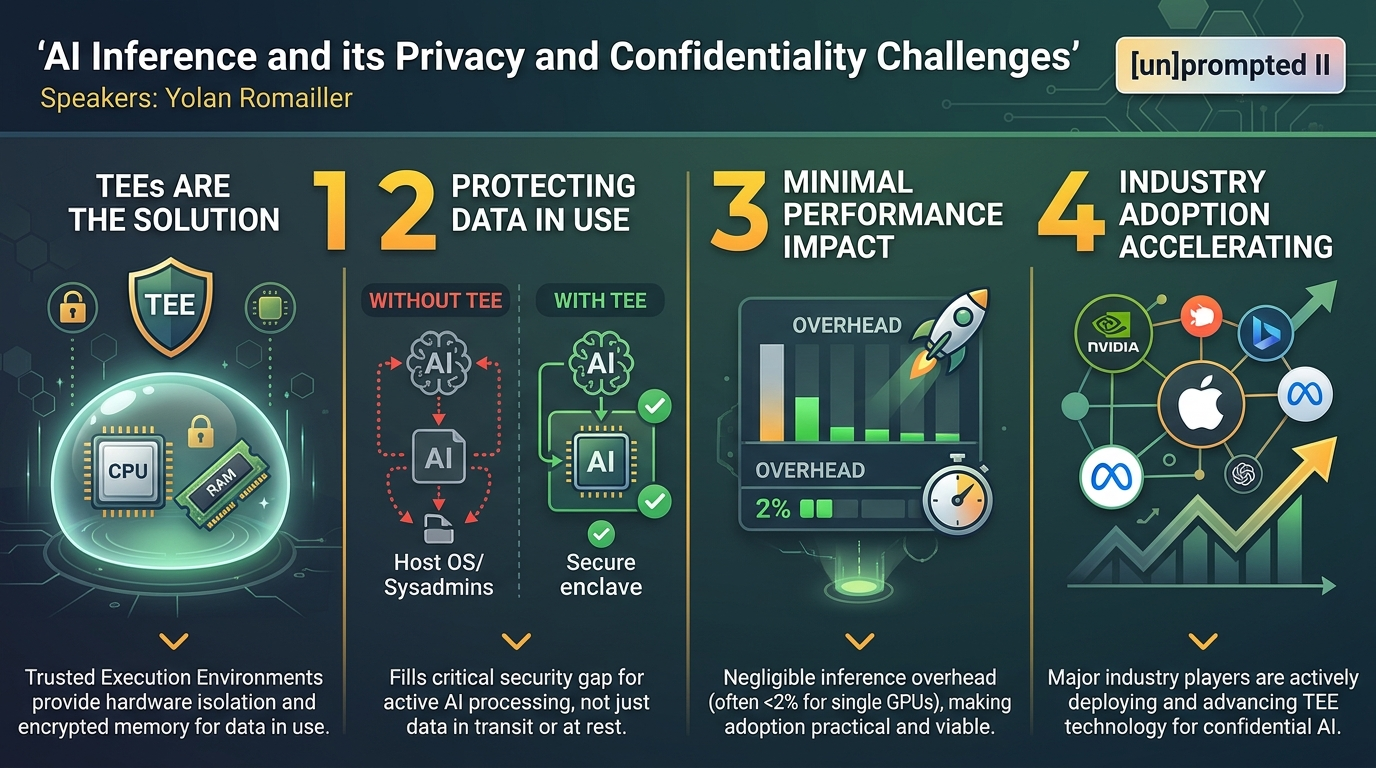
The central finding presented by Yolan Romailler is that Trusted Execution Environments (TEEs) represent the most viable and immediately applicable solution for addressing the privacy and confidentiality challenges inherent in AI inference. TEEs, also known as secure enclaves or confidential virtual machines, provide a hardware-rooted mechanism to protect data while it is actively being processed.
Key findings include:
- TEEs as the Standard for Confidential AI: Romailler asserted that TEEs are rapidly becoming the de facto standard for ensuring private and confidential AI inference. They offer a mature technology that is actively being deployed in production environments across the industry.
- Hardware-Level Isolation and Encryption: TEEs fundamentally solve the "data in use" problem by providing hardware isolation and encrypted memory. This prevents unauthorized access to data and model weights by cloud providers, hypervisor administrators, or malicious insiders, even if they have full control over the host system.
- Remote Attestation for Trust Verification: A critical component of TEEs is remote attestation. This mechanism allows an external party (the client or another trusted system) to cryptographically verify the integrity of the software running inside the TEE and confirm that it is indeed the expected, untampered code. This process establishes a root of trust, enabling secure communication channels with the confidential environment.
- Minimal Performance Overhead for Inference: Contrary to common assumptions, running AI inference workloads within TEEs incurs a surprisingly low-performance overhead. Romailler presented data showing negligible impact, making TEE adoption practical and economically feasible for large-scale deployments.
- Industry-Wide Adoption and Advancements: Major technology companies, including NVIDIA, Intel, AMD, Apple, Meta, OpenAI, and Anthropic, are actively investing in and deploying confidential computing solutions based on TEEs. Recent advancements, such as NVIDIA's capability to provide confidential computing mode on a full rack, signify rapid progress and increasing scalability.
- Addressing Complex Threat Models: While the threat modeling for TEEs can be complex due to the introduction of new moving parts, the speaker highlighted that current technology is sufficient to manage these complexities and achieve robust security guarantees, even for advanced challenges like non-targetability.
In essence, Romailler’s key finding is a clear and confident declaration: the technology to secure AI inference with robust privacy and confidentiality guarantees exists today, it works, and its adoption is accelerating, leaving "no excuse" for providers not to implement it.
Technical Deep Dive
▶ Watch: Performance and practicality of TEEs for AI inference (11:00)
The core of Yolan Romailler's technical discussion revolved around dissecting the vulnerabilities of current AI inference pipelines and presenting Trusted Execution Environments (TEEs) as the foundational solution.
A typical AI inference pipeline, as described, involves a complex choreography of components:
- Client: Initiates the request.
- Load Balancer: Distributes incoming traffic.
- API Gateway: Handles authentication, authorization, and billing.
- Application-level Load Balancer: Further distributes requests.
- Inference Router: Directs requests to appropriate models, potentially thinking in "tokens" rather than network packets.
- Pre-fill Node: Caches data for efficient processing.
- Decode Nodes: Generate the actual AI response based on the prompt.
While TLS (Transport Layer Security) is commonly used to encrypt data in transit between some of these components (e.g., client to router, router to provider), Romailler emphasized that this only secures data between nodes. Once data is processed within any of these nodes—especially the inference router, pre-fill, and decode nodes—it is typically decrypted and exposed in plain text to the underlying operating system, hypervisor, and potentially compromised administrators. This fundamental lack of confidentiality for data "in use" is the critical gap TEEs aim to fill.
Trusted Execution Environments (TEEs), sometimes referred to as secure enclaves or confidential virtual machines, are hardware-backed security features designed to isolate specific computations and their data from the rest of the system, including the operating system, hypervisor, and host administrators. Historic examples include Intel SGX (now largely deprecated for this use case), with the industry moving towards confidential virtual machines (CVMs) offered by AMD (SEV-SNP), Intel (TDX), and NVIDIA for GPUs.
The technical mechanisms underpinning TEEs provide two crucial protections:
- Hardware Isolation: A TEE creates a protected memory region and execution environment that is logically separated from the rest of the system. This means that code and data running inside the TEE cannot be directly accessed, inspected, or modified by software outside the TEE, even with root privileges on the host.
- Encrypted Memory: Data processed within a TEE is encrypted while residing in memory. This ensures that even if an attacker gains physical access to the memory or uses side-channel attacks, the sensitive information remains unintelligible. This protection extends to the AI model weights themselves, preventing their leakage.
The cornerstone of trust in TEE-based systems is remote attestation. This process allows a client or a relying party to cryptographically verify the integrity of the TEE and the software running within it. The process typically involves:
- Hardware Manufacturer PKI: The CPU or GPU manufacturer embeds a public key infrastructure (PKI) into the hardware.
- Launch Measurements: When a TEE is launched, the hardware measures the code and configuration (the "launch measurements") of the software stack within the enclave.
- Report Data: The TEE generates a signed report containing these measurements, along with an attested public key. This report is signed by a key rooted in the hardware's trusted boot process, which can be verified using the manufacturer's PKI.
- Secure Channel Establishment: By verifying the report, the client can be assured that the correct, untampered software is running in the TEE. The attested public key then allows the client to establish a secure, encrypted communication channel directly with the TEE, ensuring end-to-end confidentiality for prompts and responses. Romailler succinctly captured this principle with the maxim, "Don't trust, do verify."
Integrating TEEs into modern cloud infrastructures, particularly those leveraging Kubernetes, is also feasible. Romailler noted that it is "very easy to draw the line, the trust boundary around the whole thing without including Kubernetes." This implies that the entire AI inference stack, including the inference router, pre-fill, and decode nodes, can run within a TEE, effectively excluding the Kubernetes control plane and underlying infrastructure from the trusted computing base.
A critical aspect for widespread adoption is performance. Romailler presented compelling figures demonstrating the minimal overhead of TEEs for AI inference:
- On a single GPU without an overlap scheduler, enabling Confidential Computing (CC) mode resulted in approximately 2% overhead.
- With specialized patches, this overhead could be reduced to "barely 1%."
- For more realistic, multi-GPU setups, such as a mixture of experts serving with four GPUs, the overhead was 1.5%, scaling linearly with the number of GPUs (e.g., 3% for eight GPUs on a node).
These figures indicate that the performance impact for inference is negligible, making TEEs a practical solution for even large-scale AI deployments. He clarified that while training models within TEEs might still incur significant performance costs, this is often not a requirement, as the primary concern for confidentiality lies with inference.
Romailler also touched upon the industry's rapid advancements. He mentioned NVIDIA's efforts to improve their confidential computing mode, recently releasing a capability to provide CC mode on a full rack instead of just a single node. This signifies a move towards even greater scalability and ease of deployment for confidential AI. The mention of Apple's Private Cloud Compute and Meta's collaboration with Maxi Marlinspike for Muse further underscores the industry's commitment to TEE-based confidential computing.
Demo / Proof of Concept
▶ Watch: Addressing Trust & Safety in Confidential AI (15:40)
While Yolan Romailler's talk did not feature a live demonstration or a specific proof of concept, he extensively referenced the practical application and current deployment of Trusted Execution Environments (TEEs) for confidential AI inference. He stressed that these solutions are not theoretical but are actively being implemented in production by various companies.
Romailler specifically mentioned the Confidential Computing Summit as a venue where numerous organizations presented working solutions, some even tackling advanced challenges like non-targetability within TEEs. This implies that while his talk focused on the foundational principles and the "why" and "how" of TEEs, the "what" in terms of concrete implementations is readily available and observable within the broader confidential computing ecosystem. The absence of a direct demo in his presentation was offset by the confident assertion that the technology is mature, deployed, and proven in practice.
Defensive Implications
▶ Watch: The future of confidential AI and community demand (19:00)
The insights presented by Yolan Romailler offer clear and actionable defensive strategies for organizations and individuals concerned about AI inference privacy and confidentiality:
- Mandate and Implement Trusted Execution Environments (TEEs): The most critical defensive implication is the adoption of confidential computing. Organizations deploying AI models for inference, especially those handling sensitive user data or proprietary model weights, must prioritize running their inference pipelines within TEEs. This includes leveraging confidential virtual machines (CVMs) offered by cloud providers or directly utilizing hardware features from AMD, Intel, and NVIDIA.
- Embrace Remote Attestation for Verification: Trust should not be implicit. Defenders must implement and verify remote attestation for their TEE deployments. This ensures that the correct, untampered software (including the AI model and inference code) is running within the secure enclave. For users interacting with third-party AI services, demanding and verifying attestation reports should become a standard practice, rather than blindly trusting providers.
- Rethink Threat Models and Trust Boundaries: The talk highlighted that traditional security perimeters are insufficient for AI inference. Defenders need to re-evaluate their threat models, specifically considering data "in use." The trust boundary must be explicitly drawn to encompass the TEE, ensuring that components outside this boundary (e.g., hypervisors, host OS, cloud administrators) cannot access sensitive data.
- Develop Auditable Observability within TEEs: The challenge of "trust and safety" departments needing to monitor for misuse while maintaining confidentiality was addressed. Defenders should design and implement observable components (e.g., classifiers for content moderation) that run inside the TEE. These components can generate audited metrics or flags without exposing raw user data, providing necessary oversight while preserving privacy. The ability for one TEE to attest to another TEE's legitimacy further enhances this capability for inter-service communication.
- Demand Confidentiality from AI Providers: As a community, users and organizations must exert pressure on AI service providers to offer and guarantee confidential inference. Romailler drew parallels to the fight for end-to-end encryption in messaging; a similar collective demand is necessary for AI. Providers who do not offer verifiable confidentiality should be viewed with skepticism, especially for sensitive workloads.
- Stay Abreast of Confidential Computing Advancements: The field of confidential computing is rapidly evolving. Defenders should monitor developments from hardware manufacturers (NVIDIA's rack-level CC mode), cloud providers, and open-source initiatives to leverage the latest and most secure technologies for their AI deployments.
- Protect Proprietary Model Weights: For organizations with valuable, proprietary AI models, running inference in TEEs is crucial to prevent the leakage of model weights, safeguarding intellectual property from competitors or malicious insiders.
By proactively integrating TEEs and embracing a "don't trust, do verify" mindset, defenders can significantly enhance the security posture of AI inference, ensuring that privacy and confidentiality are not sacrificed at the altar of technological advancement.
Key Takeaways
- Confidential computing and Trusted Execution Environments (TEEs) are rapidly becoming the standard for private and confidential AI inference. They provide hardware-backed isolation and encrypted memory, protecting data and model weights while in use.
- TEEs effectively address the "data in use" security gap, complementing existing protections for data in transit (TLS) and at rest (full disk encryption).
- Remote attestation is fundamental to TEE-based security, enabling cryptographic verification of the software running inside the enclave and establishing a secure channel for communication.
- The performance overhead of running AI inference in TEEs is negligible, often less than 2% for single GPUs and scaling linearly, making it a practical and economically viable solution for large-scale deployments.
- The industry is actively adopting and advancing TEE technology, with major players like NVIDIA, Apple (Private Cloud Compute), Meta (Muse), OpenAI, and Anthropic investing heavily in confidential computing solutions.
- Users and organizations must actively demand and verify privacy and confidentiality guarantees from AI providers, as these are not inherent features but require deliberate engineering and community advocacy.
About the Speaker(s)
Yolan Romailler is the Head of Security at Confidential AI. Throughout his talk, Romailler positioned himself as a strong advocate for digital rights, aiming to reintroduce "crypto anarchism" principles—specifically, the fight for privacy and confidentiality—into the realm of hacking and modern technology. His passion for end-to-end encryption and secure communication was evident, drawing parallels between the historical struggle for private messaging and the contemporary challenge of securing AI interactions. Romailler emphasized the importance of community action in demanding and implementing these essential safeguards against the backdrop of pervasive AI integration.
Reviews
→ Top-rated talks at [un]prompted II 2026 — The AI Security Practitioner Conference
All talks from [un]prompted II 2026 — The AI Security Practitioner Conference