Agent Authorization Is Not a Vault Problem
Felipe Zimmerle (CTO · KonaSense), Rodrigo Branco (Vulnerability Researcher · Anthropic)
[un]prompted II 2026 — The AI Security Practitioner Conference · Day 3 · Stage 1
Overview
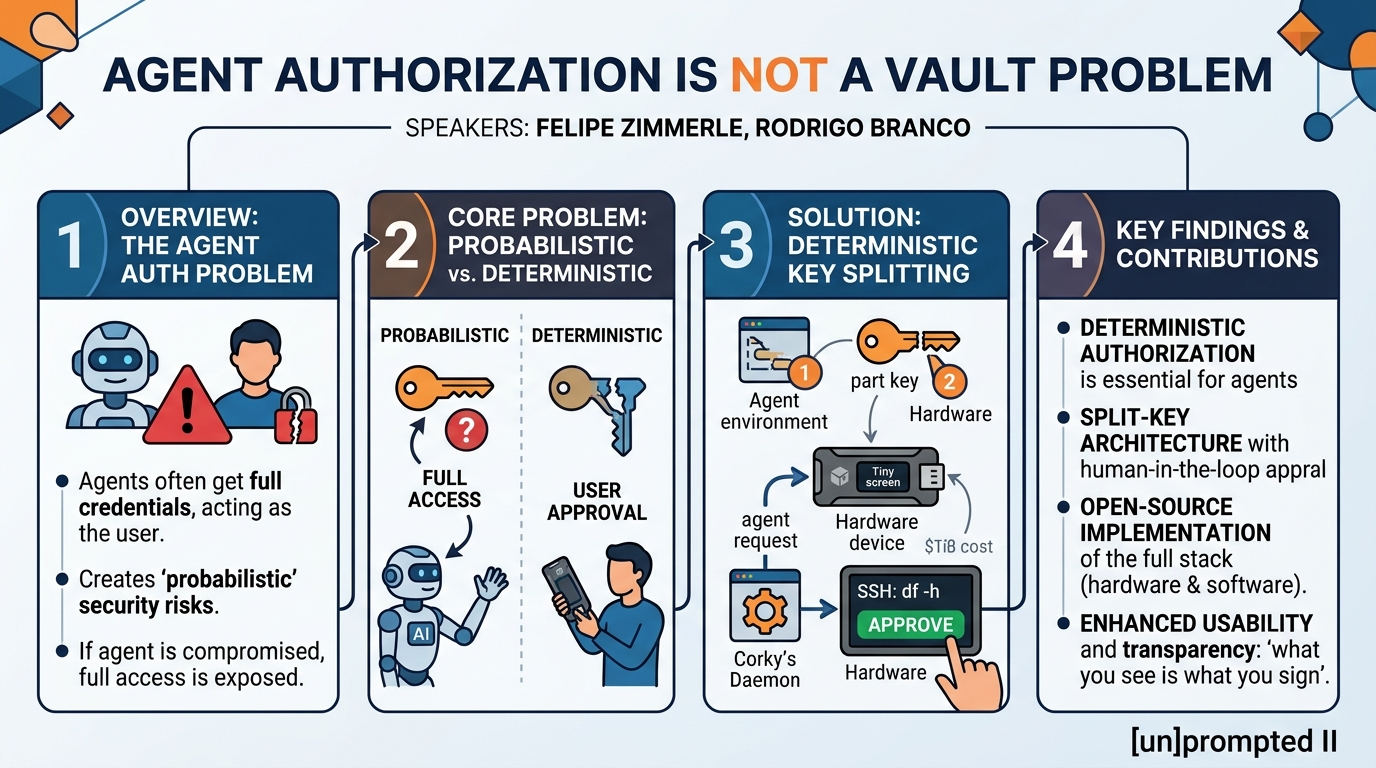
In an increasingly automated world, software agents are taking on more responsibilities, often impersonating human users to perform tasks like SSHing into production servers, pushing code to repositories, or approving pull requests. This talk, "Agent Authorization Is Not a Vault Problem," by Felipe Zimmerle and Rodrigo Branco, addresses a critical security vulnerability inherent in this paradigm: the lack of robust, deterministic authorization mechanisms for these agents. Currently, agents are frequently granted full access to sensitive keys or credentials, making them indistinguishable from the human user they represent. This probabilistic approach to security creates significant risks, as a compromised agent or an agent performing an unintended action can leverage full user privileges to access unauthorized resources.
Key moments
- 0:00 Introduction: Agent Authorization Problem
- 3:15 Open-Source Hardware Proof of Concept
- 6:00 Live Demo: SSH Agent Authorization
- 7:00 Multi-Agent Authorization Model
- 10:45 Production Readiness and Security Warnings
- 12:45 Hardware Security Limitations & Threat Model
- 18:30 Q&A: Financial Transactions & Usability
Agent Authorization Is Not a Vault Problem
Speakers: Felipe Zimmerle (CTO, KonaSense); Rodrigo Branco (Vulnerability Researcher, Anthropic)
Conference: [un]prompted II
YouTube: https://www.youtube.com/watch?v=Nblb4N2q6eg
Overview
In an increasingly automated world, software agents are taking on more responsibilities, often impersonating human users to perform tasks like SSHing into production servers, pushing code to repositories, or approving pull requests. This talk, "Agent Authorization Is Not a Vault Problem," by Felipe Zimmerle and Rodrigo Branco, addresses a critical security vulnerability inherent in this paradigm: the lack of robust, deterministic authorization mechanisms for these agents. Currently, agents are frequently granted full access to sensitive keys or credentials, making them indistinguishable from the human user they represent. This probabilistic approach to security creates significant risks, as a compromised agent or an agent performing an unintended action can leverage full user privileges to access unauthorized resources.
The speakers introduce CoreKey, an innovative open-source hardware and software solution designed to provide deterministic, human-in-the-loop authorization for agent actions. Inspired by the security principles of crypto wallets, CoreKey aims to split cryptographic keys between the agent's environment and a physical hardware device. This architecture ensures that the agent never possesses the full key, requiring explicit user approval on the hardware device for any sensitive operation. By integrating with existing protocols like SSH and WebAuthn, CoreKey seeks to enhance security without disrupting developer workflows, offering a pragmatic step towards securing autonomous agents in modern computing environments.
This approach fundamentally shifts the security model from simply managing and storing keys (a "vault problem") to actively authorizing specific actions based on a split-key mechanism. The talk highlights the importance of user transparency and control, demonstrating how CoreKey displays clear, actionable information on its screen, enabling users to confidently approve or deny agent requests. This deterministic control is crucial for mitigating risks associated with agent autonomy, preventing unintended resource access, and bolstering the overall security posture of agent-driven operations.
Background
▶ Watch: Introduction: Agent Authorization Problem (0:00)
The proliferation of software agents across various domains, from development operations to financial transactions, has introduced a significant security challenge: how to authorize and authenticate these agents without exposing critical user credentials. Traditionally, agents are provisioned with full cryptographic keys or tokens, effectively granting them the same level of access and authority as the human user they impersonate. This design choice, while convenient for automation, blurs the line between human and machine identity, leading to a "probabilistic" security model where the risk of an agent acting maliciously or unexpectedly is managed through policy and monitoring, rather than inherent technical controls.
The core problem, as articulated by the speakers, is that current controls are more probabilistic than deterministic. When an agent is given a key, it can potentially use that key for any action it is technically capable of performing, even if that action was not the user's original intent. This is especially problematic if an agent is compromised or if its AI model "finds a second way to do it," as described by Zimmerle, which might be beneficial in some cases but catastrophic in others. The current model essentially means "giving away your key" to the agent, rather than "issuing a one-time authorization" for a specific resource or action. If the agent itself is compromised, the full key is exposed, allowing attackers to access any resource the original user could.
To address this, the project draws inspiration from the established security principles of cryptographic hardware and crypto wallets. These devices are designed to hold a secret key that never leaves the hardware, requiring physical interaction (e.g., a button press) for any signing operation. The concept is to apply a similar key-splitting mechanism to agent authorization. Instead of the agent holding the entire key, the key is split between the agent's environment and a dedicated hardware device. Only when both parts are combined, and critically, when the user explicitly authorizes the action on the hardware, can the resource access be granted. This ensures that even if one component (the agent or the hardware) is compromised, the full key cannot be reconstructed or misused without the other component's cooperation and the user's explicit consent. The goal is to achieve a "deterministic guarantee" that the key is only used for precisely what the user has authorized, thereby significantly elevating the security posture of agent-driven workflows.
Key Findings
▶ Watch: Live Demo: SSH Agent Authorization (6:00)
The talk highlights several key findings and contributions in the realm of agent authorization:
- The Inadequacy of Current Agent Authorization Models: The speakers unequivocally establish that treating agent authorization as merely a "vault problem" (i.e., securely storing keys for agents) is insufficient. The fundamental flaw lies in the agent possessing the full key, leading to a probabilistic security model where an agent, whether compromised or simply behaving unexpectedly, can perform unauthorized actions. This blurs the distinction between the user and the agent, creating a critical security gap.
- Deterministic Authorization through Key Splitting: The core innovation is the concept of splitting cryptographic keys between the agent's execution environment and a physical hardware device. This ensures that the agent never directly "sees" or holds the entire key. Authorization for any action requires the combination of these split key components, with the crucial addition of explicit user approval on the hardware device. This transforms authorization from a probabilistic guess to a deterministic guarantee.
- Introduction of CoreKey as an Open-Source Solution: The project introduces CoreKey, a concrete, open-source hardware and software implementation of this deterministic authorization model. CoreKey provides a working proof-of-concept that integrates with common protocols like SSH and WebAuthn. The entire stack—hardware design (3D printed case), firmware, and desktop software (Corky's demon)—is openly available on GitHub, fostering community contributions and transparency.
- User Transparency and Informed Consent: A significant finding is the emphasis on clear and honest communication with the user. CoreKey's design prioritizes displaying the exact action being requested by the agent on its screen, allowing the user to make an informed decision to approve or deny. This tackles the phishing problem by ensuring "what you see is what you sign," even with varying levels of detail available depending on the protocol and configuration.
- Addressing Practical Challenges with Innovative Solutions: The project confronts real-world challenges, such as displaying lengthy bash commands on a small screen. Their solution involves hashing the command together with a "skill" identifier, displaying this hash to the user, who then confirms it against a similar hash displayed by the agent. This allows for verification without needing to display the entire command, maintaining the integrity of the authorization process.
- Multi-Agent Authorization Potential: The framework extends beyond a simple human-hardware interaction. The speakers propose a model where the hardware itself could host an "agent," and authorization requires cooperation between the software agent, the hardware agent, and potentially even a third party. This opens avenues for more complex, distributed authorization schemes, further decentralizing trust and enhancing security.
- Cost-Effectiveness and Accessibility: A deliberate choice was made to use an inexpensive, off-the-shelf microcontroller (MCU), costing around $20. While this implies certain security trade-offs (e.g., lack of TPM-level security against physical attacks), it significantly lowers the barrier to entry, making the technology accessible for broader adoption and experimentation. The threat model is designed to leverage the split-key approach to mitigate risks associated with the simpler hardware.
Technical Deep Dive
▶ Watch: Multi-Agent Authorization Model (7:00)
The CoreKey project presents a novel architecture for deterministic agent authorization, built upon an open-source hardware device and a layered software stack.
At its core, CoreKey consists of a small, inexpensive microcontroller (MCU), deliberately chosen for its accessibility and low cost (approximately $20, readily available). This MCU forms the hardware backbone, featuring a small display screen for user interaction. The device connects to a host computer (desktop or laptop) via USB.
The software stack supporting CoreKey operates at multiple levels:
- Corky's Daemon: This is a desktop application, referred to as "Corky's demon," which runs on the host computer. Its primary role is to mediate communication between the agents requesting authorization and the CoreKey hardware device. It acts as a local server, handling requests and forwarding them to the connected hardware.
- Device-Host Communication: The communication between the CoreKey hardware and Corky's daemon is secured using the Noise Protocol. This ensures that messages exchanged between the device and the desktop are authenticated and encrypted, preventing tampering or eavesdropping. The device must be paired with the desktop, preventing it from being used as an oracle to sign arbitrary data without proper context.
- Key Splitting and Signing: The fundamental security mechanism revolves around key splitting. A cryptographic key is conceptually divided into two parts: one residing on the host desktop (or within the agent's environment) and the other securely held within the CoreKey hardware. For any authorization request, both parts are required. The CoreKey device itself holds a key and signs everything requested, presenting the user with an interface to approve. This design mathematically proves that "what you see in the interface is really what is being asked for."
- Integration with Existing Protocols:
- SSH Integration: CoreKey integrates seamlessly with existing SSH workflows. It functions as an SSH agent, intercepting SSH requests from agents. When an agent attempts to SSH into a remote server or execute a command (e.g.,
df -h), the request is routed through Corky's daemon to the CoreKey device. The device then displays the command, hostname, and user information on its screen, prompting the user for approval. Only upon explicit user confirmation on the hardware device is the signed authorization returned, allowing the SSH command to proceed. This mechanism prevents unauthorized or unintended SSH actions, even if the software agent is compromised. - WebAuthn Integration: Similarly, CoreKey supports WebAuthn (Web Authentication API), extending its deterministic authorization capabilities to web-based authentication flows. While specific nuances are mentioned, the general principle remains the same: web authentication requests are intercepted, displayed on the CoreKey device, and require user approval for completion.
- Levels of Detail and Command Hashing: A critical challenge addressed is displaying complex or lengthy commands on the CoreKey's small screen. The project defines three levels of detail for authorization requests:
- Level 1: Full details, including the command (
df), hostname, and user. This offers the highest transparency. - Level 2: Only the hostname is displayed, with no command specifics.
- Level 3: Only the fact that user X is attempting to SSH to a given machine is shown.
The device is "honest" about the level of detail it can display based on configuration. For very long bash commands that cannot fit, a creative solution is employed: a one-way hash function is generated from the command content and an associated "skill" (contextual information about the agent's intent). This hash is then displayed on the device. The user can compare this hash with a corresponding hash displayed by the agent on their computer, thereby confirming that the command being signed is indeed the one intended, even without seeing the full text.
- Hardware Security Considerations and Limitations:
- Secure Boot: The chosen MCU supports secure boot, allowing users to burn fuses on the device to validate that the firmware originated from a trusted source. This helps prevent firmware tampering.
- Threat Model: The primary threat model relies on the key-splitting mechanism. While the MCU is inexpensive and not a Trusted Platform Module (TPM) or a dedicated hardware security module (HSM), meaning it's vulnerable to sophisticated physical attacks like fault injection or X-ray analysis, the split-key design mitigates the impact. Even if the hardware's key component is extracted, it's useless without the other half residing in the host environment.
- Current Limitations: The current MCU lacks hardware acceleration for elliptic curves, which is a target for future work (e.g., integrating FROST support). There's also no inherent protection against fault injection or side-channel attacks. Furthermore, the Proof of Concept (PoC) version includes "backdoors" like USB-based device reset and reflash capabilities, which would need to be removed or securely managed for production deployments to prevent compromise by design. Usability challenges also arise from external factors, such as protocol-embedded timeouts (e.g., 20-30 seconds for WebAuthn prompts) over which the device has no control, potentially leading to missed authorizations if the device isn't immediately accessible.
- Oracle Problem for Agents: A significant open question is how to address the "oracle problem" when an agent requires high-volume signing. Traditional crypto hardware limits throughput to prevent key extraction through repeated signing operations. However, agents are designed to use resources heavily. Distinguishing legitimate high-volume agent usage from a malicious actor attempting to extract a key via an oracle attack remains an unsolved challenge, requiring further research.
Demo / Proof of Concept
▶ Watch: Hardware Security Limitations & Threat Model (12:45)
The talk includes a straightforward yet compelling demonstration of CoreKey's functionality, showcasing its practical application in securing agent-driven SSH operations. The entire project, including the hardware design, firmware, and desktop software, is presented as an open-source proof-of-concept, available on GitHub. This includes the source code for all software components and even the 3D printable case for the hardware device.
During the demonstration, the speaker illustrates a common scenario: an agent attempting to execute a command on a remote server. Specifically, the demo involves a user (or agent) trying to SSH into localhost and then execute the command df -h to check disk space.
Here's how the demo unfolds:
- The user initiates an SSH connection to
localhostand attempts to rundf -h. - Instead of the command executing directly, the Corky's daemon intercepts the request.
- The request is forwarded to the connected CoreKey hardware device via USB, using the secure Noise Protocol.
- On the CoreKey device's small screen, a clear authorization prompt appears. This prompt explicitly displays the command being requested (e.g.,
SSH: df -h) and the target (e.g.,localhost). - The speaker highlights that without explicit approval on the CoreKey device, the SSH command cannot proceed.
- The user then physically interacts with the CoreKey device to approve the authorization.
- Upon approval, the CoreKey device signs the authorization request with its split key component, and the signed authorization is sent back to the host computer.
- The SSH command
df -hthen successfully executes onlocalhost, displaying the disk space information.
This demonstration effectively illustrates the human-in-the-loop model, where the user retains deterministic control over agent actions. The agent never possesses the full key, and every sensitive operation requires explicit, informed consent from the user via the hardware device. The speakers confirm that this concept also extends to WebAuthn for web authentications, indicating the versatility of the CoreKey approach beyond just SSH. The open-source nature of the project means that anyone can download the source code, build the hardware, and experiment with the proof of concept.
Defensive Implications
▶ Watch: Q&A: Financial Transactions & Usability (18:30)
The CoreKey project offers several critical defensive implications for organizations and individuals grappling with the security challenges of autonomous agents:
- Shift to Deterministic Authorization: Defenders should move away from probabilistic security models for agents, where agents possess full credentials and their actions are merely monitored. Instead, adopt a deterministic model where every sensitive agent action requires explicit, human-verified authorization. CoreKey provides a blueprint for achieving this by splitting keys and requiring hardware-based approval.
- Implement Hardware-Backed Key Splitting: Integrate solutions that leverage hardware devices to split cryptographic keys, ensuring that no single component (neither the agent nor the host system) ever holds the complete key. This significantly raises the bar for attackers, as compromising an agent or a workstation will not immediately yield full access to all resources. The CoreKey's approach of combining a desktop component with a physical device offers a tangible path.
- Enforce Human-in-the-Loop for Critical Operations: Mandate explicit user approval for agent actions that have significant security implications, such as SSH access to production environments, code commits, financial transactions, or sensitive data manipulation. The on-device display of the requested action, as demonstrated by CoreKey, ensures transparency and informed consent, preventing agents from performing unintended or malicious operations.
- Audit and Verify Agent Actions: Even with hardware authorization, maintain robust logging and auditing of all approved agent actions. This provides an immutable record of what was authorized, by whom, and when, which is crucial for incident response and compliance. The deterministic nature of CoreKey's authorization process makes these audit trails more reliable.
- Carefully Evaluate Threat Models for Hardware: While CoreKey uses an inexpensive MCU, defenders must understand its limitations. For extremely high-value keys or environments requiring resistance to sophisticated physical attacks (e.g., fault injection, X-ray analysis), a dedicated Trusted Platform Module (TPM) or a certified HSM might be necessary. However, for many scenarios, the split-key model of CoreKey, combined with its secure boot capabilities, offers a substantial security upgrade over existing practices. If deploying CoreKey-like solutions, consider burning the fuses for secure boot and removing any PoC-era "backdoors" (like USB reflash/reset) for production use.
- Address Usability and Timeout Challenges: Be aware of the usability challenges posed by external factors like protocol timeouts (e.g., WebAuthn's 20-30 second response window). Design workflows and policies to ensure users have sufficient time and immediate access to their authorization device when critical prompts occur. This may involve configuring agents to pause or retry if authorization is not received within the timeout.
- Consider the Oracle Problem for High-Throughput Agents: For agents requiring a very high volume of cryptographic signatures, the "oracle problem" remains an open challenge. Defenders need to consider how to distinguish legitimate high-throughput agent activity from malicious attempts to extract keys through repeated signing requests. This may require advanced behavioral analytics or specialized hardware designed for agent-specific throughput management.
- Promote Open-Source Security Solutions: The open-source nature of CoreKey allows for community scrutiny, improvement, and customization. Defenders should consider contributing to or adopting open-source security projects that align with their needs, fostering a collaborative approach to enhancing security.
Key Takeaways
- Deterministic Authorization is Crucial: Current agent authorization models are probabilistic and inherently insecure, as agents often possess full cryptographic keys. A shift to deterministic authorization, where specific actions are explicitly approved, is essential to secure agent-driven workflows.
- Hardware-Backed Key Splitting for Enhanced Security: The CoreKey project demonstrates a viable method for achieving deterministic authorization by splitting cryptographic keys between a software agent and a physical hardware device. This "human-in-the-loop" approach ensures the agent never holds the full key, significantly mitigating the risk of compromise.
- Open Source and Accessible Hardware: CoreKey leverages an inexpensive, off-the-shelf microcontroller, making the technology accessible and fostering community contributions. This lowers the barrier to entry for implementing hardware-backed authorization solutions.
- User Transparency and Informed Consent: The system prioritizes displaying clear and honest information about the requested action on the device screen. Innovative techniques like command hashing are used to maintain verification integrity even for complex commands, ensuring users make informed decisions.
- Challenges and Future Directions: While CoreKey provides a strong foundation, challenges remain, including the lack of crypto-grade hardware security (e.g., TPM features), the "oracle problem" for high-throughput agents, and managing protocol-specific timeouts. Future work aims to integrate stronger cryptographic capabilities (like FROST support) and broaden protocol support beyond SSH and WebAuthn.
- Foundation for Future Agent Security: CoreKey lays a significant groundwork for securing the next generation of autonomous agents, offering a practical, open-source solution that enhances security without unduly disrupting existing developer and operational workflows.
About the Speaker(s)
Felipe Zimmerle serves as the CTO of KonaSense. His work, as demonstrated in this talk, highlights a deep expertise in hardware security, embedded systems, and the practical application of cryptographic principles to solve real-world security challenges in emerging technologies like AI agents. His involvement in developing the open-source CoreKey project underscores his commitment to community-driven security solutions.
Rodrigo Branco is a Vulnerability Researcher at Anthropic. His contributions to the CoreKey project, particularly in the context of agent authorization, align with his focus on identifying and addressing security vulnerabilities in advanced systems. His background as a vulnerability researcher lends credibility to the project's security analysis and its emphasis on robust, deterministic controls.
Reviews
→ Top-rated talks at [un]prompted II 2026 — The AI Security Practitioner Conference
All talks from [un]prompted II 2026 — The AI Security Practitioner Conference