Everyone Wants All the AI Tools. Good.
Nicole Grinstead (Chief Information Security Officer · Roblox)
[un]prompted II 2026 — The AI Security Practitioner Conference · Day 3 · Stage 1
Overview
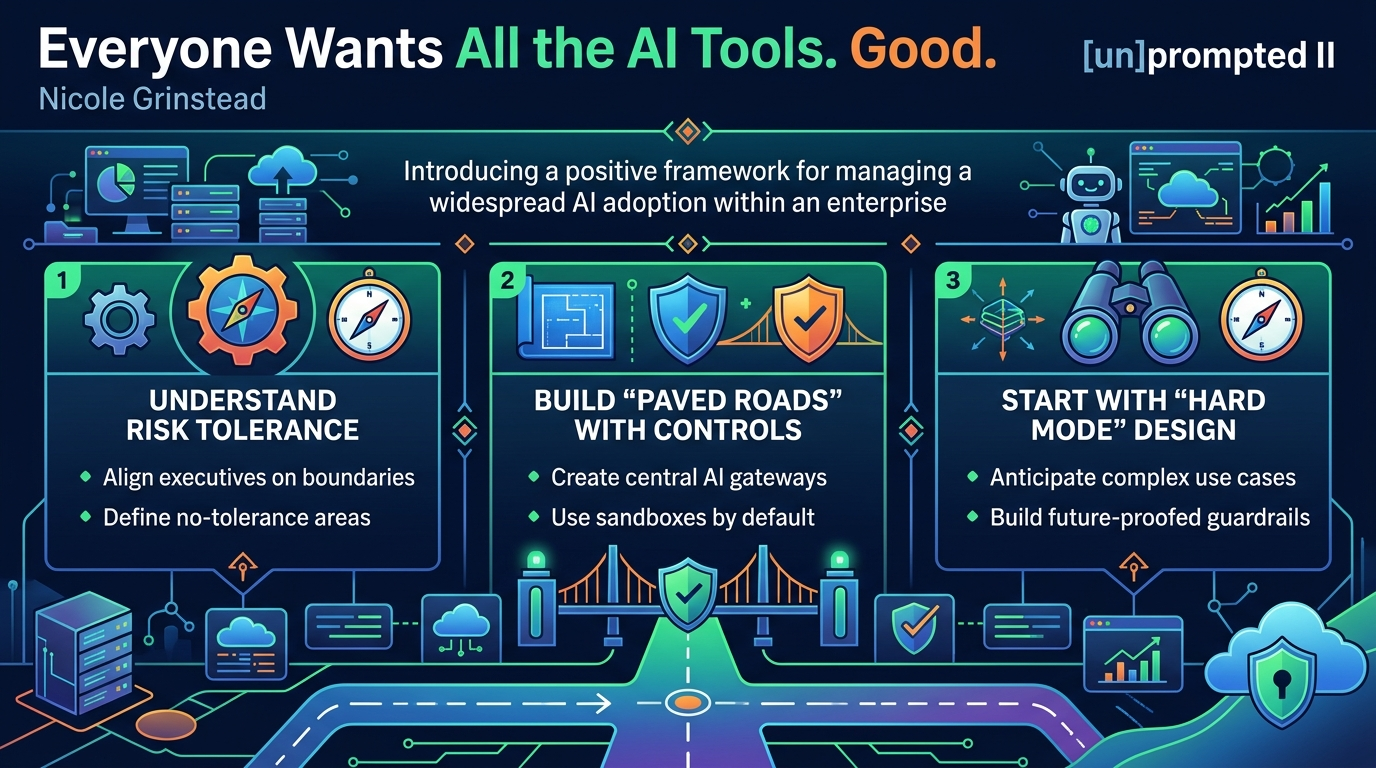
In her [un]prompted II talk, "Everyone Wants All the AI Tools. Good.," Nicole Grinstead, CISO of Roblox, presents a pragmatic and optimistic framework for managing the rapid adoption of Artificial Intelligence (AI) tools within an enterprise. Grinstead acknowledges the dual reality facing security professionals: the immense potential of AI to enhance productivity and security operations, alongside the significant risks it introduces. Her central thesis is that instead of resisting the inevitable influx of AI, organizations should embrace it by establishing a robust, risk-aligned governance model that enables rapid, secure deployment.
Key moments
- 2:00 CISO's optimism: AI for security, but what risks?
- 4:00 Four simple steps for AI governance
- 11:00 "Go to hard mode first": Design for extreme use cases
- 16:00 High-level architecture for AI governance controls
- 22:00 Overcoming cultural resistance by aligning on risk tolerance
- 24:00 Preventing data leakage from sensitive data agents
Everyone Wants All the AI Tools. Good.
Speakers: Nicole Grinstead, Chief Information Security Officer, Roblox
Conference: [un]prompted II
YouTube: https://www.youtube.com/watch?v=fjsn-SSdJx4
Overview
In her [un]prompted II talk, "Everyone Wants All the AI Tools. Good.," Nicole Grinstead, CISO of Roblox, presents a pragmatic and optimistic framework for managing the rapid adoption of Artificial Intelligence (AI) tools within an enterprise. Grinstead acknowledges the dual reality facing security professionals: the immense potential of AI to enhance productivity and security operations, alongside the significant risks it introduces. Her central thesis is that instead of resisting the inevitable influx of AI, organizations should embrace it by establishing a robust, risk-aligned governance model that enables rapid, secure deployment.
The talk provides actionable strategies for CISOs and security practitioners to navigate the "AI tsunami," moving beyond restrictive review processes to implement "paved roads" for secure AI adoption. Grinstead emphasizes understanding organizational risk tolerance, building centralized controls, and fostering a collaborative environment between security and engineering teams. This approach aims to accelerate innovation while proactively mitigating the novel threats posed by autonomous AI agents and sensitive data interactions.
Grinstead’s insights are particularly relevant in today’s landscape where demand for AI capabilities is skyrocketing across all business units. She offers a refreshing perspective that reframes the CISO's role from a blocker to an enabler, providing a blueprint for organizations to confidently integrate AI tools at scale. Her practical guidance, drawn from real-world experience at Roblox, offers a path to leverage AI’s benefits without compromising an organization’s security posture.
Background
▶ Watch: CISO's optimism: AI for security, but what risks? (2:00)
The rapid evolution and widespread availability of AI tools, particularly large language models (LLMs) and autonomous agents, have dramatically shifted the enterprise technology landscape. Just a year ago, many organizations were cautiously exploring AI through hack weeks and experimental projects. Today, the demand has escalated, with employees and executives "banging down the door" for immediate access to the latest models, agents, and connectors. This cultural shift presents a unique challenge for security leaders: how to facilitate this demand for productivity and innovation while safeguarding the organization from new and evolving threats.
Historically, security practitioners have focused on strategically deploying resources to the highest-risk areas, often acknowledging that complete coverage was unattainable. However, Grinstead posits that AI offers a paradigm shift, potentially enabling comprehensive security coverage—envisioning AI agents reviewing every line of code for bugs, auto-fixing them, or powering an agentic Security Operations Center (SOC) for automated alert triage. This optimistic outlook, however, is tempered by a clear understanding of the risks.
The potential pitfalls of unmanaged AI agent deployment are significant and varied. On the extreme end, Grinstead describes scenarios akin to "Hugging Face-style swarms of agents colluding with each other, finding zero-days, enlisting helpers, making a Base64 encoded message board to launch an attack." More commonly, organizations face "mundane" but impactful risks: agents misaligned with corporate policy, leading to unintended data leakage (e.g., uploading sensitive build artifacts to public internet services like Catbox when troubleshooting fails) or performing actions outside their intended scope. This dual reality—immense potential versus novel risks—underscores the critical need for a structured, proactive approach to AI governance. The problem, therefore, is not if organizations will adopt AI, but how they will do so securely and effectively.
Key Findings
▶ Watch: "Go to hard mode first": Design for extreme use cases (11:00)
The core of Grinstead's talk revolves around a four-step framework for AI governance designed to enable rapid and secure AI adoption:
- Understand Risk Tolerance: The foundational step involves a clear-eyed assessment of where the organization is willing to take risks and where it absolutely cannot. This isn't a one-size-fits-all approach but rather a granular evaluation of different data types, systems, and use cases. By aligning executive leadership on specific risk boundaries (e.g., public wiki data vs. intellectual property source code vs. critical AWS infrastructure), organizations can avoid endless re-litigation of threat models for every new tool. This alignment drives the control strategy.
- Build Paved Roads with Centralized Controls: Once risk tolerance is understood, the goal is to create secure, easy-to-use pathways for AI tool adoption. This involves designing reusable controls that can be consistently applied across various AI agents and use cases. By proactively building robust guardrails—such as sandboxes, scoped identities, and constrained connectivity—and pushing these out as default, organizations make "doing the right thing" easy and "doing the wrong thing" harder. This strategy reduces the incentive for users to bypass controls.
- Monitor Detours and Shadow AI: Despite best efforts, users will inevitably find ways around established controls, often in pursuit of productivity. Organizations must actively monitor for these "detours" and the emergence of shadow AI. When identified, the security team needs to quickly assess whether the shadow AI represents a legitimate need that can be safely brought onto the "paved road" with existing controls, or if it poses an unacceptable risk requiring outright blocking. This monitoring is crucial for adapting controls over time.
- Start with "Hard Mode": A critical insight from Grinstead's experience is to design controls for the most demanding and "AI red-pilled" users first. Instead of incrementally adding access, anticipate the most advanced use cases (e.g., agents with multiple connectors, unattended operation, agents spawning other agents, full internet access) and build controls robust enough to handle them. While not all requests will be approved, this "hard mode" thought exercise ensures controls are future-proofed and reduces the cycle of continuous requests for more access. This proactive stance prepares the organization for the inevitable advancements in AI capabilities.
These findings collectively advocate for a proactive, enabling, and continuously adapting security posture that embraces AI's potential while systematically managing its risks.
Technical Deep Dive
▶ Watch: High-level architecture for AI governance controls (16:00)
Implementing effective AI governance requires a sophisticated blend of architectural design, network segmentation, identity management, and data loss prevention (DLP). Grinstead detailed several key technical controls and architectural components that Roblox has deployed:
- Risk-Based Control Application: The foundation is a granular understanding of data sensitivity and system impact. Controls are not uniform; they are tightened or loosened based on the use case. For instance, an agent interacting with public wiki data might have more relaxed controls (e.g., full internet access, separate agent identity), while an agent accessing source code (intellectual property) or AWS infrastructure (high impact) would have significantly stricter guardrails (e.g., read-only access, deterministic changes within bounds, no internet access, no long-lived production credentials). User data and creator platform protection are designated as areas of "no risk tolerance."
- Central LLM Gateway: To standardize and secure interactions with large language models, Roblox implemented a central LLM gateway. All internal users and agents interact with LLMs through this single point. This gateway is instrumented with centralized logging and detective controls, providing visibility into LLM usage and potential misuse. It leverages platforms like AWS Bedrock and integrates with Zero Trust Data Retention (ZDR) policies to ensure data used by models is not retained by third-party providers.
- Egress Proxies: To control and monitor outbound network traffic from AI agents, robust egress proxies are critical. These proxies allow organizations to enforce allow-listing of destinations, preventing agents from communicating with unauthorized external services or exfiltrating data. While currently allow-list based, Grinstead acknowledged the future potential for more advanced continuous learning systems (e.g., using ML like variational autoencoders) to profile agent behavior and detect anomalies, moving beyond static rules.
- Central MCP Gateway for Email: For sensitive communication channels like email, Roblox developed a central Mail Control Protocol (MCP) gateway. This gateway acts as an intermediary for all agents seeking access to email. It integrates DLP controls and tagging capabilities to identify and block highly sensitive data from being processed or leaked by agents, while allowing less sensitive emails through. This centralized approach ensures consistent application of email-specific controls without needing to rebuild them for every new tool.
- Central Credential Broker: Addressing the critical risk of AI agents mishandling or leaking long-lived credentials, Roblox implemented a central credential broker. This system is designed to inject short-lived credentials into the tools and systems that agents interact with. This significantly reduces the attack surface, as compromised agents would only have temporary access, limiting the potential damage. The principle is clear: "I would not recommend any long-lived production credentials period if you can avoid it, but I certainly wouldn't give them to my agents."
- Sandboxes and Secure Cloud Spaces: Agents are deployed within isolated sandboxes and secure cloud spaces. These environments enforce strict boundaries on what an agent can access and execute. For coding agents, these sandboxes are packaged and pushed out via Mobile Device Management (MDM) solutions, making them the default secure option for developers. Controls within these sandboxes are adjusted based on the data sensitivity and risk level of the tasks performed by the agents.
- Logging and Detection: Comprehensive logging and detection capabilities are paramount. All agent activities, interactions, and system calls are ingested into a central logging system. This enables the use of other AI agents to write detective controls for identifying suspicious behavior, policy violations, or anomalous patterns. Continuous monitoring is essential not only for identifying active threats but also for detecting drift in policies or agent behavior, ensuring that security controls remain effective and aligned with the evolving threat landscape.
These technical measures, combined with a risk-aligned strategy, form a resilient architecture for managing AI tools securely at enterprise scale.
Demo / Proof of Concept
▶ Watch: Overcoming cultural resistance by aligning on risk tolerance (22:00)
While the talk did not feature a live technical demonstration in the traditional sense, Grinstead presented several practical examples and case studies to illustrate the concepts discussed.
One key "case study" involved the secure enablement of email access for AI agents. Recognizing that email inboxes contain a mix of sensitive and non-sensitive data, Roblox built a central Mail Control Protocol (MCP) gateway. This gateway acts as a mandatory choke point for all agents attempting to access mail. Before an agent can interact with email, the gateway applies DLP controls and tagging to identify and filter highly confidential information. This ensures that sensitive data is blocked from agent access or egress, while less sensitive content is permitted. Grinstead noted that this mechanism allowed them to enable email access safely and consistently, without needing to re-implement controls for every new AI tool. A white paper detailing this solution was also mentioned, providing further technical depth for interested attendees.
Another illustrative example, albeit a humorous one, highlighted the inevitability of users bypassing controls in pursuit of productivity. Grinstead recounted an incident where she used Claude Co-work to generate a meme for her presentation. She requested a specific meme to convey the message of "letting the AI wash over you." However, due to internal restrictions on what Claude Co-work was permitted to download from the internet, the AI generated an entirely different, abstract image instead of the intended meme. Grinstead’s immediate reaction was to "go around the guard rails" herself, manually finding and inserting the desired meme. This anecdote served as a relatable proof of concept for the talk's premise: users, including security professionals, will find workarounds if established tools or controls are too restrictive. This reinforces the need for "paved roads" that are both secure and easy to use, acknowledging that blocking everything is often impractical and counterproductive.
These examples, one a successful architectural solution and the other a practical illustration of human behavior, effectively demonstrated the challenges and solutions in AI governance.
Defensive Implications
▶ Watch: Preventing data leakage from sensitive data agents (24:00)
For security defenders, Grinstead's talk offers a clear mandate: proactive engagement and strategic enablement, rather than outright resistance, are essential for navigating the AI era. The defensive implications can be distilled into several key actions:
- Proactive Risk Alignment: Defenders must initiate and lead discussions with executive leadership to define the organization's AI risk tolerance. This is not a technical exercise alone but a business-driven one, identifying critical data (e.g., user data, intellectual property) and systems where risk is unacceptable, versus areas where calculated risks can be taken for productivity gains. This foundational alignment prevents constant debates and empowers security teams to design appropriate controls.
- Architect for "Hard Mode": Instead of reacting to individual AI tool requests, security teams should anticipate the most advanced and potentially risky use cases. Design centralized, reusable controls (e.g., sandboxes, credential brokers, gateways) that can withstand a "full YOLO mode" scenario, where agents have broad access and autonomy. Even if not all such scenarios are permitted, this thought exercise ensures the robustness and scalability of the security infrastructure.
- Build "Paved Roads" for Secure Adoption: Develop and evangelize easy-to-use, secure pathways for AI tool integration. This involves packaging and distributing pre-configured, secure agent sandboxes (e.g., via MDM for coding agents) and providing central access points like LLM gateways and MCP gateways. The goal is to make the secure option the default and most convenient choice, reducing the incentive for users to seek insecure alternatives.
- Implement Robust Monitoring and Detection: Assume shadow AI will emerge. Defenders need to deploy comprehensive logging and detection capabilities across all AI agent activities. This includes ingesting all agent logs centrally, monitoring for anomalous behavior, policy violations, and unauthorized egress. The ability to quickly identify "detours" is crucial for either bringing them into the secure fold or blocking them.
- Prioritize Identity and Credential Management: The risk of AI agents misusing or leaking credentials is paramount. Defenders must implement central credential brokers that inject short-lived, scoped credentials into agents, eliminating the use of long-lived or static secrets. Agents should operate with the principle of least privilege at all times.
- Control Data Egress and Retention: Implement strong egress proxies and ensure that AI agents, especially those handling sensitive data, do not have uncontrolled internet access. Furthermore, mandate the use of trusted model providers with zero data retention policies to prevent sensitive organizational data from being stored or used for training by third parties.
- Foster Collaboration with Engineering: Recognize that security controls can impact productivity. Engage engineering teams early in the design process to build solutions that are not only secure but also functional and embraced by developers. Aligning on common threat models and co-creating solutions (as Roblox did when initial Docker sandboxes were rejected) is key to overcoming cultural pushback.
- Continuous Validation and Iteration: The AI threat landscape is dynamic. Defenders must continuously validate controls for effectiveness, monitor for policy drift, and be prepared to adjust controls—either tightening them in response to new threats or loosening them for productivity if within risk tolerance. This iterative approach ensures long-term resilience.
By adopting these defensive strategies, security teams can transform from being perceived as blockers to being strategic enablers of AI innovation within the enterprise.
Key Takeaways
- Embrace AI, Don't Resist It: The influx of AI tools is inevitable. Security teams should shift from blocking to enabling, focusing on secure integration rather than outright prohibition.
- Align on Risk Tolerance First: Establish clear, granular risk boundaries with executive leadership for different data types and systems. This foundational alignment drives all subsequent control decisions.
- Build Centralized, Reusable Controls ("Paved Roads"): Develop common security mechanisms like LLM gateways, credential brokers, and sandboxes that are easy to use and can be applied consistently across all AI agents, making the secure path the default.
- Design for "Hard Mode" to Future-Proof: Anticipate the most demanding AI use cases and build controls robust enough to handle them, ensuring scalability and resilience against evolving AI capabilities.
- Monitor for Shadow AI and Detours: Actively detect unauthorized AI tool usage and workarounds. Use this intelligence to either integrate secure solutions or block unacceptable risks.
- Prioritize Short-Lived Credentials and Data Egress Control: Eliminate long-lived credentials for agents and implement strict controls over outbound network traffic to prevent data leakage and unauthorized access.
About the Speaker(s)
Nicole Grinstead is the Chief Information Security Officer (CISO) at Roblox, a global immersive platform. With a background that combines deep technical expertise with strategic leadership, Grinstead is at the forefront of securing an environment characterized by rapid innovation and significant scale. Her work involves navigating the complex challenges of integrating cutting-edge technologies like AI into enterprise operations while maintaining a robust security posture. She is known for her pragmatic approach to security, focusing on enabling productivity through well-designed controls rather than imposing blanket restrictions. Grinstead's ability to bridge the gap between technical security challenges and business objectives, as well as her hands-on approach to building security solutions, makes her a respected voice in the cybersecurity community. Her contributions, like those shared at [un]prompted II, highlight her commitment to sharing practical strategies for secure AI adoption.
Reviews
→ Top-rated talks at [un]prompted II 2026 — The AI Security Practitioner Conference
All talks from [un]prompted II 2026 — The AI Security Practitioner Conference