Enterprise OpenClaw: Tackling Agentic Security at Scale
Damian Finol (VP Engineering · Felix Pago)
[un]prompted II 2026 — The AI Security Practitioner Conference · Day 3 · Stage 1
Overview
The proliferation of AI agents capable of interacting with real-world systems and credentials presents a formidable new frontier in cybersecurity. Damian Finol, VP Engineering at Felix Pago, delivered a compelling talk at [un]prompted II, "Enterprise OpenClaw: Tackling Agentic Security at Scale," sharing his team's audacious journey of deploying 600 OpenClaw gateways in a production enterprise environment. This talk directly confronts the security community's initial apprehension towards agentic systems, demonstrating that with a rigorous, invariant-driven security architecture, these powerful tools can be harnessed safely and at scale.
Key moments
- 0:00 Running 600 OpenClaw gateways: a security challenge
- 3:30 Core security invariants for agentic systems
- 4:40 High-level architecture: GKE, Control Plane, Credential Egress
- 6:00 Credential egress gateway: no tokens in the pod
- 8:30 Bot fallback example: triaging customer service issues
- 12:40 Agent capabilities defined in read-only pod spec
- 16:30 Four major security takeaways for agentic systems
- 20:00 Q&A: How safety invariants were derived
Enterprise OpenClaw: Tackling Agentic Security at Scale
Speakers: Damian Finol, VP Engineering, Felix Pago
Conference: [un]prompted II
YouTube: https://www.youtube.com/watch?v=Apcl-H_dhho
Overview
The proliferation of AI agents capable of interacting with real-world systems and credentials presents a formidable new frontier in cybersecurity. Damian Finol, VP Engineering at Felix Pago, delivered a compelling talk at [un]prompted II, "Enterprise OpenClaw: Tackling Agentic Security at Scale," sharing his team's audacious journey of deploying 600 OpenClaw gateways in a production enterprise environment. This talk directly confronts the security community's initial apprehension towards agentic systems, demonstrating that with a rigorous, invariant-driven security architecture, these powerful tools can be harnessed safely and at scale.
Finol's presentation is a masterclass in securing highly dynamic, credential-wielding AI agents. He articulates the critical risks posed by agents—from prompt injection and hallucinated actions to credential theft, lateral movement, and self-modification—and then meticulously details a comprehensive defense strategy. The core tenet of his approach is a foundational "design rule": "Every security property holds, no matter what the model decides, no matter what the agent wants to do." This principle guides the development of a sophisticated security framework that leverages Kubernetes, Istio, gVisor, and custom-built services to achieve a robust and auditable agentic infrastructure, challenging the notion that such deployments are inherently too risky for enterprise adoption.
This article delves into the technical intricacies of Felix Pago's OpenClaw deployment, exploring the architectural decisions, security invariants, and custom tooling developed to mitigate the unique threats of agentic AI. It provides a blueprint for organizations looking to embrace the productivity gains of AI agents without compromising their security posture, illustrating how a proactive, defense-in-depth strategy can transform perceived risks into manageable challenges.
Background
▶ Watch: Running 600 OpenClaw gateways: a security challenge (0:00)
The journey into securing agentic AI systems for Felix Pago began with a common, yet perilous, early experimentation phase. Damian Finol recounted his initial foray into OpenClaw, an open-source agent framework, by deploying a single gateway on Google Cloud Engine (GCE). This early setup, shared among ten users, quickly exposed the inherent security vulnerabilities of allowing AI agents direct access to credentials and production systems. The experience was so alarming that Peter, OpenClaw's creator, directly messaged Finol, urging him to "shut it down" due to the significant risks associated with such an unhardened deployment.
This wake-up call underscored the fundamental challenge: traditional security paradigms are ill-equipped to handle AI agents that can autonomously interact with sensitive data and execute actions using real credentials. The risks are profound and multifaceted:
- Prompt Injection: Malicious inputs can manipulate the agent's behavior.
- Hallucinated Actions: The agent might "imagine" actions or data, leading to unintended consequences.
- Confused Deputy: An agent, authorized to act on behalf of a user, might be tricked into performing actions outside the user's intended scope, or be granted excessive privileges.
- Credential Theft: Direct access to credentials by the agent or its underlying infrastructure poses an existential threat.
- Lateral Movement: A compromised agent could be used as a pivot point to access other systems.
- Self-Modification/Mutation: Agents could alter their own code or configuration, leading to unpredictable and potentially malicious behavior.
Recognizing these severe threats, Finol and his team established a non-negotiable design rule: "Every security property holds, no matter what the model decides, no matter what the agent wants to do." This principle necessitated a complete rethinking of how to deploy and manage AI agents securely. From this, a set of foundational security invariants emerged:
- No credentials in the pod: The agent's execution environment must never hold sensitive credentials.
- Identities always recorded: A clear, auditable trail of who requested an action, which identity performed it, and which agent persona was used.
- One user, one pod, one identity, one storage path: Strict isolation to minimize blast radius.
- Default deny in the cluster: All network and resource access is denied unless explicitly permitted.
- Kubernetes is the final source of truth: The desired state of the agent and its permissions is defined and enforced by Kubernetes.
- Audit schema only grows: Comprehensive, immutable logging of all agent actions.
These invariants formed the bedrock of Felix Pago's enterprise-scale OpenClaw deployment, moving beyond mere sandboxing to create a "playground" with strictly enforced rules, ensuring that even if an agent misbehaves, the critical security properties remain intact.
Key Findings
▶ Watch: High-level architecture: GKE, Control Plane, Credential Egress (4:40)
Felix Pago's ambitious project yielded several critical findings that redefine the landscape of enterprise AI agent security:
- Scalable and Secure Agent Deployment is Achievable: The most significant finding is the successful deployment and secure operation of 600 OpenClaw gateways in a production environment. This directly refutes the initial skepticism within the security community regarding the feasibility of agentic systems at scale, demonstrating that with a meticulously engineered architecture, AI agents can be integrated safely into enterprise workflows.
- Invariant-Driven Security Architecture is Paramount: The talk emphasized that security must be designed as invariants—unbreakable rules that hold true regardless of agent behavior—with deterministic enforcement points. This approach prioritizes cryptographic identity, just-in-time credential minting, and explicit capability definitions over relying on the agent's prompt or internal logic.
- Achieving a Verifiable Security Posture: Through rigorous internal development and external validation by Hinoki Security, the system achieved a B- security scorecard rating. This rating, while acknowledging areas for continuous improvement (e.g., data exfiltration controls, memory handling), validates the effectiveness of the implemented controls against sophisticated attacks like host kernel access, inter-pod access, and credential compromise.
- Enhanced Productivity and Workflow Automation: Beyond security, the practical application of these agents demonstrated significant operational benefits. Examples included:
- Customer Service Triage: An agent reduced an hour-and-a-half manual process for triaging payment issues to just "two, three minutes," including identifying root causes and even suggesting code fixes via PRs.
- Developer Context Switching Reduction: An "ask their agent" feature allowed colleagues to query an engineer's work status, backlog, and sprint progress, and for agents to perform pre-reviews of pull requests, dramatically reducing context switching for engineers.
- Agentic CLC (Multiplayer Coding): Early experiments showed agents collaborating on code changes from a spec, generating PRs with tests, behavior descriptions, and evidence (e.g., screenshots), reducing reliance on tools like Codex and Cursor.
- The Model is Untrusted Hearsay: A core philosophical shift highlighted is treating the AI model's output and internal state as entirely untrusted. All security decisions and access controls are based on cryptographic identity, explicit configuration, and external enforcement, never on what the model "says" it's doing or what's in its prompt.
These findings collectively present a compelling case for the secure and beneficial adoption of AI agents in enterprise settings, provided organizations commit to a robust, layered, and invariant-centric security strategy.
Technical Deep Dive
▶ Watch: Bot fallback example: triaging customer service issues (8:30)
The technical architecture developed by Felix Pago for its OpenClaw deployment is a sophisticated, multi-layered system designed to enforce security invariants at every possible control point. Running 600 OpenClaw gateways necessitates a robust, scalable, and highly secure infrastructure, primarily built on Google Kubernetes Engine (GKE).
Core Infrastructure and Control Plane
The foundation of the deployment is GKE, chosen due to Finol's extensive experience with Google Cloud. Each OpenClaw gateway runs within a gVisor sandbox, providing an additional layer of isolation by intercepting syscalls and presenting a user-space kernel to the agent, thereby preventing direct access to the host kernel.
Managing hundreds of gateways manually is infeasible, so Felix Pago developed a custom control plane named Cortex. Cortex is a web-based interface for administering all gateways. It communicates with stem, a custom Kubernetes operator, which translates desired gateway configurations into Kubernetes Custom Resource Definitions (CRDs). The stem operator then ensures that the GKE cluster's actual state matches the desired state defined in the CRDs, providing declarative management and automated reconciliation.
Communication with the agents primarily occurs via Slack, requiring a custom Slack proxy. This proxy was essential because Slack's API limits applications to 10 connections, a severe bottleneck for 500+ active gateways. The proxy manages and translates inbound and outbound communications, routing messages to the correct gateway instance based on user and agent identity.
Credential Management: The Zero-Trust Approach
A cornerstone of the security architecture is the invariant: "No credentials in the pod." This is achieved through a multi-pronged approach:
- Prompt Sanitization: All instructions passed to the agents first go through Llama Guard on Vertex AI. This pre-processing step helps to sanitize prompts, mitigating prompt injection attacks before they reach the agent.
- Tool Shims and Egress Gateway: When an agent needs to call an external tool (e.g., GitHub, ClickUp), the interaction is mediated. Felix Pago "benders" every skill, effectively wrapping the tool's command-line interface (CLI) or API client with a custom shim. This shim does not contain any credentials. Instead, it makes a call to an internal service called Axon, which then routes the request through a credential egress gateway (a reverse proxy).
- Just-In-Time Credential Minting with Synapse and Token Vault: The egress gateway's crucial role is to inject credentials just in time. It interacts with Synapse, a just-in-time minting service. Synapse performs a series of stringent checks:
- Who is calling? (Requester identity)
- Why is it calling? (Justification for action)
- What is the scope? (Permissions required for the action)
- Is the action allowed?
- Is the tool installed and under CRD control?
If all checks pass, Synapse requests a scoped-down token from the token vault. This token is narrowly tailored to the specific action and user, minimizing the potential impact of compromise. The token is handed back to the egress gateway, which then uses it to call the external API (e.g., GitHub API) directly. The response is returned to the gateway, but the credential itself never touches the agent's pod.
- Workload Identity Federation for Models: For interactions with large language models (LLMs) hosted on Vertex AI, Felix Pago leverages Google Cloud's Workload Identity Federation. This allows the GKE pods to authenticate directly with Vertex AI using their Kubernetes service account identity, eliminating the need to embed API keys or other credentials within the pods for model access.
Identity and Authorization: Cryptography at Every Hop
The second invariant, "Identities always recorded," is enforced through a sophisticated act-as model and cryptographic validation:
- CRD-Defined Identity: Each agent's identity and allowed behaviors are explicitly described in its Kubernetes CRD. This includes the requester (who initiated the action), the reactor (whose token was minted), and the agent persona (the specific role the agent is playing). If the gateway attempts to deviate from this CRD-defined state, a conciliator (part of the Kubernetes operator) will detect the drift and restart the gateway, enforcing the desired configuration.
- Identity Modes: The system supports several identity modes to handle various use cases:
- Invoker: The user (e.g., Damian) is both the requester and the actor; their token is used.
- Shared Service Identity: A read-only service account for a bot (e.g., "AstroBot SA") is bound to a Slack channel, allowing the bot to perform tasks with limited, shared privileges.
- Invoker with Bot Fallback: A user initiates a workflow that attempts to use their credentials, but if they lack the necessary permissions (e.g., no GitHub account), the system falls back to a read-only service identity of the bot. This enables complex triage workflows without requiring every user to have all necessary tool access.
- Bot with Invoker Fallback: (Experimental for "Agentic CLC") The bot initiates a task (e.g., a coding change from a spec) and uses its own identity, but can fall back to the invoker's credentials if required for specific actions.
- Cryptographic Identity with Istio and Spiffe: Felix Pago "does not believe the model ever." Identity is established and verified cryptographically at every network hop. They leverage Istio and Envoy proxies for mTLS (mutual Transport Layer Security) across the service mesh. Every call carries a Spiffe ID (Secure Production Identity Framework for Everyone), which cryptographically asserts the identity of the calling service.
- OIDC Scope and Hippocampus App: When a request reaches services like the token vault's sidecar, it first verifies the Spiffe ID via mTLS. It then checks the validity of the token, its signature, issuer, and OIDC scope to ensure the requested action is permitted. If valid, a header is stamped and passed to the Hippocampus app (the application performing the action). If there's no valid header or encryption, Hippocampus denies access, preventing any credential exposure or action. This covers every mesh call, explicitly tackling the confused deputy problem.
Agent Behavior and Tooling Control
The principle "Decide what the agent can do in its spec, not in its prompt" is crucial:
- Read-Only Pod Configuration: The agent's definition, including its acceptable behavior, accessible tools, configurations, and models, is described in the Kubernetes CRD and mounted as read-only within the agent's pod. This prevents the agent from self-mutating or altering its own capabilities.
- Fixed Providers at Build Time: If an agent is only allowed to use the GitHub skill, only that skill is read-only mounted into its pod. It has no access to other tools, enforcing a strict least-privilege principle for agent capabilities.
Cluster-Wide Security Policies
Beyond individual agent controls, the entire GKE cluster operates under stringent security policies:
- Lockdown Mesh: Network policies are set to default deny, meaning no communication is allowed between workloads in the cluster unless explicitly permitted.
- Istio Authorization Policies: These policies block unauthorized communication at the proxy level within the Istio service mesh, reinforcing network segmentation.
- mTLS Everywhere: Every new endpoint or feature added automatically implements mTLS, ensuring secure communication across the entire microservices architecture.
- Talos for Slack Tokens: Sensitive Slack tokens are held exclusively by a dedicated service called Talos, further isolating them from agent pods.
- gVisor Syscall Interception: The gVisor sandbox provides additional telemetry on syscalls, offering deeper insights into agent behavior at the kernel interface level.
Auditing and Telemetry
Comprehensive auditing is essential for detecting anomalous behavior. The system generates detailed logs from services like Synapse and Axon, including:
- Level of operation (persona, fallback)
- Service involved
- Request ID (hash and raw)
This request ID allows operators to correlate actions across the entire flow, providing a complete audit trail of what the agent did, when, and why, enabling feeding into SIEMs for detection and alerting.
This intricate architecture, integrating cloud-native security features with custom-built services, demonstrates a profound commitment to securing agentic AI systems at an unprecedented scale.
Demo / Proof of Concept
▶ Watch: Agent capabilities defined in read-only pod spec (12:40)
While the talk did not feature a live, interactive demonstration of the OpenClaw architecture or an agent's security mechanisms, Damian Finol provided a compelling real-world example of an agent in action within Felix Pago's internal environment. This served as a tangible proof of concept for the utility and secure integration of their agentic system.
Finol described an internal intranet feature where employees can look up a colleague and click an "ask their agent" button. When prompted, for instance, "What is Damian working on?", the query is routed to Finol's personal OpenClaw gateway. The agent then securely accesses his ClickUp backlog, identifies his current sprint (e.g., sprint five), and summarizes his ongoing projects. This information is presented back to the inquiring employee, demonstrating the agent's ability to:
- Securely access sensitive internal data (ClickUp backlog).
- Process natural language queries.
- Provide relevant, context-specific information.
- Operate within the established security framework (e.g., using Finol's identity to access his own ClickUp, as per the
act-asmodel).
This feature not only illustrates the practical application of their secure OpenClaw deployment but also highlights a significant benefit: reducing context switching for engineers by allowing agents to handle routine information requests and even pre-review tasks. Although not a traditional "demo" in the conference setting, this example effectively showcased the secure and productive capabilities of their agentic infrastructure.
Defensive Implications
▶ Watch: Q&A: How safety invariants were derived (20:00)
The Felix Pago OpenClaw deployment offers invaluable lessons and actionable strategies for defenders looking to secure AI agentic systems in their own organizations. The core defensive implications are:
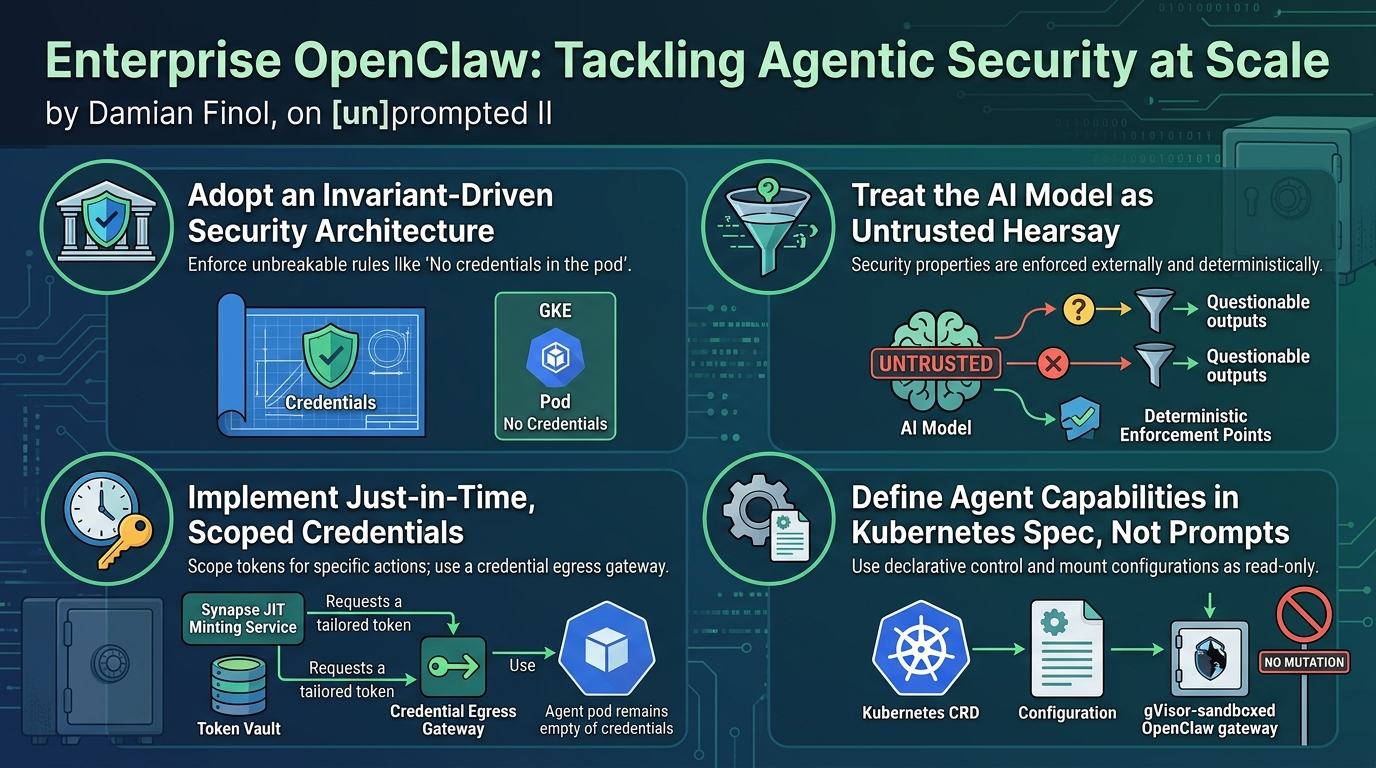
- Treat the AI Model as Untrusted Hearsay: The most fundamental shift in mindset is to never trust the model's internal state or its prompts for security decisions. All security properties must be enforced externally and deterministically, independent of the model's logic. This means prompt content should be validated by tools like Llama Guard, but never relied upon for authorization.
- Implement Security as Invariants with Deterministic Enforcement: Define clear, non-negotiable security invariants (e.g., "no credentials in the pod") and build architectural enforcement points that guarantee these invariants hold true, regardless of agent behavior. These enforcement points should be at critical control layers like Kubernetes, the service mesh, and custom security services.
- Adopt a Zero-Trust Credential Management Strategy:
- Never allow credentials in the agent's execution environment (pod).
- Mint credentials just-in-time and scope them down to the absolute minimum permissions required for a single, specific action. Services like Synapse and a token vault are crucial for this.
- Leverage credential egress gateways to inject tokens only at the point of external API interaction, keeping them isolated from the agent.
- Utilize Workload Identity Federation (or equivalent cloud provider features) to remove the need for API keys in pods for internal cloud service access.
- Harden Identity and Authorization with Cryptography:
- Establish strong, verifiable identities for every service and agent using cryptographic mechanisms like Spiffe IDs and mTLS across the entire service mesh (e.g., with Istio).
- Implement OIDC scope checks and signature validation at every hop to ensure that only authorized entities with appropriate permissions can access resources.
- Design an
act-asmodel that clearly delineates the requester, actor, and agent persona, and embed these identities in Kubernetes CRDs for declarative control and auditing.
- Strictly Control Agent Capabilities via Configuration, Not Prompts:
- Define what an agent can do (tools, models, behavior) in its explicit configuration (e.g., Kubernetes pod spec, CRDs), not implicitly through its prompt.
- Mount these configurations and tools as read-only within the agent's pod to prevent self-mutation and unauthorized tool access.
- Ensure that a Kubernetes operator actively reconciles the actual state with the desired state, immediately correcting any deviations.
- Implement Layered Security and Strong Isolation:
- Utilize sandboxing technologies like gVisor to provide an additional layer of isolation between the agent and the host kernel, limiting the impact of exploits.
- Enforce default deny network policies within the cluster and augment with Istio authorization policies to strictly control inter-service communication.
- Employ mTLS for all service-to-service communication to prevent eavesdropping and tampering.
- Establish Robust Auditing and Telemetry:
- Generate comprehensive, immutable audit logs for every agent action, including details on identity, requested action, and outcome.
- Ensure that a unique request ID allows for end-to-end tracing of agent activities across the entire system.
- Integrate these audit logs with SIEM/XDR solutions to enable real-time detection of anomalous or malicious agent behavior.
By adopting these defensive strategies, organizations can move beyond mere apprehension towards AI agents and build secure, scalable, and auditable agentic systems that deliver significant operational benefits without compromising enterprise security.
Key Takeaways
- Treat the Model as Untrusted Hearsay: Never rely on the AI model's prompt or internal state for security decisions. All security properties must be enforced externally and deterministically by the underlying infrastructure.
- Security as Invariants with Deterministic Enforcement: Define non-negotiable security invariants (e.g., no credentials in the pod) and build architectural controls at every critical layer (Kubernetes, service mesh, custom services) to guarantee their enforcement.
- Cryptographic Identity at Every Hop: Leverage strong, verifiable identities like Spiffe IDs and mTLS across your entire service mesh (e.g., with Istio) to ensure authenticated and authorized communication between all components.
- Just-In-Time, Scoped-Down Credential Minting: Never store credentials in agent pods. Instead, mint highly scoped, temporary tokens for each tool call, injecting them via a credential egress gateway and immediately revoking them after use.
- Define Agent Capabilities in Spec, Not Prompt: Explicitly declare an agent's allowed behaviors, accessible tools, and configurations in its Kubernetes CRD or pod spec, and mount these as read-only. Prevent agent self-mutation by design.
- Layered Security for Deep Defense: Combine multiple security layers, including gVisor sandboxing, default deny network policies, Istio authorization policies, and comprehensive auditing, to create a robust defense-in-depth architecture.
About the Speaker(s)
Damian Finol is the VP Engineering at Felix Pago, a role where he leads the development and deployment of advanced technological solutions, including the innovative agentic security architecture for OpenClaw. His presentation at [un]prompted II showcased his deep expertise in cloud infrastructure, particularly with Google Cloud, where he previously gained extensive experience that informs his current approach to scaling and securing complex systems. Finol is a proponent of embracing new technologies like AI agents, but only when coupled with a rigorous, invariant-driven security mindset, demonstrating a pragmatic and forward-thinking approach to engineering leadership.
Reviews
→ Top-rated talks at [un]prompted II 2026 — The AI Security Practitioner Conference
All talks from [un]prompted II 2026 — The AI Security Practitioner Conference