Same Threat, Two Verdicts: Shadow Testing Our SOC Agent
Tal Waitzenberg (Staff Research Scientist · Wiz (Google)), Erez Harush (Head of AI Research · Wiz (Google))
[un]prompted II 2026 — The AI Security Practitioner Conference · Day 3 · Stage 1
Overview
In an era where large language models (LLMs) are increasingly integrated into critical security operations, the reliability and consistency of these AI agents become paramount. This talk by Tal Waitzenberg and Erez Harush from Wiz delves into the practical challenges of deploying and maintaining an AI-powered Security Operations Center (SOC) agent that investigates over 10,000 alerts daily. The core problem addressed is how to rigorously measure the impact of changes to these agents and ensure their stability and accuracy in dynamic production environments.
Key moments
- 2:20 Same threat, opposite verdicts: the core challenge
- 5:30 Shadow agent: testing new models on real production data
- 10:00 Agent confidence is often misleading and unreliable
- 11:30 Splitting agents to isolate instability sources
- 15:30 Achieving stable investigation with structured recipes
- 19:00 Overall lesson: Stop guessing, start measuring your agent
- 20:00 Why build multiple dedicated sub-agents?
Same Threat, Two Verdicts: Shadow Testing Our SOC Agent
Speakers: Tal Waitzenberg (Staff Research Scientist, Wiz (Google)), Erez Harush (Head of AI Research, Wiz (Google))
Conference: [un]prompted II
YouTube: https://www.youtube.com/watch?v=rFG1KaaS2gg
Overview
In an era where large language models (LLMs) are increasingly integrated into critical security operations, the reliability and consistency of these AI agents become paramount. This talk by Tal Waitzenberg and Erez Harush from Wiz delves into the practical challenges of deploying and maintaining an AI-powered Security Operations Center (SOC) agent that investigates over 10,000 alerts daily. The core problem addressed is how to rigorously measure the impact of changes to these agents and ensure their stability and accuracy in dynamic production environments.
The speakers highlight that traditional benchmarking methods, while useful, are insufficient for evaluating the true performance and cost implications of AI agents operating at scale. They introduce a robust methodology centered around shadow testing and a deeper architectural understanding of AI agent behavior to combat issues like verdict instability and unreliable confidence scores. This talk is crucial for anyone building or deploying AI agents in high-stakes environments, offering concrete strategies to move beyond theoretical performance metrics to real-world operational excellence and trust.
Background
▶ Watch: Same threat, opposite verdicts: the core challenge (2:20)
The proliferation of AI and LLMs presents both immense opportunities and significant challenges for security teams. Wiz's SOC agent, designed to determine if a given threat is malicious or benign, operates under immense pressure, processing upwards of 10,000 alerts every day across diverse customer environments. While the agent's core task seems simple, its execution is complicated by the variety of contexts it encounters and the inherent complexities of LLM behavior.
The speakers frame the problem not just as achieving a high agent score on a benchmark, but as a continuous challenge of improvement: "How do you make your next version better than the previous one, and how do you measure it?" This question underpins several real-world scenarios they encountered. One was the pressure to adopt newer, more advanced LLMs, such as upgrading from Opus 5.5 to Gemini 4. This decision involved not only potential performance gains but also significant considerations around token consumption and pricing, critical aspects often overlooked in pure accuracy benchmarks.
A more concerning incident involved a real production scenario where the SOC agent initially marked an incident as malicious. However, less than 15 minutes later, after a new relevant event triggered a re-investigation, the same agent declared the incident non-malicious. This verdict instability – "same threats, same agent, and opposite verdict" – exposed a fundamental flaw. Despite constant changes to prompts, tools, skills, and underlying models, the team lacked a reliable method to measure the true impact of these modifications. This highlighted the need for a more sophisticated approach to evaluate agent performance, stability, and the true cost-benefit trade-offs in a live security context.
Key Findings
▶ Watch: Agent confidence is often misleading and unreliable (10:00)
The talk presents several critical findings that challenge conventional wisdom in AI agent development and deployment:
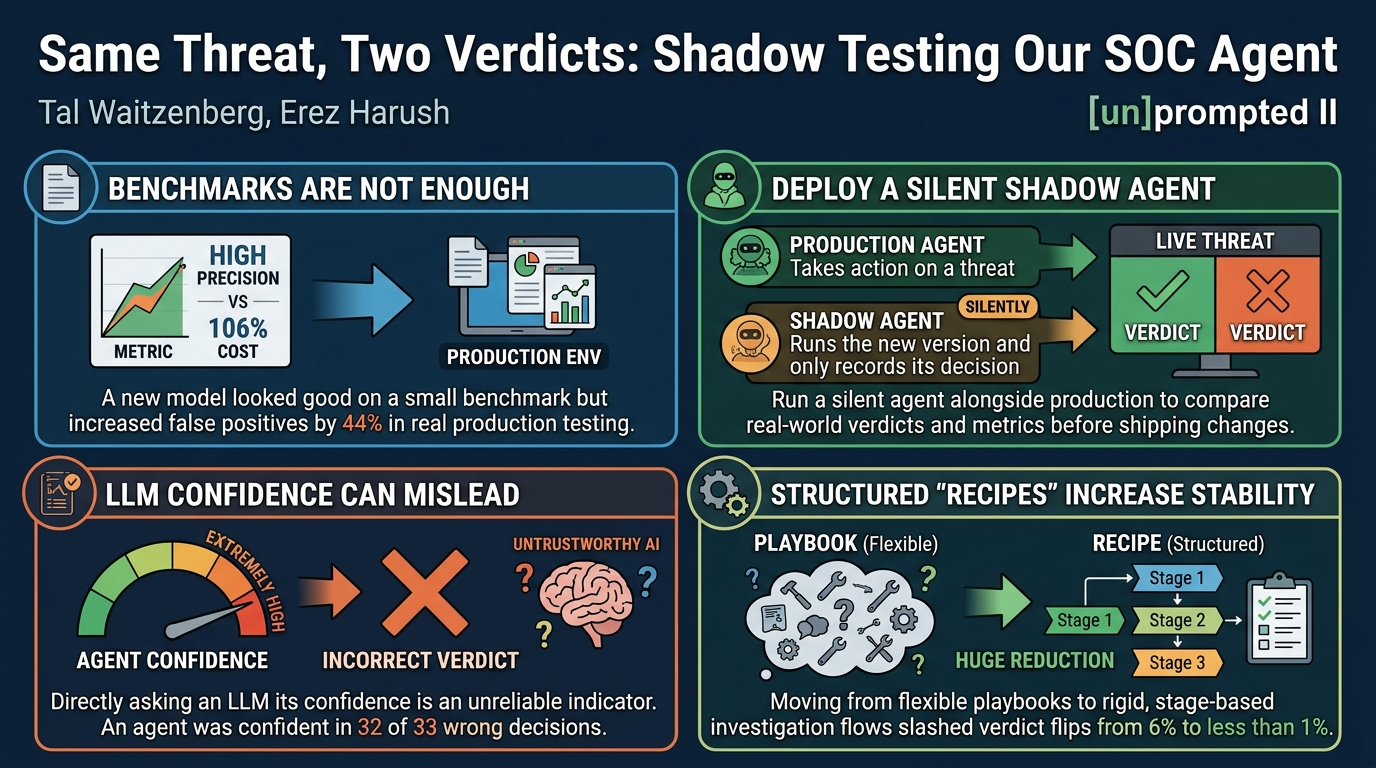
- Benchmarking is necessary but insufficient: While initial benchmarks might show promising results (e.g., a cheaper model appearing equally or more precise), they often fail to capture real-world performance degradation. In one experiment, a model that looked good on a 200-threat benchmark significantly increased false positives (44% more) and error rates (2% higher) when tested on 11,000+ live threats.
- Shadow testing is indispensable for production evaluation: Running a new agent version silently alongside the production agent on live data (shadow testing) is crucial. This approach allows for direct comparison of verdicts on identical threats, revealing discrepancies and real-world impacts on metrics like false positives, which are vital for security teams.
- AI agents can exhibit significant verdict instability: Initial observations revealed that an agent, without any changes, could produce conflicting verdicts on the same threat, with a 6% verdict flip rate observed in experiments. This instability can introduce noise into evaluation metrics, making it hard to discern genuine improvements from random variations.
- LLM confidence scores are unreliable: Directly asking an LLM about its confidence level proved to be a poor indicator of correctness. An agent might be "extremely confident" while being "extremely wrong," as demonstrated by an example where an agent was confident in 32 out of 33 incorrect verdicts.
- Architectural decomposition improves diagnosability: Splitting the monolithic agent into distinct investigation and verdict components allows for isolation of the source of instability. This modularity enables developers to pinpoint whether issues stem from evidence collection (investigation) or judgment (verdict).
- Structured "recipe-based" investigation significantly enhances stability: The primary source of instability was identified in the investigation phase, where the agent, using a flexible "playbook," chose different subsets of questions and tools each run. By moving to a more rigid, recipe-based approach that dictates specific stages and tools, the verdict instability was dramatically reduced from nearly 6% to less than 1%.
Technical Deep Dive
▶ Watch: Splitting agents to isolate instability sources (11:30)
The core technical challenge discussed is how to reliably evaluate and improve an AI-powered SOC agent that processes 10,000 daily alerts. The speakers meticulously detail their journey, highlighting the shortcomings of initial approaches and the evolution of their methodology.
Measuring Major Changes: From Benchmarks to Shadow Agents
The first challenge was evaluating a major change, specifically testing a cheaper LLM model. Their initial approach, like most teams, involved a benchmark. They compared their production baseline model against a new, experimental, cheaper model on a dataset of around 200 threats. The benchmark results were promising: the experimental model showed slightly better precision, similar false positive rates and recall, and was a compelling six times cheaper in cost. This seemingly positive outcome presented a dilemma: should they ship this change based on the benchmark?
Recognizing the limitations of benchmarks, especially for agents operating at scale in diverse production environments, they introduced the concept of a shadow agent. This is a silent agent that runs in parallel with the live production agent. When a real threat enters the system:
- The production agent performs a full investigation, makes a decision, and acts on it.
- The shadow agent also receives the live threat, performs an investigation using the new version being tested, and only records its decision without taking any action.
This setup allows for a direct, real-world comparison of two agent versions on the exact same live data. They ran a shadow agent for several days, processing approximately 11,000 threats. While the initial results showed a high 98% verdict agreement and similar true positive rates, a critical difference emerged: the shadow agent generated 44% more false alarms and its error rate increased by 2%. This significant rise in false positives, which directly translates to more manual work and wasted time for security teams, led them to reject the cheaper model despite its benchmark performance and cost benefits. This experiment underscored their first major lesson: benchmarking is a good starting point, but shadow testing on real production data is indispensable for truly understanding an agent's impact.
Addressing Verdict Instability
The shadow testing itself exposed another fundamental problem: verdict instability. The incident where the same threat received opposite verdicts from the same agent on the same day, without any changes to the agent, highlighted this issue. To quantify it, they conducted an experiment: running their production agent multiple times on the same set of threats. They discovered that in approximately 6% of the cases, the verdict would flip. This level of inconsistency is problematic not only for individual alerts but also for making evaluation metrics noisy, making it difficult to ascertain if observed improvements (e.g., 1% precision increase) were due to actual changes or random variation.
Their first attempt to address instability was to ask the LLM for its confidence level. The hypothesis was that high confidence might indicate reliability, while low confidence might signal a need for further investigation. However, this proved ineffective. They provided a stark example: a threat investigated 33 times, with the agent reporting high confidence in all runs. Yet, in 32 out of 33 instances, the agent was wrong. This demonstrated that being confident doesn't mean being correct, rendering LLM-generated confidence scores unreliable for security decisions.
Architectural Decomposition for Stability
To truly understand the source of instability, they re-architected their agent. The original architecture was a single, monolithic agent where an alert would lead to a full investigation and then a verdict. If the verdict flipped, it was impossible to tell if this was due to different evidence being gathered or different conclusions being drawn from the same evidence. The two were tangled together.
Their solution was to split the process into two distinct agents:
- The Investigation Agent: Responsible for collecting evidence and making findings.
- The Verdict Agent: Takes these findings and performs the final judgment (malicious or benign).
This modular design provided crucial diagnostic capabilities. If two runs of the overall system disagreed:
- If the findings differed, the instability was traced to the investigation path.
- If the findings were identical but the verdict differed, the instability was in the judgment part.
An experiment confirmed the stability of the Verdict Agent: when presented with the same set of findings, five different runs of the Verdict Agent consistently produced the exact same verdict. This strongly suggested that the primary source of noise was indeed the Investigation Agent. This split also offered a powerful simulation engine: once findings were collected, they could rapidly test changes to the Verdict Agent multiple times without incurring the cost and time of a full investigation from scratch.
Stabilizing the Investigation Agent
With the source of instability identified in the Investigation Agent, they focused on its behavior. The initial Investigation Agent used a playbook – a flexible list of 10-15 questions it could choose to answer (e.g., "How has this actor created this project before?", "Does this bucket contain sensitive data?"). The problem was that in different runs, the agent would choose different subsets of questions, leading to different answers and ultimately different findings, resulting in high investigation instability.
Their solution was to move from a flexible playbook to a structured recipe. A recipe is a more defined, stage-based approach that dictates exactly what the agent should do at each step, which tools it should use, and how to investigate a specific threat type. This involves taking away some of the agent's freedom to ensure consistency. Examples of recipe stages include:
- Checking specific detection artifacts (process, network, file activity).
- Analyzing specific behaviors and historical context for the machine or entity.
- Optional stages for collecting forensics (if EDR or sensors are available) and analyzing specific files.
This recipe-based approach significantly improved consistency. The result was a dramatic decrease in investigation instability from almost 6% to less than 1%. This allowed them to measure changes with much greater confidence.
Demo / Proof of Concept
▶ Watch: Overall lesson: Stop guessing, start measuring your agent (19:00)
The talk focused on presenting the methodology, experimental results, and architectural changes rather than a live demonstration of a tool or a specific proof-of-concept exploit. The "shadow agent" itself is a conceptual and architectural proof-of-concept for evaluation, implemented within their production environment to compare agent performance. The core "proof" lies in the data and the before-and-after metrics presented for instability reduction and false positive rates.
Defensive Implications
▶ Watch: Why build multiple dedicated sub-agents? (20:00)
The insights from this talk offer crucial guidance for security defenders and anyone deploying AI agents in critical environments:
- Adopt Shadow Testing for Production Readiness: Never deploy major AI agent changes directly to production based solely on internal benchmarks. Implement shadow testing to evaluate new versions against live, real-world data. This is the only way to uncover hidden performance degradations, such as increased false positives, that can overwhelm human analysts.
- Prioritize Agent Stability: Recognize that LLM-based agents can be inherently non-deterministic. Actively measure and work to reduce verdict instability. An agent that provides conflicting verdicts on the same input is unreliable and erodes trust.
- Do Not Trust LLM Confidence Scores: Disregard internal LLM confidence metrics as indicators of correctness. These scores are often misleading and provide a false sense of security. Instead, implement external validation mechanisms or "LLM as a judge" patterns where a separate prompt or model evaluates the primary agent's output.
- Modularize AI Agent Architectures: Break down monolithic agents into distinct, measurable components, such as separating the investigation (evidence collection) from the verdict (judgment). This architectural split is vital for diagnosing issues, isolating sources of instability, and enabling targeted fixes.
- Implement Structured Investigation Flows ("Recipes"): For critical security tasks, move away from free-form, "playbook"-driven investigation approaches. Instead, define explicit, stage-by-stage "recipes" that guide the agent through a consistent set of steps, tools, and data points. This significantly improves the reliability and consistency of findings.
- Measure Everything, Continuously: Shift from guessing what an agent does to rigorously measuring its behavior. This includes tracking verdict agreement, false positive rates, error rates, and the stability of individual agent components. Continuous measurement is the cornerstone of iterative improvement and building trustworthy AI security systems.
Key Takeaways
- Shadow testing is paramount for production agents: Benchmarks are a good start, but they are insufficient. Always conduct shadow testing on real production data before shipping major changes to understand the true impact on performance, cost, and operational overhead.
- Do not rely on LLM confidence: LLMs are excellent at generating text, including confident assertions, but their internal confidence scores do not correlate with correctness. Use external validation or "LLM as a judge" techniques instead.
- Control your agents through modularity: Break down large, complex agents into smaller, distinct components (e.g., investigation and verdict agents). This makes it easier to understand where problems occur and apply targeted fixes, much like splitting large functions in traditional coding.
- Measure and fix noise at each stage: Once agents are modularized, systematically measure the noise and instability within each component. This allows for precise identification and resolution of issues, leading to a more reliable overall system.
- Stop guessing, start measuring: The overarching lesson is to move away from assumptions about how AI agents perform. Implement robust measurement frameworks to continuously assess agent behavior in real-world scenarios, enabling data-driven improvements and building trust in automated security operations.
About the Speaker(s)
Tal Waitzenberg is a Staff Research Scientist at Wiz, which was acquired by Google. His work focuses on advancing the application of AI and machine learning in cloud security, particularly in developing and refining AI agents for critical security operations.
Erez Harush is the Head of AI Research at Wiz, which was acquired by Google. He leads the research initiatives that drive the integration of cutting-edge AI technologies into Wiz's security products, with a strong emphasis on practical, scalable, and reliable AI solutions for complex security challenges.
Reviews
→ Top-rated talks at [un]prompted II 2026 — The AI Security Practitioner Conference
All talks from [un]prompted II 2026 — The AI Security Practitioner Conference