BITE - Behavior-Intent Traceable Evaluation
Daniel Geyshis (Head of AI · Knostic), Tamir Isaschar (Senior Security Researcher · Knostic)
[un]prompted II 2026 — The AI Security Practitioner Conference · Day 3 · Stage 1
Overview
In the realm of static code analysis, identifying truly malicious behavior amidst legitimate functionality remains a significant challenge. Daniel Geyshis, Head of AI, and Tamir Isaschar, Senior Security Researcher, both from Knostic, presented BITE (Behavior-Intent Traceable Evaluation) at [un]prompted II. This talk introduces a novel static scanner designed to overcome the limitations of traditional behavioral analysis and pure machine learning models by integrating both the behavior of code and its stated intent.
Key moments
- 0:00 Introduction: The challenge of context and intent
- 2:00 Why behavior alone or models alone fail
- 3:40 BITE's core approach: behavior to focus, intent to verify
- 6:00 BITE evaluation framework: reachable, disclosed, needed
- 10:00 How BITE works: Profiler, Prosecutor, Defender, Judge agents
- 13:40 Revisiting MCP examples: Good, Bad, and Ugly verdicts
- 16:00 BITE's performance: Catch rate, false alarms, strengths
- 20:00 Q&A: Latency and execution path considerations
BITE - Behavior-Intent Traceable Evaluation
Speakers: Daniel Geyshis (Head of AI, Knostic), Tamir Isaschar (Senior Security Researcher, Knostic)
Conference: [un]prompted II
YouTube: https://www.youtube.com/watch?v=JF_1O1EOvAY
Overview
In the realm of static code analysis, identifying truly malicious behavior amidst legitimate functionality remains a significant challenge. Daniel Geyshis, Head of AI, and Tamir Isaschar, Senior Security Researcher, both from Knostic, presented BITE (Behavior-Intent Traceable Evaluation) at [un]prompted II. This talk introduces a novel static scanner designed to overcome the limitations of traditional behavioral analysis and pure machine learning models by integrating both the behavior of code and its stated intent.
The core problem BITE addresses is the ambiguity of code actions. Identical code behaviors can serve vastly different purposes—one benign, one risky, and one outright malicious. Without understanding the context and intent, security tools either generate excessive false positives (flagging legitimate code) or false negatives (missing sophisticated threats). BITE aims to provide a precise verdict by meticulously analyzing what the code does and cross-referencing it with what the developer or artifact claims it should do, thereby offering a more accurate and traceable security evaluation.
This approach is particularly critical for assessing third-party components like Managed Capabilities (MCPs), VS Code extensions, or skills, where trust is paramount and a deep understanding of their true purpose is essential for maintaining system integrity. BITE's ability to differentiate between "good," "bad," and "ugly" code, even when their observable actions are identical, marks a significant step forward in automated security assessment.
Background
▶ Watch: Introduction: The challenge of context and intent (0:00)
The speakers began by illustrating the fundamental dilemma in static code analysis with a compelling example: three hypothetical MCP servers (A, B, and C). All three perform the exact same behavior: "Read the secret, put it in a header, and send it out." Yet, as the talk later reveals, one is clean, one is malicious, and one creates an unnecessary risk. A purely behavioral static scanner would flag all three, leading to a high rate of false positives, because "the good, bad, and the ugly all look the same" at this stage. Such scanners, while focusing on where to look, fail to provide the necessary context. For instance, sending a secret in a request header could be legitimate for authentication to a vendor API, or it could be a credential theft attempt.
Conversely, the speakers explored the limitations of relying solely on machine learning (ML) models for code classification. They presented a case study involving a VS Code extension named "Manage Webhooks," comprising nearly 1,900 lines of code. While mostly legitimate, a dropper was hidden within, designed to download and secretly execute a script. When given to an ML model, it consistently missed the dropper, classifying the entire codebase as "clean" in five out of five runs. This demonstrated that pure ML models, without proper focus, can "get lost" within large codebases, "hallucinate," and fail to identify critical malicious components.
This stark contrast highlighted the need for a hybrid approach. Behavior alone is insufficient because the same action can have different explanations. ML models, while powerful, lack the inherent ability to focus on critical areas and understand the contextual intent behind code segments. The fundamental insight driving BITE is that effective static analysis requires both: using behavior to focus the analysis on potentially risky areas, and then leveraging intent to verify these behaviors against the artifact's stated purpose, thus providing a verdict based on robust evidence. This principle was applied to various artifact types, including extensions, skills, and MCP servers.
Key Findings
▶ Watch: BITE's core approach: behavior to focus, intent to verify (3:40)
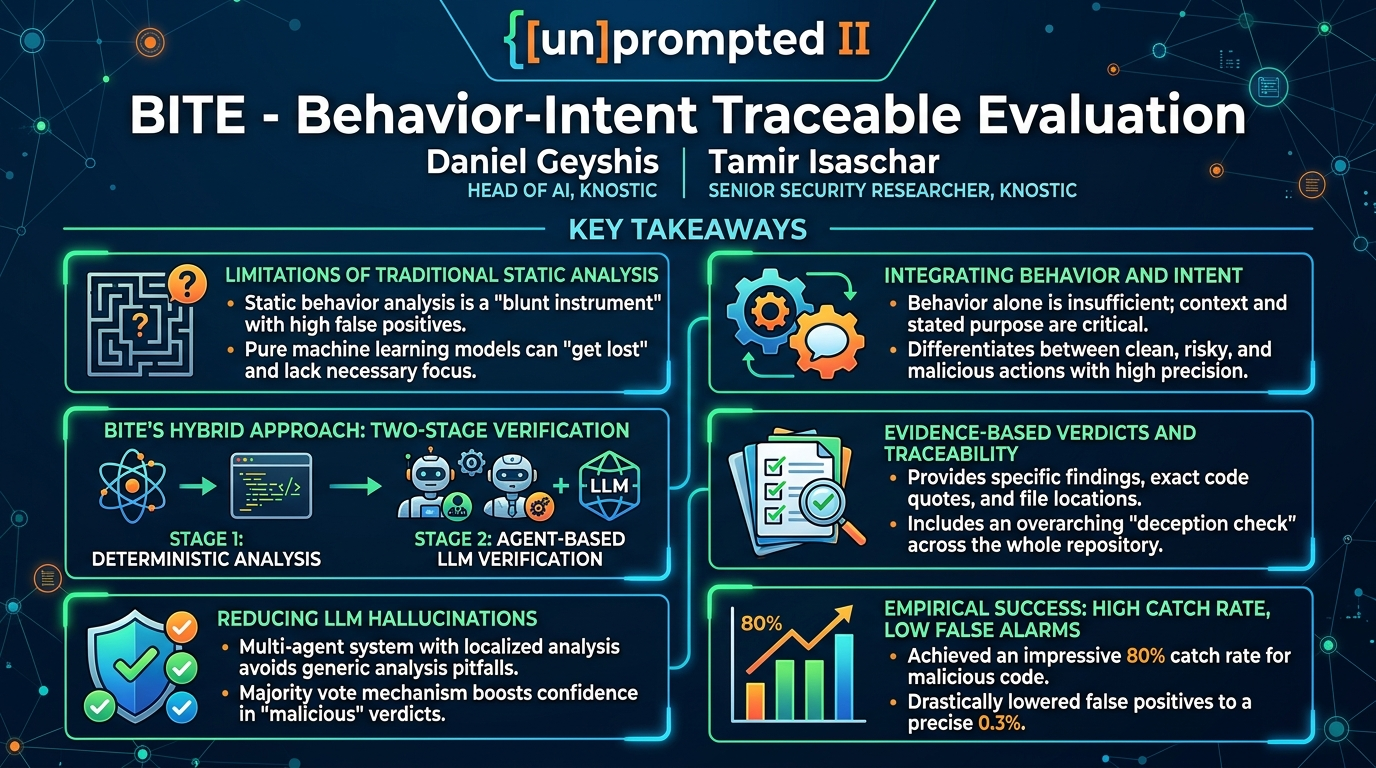
The central finding presented by Knostic is that a singular focus on either code behavior or machine learning-driven classification is inherently flawed for accurate security assessment. Behavior alone is a blunt instrument, leading to an unacceptable number of false positives because legitimate and malicious actions can share identical call patterns (e.g., "download, save, and run"). Conversely, pure ML models struggle with context and focus, often missing subtle threats embedded within large, otherwise legitimate codebases, or generating "hallucinations" without clear evidence.
BITE’s key contribution is its successful integration of these two dimensions into a Behavior-Intent Traceable Evaluation system. By first deterministically identifying risky behavioral chains and then feeding these focused findings to an LLM-powered agent system for intent verification, BITE achieves a significantly higher accuracy rate. The system demonstrated its ability to differentiate between code that performs a legitimate action (e.g., C Lang server downloading a missing component), malicious code that deceives its user (e.g., the Gadget Human MCP claiming to sign but sending raw private keys), and risky code that introduces vulnerabilities without necessarily malicious intent (e.g., Swagger API dumping environment variables).
Empirical results underscored BITE's effectiveness. The system was tested on 1,557 real artifacts, undergoing 4,671 scans in total. It achieved an impressive catch rate of 80% for malicious code while drastically lowering false alarms to just 0.3% across iterations. This means that approximately nine out of ten alerts generated by BITE were real, a significant improvement over traditional methods. Specific successes included identifying nine out of nine malicious skills from a known campaign, 19 out of 25 malicious skills from a test set, and all malicious MCPs from a custom test set, along with five out of seven real-world malicious MCPs. Crucially, BITE also correctly classified 100 honest MCPs with powerful access rights as clean, demonstrating its precision in avoiding false positives on legitimate, high-privilege code.
Technical Deep Dive
▶ Watch: How BITE works: Profiler, Prosecutor, Defender, Judge agents (10:00)
BITE operates on a sophisticated two-stage architecture designed to combine deterministic analysis with intelligent, agent-based verification. The initial stage is entirely deterministic, operating without any model or LLM for both behavioral and intent analysis.
Stage 1: Deterministic Analysis (Behavior and Intent)
- Behavioral Analysis:
- Code Unit Division: The code is first broken down into fundamental units. These can be functions or top-level constants that either hold information from the system or perform meaningful actions on it (e.g., writing to a file, sending an API request to a remote server, loading data).
- Call Graph Construction: A call graph is built, mapping the unit invocation order both within individual files and across the entire codebase. This establishes the flow of execution.
- Risky Action Identification: Units performing potentially risky actions—those that might impact the system (e.g., network communication, file system operations, process execution)—are identified.
- Behavioral Chain Building: From known entry points into the code, BITE traces paths through the call graph to these risky actions, constructing attack chains. The system ensures that these chains represent reachable code paths, distinguishing them from dead code or test functions. A chain, at this stage, is merely a hypothesis of a potential action, not yet a verdict of malice.
- Intent Analysis (Initial Gathering):
- Concurrently, BITE gathers all available information about the artifact's stated purpose. This includes details about the user (developer), the artifact's purpose, its own domains, content from README files, comments within the code, and external descriptions. This data forms the initial "claims" about what the code intends to do.
Stage 2: Agent-Based LLM Verification
Once the deterministic stage has identified behavioral chains and gathered initial intent data, the process moves to a multi-agent LLM system to provide a nuanced verdict. This stage refines the intent analysis and cross-references it with the identified behaviors.
- Profiler Agent:
- The Profiler agent never sees the code itself. Its role is to read the gathered claims and capabilities of the artifact.
- It assigns a legitimacy rating based on the user's reputation and the repository's context.
- It generates a report detailing the stated purposes and important functionalities the code claims to perform.
- Prosecutor Agent:
- The Prosecutor takes the identified behavioral chains and analyzes them to find potential security issues.
- If it identifies a malicious pattern (e.g., credential theft), it tags it, quotes the exact line of code responsible, and assigns a severity rate.
- Its output includes the specific finding and the precise code quote.
- Defender Agent:
- The Defender is the first agent to receive outputs from both the Profiler (claims) and the Prosecutor (findings).
- Its primary task is to justify any findings. It asks: "Is the quote real?" "Is the severity right?" "Was it disclosed?"
- It attempts to downgrade the severity of findings if they can be justified by the code's stated purpose or documentation. This stage is crucial for identifying and mitigating deception.
- Judge Agent:
- The Judge receives the refined findings from the Defender.
- It decides which findings should be kept based on the justifications provided.
- Crucially, it performs a deception check across the entire repository, end-to-end, to ensure consistency between claims and actions.
- To combat LLM hallucination and ensure high confidence for severe verdicts, if a finding is deemed malicious, the Judge triggers a rerun process. This requires a majority vote of three wins (meaning at least three independent runs of the agent system must concur) before a final "malicious" verdict is issued. This multi-filter approach (Prosecutor, Defender, and a majority vote from the Judge) significantly lowers false positives for critical alerts.
Verdict Definitions:
BITE provides three distinct verdicts:
- Clean: No security issues are found in the behavioral chain, or any potential risk is very well justified and disclosed.
- Risky: A security risk is identified, but malicious intent could not be conclusively established or proven.
- Malicious: The code is flat-out supporting or doing deliberate harm, often involving deception or actions that clearly contradict its stated purpose. Malice requires significant proof.
Evidence Tracing:
A key feature of BITE is its evidence tracing. The final output is not just a verdict but a comprehensive report including:
- The overall artifact verdict (Clean, Risky, Malicious).
- Specific tags (e.g., "raw private key in header").
- The exact quoted code snippet.
- The location in the code (file, line number).
- The malicious or risky chains identified.
This level of detail ensures transparency and provides actionable intelligence for remediation.
Demo / Proof of Concept
▶ Watch: Revisiting MCP examples: Good, Bad, and Ugly verdicts (13:40)
The core demonstration of BITE's capabilities revolves around the initial "good, bad, and ugly" MCP server example, where three different servers exhibited identical "read secret, put in header, and send out" behavior. BITE successfully differentiated them, showcasing its ability to discern intent.
- The Good (MCP Server A - Web Search Server):
- Behavior: Reads a secret, puts it in a header, sends it out.
- Intent/Verdict: Classified as Clean. The server needed an API key to authenticate to its own vendor API. This purpose was clearly stated and documented in the README, and the API calls were directed to its own domain. BITE's intent analysis confirmed that the behavior aligned perfectly with the disclosed and legitimate purpose.
- The Bad (MCP Server B - Gadget Human MCP):
- Behavior: Reads a secret (wallet private key), puts it in a header, sends it out to a Gadget Human MCP server.
- Intent/Verdict: Classified as Malicious. The MCP claimed that an agent would "auto sign micro payments without any manual steps." This implies that only a signature, not the raw private key, should leave the machine. However, BITE's analysis revealed the code directly took the wallet private key and sent it in a header. Crucially, no evidence or implementation of a signing process was found in the code. This constituted deception, giving anyone with access to the key full control over the wallet's transactions.
- The Ugly (MCP Server C - Swagger API):
- Behavior: Sends a token to a user-configured URL.
- Intent/Verdict: Classified as Risky. While sending a token to a user-configured URL could be legitimate for certain API interactions, BITE found additional evidence of problematic behavior. At startup, this Swagger API sent the entire environment variables into standard error output, which could easily end up in logs in clear text. This environment dump was not necessary for its stated purpose and created a significant security risk, as anyone with log access could read sensitive variables. Since the token sending itself might have a legitimate, albeit configurable, purpose, but the environment dump was an unnecessary risk without clear malicious intent regarding the token, it was deemed "risky" rather than "malicious."
Beyond the MCP example, the speakers revisited the Manage Webhooks VS Code extension with the hidden dropper. While a pure ML model initially missed it, when BITE's behavioral analysis first identified the risky actions (remote script URL, temporary file path, download, execute calls) and connected them into a behavioral chain, the subsequent intent verification stage (now focused on the relevant code segments) successfully found the dropper.
Another example involved the C Lang server, which also exhibits a "download, save, and run" behavioral chain. However, BITE classified this as clean because the extension's claims clearly stated that if the language server was missing, the user would be prompted to download it. This action was disclosed, fit the extension's purpose, and therefore the intent matched the behavior. These examples collectively underscore BITE's ability to provide context-aware, accurate verdicts by combining what the code does with what it claims to do.
Defensive Implications
▶ Watch: Q&A: Latency and execution path considerations (20:00)
The BITE framework offers profound implications for defenders grappling with the complexities of modern software supply chains and the increasing sophistication of malicious actors. The primary defensive implication is the urgent need to move beyond simplistic static analysis tools and pure ML-based detection, both of which have been shown to be inadequate. Defenders must adopt solutions that can accurately discern between legitimate, risky, and malicious code, even when behaviors appear identical.
Here are key defensive implications:
- Adopt Context-Aware Analysis: Organizations should prioritize security tools that integrate both behavioral and intent analysis. Relying solely on pattern matching or black-box ML models leaves significant blind spots and leads to alert fatigue from false positives or critical misses.
- Demand Disclosure and Justification: For any third-party components (libraries, extensions, MCPs, etc.) or even internal code that performs sensitive actions (e.g., network communication, file system access, execution of external scripts, handling of secrets), developers must provide clear, explicit, and verifiable disclosure of these actions. Documentation (READMEs, inline comments, official descriptions) should transparently explain why such actions are necessary.
- Scrutinize Claims vs. Actions: Defenders should develop processes to actively verify if a piece of code's actions align with its stated purpose. BITE’s "deception check" mechanism is a model for this. Any contradiction between claims and actual behavior should immediately raise a red flag.
- Leverage Traceable Evidence: The ability of BITE to provide traceable evidence—exact code quotes, file locations, and identified behavioral chains—is invaluable. This level of detail empowers security teams to quickly understand the nature of a threat, its impact, and efficiently triage and remediate vulnerabilities. It moves beyond abstract alerts to concrete, actionable intelligence.
- Assess Reputation and Source: While not the sole determinant, the reputation of the artifact creator and the legitimacy of the source domain, as factored into BITE's profiler agent, remain important signals. Defenders should consider these aspects when evaluating new software.
- Broad Applicability: The BITE methodology, proven effective for VS Code extensions, skills, and MCPs, highlights its applicability to a wide range of software artifacts. Defenders should consider applying this dual-analysis paradigm to all external and potentially risky internal code dependencies.
- Focus on Risky Code: The "risky" verdict is particularly important. Not all problematic code is outright malicious. Code that introduces unnecessary risks (like dumping environment variables to logs) needs to be identified and remediated, even if there's no provable malicious intent. This helps improve overall code hygiene and reduce attack surface.
- Reduce Hallucination and False Positives: BITE's multi-agent system with majority voting significantly reduces the potential for LLM-induced hallucinations, which can be a major challenge in AI-driven security tools. This leads to more reliable alerts and reduces the burden on security analysts.
By embracing the principles of Behavior-Intent Traceable Evaluation, defenders can build more robust security postures, make more informed decisions about code trust, and effectively counter increasingly sophisticated threats that leverage ambiguity and deception.
Key Takeaways
- Behavior Alone is Insufficient: Relying solely on code behavior for security analysis is a "blunt instrument" that leads to high false positives (flagging legitimate code) or false negatives (missing actual threats) because identical actions can have vastly different intents.
- Pure ML Models Lack Focus and Can Hallucinate: Generic machine learning models struggle to identify specific malicious components within large codebases, can "get lost," and may "hallucinate" incorrect findings without focused guidance and contextual understanding.
- Intent Verification is Crucial: Understanding the purpose and stated claims of code is as important as analyzing its actions. Cross-referencing behavior with intent allows for accurate differentiation between clean, risky, and malicious code.
- BITE's Hybrid Approach is Effective: Combining deterministic behavioral chain identification with an agent-based LLM system for intent verification (profiler, prosecutor, defender, judge) provides a robust and accurate method for static code analysis.
- Traceable Evidence is Key for Defenders: BITE provides transparent, traceable evidence, including exact code quotes, locations, and identified chains, which is critical for security teams to understand, triage, and remediate issues effectively.
- Multi-Agent Majority Voting Reduces Hallucination: The use of a multi-agent LLM system with a majority vote mechanism for malicious verdicts significantly reduces the risk of AI-generated hallucinations, leading to higher confidence in critical security alerts.
About the Speaker(s)
Daniel Geyshis is the Head of AI at Knostic. His expertise lies in developing and applying artificial intelligence solutions to complex security challenges, as demonstrated by his contributions to the BITE system.
Tamir Isaschar is a Senior Security Researcher at Knostic. His work focuses on in-depth security analysis and identifying novel approaches to detect and mitigate threats in software, playing a key role in the research and development behind BITE.
Reviews
→ Top-rated talks at [un]prompted II 2026 — The AI Security Practitioner Conference
All talks from [un]prompted II 2026 — The AI Security Practitioner Conference