Threat Model Impossible: 1 Agent. 30 Days. 687 Security Reviews. And a Refrigerator.
Farzan Karimi (Deputy CISO · Moderna)
[un]prompted II 2026 — The AI Security Practitioner Conference · Day 3 · Stage 1
Overview
In an era where digital transformation accelerates, traditional security practices often struggle to keep pace. Farzan Karimi, Deputy CISO at Moderna, took the stage at [un]prompted II to unveil a groundbreaking solution to one of cybersecurity's most persistent bottlenecks: the manual threat model. His talk, "Threat Model Impossible: 1 Agent. 30 Days. 687 Security Reviews. And a Refrigerator," detailed Moderna's ambitious project to automate tier-one security reviews across their entire enterprise ecosystem using a custom-built, Large Language Model (LLM)-powered agent. This initiative was not merely an academic exercise but a critical operational necessity, driven by the challenge of securing a vast and diverse environment, including vital Operational Technology (OT) such as refrigerators storing life-saving mRNA medicines.
Key moments
- 1:30 Scaling threat modeling: 687 reviews including a refrigerator
- 3:45 Live demo: Automated threat modeling a refrigerator
- 6:50 Designing the 50-question system owner survey for context
- 10:20 Analyzing agent error rates and valid bug findings
- 15:55 V2 agent generates interactive threat model diagrams and attack chains
- 18:05 Overcoming pushback for mandatory security surveys (Q&A)
- 23:05 Incorporating compensating controls into the threat model (Q&A)
Threat Model Impossible: 1 Agent. 30 Days. 687 Security Reviews. And a Refrigerator.
Speakers: Farzan Karimi, Deputy CISO, Moderna
Conference: [un]prompted II
YouTube: https://www.youtube.com/watch?v=61hH4y8aABE
Overview
In an era where digital transformation accelerates, traditional security practices often struggle to keep pace. Farzan Karimi, Deputy CISO at Moderna, took the stage at [un]prompted II to unveil a groundbreaking solution to one of cybersecurity's most persistent bottlenecks: the manual threat model. His talk, "Threat Model Impossible: 1 Agent. 30 Days. 687 Security Reviews. And a Refrigerator," detailed Moderna's ambitious project to automate tier-one security reviews across their entire enterprise ecosystem using a custom-built, Large Language Model (LLM)-powered agent. This initiative was not merely an academic exercise but a critical operational necessity, driven by the challenge of securing a vast and diverse environment, including vital Operational Technology (OT) such as refrigerators storing life-saving mRNA medicines.
Karimi, leveraging his extensive background in offensive security with experience at Google Android, EA, and the Windows red team, described how his security engineering team was tasked with an seemingly impossible mission: to conduct threat models for every application within Moderna in a single month. The talk revealed how this challenge, typically requiring days or even weeks of manual effort per application, was conquered by a sophisticated automation agent. The result was a staggering 687 security reviews completed in 30 days, shrinking two to three business days of work down to just 15 minutes of agent time per application, ultimately saving an estimated 14,000 hours annually. This presentation offers a compelling blueprint for how organizations can harness AI to revolutionize their security posture, moving from a reactive to a proactive and continuously secure development lifecycle.
Background
▶ Watch: Scaling threat modeling: 687 reviews including a refrigerator (1:30)
The foundational challenge addressed by Karimi's talk is the inherent scalability problem of traditional threat modeling. In many enterprises, security reviews are a manual, time-intensive process. Security engineers often spend days, sometimes weeks, analyzing complex applications, often struggling with a lack of critical artifacts like Data Flow Diagrams (DFDs) or architecture diagrams from system owners. This manual bottleneck becomes insurmountable in large, rapidly expanding organizations like Moderna, an mRNA company focused on curing cancer, which possesses a vast and diverse application landscape. The sheer volume of applications, coupled with the critical nature of their work—ranging from custom code to specialized OT devices like refrigerators holding patient-specific vials—demanded a radical departure from conventional methods.
Moderna faced the unique predicament of needing to conduct security reviews for every application, irrespective of its perceived complexity or traditional risk profile. This included devices like Appendorf Visionize refrigerators, which, while seemingly innocuous, played a critical role in their operations. These devices fell into their standard intake process, necessitating a formal threat model. The sheer volume (over 700 applications in a month) and the diversity of assets, many managed by system owners with limited security expertise, underscored the urgent need for an automated, scalable solution. The problem wasn't just about efficiency; it was about establishing a consistent security baseline across an entire enterprise where the stakes for failure were exceptionally high.
Key Findings
▶ Watch: Designing the 50-question system owner survey for context (6:50)
The implementation of Moderna's LLM-powered threat modeling agent yielded several transformative findings, fundamentally reshaping their approach to security reviews:
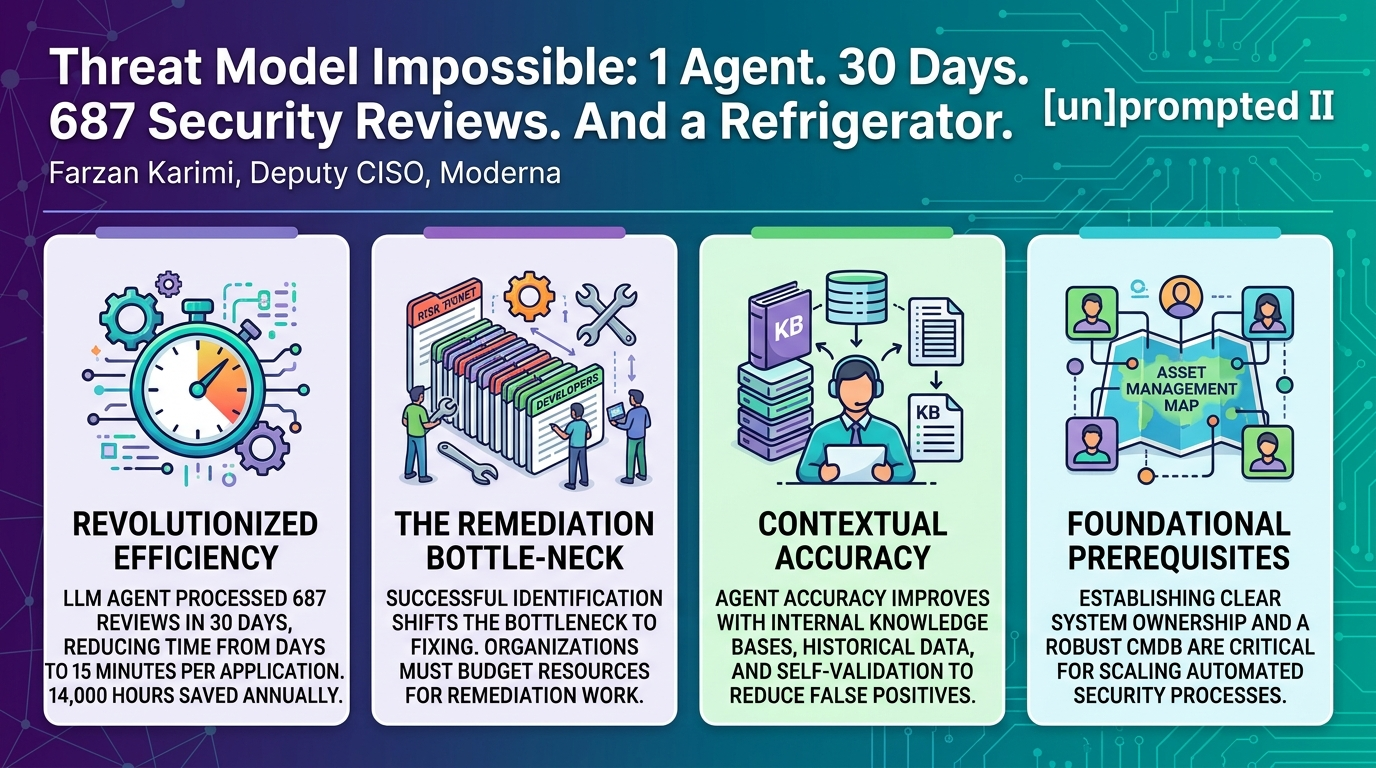
- Unprecedented Scale and Efficiency: The agent successfully executed 687 security reviews within 30 days. This dramatically reduced the time per review from an average of two to three business days for a human analyst to approximately 15 minutes of agent time. This efficiency translated into an estimated saving of 14,000 hours annually, equivalent to 6.5 to 7 Full-Time Employees (FTEs) dedicated solely to tier-one security reviews.
- Shifted Bottleneck: The primary bottleneck in Moderna's security pipeline shifted from "finding" vulnerabilities (i.e., conducting reviews) to "fixing" them (i.e., remediation and quality control). While a "good problem to have," this highlights the need for organizations to proactively budget and plan for increased remediation efforts.
- High Volume of Findings: The agent generated approximately 2,800 risk tickets during the exercise. Of these, 66% (1,870 tickets) were validated as legitimate bugs. Notably, 43% (1,200 tickets) were immediately actionable, high-quality findings. The remaining valid tickets were either canceled due to changes in requirements post-run (e.g., re-evaluating the necessity of an IR kill switch for all applications) or identified as duplicates of previously discovered issues.
- Manageable Agent Error Rate: While 16.8% of the generated tickets were attributed to agent error (hallucinations, mistakes, or assumptions due to insufficient data), this rate was considered highly acceptable given the scale of automation. The remaining invalid tickets were primarily due to inaccurate or "garbage in" data provided by system owners in the initial survey.
- Foundational Requirements for Scale: The project underscored the critical importance of establishing clear system ownership and a robust Configuration Management Database (CMDB). Moderna identified 1,200 system owners as a result of this work, which proved indispensable for accountability and incident response.
- Versatility Across Asset Types: The agent demonstrated its ability to effectively threat model diverse assets, from standard applications to critical OT devices like refrigerators, identifying relevant risks (e.g., hard-coded credentials, exposed HTTP) even in unexpected contexts.
Technical Deep Dive
▶ Watch: Analyzing agent error rates and valid bug findings (10:20)
Moderna's automated threat modeling solution is a testament to pragmatic, enterprise-scale AI implementation, not merely an LLM experiment. It comprises a sophisticated pipeline and an evolving agent architecture designed for efficiency and accuracy.
Agent Architecture (V1)
The initial version of the agent was built using Copilot Studio, leveraging Claude Opus 4.8 as its backend LLM. The core workflow involved:
- System Owner Survey: A crucial input mechanism, this was a 50-question survey designed to gather structured information from system owners. Unlike traditional methods requiring DFDs or architecture diagrams, this survey focused on practical security-relevant questions (e.g., custom code, secret storage, internet-facing interfaces, IR considerations like kill switch capabilities). This streamlined data collection, especially for non-technical OT owners.
- Artifact Ingestion: The agent ingested all provided artifacts, including vendor documentation (fact sheets, brochures, technical specifications) for commercial off-the-shelf (COTS) products like the Appendorf refrigerator. These documents often contained critical security-relevant details like exposed ports, protocols, and cloud connectivity methods.
- Internal Knowledge Base Integration: A key differentiator, the agent was fed Moderna's internal Knowledge Bases (KBs) and security policies. This allowed the LLM to evaluate ingested data against specific organizational requirements and standards, ensuring findings were relevant to Moderna's unique risk posture.
- Threat Model Agent Instructions: The agent operated under a detailed set of instructions, acting as a "pragmatic senior reviewer." Key directives included:
- Focus on "fewer, higher quality findings."
- Evaluate Role-Based Access Control (RBAC) enforcement.
- Assess Single Sign-On (SSO) implementation.
- A critical instruction: "Standard existence is not evidence of implementation," meaning the agent must validate compliance rather than assume it based on policy documentation alone.
- Employ adversarial reasoning in a multi-phase review process, where the agent actively challenges its own proposed bugs by cross-referencing documents, thereby reducing false positives.
- Output Generation: The agent produced standardized risk tickets in a JSON contract format. This structured output facilitated seamless integration with downstream systems.
- Jira Integration: Initially, Power Automate was used to normalize and integrate these bugs into Moderna's Jira instance. Karimi noted that modern LLM platforms now offer "skills" for easier OAuth integration with case management systems, simplifying this step.
Enterprise Review Pipeline
The end-to-end process for scaling threat modeling involved six key steps:
- Establish System Owners: A foundational step, requiring a robust CMDB to assign ownership to all assets.
- Owner Survey: The 50-question survey, made mandatory with executive sponsorship, ensured consistent data input.
- Threat Agent Run: The automated processing of survey data and artifacts against internal KBs.
- Cut Bugs: Generation of risk tickets in a standardized format.
- Jira Integration: Populating the case management system with identified risks.
- Human Quality Control (QC) & Remediation: Essential human oversight to validate findings, address false positives, and manage the remediation lifecycle.
V2 Enhancements (Lysis)
Moderna's ongoing iteration led to Threat Model Agent V2, codenamed Lysis, incorporating significant improvements:
- Control Plane Hooks: Automated, on-demand threat model runs triggered when applications are published to an internal workbench or control plane, providing a "snapshot in time" security assessment before go-live.
- Code Hooks: Integration into development workflows (e.g., Codex, cloud environments) to scan code and artifacts for risks prior to production deployment.
- Richer Context: Lysis gains access to:
- Previous risk tickets: Historical data to inform new assessments.
- Conversations: Context from internal communication platforms like Slack or Teams.
- Real-time KBs and Source Code: Dynamic access to the latest internal policies and application source code for more accurate analysis.
- Interactive Threat Model Diagram Generator: A highly anticipated feature, Lysis can now generate interactive DFDs, complete with entities, trusted zones, and findings, allowing for collaborative discussions with development teams.
- Model Agnostic Design: While V1 used Claude Opus 4.8, Moderna aims for a model-agnostic approach, exploring new "frontier models" like Daybreak for enhanced cyber-specific threat modeling capabilities.
Demo / Proof of Concept
▶ Watch: Overcoming pushback for mandatory security surveys (Q&A) (18:05)
Farzan Karimi provided a compelling live demonstration of the threat model agent, showcasing its capabilities by analyzing an Appendorf Visionize refrigerator – a real-world asset within Moderna's critical infrastructure.
The demo began by illustrating the system owner's input process. For the refrigerator, this involved gathering various vendor documents: fact sheets, brochures, and technical specifications. Karimi highlighted that these seemingly innocuous documents often contain crucial technical details, such as exposed protocols, ports, and cloud connectivity methods, which are vital for a security assessment.
Next, the threat model agent was invoked with a simple prompt: "threat model this Appendorf Visionize refrigerator," followed by dumping all collected artifacts into its interface. The demonstration, time-lapsed for brevity, showed the agent rapidly processing these documents against Moderna's internal KBs and security policies. In a matter of minutes, the agent began generating standardized risk tickets and ultimately produced a conditional approval/go-live decision.
Karimi then delved into specific findings from the refrigerator's threat model:
- The vendor documentation explicitly mentioned a hard-coded default password.
- The refrigerator was configured to expose HTTP by default.
These two seemingly minor findings, when combined, revealed a critical attack chain: an attacker could potentially sniff the hard-coded administrator credentials transmitted over clear-text HTTP, then use these credentials to tamper with the refrigerator's temperature settings. For Moderna, where these refrigerators store sensitive patient medicines and vials, such an attack could have severe consequences, impacting patient safety and treatment efficacy. Karimi starkly contrasted this with a common consumer scenario: "For you, it might just mean spoiled milk, right? But like for for us, that's a pretty big deal."
The demonstration then transitioned to the V2 capabilities with a preview of Lysis, the updated threat model agent. This V2 demo highlighted the generation of a findings.json file and, most impressively, an interactive threat model diagram. This diagram visually represented the refrigerator's entities, trusted networks, and security zones, overlaid with the identified findings. Crucially, the diagram allowed for the visualization of attack chains, illustrating how multiple individual vulnerabilities (like the hard-coded password and HTTP exposure) could be chained together to achieve a high-impact outcome. The interactive nature of the diagram also allowed users to open and close bugs, facilitating live discussions and tracking resolution progress with development teams. This feature transforms a static report into a dynamic, collaborative artifact, making threat modeling more accessible and actionable for all stakeholders.
Defensive Implications
▶ Watch: Incorporating compensating controls into the threat model (Q&A) (23:05)
Moderna's pioneering work in automated threat modeling provides several critical defensive implications for organizations grappling with scaling their security efforts:
- Embrace Automated First-Tier Reviews: Organizations should strategically implement LLM-powered agents to conduct initial, high-volume threat models. This frees up human security engineers from repetitive, tier-one analysis, allowing them to focus on higher-value tasks such as complex deep dives, quality control, and strategic remediation planning.
- Prioritize CMDB and System Ownership: A robust Configuration Management Database (CMDB) and clear system ownership are non-negotiable foundations for any scalable security program. Without knowing what assets you have and who is responsible for them, automation efforts will falter. Executive sponsorship is crucial to enforce this across the enterprise.
- Standardize Data Collection with Structured Surveys: Move beyond reliance on developers to produce complex DFDs. Implement structured, security-focused questionnaires (like Moderna's 50-question survey) to gather consistent, machine-readable data from system owners. This democratizes the input process and provides rich context for LLMs.
- Anticipate and Budget for Remediation Bottlenecks: Successfully automating vulnerability identification will inevitably shift the bottleneck to remediation. Organizations must proactively plan and budget for the increased workload on development teams and security engineers assisting with fixes. This includes potentially hiring more staff or reallocating existing resources.
- Integrate Continuous Threat Modeling into SDLC: Extend threat modeling beyond a one-off event. Implement hooks into CI/CD pipelines or control planes to trigger automated threat models on code commits, application publishes, or infrastructure changes. This provides continuous security feedback and shifts left the identification of risks.
- Enhance Agent Context and Adversarial Reasoning: To improve accuracy and reduce false positives, agents should be designed to leverage rich contextual data, including historical risk tickets, internal communications (Slack/Teams), real-time KBs, and source code. Incorporating adversarial reasoning within the agent's logic (where it challenges its own findings) is vital for higher-quality output.
- Focus on Attack Chains, Not Just Individual Bugs: Leverage the agent's ability to identify and visualize attack chains. Prioritize remediation efforts based on these chains, as they represent the most critical pathways for attackers to achieve high-impact outcomes. This provides a more strategic approach to risk reduction.
- Maintain Human-in-the-Loop for Quality Control and Adaptation: While automation is powerful, human oversight remains critical. Security engineers must perform Quality Control (QC) on agent-generated findings, validate their accuracy, and adapt the agent's instructions and context based on evolving threats and organizational requirements. This partnership ensures both scale and quality.
- Contribute to and Leverage Open Source: Moderna's decision to open-source components of their V2 agent (the survey, agent core, and diagram generator) encourages community collaboration. Defenders should explore and contribute to such initiatives to collectively advance the state of automated security tools.
Key Takeaways
- LLM agents revolutionize threat modeling: Moderna's agent processed 687 security reviews in 30 days, saving approximately 14,000 hours annually by reducing review time from days to 15 minutes per application.
- Executive sponsorship is paramount: Successful enterprise-wide adoption of new security processes, like mandatory system owner surveys and CMDB population, hinges on strong leadership buy-in.
- The bottleneck shifts from finding to fixing: Organizations must be prepared to budget and allocate resources for increased remediation efforts once vulnerability identification is significantly accelerated.
- Rich context and adversarial reasoning improve accuracy: Feeding agents internal KBs, historical data, and enabling them to self-validate findings drastically reduces false positives and enhances the quality of risk tickets.
- Automated diagram and attack chain generation are game-changers: Visualizing threat models and attack paths (e.g., hard-coded creds + HTTP leading to temperature tampering in a refrigerator) makes security risks more understandable and actionable for development teams.
- Scalable security requires foundational elements: Establishing clear system ownership and a comprehensive CMDB are critical prerequisites for effectively implementing and scaling automated security solutions across diverse assets, including OT/IoT.
About the Speaker(s)
Farzan Karimi is the Deputy CISO at Moderna, where he has been for three years. At Moderna, an mRNA company focused on pioneering advancements like curing cancer, Karimi manages the Incident Response (IR), Red Team, and Security Engineering teams. His professional history is deeply rooted in offensive security, having previously built offensive security organizations at major technology and entertainment companies such, as Google Android and Electronic Arts (EA). Prior to these roles, he was also a part of the esteemed Windows red team. Karimi's expertise bridges the gap between understanding attacker methodologies and building robust, scalable defensive strategies, as demonstrated by Moderna's innovative approach to automated threat modeling.
Reviews
→ Top-rated talks at [un]prompted II 2026 — The AI Security Practitioner Conference
All talks from [un]prompted II 2026 — The AI Security Practitioner Conference