The Dirty Laundry of the Web PKI
Emily Stark (Team Lead · Google)
USENIX Enigma Conference 2023 · Day 1 · Grand Ballroom
Overview
In her compelling USENIX Enigma talk, "The Dirty Laundry of the Web PKI," Emily Stark, a Team Lead on the Chrome security team at Google, dissects the foundational system underpinning all secure web connections: the Public Key Infrastructure (PKI). This intricate network of trust, which enables web browsers to establish encrypted and authenticated connections to websites, is critical for modern society. As Stark eloquently puts it, compromising this system allows for widespread impersonation, surveillance, data tampering, and even the infiltration of critical infrastructure. Despite its paramount importance, Stark paints a stark picture of the web PKI as "Legacy, overcomplicated, rickety, ancient, and dumpster fire," rather than the sophisticated, streamlined, and secure system one might hope for.
Key moments
- 0:00 Web PKI: a critical but 'dumpster fire' system
- 2:00 Understanding Web PKI and its fundamental shortcomings
- 7:30 ACME: Automating certificate issuance for greater agility
- 12:00 Certificate Transparency: Enhancing security with public logs
- 16:00 Revocation: A messy, complex, and ineffective solution
- 20:00 Future: Agility, security, and simplicity through automation
The Dirty Laundry of the Web PKI
Speakers: Emily Stark, Team Lead, Google
Conference: USENIX Enigma
YouTube: https://www.youtube.com/watch?v=rFE3ptYRfvY
Overview
In her compelling USENIX Enigma talk, "The Dirty Laundry of the Web PKI," Emily Stark, a Team Lead on the Chrome security team at Google, dissects the foundational system underpinning all secure web connections: the Public Key Infrastructure (PKI). This intricate network of trust, which enables web browsers to establish encrypted and authenticated connections to websites, is critical for modern society. As Stark eloquently puts it, compromising this system allows for widespread impersonation, surveillance, data tampering, and even the infiltration of critical infrastructure. Despite its paramount importance, Stark paints a stark picture of the web PKI as "Legacy, overcomplicated, rickety, ancient, and dumpster fire," rather than the sophisticated, streamlined, and secure system one might hope for.
The talk systematically exposes the web PKI's inherent flaws, categorizing them into three core areas: its glacially slow evolution, significant security shortcomings, and the burden of overcomplicated legacy baggage. Stark's objective is not merely to highlight these deficiencies but to outline a roadmap for pulling the system into the present and future. By focusing on increasing agility, rectifying security vulnerabilities, and simplifying its convoluted architecture, the presentation offers a critical perspective on how to transform the web PKI into a more robust, reliable, and secure foundation for the ubiquitously encrypted web we rely on today.
Background
▶ Watch: Web PKI: a critical but 'dumpster fire' system (0:00)
The concept of the web PKI, while perhaps not universally known by its technical moniker, is intrinsically linked to the familiar HTTPS certificate. When a website owner, for instance, for example.com, wishes to enable secure connections, they obtain a certificate from a trusted Certification Authority (CA). This certificate serves as cryptographic proof that the website owner indeed controls the legitimate example.com. Upon a client (such as a web browser) attempting to establish an HTTPS connection, the website presents its certificate. The client then endeavors to validate this certificate by tracing a chain of trust from the presented certificate back to a root certificate residing in its local trust store (or root store). This trust store is governed by a trust store program (or root program), a set of policies and procedures dictating which CAs are considered trustworthy. If a valid chain can be constructed, the certificate is accepted; otherwise, it is rejected. This entire ecosystem of trusted CAs, issuing certificates directly or indirectly to websites, constitutes the web PKI.
The origins of the web PKI trace back to an era when encryption on the internet was a rarity, primarily reserved for high-value, well-resourced websites. It was designed for a niche rather than the norm. However, the digital landscape has transformed dramatically. Today, encryption is ubiquitous, with virtually all web traffic expected to be encrypted. This exponential growth in HTTPS adoption, while a significant positive development for internet security, has exposed the fundamental architectural limitations of the legacy web PKI. The system, once an edge case solution, now needs to be robust, reliable, and usable enough to underpin the entire global web. This critical shift in scale and expectation necessitates a radical re-evaluation and modernization of the web PKI, a challenge Emily Stark thoroughly explores.
Key Findings
▶ Watch: ACME: Automating certificate issuance for greater agility (7:30)
Emily Stark's talk uncovers several critical deficiencies within the web PKI, broadly categorized into issues of agility, security, and complexity. These findings collectively paint a picture of a system struggling to meet the demands of the modern, ubiquitously encrypted web.
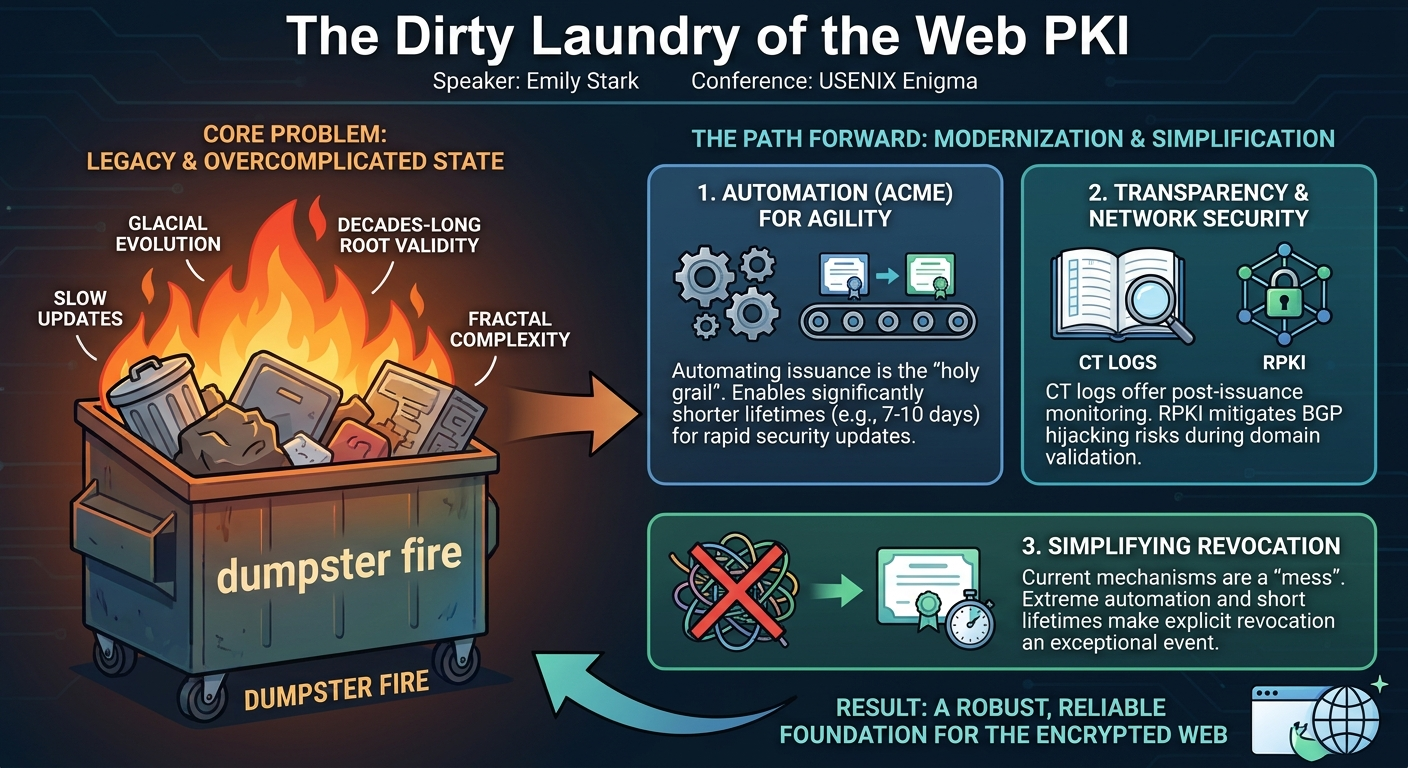
First, the web PKI suffers from glacial evolution. Root CA certificates, the ultimate anchors of trust, have historically been issued with validity periods spanning decades, with some client implementations not even enforcing expiration. Compounding this, many clients have had slow, unreliable, or entirely non-existent update channels for their trust stores. The combined effect is that once a root certificate is deployed, its removal or replacement can take years, as older devices slowly cycle out of the market. While modern clients are improving with dynamic update channels and root programs are introducing term limits (e.g., 5-10 years) for root CA certificates, the system's inherent inertia remains a significant challenge. Server certificates also contribute to this slowness; despite heroic cross-industry efforts to reduce their maximum lifetime, they are still capped at 13 months. This relatively long duration often means certificate replacement remains a manual, reactive process, rather than a proactive, automated one. Stark highlights the absurdity that, technically, a CA can still validate a domain for certificate issuance via snail mail, underscoring how far removed the system is from the agility required today.
Second, the web PKI is plagued by security shortcomings. The sheer scale of trust is alarming: clients typically trust dozens, if not hundreds, of organizations to issue certificates. A compromise of just one of these CAs could allow an attacker to impersonate any website. The process by which these CAs are deemed trustworthy, primarily through audits, is deeply flawed. CA audits are often conducted by financial auditing firms, not specialized security shops, and are chosen by the CAs themselves, potentially leading to a conflict of interest. The output is frequently boilerplate, lacking detailed findings, and major security flaws have been uncovered in CA operations that audits completely missed. This makes comprehensive pre-assessment of trustworthiness nearly impossible. Furthermore, the fundamental process of domain validation by CAs is susceptible to network-level attacks. When a CA validates control of a domain by requesting a challenge value from it, this process is circular: the CA is authenticating a domain by making a request to it, but the CA is also responsible for authenticating requests to that domain. Attackers can exploit this by manipulating DNS responses or using BGP hijacking to reroute traffic, pointing the CA to their malicious servers. Stark describes this as a "delegated Trust on First Use model," highlighting its inherent weakness.
Finally, the web PKI is burdened by overcomplicated legacy baggage, leading to "fractal complexity." The x.509 certificate format itself is a frequent source of parsing bugs and misimplemented validation logic. Standing up a new CA is a multi-year, multi-million dollar endeavor. Even client-side validation involves complex graph algorithms. These "sharp edges" consume immense time and resources, diverting focus from actual security improvements. Stark singles out revocation as a particularly egregious example of this complexity. Despite its apparent necessity—informing clients when a certificate's key is compromised or the certificate is no longer valid—revocation in the web PKI is "a total mess." There are multiple standardized mechanisms (at least three), none of which are widely used or effectively solve the problem. Browsers often employ their own proprietary revocation mechanisms, while CAs are forced to implement arcane requirements, such as ensuring certain revocation lists could be downloaded in under three seconds over an "antelope telephone line" (dial-up modem) until late last year. A third of disclosed CA security incidents last year were related to these costly-to-build, costly-to-run revocation systems, which ultimately provide minimal security value to users due to "soft fail" implementations.
Technical Deep Dive
▶ Watch: Certificate Transparency: Enhancing security with public logs (12:00)
The core of Emily Stark's proposed solution to the web PKI's "dumpster fire" state revolves around a multi-pronged technical strategy focusing on agility, enhanced security mechanisms, and radical simplification.
To address the issue of agility, a significant push is underway to modernize the certificate ecosystem. Modern clients now feature dynamic and reliable update channels for their trust stores, allowing for quicker deployment and removal of root CA certificates. Furthermore, root programs are implementing term limits for root CAs, ensuring that after 5-10 years, certificates automatically expire and must be replaced, forcing the ecosystem to become more responsive. On the server side, the maximum lifetime of server certificates has been reduced to 13 months. However, the true "holy grail" for agility, as Stark emphasizes, is the automation of certificate issuance and renewal. This is being achieved through protocols like Automated Certificate Management Environment (ACME), which has seen widespread deployment. ACME enables a server and a CA to coordinate automatically, replacing manual, human-driven processes. This automation allows for dramatically shorter certificate lifetimes (potentially as low as 7-10 days), faster rollout of new security requirements, and improved robustness through features like automatic failover among CAs.
Security improvements are equally critical. One of the most significant recent advancements is Certificate Transparency (CT). CT requires that all newly issued certificates be published in public, cryptographically verifiable logs. This transparency layer, bolted onto the web PKI, doesn't prevent malicious issuance but enables its discovery and rectification. Domain owners can directly monitor for unauthorized certificates, while researchers and root program owners can holistically observe issuance patterns, identify suboptimal practices, and catalyze policy improvements. Beyond CT, direct improvements to domain validation are emerging. Some CAs have begun performing multi-perspective domain validation, where domain control is verified from multiple global vantage points. This makes it significantly harder for attackers to subvert the process via localized DNS or BGP manipulation, requiring more sophisticated and resourced attacks. Another vital technology is Resource Public Key Infrastructure (RPKI), which is gaining rapid adoption. RPKI allows network operators to cryptographically sign and validate BGP routes, directly combating BGP hijacking—a known vector for redirecting traffic and subverting CA domain validation.
The third pillar of modernization is simplification, particularly evident in addressing the revocation mess. Stark argues for removing outdated requirements, such as the "dial-up modem" speed requirement for certificate revocation lists. More controversially, she questions whether CAs should even be required to run these complex revocation systems if web browsers aren't effectively using them for security purposes. The ultimate simplification, however, ties back to automation: if ACME enables certificate lifetimes to be reduced to mere days (e.g., 7-10 days), then by the time a compromised certificate is discovered and revocation information could propagate, the certificate would likely have expired naturally. In such a scenario, explicit revocation would become an "exceptional case," dramatically simplifying the underlying problem and removing many of the privacy, performance, and security constraints that plague current revocation mechanisms. The overarching technical theme is to streamline the web PKI, making CAs and clients "do a small number of things, do them well, and do them for a good reason," moving away from its current state of "fractal complexity."
Demo / Proof of Concept
▶ Watch: Revocation: A messy, complex, and ineffective solution (16:00)
The talk "The Dirty Laundry of the Web PKI" is a high-level, analytical overview of the systemic issues and proposed solutions within the web PKI. As such, Emily Stark did not present a live demonstration or proof of concept during her presentation. The content focused on conceptual frameworks, architectural problems, and industry-wide initiatives rather than specific tool usage or exploit showcases.
Defensive Implications
▶ Watch: Future: Agility, security, and simplicity through automation (20:00)
The insights shared by Emily Stark offer critical guidance for various stakeholders in the web ecosystem to bolster their defenses against the inherent weaknesses of the web PKI.
For website administrators and developers, the most pressing defensive implication is the embrace of automation. Prioritizing the implementation of ACME (Automated Certificate Management Environment) for certificate issuance and renewal is paramount. This shifts certificate management from a manual, error-prone process to an automated, reliable one, which is not only more efficient but also enables significantly shorter certificate lifetimes (e.g., 7-10 days). Shorter lifetimes drastically reduce the window of opportunity for attackers to exploit compromised certificates, making revocation a far less critical concern.
Domain owners and security teams should actively leverage Certificate Transparency (CT) logs. Regularly monitoring CT logs for certificates issued for their domains is a proactive defense against unauthorized or malicious certificate issuance. While CT doesn't prevent mis-issuance, it provides the visibility needed to detect and respond to such incidents swiftly.
Network operators and ISPs have a crucial role in strengthening the underlying network infrastructure that CAs rely on for domain validation. Adopting and deploying Resource Public Key Infrastructure (RPKI) is a vital step to prevent BGP hijacking. By cryptographically signing and validating BGP routes, RPKI reduces the risk of attackers redirecting traffic and subverting the CA's domain validation process.
Furthermore, all stakeholders should advocate for and adopt shorter certificate lifetimes across the entire ecosystem. While 13 months is currently the cap, the ideal scenario, facilitated by automation, would see lifetimes reduced to days. This collective push will make the web PKI inherently more resilient.
Finally, security professionals and auditors should understand the limitations of traditional CA audits. Stark highlights that these audits are not a perfect guarantee of security. Instead, a multi-layered approach combining audits with transparency mechanisms like CT, multi-perspective domain validation, and robust incident response protocols is necessary to assess and maintain trust in CAs. The overall message is to move beyond passive reliance on legacy systems and actively engage with modern, agile, and transparent security practices.
Key Takeaways
- The web PKI, while essential for secure web connections, is fundamentally flawed, characterized by its "Legacy, overcomplicated, rickety, ancient, and dumpster fire" state.
- Agility is paramount for security: The system's historical glacial evolution, with decades-long root certificate validity and slow client updates, is being addressed by modern client update channels, root CA term limits, and shorter server certificate lifetimes (currently 13 months).
- Automation (ACME) is the holy grail: The Automated Certificate Management Environment (ACME) protocol is critical for achieving true agility, enabling automated certificate issuance and renewal, dramatically shorter certificate lifetimes (potentially 7-10 days), and faster deployment of new security requirements.
- Transparency and network security are vital: Traditional CA audits are insufficient; Certificate Transparency (CT) provides crucial post-issuance monitoring. Vulnerabilities in CA domain validation (DNS/BGP hijacking) are being mitigated by multi-perspective domain validation and Resource Public Key Infrastructure (RPKI) adoption.
- Revocation is broken and needs simplification: The current revocation mechanisms are a "total mess" of half-baked, costly, and ineffective solutions. True resolution lies in extreme automation and significantly shorter certificate lifetimes, making revocation an exceptional, rare event.
- Focus on doing less, better: The web PKI suffers from "fractal complexity" (e.g., x.509 format). The path forward requires CAs and clients to simplify their operations, focusing on a small number of critical tasks, executing them well, and doing so for a clear security benefit.
About the Speaker(s)
Emily Stark is a Team Lead on the Chrome security team at Google. Her work primarily focuses on the critical areas of TLS (Transport Layer Security), HTTPS adoption, certificates, and cryptography, encompassing "all things HTTPS and TLS." Her extensive experience in these domains provides her with a unique perspective on the intricate challenges and necessary advancements within the web PKI.
Reviews
Dr. Zero (Offensive Security Researcher) — MUST SEE
Emily Stark isn't just complaining about the Web PKI; she helps run the Chrome root store and is telling the industry exactly how Google plans to burn the legacy trash. This isn't a zero-day drop, it's a structural hit job on X.509 complexity, useless financial-firm CA audits, and the absolute joke that is certificate revocation. Required watching if you want to know where TLS enforcement is actually heading.
Heather Calloway (CISO) — MUST SEE
Emily Stark exposes the structural vulnerabilities in the web PKI and explains why CA compliance audits are effectively security theater. The strategic takeaway is absolute: certificate lifespans are shrinking to single-digit days, and manual certificate management is a dead end. I'd make this required viewing for any infrastructure VP still trying to track TLS renewals in a spreadsheet.