ReporTor: Facilitating User Reporting of Issues Encountered in Naturalistic Web Browsing via the Tor Browser
Nicholas Micallef (Paper author · Swansea University), Cameron Cartier (Paper author · Black Hills Information Security), Kevin Gallagher (Paper author · NOVA LINCS, NOVA School of Science and Technology), Lucas Zagal (Paper author · University of Utah), Sameer Patil (Paper author · University of Utah)
Privacy Enhancing Technologies Symposium (PETS) 2026 · Day 2 · Caribou
Overview
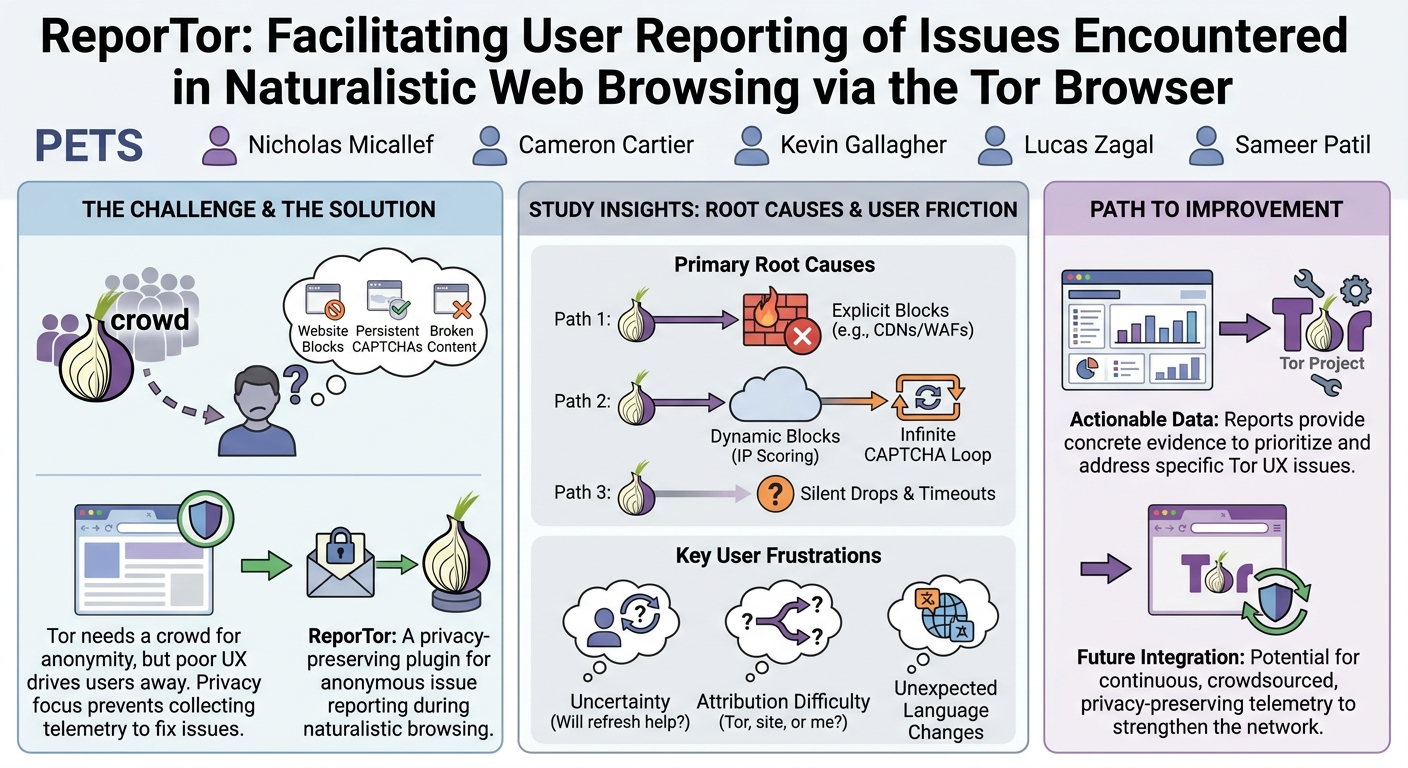
The Tor Browser is a crucial tool for privacy and anonymity online, but its effectiveness is inherently tied to its user base: the more users, the stronger the anonymity set, a concept often described as "being lost in a crowd." Unfortunately, the Tor Browser is plagued by significant user experience (UX) challenges, including frequent website blocks, persistent CAPTCHAs, and broken content. These issues not only frustrate users but actively drive them away, diminishing the network's overall anonymity. Unlike commercial browsers that collect extensive telemetry to identify and resolve such problems, Tor's strict privacy principles prevent it from gathering this data, leaving many UX issues invisible and unaddressed.
Key moments
- 0:00 Tor Browser's usability challenges and invisible UX problems
- 1:00 How the ReporTor plugin collects issue data anonymously
- 3:17 Autobiographical study approach and participant recruitment challenges
- 4:17 Most common issues: inaccessible resources, CAPTCHAs, broken content
- 5:07 Underlying root causes: explicit, dynamic blocks, silent drops
- 6:23 Key user frustrations and proposed improvements for Tor
ReporTor: Facilitating User Reporting of Issues Encountered in Naturalistic Web Browsing via the Tor Browser
Speakers: Nicholas Micallef (Paper author, Swansea University); Cameron Cartier (Paper author, Black Hills Information Security); Kevin Gallagher (Paper author, NOVA LINCS, NOVA School of Science and Technology); Lucas Zagal (Paper author, University of Utah); Sameer Patil (Paper author, University of Utah)
Conference: PETS
YouTube: https://www.youtube.com/watch?v=dXNrxWVfgSc
Overview
The Tor Browser is a crucial tool for privacy and anonymity online, but its effectiveness is inherently tied to its user base: the more users, the stronger the anonymity set, a concept often described as "being lost in a crowd." Unfortunately, the Tor Browser is plagued by significant user experience (UX) challenges, including frequent website blocks, persistent CAPTCHAs, and broken content. These issues not only frustrate users but actively drive them away, diminishing the network's overall anonymity. Unlike commercial browsers that collect extensive telemetry to identify and resolve such problems, Tor's strict privacy principles prevent it from gathering this data, leaving many UX issues invisible and unaddressed.
Presented by Cameron Cartier of Black Hills Information Security, alongside co-authors Nicholas Micallef, Kevin Gallagher, Lucas Zagal, and Sameer Patil, this talk introduces ReporTor, an innovative browser plugin designed to bridge this gap. ReporTor enables Tor users to anonymously report issues they encounter during naturalistic web browsing. The research presented details an autobiographical study where the plugin was used to systematically collect data on real-world browsing impediments, providing critical insights into their nature and root causes.
This work is significant because it offers a privacy-preserving mechanism to gather invaluable user feedback, directly addressing a long-standing challenge for the Tor Project. By illuminating the specific technical and experiential issues that deter users, ReporTor lays the groundwork for targeted improvements to the Tor Browser, ultimately fostering a more robust, accessible, and widely adopted anonymity network. The findings not only underscore the prevalence of Tor-blocking mechanisms but also highlight the profound user frustration stemming from uncertainty and lack of attribution regarding these issues.
Background
▶ Watch: Tor Browser's usability challenges and invisible UX problems (0:00)
The foundational principle of Tor's anonymity model is traffic obfuscation by blending into a large crowd. The more users actively using the Tor network, the harder it becomes for adversaries to de-anonymize individual users by analyzing traffic patterns. This "strength in numbers" paradigm makes user retention and growth paramount to Tor's mission. However, the very nature of Tor's operation, routing traffic through multiple volunteer-operated relays, often results in a degraded browsing experience compared to the clearnet. Common issues include broken URLs, persistent CAPTCHAs, and outright website blocks. These usability problems are not merely inconveniences; they directly undermine user retention, leading to a smaller user base and, consequently, a weaker anonymity set.
Mainstream web browsers, such as Chrome or Firefox, leverage vast amounts of telemetry data to identify and rectify performance issues, crashes, and broken website functionalities. This data, collected from millions of users, provides developers with a clear picture of what needs fixing. The Tor Browser, however, operates under an entirely different privacy ethos. Its core mission is to protect user privacy and anonymity, which precludes the collection of any form of telemetry that could potentially be linked back to an individual or reveal their browsing habits. This commitment to privacy, while essential, creates a significant blind spot: developers lack the necessary information to detect and diagnose the UX problems that drive users away. Without data, these problems remain "invisible," perpetuating a cycle of user frustration and attrition.
Previous attempts to study Tor user experience have faced considerable hurdles, primarily due to the privacy-sensitive nature of Tor users. Recruiting participants willing to share their browsing experiences, even anonymously, for extended periods has proven challenging. As the speakers noted, prior work struggled to recruit even a modest 13 to 17 users for such studies. This difficulty underscored the need for a novel approach – one that could gather data effectively without compromising the very privacy principles that Tor users value most. The ReporTor project was conceived to address this fundamental dilemma: how to improve the usability of a privacy-focused browser without sacrificing the privacy it promises.
Key Findings
▶ Watch: Autobiographical study approach and participant recruitment challenges (3:17)
The ReporTor study yielded crucial insights into the real-world challenges faced by Tor Browser users and demonstrated the effectiveness of an anonymous, user-driven reporting mechanism. The primary research question – "can such an anonymous user-driven issue reporting mechanism facilitate the collection of useful data from motivated users about the problems they face during everyday online browsing via Tor browser?" – was affirmatively answered. The study successfully collected a substantial dataset that provided a deeper understanding of underlying causes.
Among the 119 issue reports collected over 40 days by five researchers, several recurring problem categories emerged:
- Resources being completely inaccessible: This accounted for the vast majority of reported issues, indicating a widespread problem of outright blocking.
- CAPTCHAs: The second most common issue, often manifesting as "infinite CAPTCHAs" where users were forced to solve multiple challenges (e.g., 10 or more) before giving up.
- Content being broken: Websites failing to render correctly or displaying incomplete information.
- Timeouts and other issues: Instances where connections simply failed, or the nature of the problem was difficult for the user to ascertain.
It was noted that the sum of these percentages often exceeded 100%, reflecting situations where users encountered multiple issues simultaneously or found it impossible to definitively determine the sole cause of a problem. Crucially, the study demonstrated that approximately half of the reported issues were reproducible, affirming the utility of the collected data for actionable improvements.
A detailed analysis of the collected reports revealed several fundamental root causes for the encountered issues:
- Explicit Blocks: Many content delivery networks (CDNs) and web application firewalls (WAFs) are configured to explicitly ban all traffic originating from Tor exit nodes. A prime example cited was the Akamai network, which rendered any website behind it completely inaccessible, making tasks like booking an Airbnb impossible. These blocks are often a blanket measure against perceived malicious activity, without distinguishing legitimate Tor users.
- Dynamic Blocks: Systems like Cloudflare's IP scoring mechanisms frequently flag Tor exit nodes as malicious, not because they are explicitly identified as Tor traffic, but because the aggregated traffic patterns from these nodes deviate significantly from typical clearnet browsing behavior. Tor exit nodes often funnel traffic from numerous users, leading to high request volumes, varied user agents, and unusual browsing sequences that trigger automated bot detection and abuse prevention systems. This often results in the presentation of infinite CAPTCHAs or temporary blocks.
- Website-Specific Responses: In some instances, the issue was not with a CDN or WAF but with the website itself, which would respond differently to Tor traffic compared to clearnet traffic. This could manifest as different content, functionality, or outright refusal to serve the page.
- Silent Drops: A more insidious problem involved Tor traffic being silently dropped or experiencing timeouts without any explicit block messages. These issues are harder to observe and diagnose, as they provide no clear indication of why the connection failed, leading to greater user frustration and uncertainty.
Beyond the technical causes, the aggregated analysis highlighted three major sources of annoyance for Tor users:
- Uncertainty: Users frequently faced situations where they couldn't determine if an issue could be resolved by a circuit refresh or if it was an insurmountable block requiring them to switch browsers.
- Attribution of the issue: It was challenging for users to discern whether a problem stemmed from their own configuration, the Tor network, or the target website, making self-troubleshooting difficult.
- Language barriers: Occasionally, exit nodes would route traffic through servers in countries with different languages, leading to content being presented in an incomprehensible language, necessitating repeated circuit refreshes until a suitable node was found.
Technical Deep Dive
▶ Watch: Most common issues: inaccessible resources, CAPTCHAs, broken content (4:17)
The core of the ReporTor project is a custom-developed browser plugin designed to facilitate anonymous, user-driven issue reporting within the Tor Browser environment. The plugin's design prioritizes user privacy while gathering essential diagnostic information.
When a user encounters an issue, they activate the ReporTor plugin, which presents a simple interface for reporting. The data collected includes:
- URL: The uniform resource locator of the problematic page. Crucially, the query string is stripped from the URL to prevent the accidental leakage of sensitive session identifiers or personal data. This design choice underscores the project's commitment to user privacy.
- Exit Node: The IP address or identifier of the Tor exit node through which the user's traffic is currently routing. In an ideal scenario, this would be auto-filled, but due to the Tor Browser's stringent privacy technologies that obscure internal network details from browser extensions, this was not feasible. Instead, users selected their exit node from a drop-down list, which requires some manual effort but maintains privacy.
- Browser Security Level: The current security setting of the Tor Browser (e.g., Standard, Safer, Safest), which can influence website rendering and script execution, potentially contributing to issues.
- Problems Experienced: A predefined list of common issues (e.g., "broken content," "CAPTCHA," "blocked"), developed through a week-long pilot study. Participants could select any number of issues that applied, acknowledging the multifaceted nature of web browsing problems.
- Free-form Text Response: An open text field allowing users to provide additional context, specific error messages, or any other information they deemed relevant and were willing to share.
The reporting mechanism itself was meticulously designed to uphold Tor's privacy guarantees. During the study, submitted reports were directed to a research database hosted behind an onion service. By leveraging the Tor network for report submission, all communications were inherently end-to-end encrypted and routed anonymously, ensuring that the act of reporting an issue did not compromise the user's identity or browsing activity. The backend infrastructure comprised a Flask server responsible for receiving, parsing, and organizing the reported information into a structured database for subsequent analysis.
The study employed an autobiographical methodology, a deliberate choice made to overcome the significant challenges associated with recruiting privacy-sensitive Tor users for research. The five authors of the paper themselves served as participants, committing to using the Tor Browser as their default browser for an entire month (40 days). This approach ensured a highly motivated and informed participant group, deeply invested in the study's success and intimately familiar with the nuances of Tor browsing.
The data collection process was rigorous:
- Plugin Reports: Whenever an author encountered an issue, they immediately submitted a report using the ReporTor plugin. This provided real-time, context-specific data.
- Daily Questionnaires: At the end of each day, participants completed a questionnaire to capture information not suitable for the immediate plugin report, such as broader observations or reflections on issues identified after the fact. A total of 109 daily questionnaires were submitted.
- Post-Study Interviews: Following the month-long browsing period, one of the authors conducted informal interviews with the others. These interviews served to uncover deeper qualitative insights, explore the less technical aspects of user frustration, and gather comprehensive feedback on the plugin's usability and overall effectiveness. Four such interviews were conducted.
In total, the study amassed 119 detailed reports of issues, providing a rich dataset for quantitative and qualitative analysis. This methodological rigor, combined with the privacy-preserving technical architecture of ReporTor, allowed the researchers to gather actionable data on Tor usability challenges without compromising the fundamental principles of the Tor network.
Demo / Proof of Concept
▶ Watch: Underlying root causes: explicit, dynamic blocks, silent drops (5:07)
While the talk did not feature a live, interactive demonstration in the traditional sense, the ReporTor plugin itself served as the central proof of concept. The speakers presented screenshots of the plugin's interface, illustrating its design and the specific data fields it collects. The entire research study, where the five authors utilized ReporTor as their primary issue reporting tool for 40 days, effectively acted as an extensive, real-world validation and demonstration of the plugin's functionality and utility. The collection of 119 reproducible issue reports directly attests to ReporTor's capability to gather useful, actionable data in a naturalistic browsing environment, thereby validating its core design and purpose.
Defensive Implications
▶ Watch: Key user frustrations and proposed improvements for Tor (6:23)
The findings from the ReporTor study carry significant defensive implications for various stakeholders within the internet ecosystem, particularly for the Tor Project, website operators, and security professionals.
For the Tor Project and Developers:
- Direct Integration of ReporTor: The most immediate and impactful implication is the recommendation to integrate ReporTor directly into the Tor Browser. This would transform the current research tool into a crowdsourcing mechanism, providing the Tor Project with continuous, privacy-preserving telemetry on user experience issues. Such data is invaluable for prioritizing development efforts, identifying emerging blocking trends, and verifying the effectiveness of fixes.
- Strategic Exit Node Management: The hypothesis that routing traffic through less popular exit nodes might reduce blocking suggests a potential area for network-level optimization. The Tor Project could explore algorithms or policies to distribute traffic more evenly or prioritize exit nodes that are less frequently flagged by CDNs and WAFs. This requires careful balancing against performance and load distribution.
- Improved User Feedback and Attribution: The high degree of user uncertainty and difficulty in issue attribution highlights a critical area for improvement in the Tor Browser's user interface. Providing clearer diagnostic messages, suggesting troubleshooting steps (e.g., "try a new Tor circuit"), or even attempting to identify the likely cause (e.g., "this site appears to be blocking Tor traffic") could significantly reduce user frustration and empower users to resolve issues or understand why they cannot.
- Addressing Silent Drops and Timeouts: The prevalence of silent drops and timeouts indicates a need for deeper investigation into network-level interference or subtle blocking mechanisms that do not provide explicit error codes. This may involve developing more sophisticated traffic fingerprinting analysis or collaborating with network measurement projects to identify points of failure.
- Combating Language Issues: While less technical, the issue of exit nodes leading to content in unfamiliar languages points to a need for better user control over circuit selection, perhaps allowing users to specify preferred regions or languages for exit nodes, or at least providing clearer indications of the exit node's geographic location.
For Website Operators, CDNs, and WAF Providers:
- Re-evaluate Tor Blocking Policies: The study clearly demonstrates that legitimate users are being denied access due to blanket bans or overly aggressive IP scoring systems (e.g., Akamai, Cloudflare). Defenders operating websites or security services should re-evaluate their policies towards Tor traffic. Differentiating between malicious activity and legitimate privacy-conscious users is crucial. Implementing more nuanced detection mechanisms that go beyond simple IP blacklisting could improve accessibility without compromising security.
- Transparency in Blocking: When Tor traffic is blocked, providing a clear, user-friendly message explaining why access is denied, rather than a generic error or an infinite CAPTCHA loop, could improve the user experience and reduce frustration. This allows users to understand the situation and potentially take alternative action.
- Collaborate with the Tor Project: CDNs and WAFs could engage in dialogue with the Tor Project to better understand Tor's operational characteristics and develop more effective, less disruptive mitigation strategies against abuse that do not indiscriminately punish all Tor users.
For Security Professionals and Researchers:
- Understanding Adversary Tactics: The insights into how CDNs and WAFs detect and block Tor traffic (both explicit and dynamic blocks based on traffic patterns) are valuable for understanding the current state of anti-Tor defenses. This knowledge can inform the development of new anti-censorship techniques and improved Tor obfuscation strategies.
- Quantifying User Impact: The methodology and findings provide a template for future research into user experience within other privacy-enhancing technologies or circumvention tools, enabling a more data-driven approach to improving their usability and adoption.
Ultimately, the ReporTor project provides the necessary data to move beyond anecdotal evidence regarding Tor's usability problems. By understanding the specific challenges and their root causes, all parties can work towards a more open and accessible internet for everyone, including those who rely on Tor for privacy and security.
Key Takeaways
- Tor's Usability Crisis: The Tor Browser faces significant user experience challenges, including widespread blocking, CAPTCHAs, and broken content, which actively drive users away and diminish the network's overall anonymity.
- Anonymous Reporting is Effective: The ReporTor plugin demonstrates that an anonymous, user-driven issue reporting mechanism can successfully collect useful and reproducible data on Tor browsing problems without compromising user privacy.
- Root Causes Identified: The primary causes of Tor browsing issues are explicit blocks by CDNs/WAFs (e.g., Akamai), dynamic blocks by IP scoring systems (e.g., Cloudflare) based on traffic patterns, and silent traffic drops/timeouts.
- User Frustration Factors: Tor users are most annoyed by the uncertainty of issue resolution (e.g., whether a circuit refresh will help), difficulty in attributing the problem's source, and unexpected language changes due to exit node location.
- Actionable Data for Improvement: The collected data provides concrete evidence for the Tor Project to prioritize and address specific UX issues, offering a pathway to a more robust and user-friendly Tor Browser.
- Path to Integration: Direct integration of ReporTor into the Tor Browser could provide continuous, crowdsourced telemetry, enabling ongoing, data-driven improvements to the Tor user experience and strengthening the network.
About the Speaker(s)
The talk was presented by Cameron Cartier, a pen tester currently working for Black Hills Information Security. He was joined by co-authors Nicholas Micallef from Swansea University, Kevin Gallagher affiliated with NOVA LINCS and the NOVA School of Science and Technology, and Lucas Zagal and Sameer Patil, both associated with the University of Utah. Their collaborative work spans the fields of cybersecurity, user experience, and privacy-enhancing technologies, bringing a multidisciplinary approach to addressing the challenges of Tor Browser usability.
Reviews
Dr. Zero (Offensive Security Researcher) — WEAK
ReporTor tackles the impossible problem of getting telemetry out of a browser fundamentally designed to prevent it. Building an extension that routes stripped-down bug reports over onion services is a pragmatic, well-executed hack. But parading an N=5 study where the authors just logged their own traffic as a major revelation about CDN blocking keeps this firmly in the 'competent but limited' category.
Heather Calloway (CISO) — WEAK
The researchers present a mechanism for gathering diagnostic telemetry from Tor users without breaking anonymity. While they want enterprises to stop blocking Tor traffic—a request most CISOs will ignore due to abuse risk—the underlying engineering proves we can extract actionable diagnostics without resorting to surveillance.
→ Top-rated talks at Privacy Enhancing Technologies Symposium (PETS) 2026
All talks from Privacy Enhancing Technologies Symposium (PETS) 2026