How Experts Personalize Privacy & Security Advice for At-Risk Users
Wentao Guo (Paper author · University of Maryland), Alexander Yang (Paper author · University of Maryland), Nathan Malkin (Paper author · New Jersey Institute of Technology), Michelle L. Mazurek (Paper author · University of Maryland)
Privacy Enhancing Technologies Symposium (PETS) 2026 · Day 2 · Caribou
Overview
In an increasingly digitized world, the average user faces a myriad of privacy and security challenges. However, a specific demographic, termed "at-risk users," confronts heightened threats and disproportionate harms, demanding a far more nuanced and personalized approach to digital security advice. This talk, presented by Wentao Guo, delves into an extensive interview study aimed at understanding the intricate processes and perspectives of experts who provide tailored privacy and security guidance to these vulnerable individuals. The research, conducted by a team from the University of Maryland and New Jersey Institute of Technology, sheds light on the complexities, uncertainties, and critical considerations involved in delivering effective, context-specific advice.
Key moments
- 0:00 Introduction and defining at-risk users
- 1:20 Why tailoring privacy advice for at-risk users is complex
- 2:55 Study's research questions and participant expertise
- 4:10 Unreliable client information: over/underestimation of threats
- 6:00 Observing clients to assess technical competency
- 8:10 Need for better, less distressing diagnostic tools
How Experts Personalize Privacy & Security Advice for At-Risk Users
Speakers: Wentao Guo (Paper author, University of Maryland), Alexander Yang (Paper author, University of Maryland), Nathan Malkin (Paper author, New Jersey Institute of Technology), Michelle L. Mazurek (Paper author, University of Maryland)
Conference: PETS
YouTube: https://www.youtube.com/watch?v=saeoO8Izihc
Overview
In an increasingly digitized world, the average user faces a myriad of privacy and security challenges. However, a specific demographic, termed "at-risk users," confronts heightened threats and disproportionate harms, demanding a far more nuanced and personalized approach to digital security advice. This talk, presented by Wentao Guo, delves into an extensive interview study aimed at understanding the intricate processes and perspectives of experts who provide tailored privacy and security guidance to these vulnerable individuals. The research, conducted by a team from the University of Maryland and New Jersey Institute of Technology, sheds light on the complexities, uncertainties, and critical considerations involved in delivering effective, context-specific advice.
The core premise of the research is that generic security recommendations, often sufficient for the general public, are woefully inadequate for individuals facing targeted, sophisticated, or emotionally charged digital threats. Examples range from journalists targeted by nation-state spyware to victims of online harassment by abusive ex-partners. For these users, the stakes are exceptionally high, with digital vulnerabilities potentially escalating to physical violence or severe personal consequences. The study's findings are crucial for informing future research, improving the support mechanisms for advice providers, and enhancing the design of self-service security tools that can genuinely cater to individual risk profiles.
By meticulously documenting the undocumented processes of expert advice tailoring, Guo and his co-authors aim to bridge a significant knowledge gap. Their work not only illuminates the challenges faced by providers but also offers actionable recommendations for researchers and technologists to develop more effective diagnostic tools, user-friendly security applications, and robust frameworks for assessing user capabilities. This article will explore the study's methodology, key findings, the technical implications of its insights, and the critical takeaways for anyone involved in digital security and privacy.
Background
▶ Watch: Introduction and defining at-risk users (0:00)
The necessity for personalized privacy and security advice stems from the diverse and often extreme threats faced by at-risk users. As highlighted in the talk, these individuals include journalists reporting on government corruption, who may be targeted by expensive spyware, and individuals experiencing online harassment from abusive ex-partners who possess intimate personal knowledge and potential access to shared accounts and devices. For such users, the potential for digital attacks is elevated, and the consequences of a breach can be severe, extending beyond data loss to include reputational damage, financial ruin, or even physical danger.
The challenge lies in the fact that standard security advice often falls short. A common recommendation, such as immediately deleting detected spyware, might inadvertently alert an adversary, escalating the risk of physical violence in a domestic abuse scenario. This critical example underscores the delicate balance experts must strike between technical security and the broader safety and well-being of the client. Organizations like the Clinic to End Tech Abuse and the Committee to Protect Journalists have long recognized this need, offering specialized, long-term support and helplines. These providers invest significant effort in understanding the unique needs of their communities, yet their methods for tailoring advice have largely remained informal and undocumented.
This lack of formal documentation creates a significant gap in collective knowledge. The research presented by Wentao Guo and his team aims to fill this void by systematically investigating how these experts operate. The study was guided by three core research questions:
- What kinds of choices do providers make to differentiate advice for different people, and why?
- How can research and technology design better support providers in tailoring advice?
- How should self-service tools account for risk factors when tailoring advice?
To address these questions, the researchers conducted an in-depth interview study with 18 privacy and security advice providers. Participants were recruited through organizational affiliations, personal networks, and snowball sampling. Their expertise spanned critical areas, primarily focusing on human rights defenders (activists, journalists), identity-based minorities (racial, religious), and individuals affected by tech abuse. This diverse pool of experts provided a rich qualitative dataset, enabling the researchers to distill a comprehensive understanding of the complex decision-making processes involved in personalized security advice. The study posits that by understanding these expert processes, we can inform efforts to improve advice for at-risk users, address provider challenges, and enhance the efficacy of automated self-service advice tools.
Key Findings
▶ Watch: Study's research questions and participant expertise (2:55)
The central revelation from the interview study is that providers of personalized privacy and security advice constantly grapple with multiple sources of uncertainty when tailoring recommendations for at-risk clients. This uncertainty permeates every stage of the advice-giving process, from understanding the client's actual threat model to assessing their technical capacity and the potential psychological impact of interventions. The researchers developed a framework (though not detailed in the talk, its existence is noted) that describes how providers learn different types of context about client situations to achieve specific objectives in tailoring advice. The talk zoomed in on the strategies providers employ to gather reliable information amidst this pervasive uncertainty.
Four primary strategies were identified for obtaining client context and information:
- Directly Asking Clients: This is the most straightforward method, yet it comes with significant caveats regarding reliability. Providers reported that clients frequently overestimate or underestimate the threats they face. For instance, individuals lacking technical knowledge might believe their abuser is "capable of anything and everything," leading to exaggerated threat perceptions. Conversely, some clients underestimate risks or provide "wildly inaccurate judgments" of their own capacity to learn new tools and habits. Consequently, experts learn to take client self-reports "with a grain of salt," understanding that their emotional state or lack of technical understanding can skew their perception of risk and their ability to adopt new practices.
- Searching for Evidence of Compromise: A more objective approach involves actively investigating devices and accounts for signs of compromise, such as spyware or unauthorized access. While potentially very useful, this strategy also carries risks. As one participant noted, proving or disproving the presence of spyware can be challenging and often yields inconclusive results. Such ambiguity can be deeply distressing for clients, making them feel more vulnerable rather than more secure. Providers often prioritize ruling out simpler, non-technical issues first, as spending extensive time on inconclusive technical diagnostics can feel like a "step backwards" and negatively impact the client's psychological well-being. This highlights the crucial interplay between technical investigation and client psychology.
- Observing or Researching Clients: To overcome the unreliability of self-reporting and the ambiguity of direct evidence, some providers engage in more time-intensive observation and research. A notable example involved assessing a client's technical competency by having them attempt to use successively more complex tools. The speaker specifically mentioned VeraCrypt, a disk encryption software, as a benchmark: "If you're a normal person, you're going to stumble trying to use this. But if a client can figure out how to use it, then they say, 'Okay, we can give you anything.'" This method provides concrete evidence of a client's ability to adopt new security practices, allowing providers to tailor advice that is both effective and realistically implementable. However, this approach demands significant time, a resource often scarce for providers.
- Making Inferential Guesses: As a fallback, especially when time or direct access to a client is limited, providers sometimes resort to making educated guesses based on contextual factors like a client's geographical and cultural background. These inferences might concern technical competency or typical threat profiles associated with certain regions or communities. While acknowledged as potentially inaccurate, this method can be "good enough" when immediate, albeit imperfect, advice is needed. This strategy underscores the human element of security advice, where intuition and broad contextual knowledge sometimes compensate for a lack of specific, verifiable data.
These findings collectively emphasize that effective security advice for at-risk users is a deeply human-centered process, requiring providers to navigate a complex landscape of technical, psychological, and logistical challenges. The pervasive uncertainty demands adaptive strategies and a keen understanding of both the adversary and the advisee.
Technical Deep Dive
▶ Watch: Unreliable client information: over/underestimation of threats (4:10)
While the talk focuses on the human processes of security advice, its findings have profound implications for the design and deployment of security technologies. The "technical deep dive" in this context is less about specific code or protocol analysis and more about the technical challenges inherent in personalized security, the limitations of current tools, and the requirements for future technological development to better support at-risk users and their expert advisors.
The adversaries targeting at-risk users employ a range of sophisticated technical methods. The talk explicitly mentions expensive spyware used by governments against journalists, indicating a threat landscape involving advanced persistent threats (APTs) and commercial surveillance tools like Pegasus. These tools leverage zero-day exploits or highly stealthy persistence mechanisms, making their detection and removal technically challenging. Similarly, online harassment often involves exploiting social engineering, compromised credentials, or vulnerabilities in widely used platforms, requiring a comprehensive understanding of account security, data privacy settings, and digital forensics. An abusive ex-partner might exploit formerly shared accounts and devices, implying a need for robust access control, device hardening, and secure data wiping procedures.
One of the most critical technical areas highlighted is the need for better diagnostic tools to detect compromised devices and accounts. Providers struggle with the current state of these tools, not just in terms of their efficacy but also their user experience. The likelihood of "inconclusive results" when scanning for spyware or other compromises is a major concern. From a technical standpoint, this points to several issues:
- Detection Efficacy: Current tools may not be robust enough to reliably identify sophisticated threats or distinguish between legitimate system processes and malicious ones.
- False Positives/Negatives: Inaccurate results can lead to undue stress for clients (false positives) or a false sense of security (false negatives), both of which are detrimental.
- Usability and Interpretation: Many diagnostic tools are designed for technical experts, not for use in a client-facing context where results need to be clearly understood and acted upon without causing alarm. The psychological impact of technical information is a key consideration.
The talk also underscores the challenge of accessible client-facing tools for fundamental security tasks. Encryption tools, exemplified by VeraCrypt, are powerful but often present significant usability hurdles. The speaker's anecdote about using VeraCrypt as a benchmark for technical competency illustrates a broader problem: many essential security tools are designed with technical capability as a prerequisite, rather than prioritizing ease of use for a diverse user base. This applies not only to encryption but also to password management and other critical security hygiene practices. The technical implication here is a call for human-centered design in security tools, prioritizing intuitive interfaces, clear feedback mechanisms, and robust error handling to lower the barrier to entry for non-technical users.
Furthermore, the need for better ways to support technical competency evaluation is a technical design challenge. While observing clients use tools is effective, it is time-consuming. Future tools could integrate features that passively or actively assess a user's technical proficiency without explicit testing, perhaps through adaptive interfaces or guided walkthroughs that adjust complexity based on user interaction. This would require intelligent system design that can infer user capabilities and tailor the user experience accordingly.
In summary, the technical deep dive reveals that the current ecosystem of security tools and diagnostic capabilities is often insufficient for the nuanced demands of at-risk users. The technical challenges are not just about building more powerful security mechanisms, but about building mechanisms that are:
- Reliable and conclusive in detecting advanced threats.
- User-friendly and accessible for individuals with varying technical skills.
- Context-aware and able to integrate with the broader psychological and social factors affecting at-risk users.
- Supportive of expert workflows by providing actionable insights and reducing uncertainty.
The talk implicitly calls for a paradigm shift in security tool development, moving from a purely technical efficacy focus to one that deeply integrates user experience, psychological impact, and the real-world operational challenges faced by security advice providers.
Demo / Proof of Concept
▶ Watch: Observing clients to assess technical competency (6:00)
This talk was based on an interview study and presented research findings and a conceptual framework. As such, it did not include a live demonstration or a proof of concept of a specific tool or exploit. The speaker did mention a poster session where they were happy to discuss the developed framework and guidelines for designing self-service tools, indicating the output of their research is primarily conceptual and analytical rather than a tangible technical artifact.
Defensive Implications
▶ Watch: Need for better, less distressing diagnostic tools (8:10)
The findings from this study offer critical defensive implications for various stakeholders, from individual at-risk users to security researchers, tool developers, and organizations providing support. Understanding the complexities faced by expert advisors is key to building more resilient defenses against sophisticated and targeted threats.
For security researchers and threat intelligence analysts, there is a clear call for more focused research on evolving threats and technologies. Providers need better insights into "prevalent patterns of attacks" and the "symptoms of those attacks." This means not just identifying new malware or vulnerabilities, but also understanding the typical attack chains, indicators of compromise (IOCs), and adversary tactics, techniques, and procedures (TTPs) specifically targeting human rights defenders, journalists, and victims of tech abuse. Such intelligence needs to be packaged in a way that is actionable and easily digestible by advice providers, allowing them to quickly recognize and respond to emerging threats.
For developers of security tools and technologies, the implications are twofold:
- Improved Diagnostic Tools: There is an urgent need for diagnostic tools that are not only more effective at detecting compromised devices and accounts but also provide clearer, more conclusive results. The current high likelihood of inconclusive findings can distress clients and undermine trust. Future tools should aim for higher accuracy, lower false positive rates, and crucially, provide easy-to-understand explanations of their findings (or lack thereof). Designing these tools with a focus on psychological safety is paramount, ensuring that the process of investigation does not inadvertently cause more harm.
- More Accessible Client-Facing Tools: The struggle providers face in assessing a client's technical competency, especially with tools like VeraCrypt or complex password managers, highlights a significant usability gap. Developers must prioritize human-centered design to make essential security tools (e.g., encryption, password management, secure communication) inherently more intuitive and easier to use for non-technical users. This includes simplifying interfaces, providing clear guidance, and offering adaptive learning pathways that cater to different skill levels. The goal is to reduce the cognitive load on users, making it feasible for at-risk individuals to adopt and maintain robust security practices without requiring extensive technical training.
For organizations and individuals providing security advice, the study reinforces several best practices and highlights areas for improvement:
- Acknowledge and Address Uncertainty: Providers must recognize that uncertainty is inherent in tailoring advice. They should be transparent with clients about the limitations of diagnostic tools and the subjective nature of risk assessment.
- Prioritize Psychological Well-being: The emotional impact of security investigations and advice cannot be overstated. Providers should be trained to handle client distress, manage expectations, and prioritize actions that minimize psychological harm, even if it means deferring a technically optimal solution.
- Develop Contextual Understanding: While time-consuming, observing client behavior and understanding their unique technical, geographical, and cultural contexts is invaluable. Organizations should invest in training and resources that enable providers to gather this nuanced information effectively.
- Leverage Collaborative Knowledge: Documenting and sharing anonymized case studies and effective strategies among providers can help build a collective knowledge base, reducing reliance on individual inferential guesses.
Finally, for at-risk users themselves, the study implicitly suggests the importance of seeking expert advice when facing significant threats. It also underscores the need for honest self-assessment regarding technical capacity and the emotional bandwidth to implement complex security measures. Understanding that personalized advice is a complex, iterative process can help users better engage with their advisors and manage their expectations.
In essence, the defensive implications call for a holistic approach that integrates advanced technical capabilities with a deep understanding of human psychology, user experience, and the specific socio-political contexts of at-risk individuals. It's about building a security ecosystem that supports not just the technology, but the people who use it and the experts who guide them.
Key Takeaways
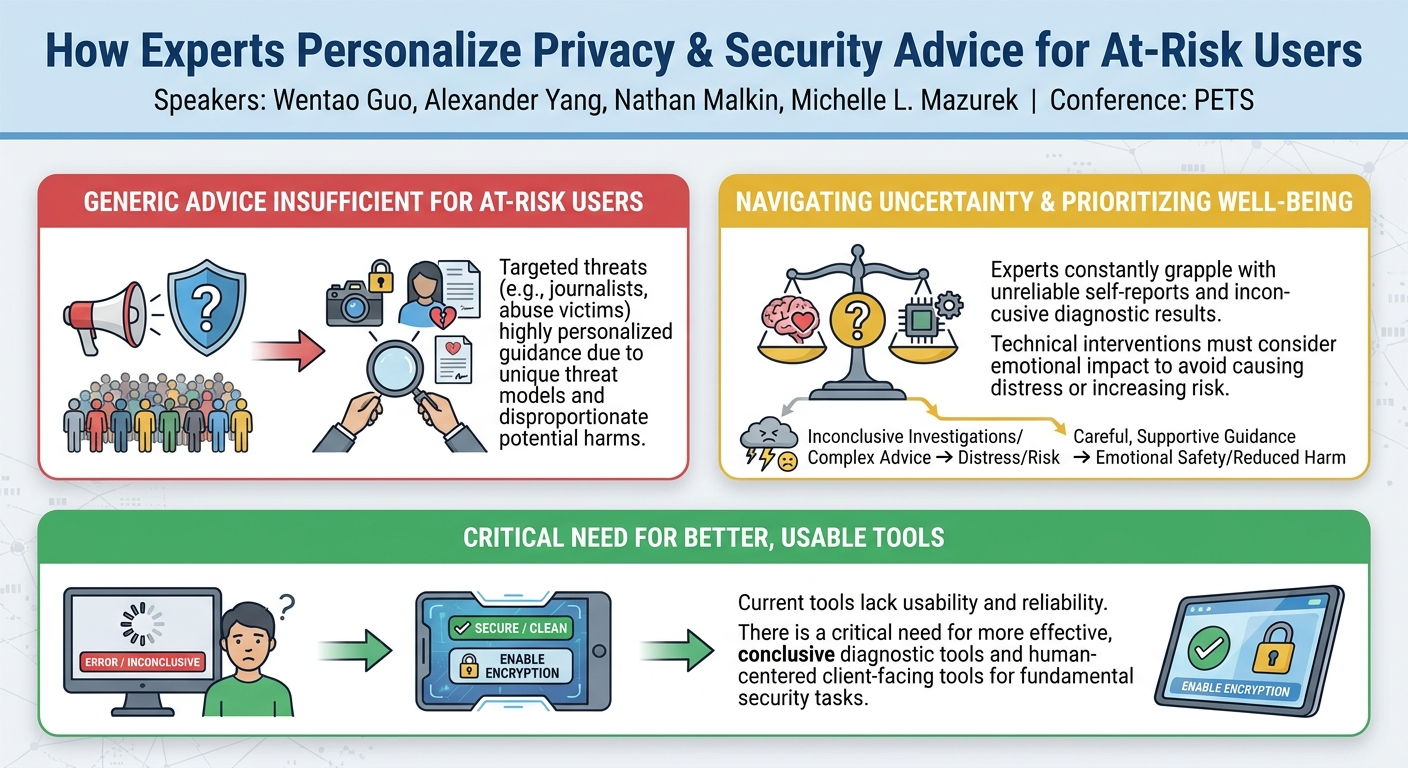
- Generic security advice is insufficient for at-risk users: Individuals facing targeted threats (e.g., journalists, victims of abuse) require highly personalized guidance due to unique threat models and disproportionate potential harms.
- Uncertainty is central to expert advice: Providers constantly grapple with unreliable client self-reports, inconclusive diagnostic results, and limited time, necessitating adaptive strategies to gather context.
- Client psychological well-being is paramount: Technical interventions must consider the emotional impact on clients, as inconclusive investigations or overly complex advice can cause significant distress or even increase physical risk.
- Current security tools lack usability and reliability: There is a critical need for more effective, conclusive, and user-friendly diagnostic tools for detecting compromises, as well as more accessible client-facing tools for fundamental security tasks like encryption and password management.
- Contextual understanding is vital: Experts employ various methods, from direct questioning to observation and inferential guesses based on background, to understand a client's technical capacity and specific threat landscape.
- Research and technology design must support providers: Future efforts should focus on evolving threat intelligence, improving diagnostic tool reliability and clarity, and designing human-centered security tools that are intuitive for non-technical at-risk users.
About the Speaker(s)
The talk "How Experts Personalize Privacy & Security Advice for At-Risk Users" was presented by Wentao Guo, who is listed as a paper author from the University of Maryland. His co-authors on this research paper include Alexander Yang (University of Maryland), Nathan Malkin (New Jersey Institute of Technology), and Michelle L. Mazurek (University of Maryland). Wentao Guo concluded his presentation by mentioning that he is recruiting graduate students in human-centered security and privacy at the University of Georgia, starting in Fall 2027, indicating his ongoing commitment to research in this critical area. The collective work of these authors contributes significantly to the understanding of human factors in cybersecurity, particularly for vulnerable populations.
Reviews
Dr. Zero (Offensive Security Researcher) — SOLID
Guo and the UMD team formally document why throwing standard infosec advice at domestic abuse victims or targeted journalists usually fails. It’s a rigorous HCI study proving what frontline responders already know: clients are unreliable narrators, diagnostic tools spit out inconclusive garbage, and building security software exclusively for power-users gets people hurt.
Heather Calloway (CISO) — SOLID
This research studies how specialized advisors tailor security guidance for at-risk users like journalists and abuse victims. For the enterprise, this is the exact challenge we face in our Executive Protection (EP) programs and high-risk traveler briefings. It proves that standard IT helpdesk playbooks are dangerously inadequate for targeted users.
→ Top-rated talks at Privacy Enhancing Technologies Symposium (PETS) 2026
All talks from Privacy Enhancing Technologies Symposium (PETS) 2026