Cultivating a Tech-Safety Mindset using Game-Based Learning for Defending against Technology-Facilitated Abuse
Majed Almansoori (Paper author · University of Wisconsin–Madison and United Arab Emirates University (UAEU)), Chirag Ghosh (Paper author · Indian Institute of Technology, Kharagpur), Sarita Singh (Paper author · Indian Institute of Technology, Kharagpur), Rahul Chatterjee (Paper author · University of Wisconsin–Madison), Mainack Mondal (Paper author · Indian Institute of Technology, Kharagpur)
Privacy Enhancing Technologies Symposium (PETS) 2026 · Day 2 · Caribou
Overview
In an increasingly digitized world, the pervasive threat of Technology-Facilitated Abuse (TFA) presents a significant challenge to personal safety and digital well-being. This talk, presented by Majed Almansoori and his collaborators from the University of Wisconsin–Madison, United Arab Emirates University, and Indian Institute of Technology Kharagpur, delves into an innovative, proactive approach to combating TFA: game-based learning. The research introduces "Be Safe," a narrative-driven visual novel game designed to educate users about TFA, help them identify its signs, and equip them with effective mitigation strategies, ultimately fostering a resilient tech safety mindset.
Key moments
- 0:23 Defining Technology-Facilitated Abuse (TFA)
- 2:49 Why proactive game-based learning is needed
- 3:40 Three critical design goals for a TFA game
- 4:40 Introducing 'Be Safe': A narrative-driven visual novel
- 6:17 Goal: Cultivating a lasting tech safety mindset
- 8:40 User study results: Game successfully teaches TFA
Cultivating a Tech-Safety Mindset using Game-Based Learning for Defending against Technology-Facilitated Abuse
Speakers: Majed Almansoori (Paper author, University of Wisconsin–Madison and United Arab Emirates University (UAEU)); Chirag Ghosh (Paper author, Indian Institute of Technology, Kharagpur); Sarita Singh (Paper author, Indian Institute of Technology, Kharagpur); Rahul Chatterjee (Paper author, University of Wisconsin–Madison); Mainack Mondal (Paper author, Indian Institute of Technology, Kharagpur)
Conference: PETS
YouTube: https://www.youtube.com/watch?v=Osy0WsdNFXA
Overview
In an increasingly digitized world, the pervasive threat of Technology-Facilitated Abuse (TFA) presents a significant challenge to personal safety and digital well-being. This talk, presented by Majed Almansoori and his collaborators from the University of Wisconsin–Madison, United Arab Emirates University, and Indian Institute of Technology Kharagpur, delves into an innovative, proactive approach to combating TFA: game-based learning. The research introduces "Be Safe," a narrative-driven visual novel game designed to educate users about TFA, help them identify its signs, and equip them with effective mitigation strategies, ultimately fostering a resilient tech safety mindset.
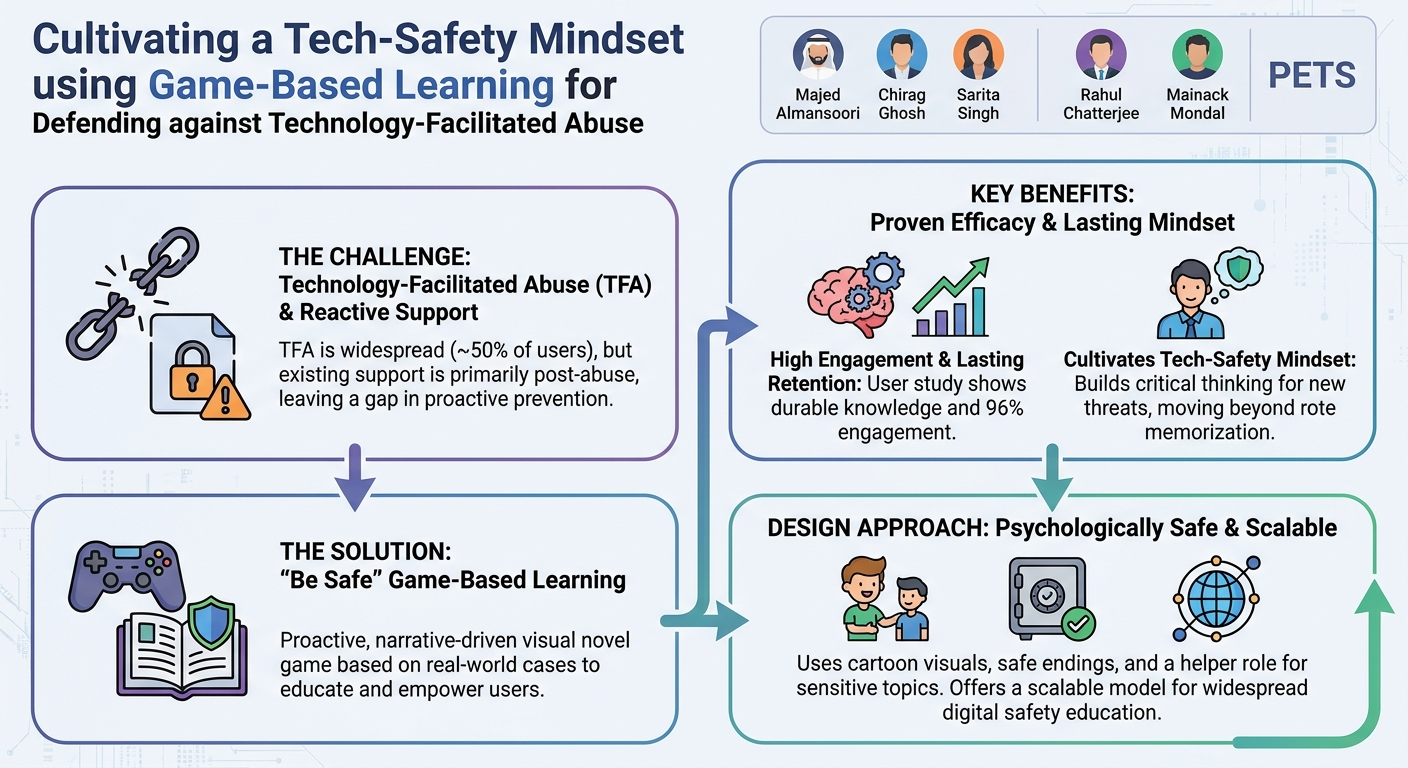
The core problem addressed by this work is the reactive nature of current support systems for TFA victims. While numerous organizations provide critical aid after abuse has occurred, there is a distinct gap in proactive educational interventions aimed at prevention. The speakers highlight the alarming prevalence of TFA, affecting nearly 50% of online users and a staggering 60% of young adults, underscoring the urgent need for scalable, engaging, and effective educational tools. "Be Safe" emerges as a compelling solution, leveraging the proven efficacy of educational games to empower individuals before they become victims, thereby complementing existing reactive support services.
The significance of this research lies in its novel application of interactive learning to a sensitive and evolving security threat. By creating a psychologically safe environment for learning about digital harassment, monitoring, and control, the "Be Safe" game aims to move beyond rote memorization of security tips. Instead, it seeks to cultivate a lasting mindset where users can apply critical thinking to new and emerging technological threats, fostering confidence in taking proactive safety actions. This approach not only enhances individual resilience but also offers a scalable model for widespread digital safety education.
Background
▶ Watch: Defining Technology-Facilitated Abuse (TFA) (0:23)
Technology-Facilitated Abuse (TFA) is defined as the misuse of technology to spy on, harass, control, or monitor another person. This broad definition encompasses a spectrum of harmful behaviors, from cyberstalking and online harassment to the unauthorized sharing of private information and the installation of monitoring software. A critical characteristic of TFA is that abusers often do not require sophisticated technical knowledge; they can leverage common, readily available technologies—such as social media platforms, communication apps, and even smart devices—in unexpected and harmful ways. The accessibility of these tools contributes significantly to the widespread nature of TFA.
The prevalence of TFA is alarmingly high, as evidenced by prior research cited in the talk. Nearly 50% of online users report having experienced some form of TFA, with one-quarter experiencing severe forms. Among young adults, this figure rises to 60%, indicating a particularly vulnerable demographic. Importantly, TFA transcends demographic boundaries, affecting men and women equally. These statistics paint a stark picture of a pervasive digital threat that impacts a significant portion of the online population.
Despite the widespread nature of TFA, existing support structures primarily focus on post-abuse intervention. Organizations like CETA (the Clinic to End Tech Abuse), the Madison Tech Clinic, and the Safety Net project provide invaluable assistance to victims, offering support, resources, and guidance after the abuse has already taken hold. While these services are indispensable, they operate reactively, addressing the consequences rather than preventing the occurrence of abuse. This reactive paradigm leaves a critical gap in proactive interventions that could educate individuals and mitigate risks before harm is done.
The need for proactive interventions is multifold. Firstly, they aim to tackle the issue before abuse manifests, potentially preventing significant emotional, psychological, and even physical harm. Secondly, proactive solutions can be designed for scalability, reaching large populations more efficiently than one-on-one support services. Thirdly, they can complement existing help services, forming a comprehensive defense strategy rather than replacing established support networks. Ultimately, the overarching goal of proactive interventions is to help users cultivate a tech safety mindset—a set of attitudes, knowledge, and behaviors that enable individuals to navigate the digital world safely and confidently.
Among various educational approaches, game-based learning stands out as a particularly effective method for delivering proactive interventions. Research has consistently shown that educational games surpass passive learning methods, such as reading lengthy FAQs or watching instructional videos, in several key aspects. Games foster active learning, requiring participants to make decisions and engage directly with the content. They are inherently engaging and fun, which helps maintain user interest and motivation. Crucially, games provide immediate feedback, allowing learners to understand the consequences of their choices in real-time and reinforce key learning points. This interactive and iterative learning process is ideal for sensitive and evolving topics like TFA, where understanding nuanced situations and practicing decision-making are paramount.
Key Findings
▶ Watch: Three critical design goals for a TFA game (3:40)
The user study conducted to evaluate Be Safe yielded compelling evidence supporting the efficacy of game-based learning for TFA education and the cultivation of a tech safety mindset. With 198 participants recruited via Prolific, the study employed a pre-post survey design, assessing participants' understanding before playing a single story from the game, immediately after, and then again after a one-week interval. This methodology allowed the researchers to gauge both immediate learning gains and the retention of knowledge over time.
The most significant finding was that the game successfully teaches people about TFA. The majority of participants demonstrated an improved understanding of the topic, indicating that the game's narrative-driven approach and interactive mechanics were effective in conveying complex concepts. Crucially, the knowledge gained was not fleeting; participants maintained their improved understanding after one week, suggesting that "Be Safe" fosters durable learning rather than temporary memorization. This long-term retention is vital for cultivating a lasting tech safety mindset that can be applied to future situations.
Engagement was another strong point, with an overwhelming 96% of participants reporting that the game was engaging. This high level of engagement is a testament to the game's design, which prioritizes active participation, immediate feedback, and narrative immersion. The engaging nature of the game is critical for educational tools, especially when dealing with sensitive and potentially uncomfortable topics like abuse, as it keeps learners invested in the process.
Beyond general engagement, 40% of participants explicitly appreciated the learning content about TFA. This indicates that a substantial portion of the user base not only found the game enjoyable but also recognized and valued its educational purpose. Participants' qualitative feedback further highlighted the game's impact: many expressed a desire to share the game with others ("I want to let my kids play this game") and a motivation to explore their privacy settings in different contexts ("I will explore whether the same settings apply to other apps"). These unsolicited statements underscore the game's ability to inspire proactive behaviors and disseminate knowledge within communities.
A particularly insightful finding was that the game proved helpful not only for individuals who had never been exposed to abuse but also for those who had already experienced TFA. This suggests that "Be Safe" serves a dual purpose: it acts as a preventative educational tool for the uninitiated and offers valuable insights and validation for individuals who have already been victimized, potentially empowering them to better understand their past experiences and take more informed actions moving forward. This broad applicability significantly enhances the game's utility as a public education resource.
Technical Deep Dive
▶ Watch: Introducing 'Be Safe': A narrative-driven visual novel (4:40)
The "Be Safe" game is fundamentally a narrative-driven visual novel game, a genre chosen for its ability to immerse players in stories and allow them to make impactful decisions within a compelling context. This design choice is critical for tackling a sensitive subject like TFA, as it enables a nuanced exploration of scenarios without being overly confrontational. The game's structure is modular, consisting of multiple stories, each designed to illustrate different facets of TFA. Each story, in turn, is broken down into multiple stages, guiding the player through a learning progression:
- Contextual Setup: The game first presents the scenario and context of the story before any abuse occurs. This establishes the characters, their relationships, and the digital environment, allowing players to understand the baseline normal before threats emerge.
- TFA Sign Identification: Players are then challenged to identify TFA signs and flags within the unfolding narrative. This active recognition phase is crucial for developing observational skills and understanding the subtle (or not-so-subtle) indicators of abuse.
- Mitigation Strategy Learning: Finally, players learn about and apply mitigation strategies to address the identified TFA issues. This stage moves beyond awareness to action, equipping players with practical steps they can take.
The educational goals are carefully interwoven into the game's narrative. The researchers designed six interactive stories, each meticulously crafted based on real-world cases of TFA. This grounding in authentic experiences ensures the relevance and credibility of the content. The focus areas for these stories were primarily abuse on social media and using smartphones, reflecting the most prevalent vectors of TFA observed in the field. These stories were engineered to achieve four main goals:
- Teach about TFA: Directly convey information about various forms of abuse.
- Increase awareness about digital threats: Broaden players' understanding of risks in the digital landscape.
- Build confidence in taking proactive actions: Empower players to believe in their ability to respond effectively.
- Motivate them to adopt proactive safety behaviors: Inspire a lasting change in digital habits.
The ultimate objective of "Be Safe" transcends teaching isolated security topics; it aims to cultivate a lasting tech safety mindset. This means enabling online users to apply the principles and lessons learned from the game to future, novel situations and different technological contexts, rather than just memorizing specific solutions for specific problems.
To reinforce learning and engagement, "Be Safe" incorporates several key game mechanics:
- Multiple Quizzes: Embedded throughout each story, these quizzes serve as active learning checkpoints. They require players to apply their understanding and make decisions, thereby reinforcing the learning value and keeping users actively engaged.
- Immediate Feedback: After each decision or quiz answer, players receive instant feedback indicating whether their choices were correct or incorrect. This mechanism is vital for reinforcing key learning points, correcting misconceptions in real-time, and guiding players towards optimal safety choices.
- Game Incentives: To sustain engagement and encourage completion of the learning experience, the game includes incentives such as badges. These small rewards provide a sense of achievement and motivate players to continue interacting with the content.
Recognizing the sensitive nature of TFA, the design of a safe environment for players was paramount. The researchers implemented several psychological safety measures:
- Convergent Safe Endings: Regardless of the player's choices or mistakes within a story, the narrative is designed to always converge to a safe ending. The victim character in the story ultimately resolves the TFA issue they face. This ensures that players do not experience distress from negative outcomes within the game, reinforcing a sense of hope and efficacy.
- Player as Helper: The player's role is consistently positioned as a helper, not a victim. This creates a psychological distance from the sensitive content, allowing players to objectively analyze situations and make decisions without feeling personally threatened or re-traumatized.
- Cartoon Visuals: Instead of realistic graphics, the game employs cartoon visuals. This aesthetic choice further enhances psychological distance, making the potentially disturbing scenarios more palatable and less impactful on the player's emotional state, while still effectively conveying the narrative.
Collectively, these technical and design choices demonstrate a thoughtful approach to creating an educational tool that is both effective in imparting critical safety knowledge and responsible in its handling of a challenging subject matter.
Demo / Proof of Concept
▶ Watch: Goal: Cultivating a lasting tech safety mindset (6:17)
The "Be Safe" game itself serves as the primary proof of concept for the talk's central hypothesis: that game-based learning can effectively cultivate a tech safety mindset for defending against technology-facilitated abuse. The presentation elaborates on the game's design and mechanics, providing a conceptual demonstration of how its narrative structure, interactive elements, and psychological safety features are integrated to achieve its educational goals. While a live gameplay demonstration was not shown in the talk, the description of "Be Safe" as a "narrative-driven visual novel game" with "multiple stories" and "quizzes" clearly outlines the interactive experience offered.
To empirically validate "Be Safe," the researchers conducted a rigorous user study involving 198 participants recruited through the Prolific platform. This study was meticulously designed to evaluate the game's effectiveness in teaching about TFA and fostering a tech safety mindset. Each participant was assigned to play one story only from the "Be Safe" game, ensuring a controlled exposure to the learning content.
The evaluation followed a robust pre-post survey design. Participants first completed a pre-survey to establish their baseline understanding of TFA and related topics. Following this, they engaged with their assigned "Be Safe" story. Immediately after completing the game, participants filled out a post-survey, repeating the same questions from the pre-survey to measure immediate learning gains. A crucial aspect of the study design was a second post-survey administered after one week. This delayed assessment was vital for determining the retention of learned information and whether the game successfully cultivated a lasting mindset rather than just temporary knowledge. The study's methodical approach to data collection and analysis provided the empirical evidence supporting the key findings regarding the game's teaching success, engagement levels, and ability to foster proactive safety behaviors.
Defensive Implications
▶ Watch: User study results: Game successfully teaches TFA (8:40)
The research on "Be Safe" provides critical insights and actionable strategies for individuals, organizations, and educators in the ongoing battle against Technology-Facilitated Abuse. The most significant defensive implication is the unequivocal validation of proactive education as a crucial first line of defense. Rather than solely relying on reactive support services, which intervene only after harm has occurred, this work demonstrates that empowering individuals with knowledge and skills before abuse begins can significantly reduce vulnerability and foster resilience.
Organizations and educational institutions should seriously consider integrating game-based learning into their digital safety and cybersecurity awareness programs. The "Be Safe" model highlights that interactive, engaging, and psychologically safe educational games are far more effective than traditional passive methods (e.g., policy documents, instructional videos). Such games can scale easily to reach large populations, making them an ideal vehicle for widespread digital literacy initiatives. The key design principles of "Be Safe"—narrative-driven stories, real-world scenarios, immediate feedback, and positive reinforcement—can serve as a blueprint for developing similar educational tools across various security topics.
Defenders should focus on educating users about the prevalent attack vectors. The game's emphasis on social media and smartphone-based abuse is particularly relevant, as these platforms are primary conduits for TFA. Educational content should guide users on how to identify subtle (and overt) TFA signs and flags, which might include unusual login alerts, changes in account settings, unexplained battery drain, location tracking, or harassing messages. Empowering individuals to recognize these indicators is the first step towards self-protection.
Furthermore, the game's success in helping users build confidence in taking actions and motivating them to adopt proactive safety behaviors is a powerful defensive outcome. Educational programs should not just inform but also empower. This means providing clear, actionable mitigation strategies, such as strengthening privacy settings, knowing how to block or report abusers, seeking support from trusted individuals or organizations, and understanding digital consent. The goal is to move users from passive recipients of information to active agents in their own digital safety.
The finding that "Be Safe" is beneficial for both individuals with and without prior experience of abuse underscores its broad applicability. This suggests that proactive educational tools can serve both a preventative function for the uninitiated and a supportive, empowering function for survivors, helping them to process past experiences and better navigate future digital interactions. Therefore, defensive strategies should cater to a diverse audience, acknowledging varying levels of prior exposure and knowledge.
Finally, the research emphasizes the importance of cultivating a lasting tech safety mindset. Defenders should aim to instill a framework of critical thinking rather than just a checklist of rules. This mindset enables individuals to adapt to new technologies and emerging threats, applying fundamental principles of privacy, security, and responsible online behavior across different contexts. By complementing existing reactive support services with robust proactive education, the security community can build a more resilient and informed online population, better equipped to defend against the evolving landscape of technology-facilitated abuse.
Key Takeaways
- Technology-Facilitated Abuse (TFA) is a widespread and critical issue, affecting nearly 50% of online users and 60% of young adults, necessitating proactive intervention beyond existing reactive support services.
- Game-based learning is a highly effective method for digital safety education, offering active engagement, immediate feedback, and a fun environment that surpasses passive learning approaches.
- The "Be Safe" game successfully demonstrates how narrative-driven visual novels based on real-world cases can teach users about TFA, increase awareness of digital threats, and build confidence in taking proactive safety actions.
- The game cultivates a lasting tech safety mindset, enabling users to apply learned principles to new situations and contexts, not just specific scenarios presented in the game.
- Crucial design elements, such as psychological safety measures (player as helper, cartoon visuals, convergent safe endings), are vital for effectively addressing sensitive topics like abuse.
- Proactive educational tools like "Be Safe" are beneficial for both individuals without prior abuse experience and survivors, offering prevention for some and empowerment for others, highlighting their broad defensive utility.
About the Speaker(s)
The research presented in this talk is a collaborative effort by academics from multiple institutions. The presentation was delivered by Majed Almansoori, who is a paper author affiliated with both the University of Wisconsin–Madison and the United Arab Emirates University (UAEU). His work, along with that of his co-authors, focuses on critical areas of digital security and user empowerment.
The contributing authors include Chirag Ghosh and Sarita Singh from the Indian Institute of Technology, Kharagpur, and Rahul Chatterjee from the University of Wisconsin–Madison, alongside Mainack Mondal, also from the Indian Institute of Technology, Kharagpur. Their collective expertise spans areas related to human-computer interaction, cybersecurity, and the design of interventions against technology-facilitated abuse, emphasizing the interdisciplinary nature of addressing such complex societal challenges. Their research highlights a commitment to developing innovative, user-centered solutions for enhancing digital safety and cultivating a proactive security mindset among online users.
Reviews
Dr. Zero (Offensive Security Researcher) — SOLID
They built a visual novel to teach users how to spot stalkerware and digital abuse without re-traumatizing victims. It's competent usable security work that actually respects the psychological threat model of its users, even if the academic evaluation leans on a standard, shallow Prolific study.
Heather Calloway (CISO) — SOLID
This is an academic study on gamifying personal safety education, not a direct enterprise security briefing. However, it holds a mirror to our own corporate awareness programs: if a visual novel can teach durable security habits for personal devices, it exposes just how poorly our enterprise compliance modules perform.
→ Top-rated talks at Privacy Enhancing Technologies Symposium (PETS) 2026
All talks from Privacy Enhancing Technologies Symposium (PETS) 2026