Location-Enhanced Information Flow for Home Automations
McKenna McCall (Paper author · Colorado State University), Ben Weinshel (Paper author · Carnegie Mellon University), Kunlin Cai (Paper author · University of California, Los Angeles), Ying Li (Paper author · University of California, Los Angeles), Eric Zeng (Paper author · Georgetown University), Devika Manohar (Paper author · Carnegie Mellon University), Lujo Bauer (Paper author · Carnegie Mellon University), Limin Jia (Paper author · Carnegie Mellon University), Yuan Tian (Paper author · University of California, Los Angeles)
Privacy Enhancing Technologies Symposium (PETS) 2026 · Day 2 · Caribou
Overview
The proliferation of smart home devices, from smart speakers and cameras to lighting systems, has brought unprecedented convenience and energy efficiency to modern living. However, the sophisticated automation features offered by platforms like Amazon Alexa and Home Assistant, while beneficial, introduce subtle yet significant security and privacy risks that often go unnoticed by users. This talk, presented by Ben Weinshel, a PhD student in societal computing at Carnegie Mellon University, on behalf of a collaborative research team from Carnegie Mellon, UCLA, Colorado State University, and Georgetown University, addresses the critical challenge of identifying and mitigating these "risky home automations."
Key moments
- 0:00 Introduction: identifying risky home automations
- 3:00 Prior work's limitations for in-home risks
- 4:07 New analysis: device location for risk detection
- 6:00 Collecting real-world home automation data and user concerns
- 8:10 New analysis significantly improves risk detection accuracy
- 9:00 False positives and future work for risk communication
- 9:59 Conclusion, paper details, and artifact availability
Location-Enhanced Information Flow for Home Automations
Speakers: McKenna McCall (Paper author, Colorado State University); Ben Weinshel (Paper author, Carnegie Mellon University); Kunlin Cai (Paper author, University of California, Los Angeles); Ying Li (Paper author, University of California, Los Angeles); Eric Zeng (Paper author, Georgetown University); Devika Manohar (Paper author, Carnegie Mellon University); Lujo Bauer (Paper author, Carnegie Mellon University); Limin Jia (Paper author, Carnegie Mellon University); Yuan Tian (Paper author, University of California, Los Angeles)
Conference: PETS
YouTube: https://www.youtube.com/watch?v=UIZdE8v3Bzw
Overview
The proliferation of smart home devices, from smart speakers and cameras to lighting systems, has brought unprecedented convenience and energy efficiency to modern living. However, the sophisticated automation features offered by platforms like Amazon Alexa and Home Assistant, while beneficial, introduce subtle yet significant security and privacy risks that often go unnoticed by users. This talk, presented by Ben Weinshel, a PhD student in societal computing at Carnegie Mellon University, on behalf of a collaborative research team from Carnegie Mellon, UCLA, Colorado State University, and Georgetown University, addresses the critical challenge of identifying and mitigating these "risky home automations."
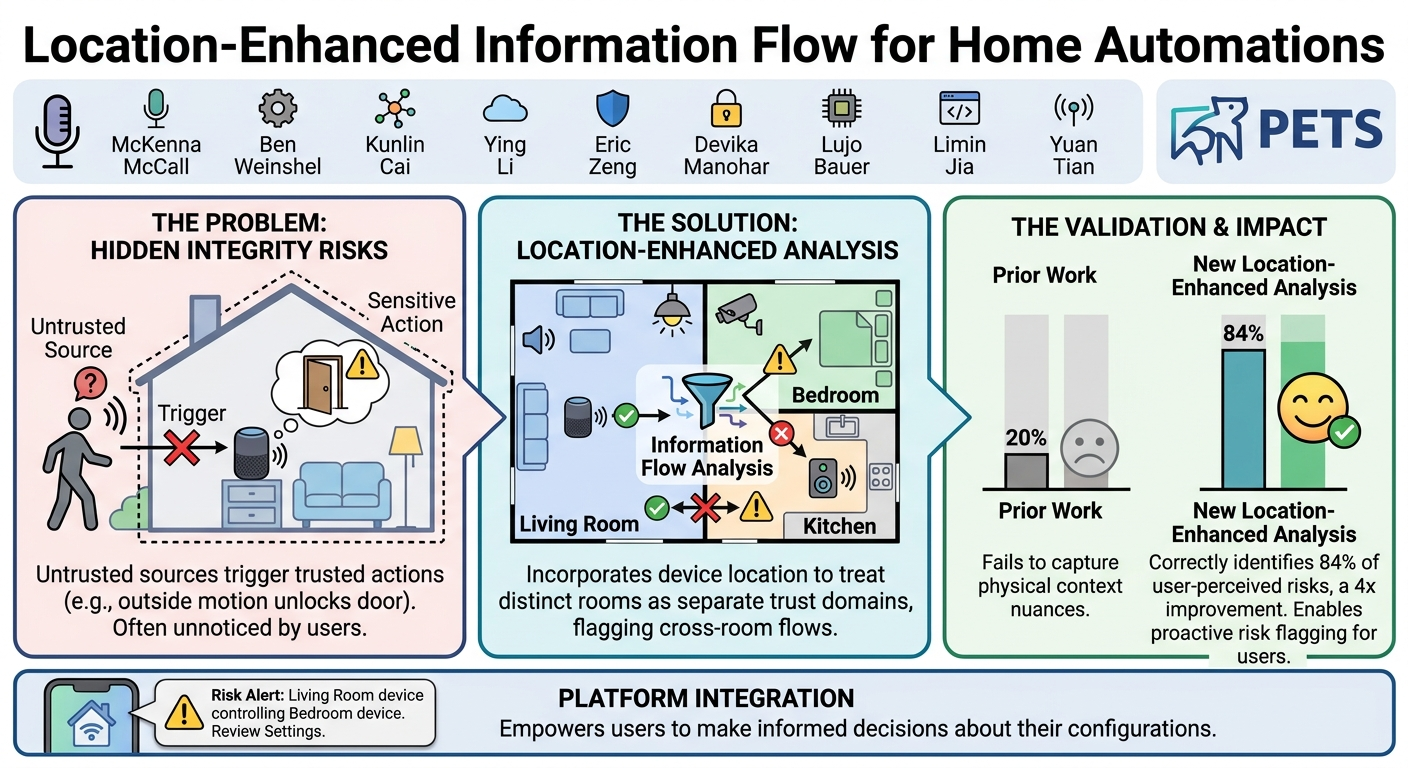
The core problem highlighted is the potential for integrity risks, where an untrusted source can illicitly trigger a more trusted action. Examples include an automation that unlocks a smart door based on motion in the front yard, allowing any passerby to gain entry, or a living room smart speaker being used to set an alarm in a bedroom at 3 AM. Existing security analysis tools, often based on information flow analysis, have proven inadequate for the nuanced, physical context of a home, failing to detect risks that users themselves perceive as concerning.
To bridge this gap, the researchers developed an improved information flow analysis specifically designed for the home environment, incorporating device location as a crucial factor. They validated this new analysis through an extensive interview study with 22 IoT users, collecting a dataset of 373 real-world automations and establishing a ground truth of user-perceived risks. Their findings demonstrate that this location-enhanced approach significantly outperforms prior work, correctly identifying 84% of automations deemed risky by users, compared to a mere 20% by previous methods. This research offers a vital step towards creating tools that can proactively flag these latent security vulnerabilities, empowering users to make informed decisions about their smart home configurations.
Background
▶ Watch: Introduction: identifying risky home automations (0:00)
The promise of smart homes revolves around increased comfort, convenience, and efficiency. Users can automate tasks like turning on lights, brewing coffee in the morning, or adjusting thermostats based on presence, often leading to tangible benefits like energy savings. These automations typically follow a simple trigger-action pattern: If a certain condition (trigger) is met, then a specified action is executed. Popular platforms such as Amazon Alexa, Home Assistant, and IFTTT provide robust frameworks for users to configure these rules.
However, this convenience often comes at the cost of unforeseen security and privacy implications. The talk emphasizes integrity risks, defined as scenarios where an untrusted source can cause a more trusted action. A common example involves a smart door configured to unlock when motion is detected in the front yard. While intended for the homeowner's convenience upon arrival, this automation lacks authentication, meaning anyone moving in the front yard could potentially unlock the door. Another illustrative case involves multiple Amazon Echo devices in a home: a guest in the living room might unintentionally, or even maliciously, command the living room Alexa to set an alarm in a bedroom. Even more subtly, if windows are open, an individual outside the home could shout commands to an accessible smart speaker, triggering actions within the home. These examples highlight how seemingly innocuous automations can open doors to significant security vulnerabilities that are not immediately obvious to the average user.
To address such risks, prior research has leveraged information flow analysis. This technique involves assigning labels to data sources (triggers) and sinks (actions) based on their trustworthiness or sensitivity, and then evaluating whether information is allowed to flow between them according to a predefined lattice. For integrity risks, the focus is on preventing information from flowing from less trusted sources to more trusted actions. Prior work often used a simplified set of labels: Untrusted for external entities (e.g., someone outside the home) and Restricted Physical for entities within the home (e.g., someone inside a room). Using this model, the "front yard motion unlocks door" example would be flagged as a violation because Untrusted (motion outside) flows to Restricted Physical (unlocking the door), which is a downward flow in the lattice and thus disallowed.
While effective for automations that bridge online services with the physical world (like IFTTT's "blink lights when favorite team scores"), this prior analysis falls short in capturing the intricate nuances of a smart home's internal environment. The "living room Alexa sets bedroom alarm" scenario perfectly illustrates this limitation. Under the previous labeling scheme, both the trigger (living room Alexa) and the action (bedroom alarm) would be labeled Restricted Physical because they are both within the home. Consequently, the information flow analysis would not detect a violation, as Restricted Physical to Restricted Physical is considered permissible. Yet, as the researchers point out, many users would intuitively perceive this automation as problematic. The separation of rooms, and the different levels of access granted to guests in various spaces (e.g., a living room vs. a bedroom), are critical contextual factors that the Restricted Physical label fails to capture. This disconnect between analytical models and user perception underscored the need for a more granular, context-aware approach to information flow analysis within the home.
Key Findings
▶ Watch: New analysis: device location for risk detection (4:07)
The central contribution of this research is the development and validation of an improved information flow analysis that explicitly incorporates device location within the home. This enhancement significantly increases the accuracy of identifying risky automations, aligning more closely with users' actual security concerns.
The researchers' methodology involved several key steps, culminating in compelling findings:
- Refined Information Flow Analysis: The core innovation lies in adapting the traditional information flow model to account for the spatial organization of a home. Instead of a single "restricted physical" label for the entire interior, each room is assigned its own distinct label. The principle is that information flow is generally permissible within a single room but restricted or flagged when it attempts to flow between different rooms, reflecting the natural boundaries and varying trust levels users associate with different physical spaces.
- Comprehensive User Study and Data Collection: Recognizing the lack of suitable datasets, the team conducted an in-depth interview study with 22 IoT users recruited from Prolific. Participants shared their screens and discussed all their smart home automations across all platforms they used, not just a single one. This approach yielded a diverse dataset of 373 automations, capturing the full spectrum of user configurations, including popular platforms like Amazon Alexa and Home Assistant, as well as smaller, single-purpose apps like Stage Lock. Crucially, the study also collected detailed information about device locations and home layouts, which is essential for the location-enhanced analysis. The researchers also included "built-in" automations (e.g., direct voice commands to turn on lights) as they follow the same trigger-action pattern.
- Ground Truth Establishment: During the interviews, the researchers performed a live analysis of participants' automations, discussing specific hypothetical scenarios that might constitute an information flow violation. For instance, if a smart speaker was near an open window, they would ask about the concern of someone outside shouting commands. Out of 114 scenarios discussed in detail, participants expressed concern about 67 of them, providing a robust "ground truth" for evaluating the analysis. The study found that integrity risks (e.g., unauthorized actions) were generally more concerning to users than secrecy risks (e.g., someone learning if the home is occupied).
- Superior Performance of Location-Enhanced Analysis: When evaluated against this ground truth, the new location-enhanced analysis demonstrated significantly improved performance. It correctly flagged 84% of the automations that participants were concerned about. In stark contrast, the prior information flow analysis, which did not account for device location within the home, only identified 20% of these user-perceived risky automations. This highlights a four-fold improvement in identifying actual user concerns.
- Understanding False Positives: While the new analysis showed a substantial increase in true positives, it also exhibited a modest increase in false positives (flagging automations as risky when users weren't concerned). The majority of these false positives stemmed from simple lighting automations, such as having lights in the living room turn on lights in the kitchen. While technically an information flow violation under the room-segmented lattice, users generally did not perceive these as critical security risks. The authors argue that for a security tool, it is preferable to flag more potentially risky automations and allow users to make informed decisions, rather than missing critical vulnerabilities. Future work, however, aims to refine the analysis to reduce these non-critical false positives and explore optimal ways to communicate these nuanced risks to users.
Finally, the research team has made their artifact available, including an anonymized dataset of automations and the information flow analysis code, allowing for reproducibility and further research.
Technical Deep Dive
▶ Watch: Collecting real-world home automation data and user concerns (6:00)
The technical foundation of this research lies in extending traditional information flow analysis to incorporate the spatial context of a smart home. The core principle guiding this enhancement is that automations contained entirely within a single room are generally considered low risk, as the same individuals typically have access to all devices within that confined space. Conversely, automations that involve devices in different rooms introduce higher potential for risk, as they can bridge distinct access domains.
To implement this principle, the researchers modified the existing information flow model, which traditionally relies on a lattice structure to define permissible data flows. In the prior work, labels like Untrusted (outside the home) and Restricted Physical (inside the home) formed a simple two-tier lattice. Information was allowed to flow "upwards" in the lattice (e.g., Untrusted to Untrusted) but not "downwards" to a more trusted domain (e.g., Untrusted to Restricted Physical). The limitation was that the entire home was treated as a single Restricted Physical domain, failing to differentiate between rooms.
The improved analysis introduces a more granular labeling scheme. Instead of a generic Restricted Physical label, each room in the home is assigned a unique label (e.g., Living Room, Bedroom, Kitchen, Bathroom, Hallway). When an automation's trigger or action involves a device, that device's location dictates the label applied to that part of the automation. For example, a smart speaker in the living room would be labeled Living Room, and a smart light in the bedroom would be labeled Bedroom.
The lattice structure is then adapted to reflect these room-specific labels. In this extended lattice, information flow is explicitly permitted when the trigger and action labels are identical (e.g., Living Room to Living Room). This represents an automation where both components are within the same physical space, and thus, the same set of people have access to both the trigger and action devices. However, the critical modification is that direct information flow between different room labels is generally disallowed or flagged as a violation. This means a flow from Living Room to Bedroom would be considered an information flow violation because it represents a cross-room interaction, which the model deems potentially risky. This effectively partitions the Restricted Physical domain of the prior work into multiple, distinct, and largely isolated room-specific domains within the lattice.
Consider the problematic automation of a living room Alexa setting an alarm in the bedroom.
- Trigger: Voice command to Living Room Alexa. Label:
Living Room. - Action: Set alarm on Bedroom Smart Speaker. Label:
Bedroom. - Analysis: The proposed lattice disallows direct flow from
Living RoomtoBedroom. Therefore, this automation is correctly identified as a violation, aligning with user concerns about guests in the living room controlling devices in private spaces.
The data collection methodology was equally critical for this technical validation. The researchers employed a screen-sharing interview study with 22 IoT users. This direct observation method allowed them to comprehensively catalog all automations configured by users, spanning various platforms like Amazon Alexa, Home Assistant, and even smaller, dedicated apps like Stage Lock. Crucially, participants were asked about the precise physical location of each device involved in their automations and the layout of their homes, including which rooms were connected. This granular spatial data was indispensable for assigning the new room-specific labels and constructing an accurate representation of the home environment for analysis. The resulting dataset comprised 373 automations, a rich resource containing the trigger, action, and their respective locations, which is a significant advancement over existing datasets that often lack this critical spatial context.
The evaluation process involved:
- Coding and Labeling: All collected automation data was systematically coded and labeled according to the new room-specific information flow model.
- Running Analysis: The proposed information flow analysis was executed on the labeled dataset.
- Comparison to Ground Truth: The results of the analysis were then compared against the ground truth established from the user interviews, where participants had indicated their concern levels for specific automation scenarios. This allowed the team to quantify the accuracy of their model.
The paper provides further details on the precise construction of the lattices and the technical performance metrics, but the core innovation remains the contextualization of information flow within the physical boundaries of a home's rooms.
Demo / Proof of Concept
▶ Watch: False positives and future work for risk communication (9:00)
While the talk did not feature a live, interactive demonstration of a user-facing tool, the research itself constitutes a robust proof of concept for the location-enhanced information flow analysis. The entire methodology, from the development of the refined analysis to the comprehensive user study and evaluation, serves to validate the proposed approach.
Crucially, the authors have made their artifact publicly available. This artifact includes an anonymized dataset of automations collected from the user interviews, along with the information flow analysis code itself. This allows other researchers and interested parties to reproduce their findings, further investigate the dataset, and build upon their analytical framework. The availability of this code and data is a strong indicator of the technical viability and reproducibility of their proposed solution, effectively serving as the practical "demonstration" in an academic research context. The "live analysis" conducted during the user interviews, where researchers discussed specific scenarios with participants, further illustrates the practical application of their analysis in identifying potential risks, even if it wasn't a public-facing demo.
Defensive Implications
▶ Watch: Conclusion, paper details, and artifact availability (9:59)
The findings from this research offer critical insights for various stakeholders involved in the smart home ecosystem, from individual users to platform developers and security researchers. Implementing the principles of location-enhanced information flow analysis can significantly bolster the security posture of smart homes.
For Individual Users:
- Increased Awareness: Users should be made aware that automations, especially those spanning different rooms, can introduce subtle integrity risks. The seemingly innocuous act of a smart speaker in one room controlling a device in another can have unintended consequences.
- Device Placement Matters: The physical location of smart devices is not merely a matter of convenience but a critical security consideration. Placing devices like smart speakers near open windows or in easily accessible areas (e.g., a living room accessible to guests) can create vectors for unauthorized control over devices in more private spaces.
- Question Assumptions: When setting up new automations, users should proactively ask: "Who can trigger this, and what are the implications if someone I don't fully trust gains access to that trigger?" This critical thinking can help identify cross-room or external-to-internal risks.
- Review Existing Automations: Periodically reviewing all configured automations, particularly those involving sensitive actions (e.g., door locks, alarms, cameras) or cross-room interactions, is essential.
For Smart Home Platform Developers and Device Manufacturers:
- Integrate Location-Aware Analysis: Platforms should incorporate location-enhanced information flow analysis directly into their automation configuration interfaces. This means requiring users to specify device locations and then running a background analysis.
- Proactive Risk Flagging: When a user attempts to create an automation that violates the location-based information flow (e.g.,
Living RoomtoBedroom), the platform should immediately flag this as a potential risk. - Clear Risk Communication: Instead of generic warnings, platforms should provide specific, understandable explanations of why an automation is risky (e.g., "This automation allows anyone with access to your living room speaker to control your bedroom lights, which could be a privacy concern").
- Granular Access Control: Implement more granular access control policies that differentiate permissions based on device location or user role (e.g., a guest profile might only have access to living room devices, not bedroom devices).
- Default Secure Configurations: Consider more restrictive default settings for cross-room or external-facing automations, requiring explicit user overrides for less secure configurations.
- Contextual Permissions: Develop systems that can infer context (e.g., "windows open" via sensors) and dynamically adjust permissions or flag risks accordingly.
For Security Researchers and Academics:
- Refine Analysis Accuracy: Further research is needed to refine the analysis and reduce false positives, particularly for automations like "living room lights turn on kitchen lights" that users typically don't perceive as risky. This could involve user-configurable trust levels for different room types or actions.
- Effective Risk Communication: Developing intuitive and effective ways to communicate complex information flow risks to non-technical users remains a significant challenge. User interface design, natural language explanations, and interactive tools could be explored.
- Broader Application: The principles of location-enhanced information flow could be extended to other IoT environments beyond smart homes, such as smart offices or industrial settings, where spatial context also defines trust boundaries.
- Automated Remediation: Explore methods for not just identifying but also suggesting automated remediation strategies for risky automations.
By adopting these defensive measures, the smart home ecosystem can evolve towards greater security and user trust, mitigating the subtle but significant integrity risks that currently exist.
Key Takeaways
- Subtle Integrity Risks: Smart home automations, while convenient, introduce non-obvious integrity risks where untrusted sources can trigger trusted actions, often unnoticed by users.
- Limitations of Prior Analysis: Traditional information flow analysis failed to adequately capture the nuances of the home environment, particularly the distinction between different physical rooms, leading to missed vulnerabilities.
- Location as a Security Context: Incorporating device location into information flow analysis significantly improves the detection of risky automations by treating different rooms as distinct trust domains.
- User Alignment: The new location-enhanced analysis correctly identified 84% of automations that users perceived as risky, a substantial improvement over prior methods (20%), demonstrating alignment with user concerns.
- Proactive Risk Flagging: Security tools should proactively flag potential risks to users, even if it leads to some false positives (e.g., non-critical lighting automations), enabling users to make informed decisions.
- Call for Platform Integration: Smart home platform developers should integrate location-aware risk analysis, provide clear risk communication, and consider more granular access controls to enhance user security.
About the Speaker(s)
The primary presenter for this work was Ben Weinshel, a PhD student in societal computing at Carnegie Mellon University. He presented on behalf of a large, collaborative research team that contributed to the paper. The co-authors include:
- McKenna McCall (Paper author, Colorado State University)
- Kunlin Cai (Paper author, University of California, Los Angeles)
- Ying Li (Paper author, University of California, Los Angeles)
- Eric Zeng (Paper author, Georgetown University)
- Devika Manohar (Paper author, Carnegie Mellon University)
- Lujo Bauer (Paper author, Carnegie Mellon University)
- Limin Jia (Paper author, Carnegie Mellon University)
- Yuan Tian (Paper author, University of California, Los Angeles)
This research is a testament to the inter-institutional collaboration between Carnegie Mellon University, the University of California, Los Angeles, Colorado State University, and Georgetown University, bringing together diverse expertise in addressing complex security challenges in smart home environments.
Reviews
Dr. Zero (Offensive Security Researcher) — STRONG ACCEPT
Weinshel and the CMU crew took the broken, abstract academic models for IoT information flow and injected actual physical reality into them. They proved that treating a whole house as one trust zone is defensive malpractice, backing it up with a solid user study and open-sourced artifacts. It's the rare academic IoT paper that actually translates to how humans live and build automations.
Heather Calloway (CISO) — WEAK
This is academic privacy research focused on consumer smart home automations, making it largely outside the scope of a corporate security program. However, for teams managing executive protection or corporate smart-office environments, it highlights a critical physical-to-digital bridge risk: location-blind trust models.
→ Top-rated talks at Privacy Enhancing Technologies Symposium (PETS) 2026
All talks from Privacy Enhancing Technologies Symposium (PETS) 2026