"Because I didn't touch these and even don't know why I should to change these": Why App Developers Do (Not) Update Apple's Privacy Labels
Arwa Alsahdi (Paper author · The George Washington University), Jialiang Yan (Paper author · The George Washington University), Monica Kodwani (Paper author · The George Washington University), Matthias Fassl (Paper author · The George Washington University), Chris Kanich (Paper author · University of Illinois Chicago), Adam J. Aviv (Paper author · The George Washington University)
Privacy Enhancing Technologies Symposium (PETS) 2026 · Day 2 · Caribou
Overview
In an era where personal data is a valuable commodity, the transparency surrounding how mobile applications collect and utilize user information has become a critical concern. This talk, presented at PETS, delves into the efficacy and maintenance of Apple's Privacy Labels, a mechanism designed to provide users with clear, standardized disclosures about an app's data practices. Led by Arwa Alsahdi and her co-authors from The George Washington University and the University of Illinois Chicago, the research investigates a fundamental question: as apps evolve, do their self-reported privacy labels keep pace with these changes, or do they become outdated, potentially misleading users?
Key moments
- 0:00 The problem of data collection and Apple Privacy Labels
- 2:30 Less than 6% of apps update privacy labels
- 4:00 Apple's privacy manifest influences label updates
- 4:50 Developers' reasons for changing or not changing labels
- 7:50 Reasons for discrepancies between policies and privacy labels
- 8:00 Maintaining privacy labels is a socio-technical challenge
"Because I didn't touch these and even don't know why I should to change these": Why App Developers Do (Not) Update Apple's Privacy Labels
Speakers: Arwa Alsahdi (Paper author, The George Washington University); Jialiang Yan (Paper author, The George Washington University); Monica Kodwani (Paper author, The George Washington University); Matthias Fassl (Paper author, The George Washington University); Chris Kanich (Paper author, University of Illinois Chicago); Adam J. Aviv (Paper author, The George Washington University)
Conference: PETS
YouTube: https://www.youtube.com/watch?v=7jJcuKd4_as
Overview
In an era where personal data is a valuable commodity, the transparency surrounding how mobile applications collect and utilize user information has become a critical concern. This talk, presented at PETS, delves into the efficacy and maintenance of Apple's Privacy Labels, a mechanism designed to provide users with clear, standardized disclosures about an app's data practices. Led by Arwa Alsahdi and her co-authors from The George Washington University and the University of Illinois Chicago, the research investigates a fundamental question: as apps evolve, do their self-reported privacy labels keep pace with these changes, or do they become outdated, potentially misleading users?
The core of the study addresses the inherent challenge of self-attestation in privacy mechanisms. While Apple's Privacy Labels aim to empower users to make informed decisions before downloading an app, their accuracy hinges entirely on developers diligently updating them. The researchers employed a comprehensive mixed-methods approach, combining large-scale data analysis of nearly a million apps with developer surveys and in-depth interviews, to uncover the real-world motivations, processes, and discrepancies surrounding privacy label maintenance. The findings reveal a significant gap between the intended transparency and the actual implementation, highlighting a complex socio-technical problem that extends beyond simple documentation.
This research is particularly relevant for users, developers, and platform providers alike. For users, it sheds light on the limitations of relying solely on self-reported privacy information. For developers, it underscores the challenges and responsibilities associated with maintaining accurate disclosures in a rapidly changing app ecosystem. For Apple, it provides critical insights into the effectiveness of its transparency initiatives and points toward areas where platform interventions could be strengthened to foster greater accountability and accuracy in data practice reporting.
Background
▶ Watch: The problem of data collection and Apple Privacy Labels (0:00)
The proliferation of mobile applications has created a vast ecosystem where users routinely download software without a full understanding of the data collection practices embedded within. Investigations by journalists have repeatedly exposed how seemingly innocuous apps can collect sensitive user data, such as location information, which then flows into the hands of data brokers. These brokers, in turn, share or sell this data for various purposes, including targeted advertising and retail analytics, often without the user's explicit knowledge or consent. This pervasive lack of transparency has spurred a global push from regulators and privacy advocates to implement mechanisms that inform users about how their data is being handled.
Various transparency mechanisms have emerged to address this challenge, ranging from lengthy privacy policies and intrusive consent or cookie banners to more standardized disclosures on mobile platforms. Apple's Privacy Labels, introduced in late 2020, represent one such effort, aiming to provide a summarized and standardized description of an app's data practices directly within the App Store listing. These labels are structured into four main parts:
- Privacy Types: Indicating whether data is collected and if it's linked to the user's identity.
- Data Categories: Broad classifications of the types of data collected (e.g., location, contacts, health and fitness).
- Purpose of Data Collection: The specific reasons for collecting data (e.g., analytics, product personalization, developer advertising).
- Precise Data Type: Granular details about the exact data points collected within a category.
A critical aspect of Apple's Privacy Labels, and indeed many similar transparency initiatives, is their self-reported nature. Developers are responsible for accurately declaring their data practices, and crucially, these disclosures are not, to the best of the researchers' knowledge, systematically verified by the platform (Apple). This self-attestation model immediately raises a pertinent question: given that applications are dynamic entities, constantly evolving with new features, third-party SDKs, and bug fixes, do these privacy labels remain accurate over time, or do they quickly become outdated and potentially misleading? The inherent tension between the static nature of a reported label and the dynamic nature of app development forms the foundational problem that this research set out to explore.
Key Findings
▶ Watch: Apple's privacy manifest influences label updates (4:00)
The research embarked on answering critical questions regarding the evolution and maintenance of Apple's Privacy Labels: how frequently do they change, what motivates these changes (or lack thereof), and how do developers manage their accuracy? The study adopted a rigorous mixed-methods approach, combining a large-scale analysis of approximately 900,000 apps over a four-year period with a developer survey (sending 7,000 emails and receiving 128 responses) and semi-structured interviews with 19 developers.
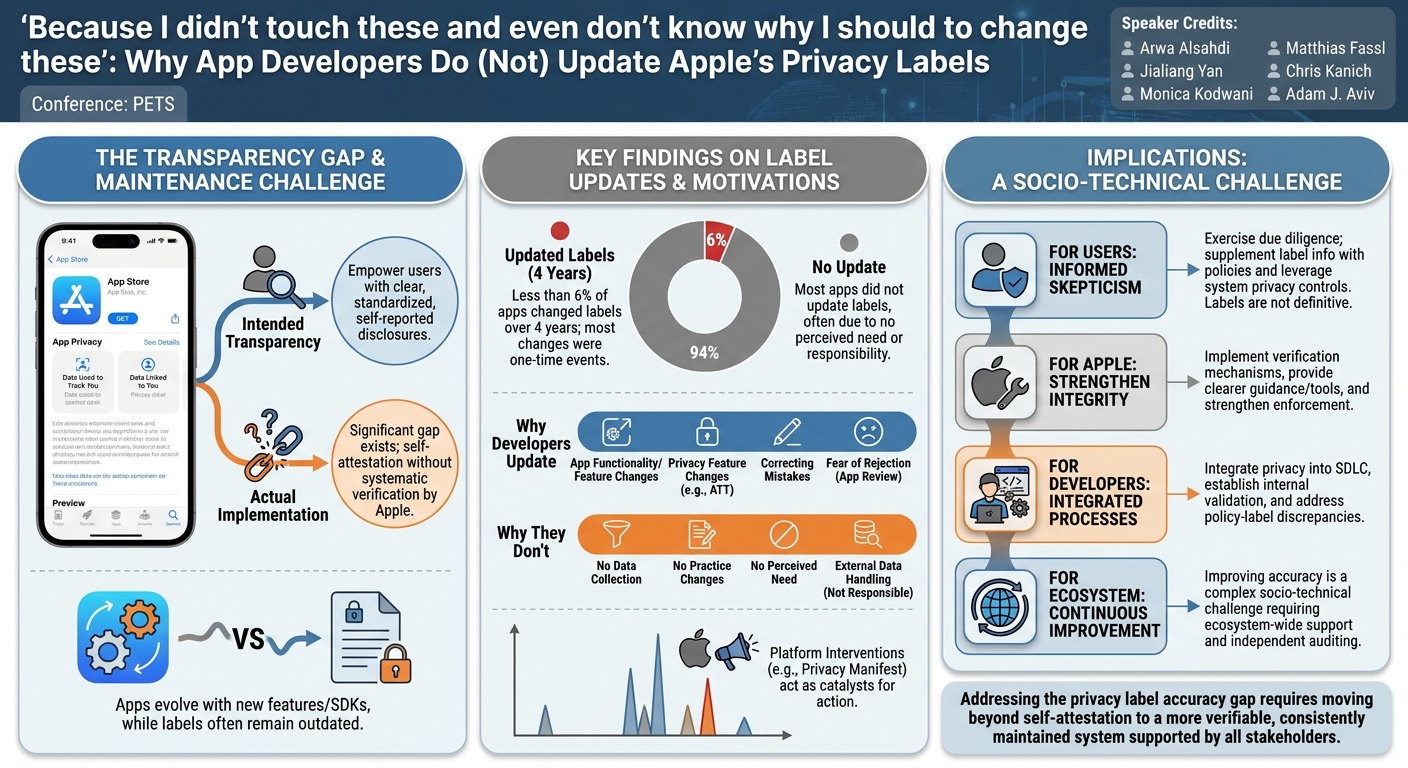
A striking finding from the large-scale analysis was the infrequent updating of privacy labels: less than 6% of apps changed their privacy labels over the four-year study period. Furthermore, when changes did occur, they were typically a one-time event, indicating a lack of continuous maintenance. The analysis identified three primary patterns of transition when labels were updated:
- Adding Tracking Data: The most common change involved developers disclosing that their app now collected "data used to track you," often reflecting shifts in their advertising or analytics practices.
- Shifting from No Collection to Collection: Apps that previously declared "data not collected" updated their labels to indicate active data collection, suggesting a change in functionality or the integration of new services.
- Granular Updates: Some developers made more refined changes, updating the specific purpose of data collection or the precise data types within existing categories.
While the overall number of apps with privacy labels increased significantly over the four years (a natural consequence of Apple requiring labels for new app versions and updates), the line representing apps declaring "data not collected" remained remarkably steady. Interestingly, spikes in privacy label changes observed in the data correlated with Apple's platform announcements, particularly around the introduction of the Privacy Manifest. This suggests that platform interventions can indeed influence when and how developers update their privacy disclosures, acting as a catalyst for action.
The developer survey and interviews provided crucial qualitative insights into the motivations behind these patterns. Developers who did change their privacy labels cited several key reasons:
- App Functionality/Feature Changes: Updates to reflect new app features or modifications to existing ones.
- Privacy Feature Changes: Specifically, changes related to Apple's App Tracking Transparency (ATT) framework.
- Correction of Mistakes: Rectifying previous, mistakenly set labels.
- Fear of Rejection: Concerns that inaccurate or outdated labels would lead to app rejection by Apple during the review process.
Conversely, developers who did not update their privacy labels offered equally compelling reasons:
- No Data Collection: Their apps genuinely did not collect user data.
- No Change in Data Practices: The app's data handling had remained consistent.
- No Perceived Need: Developers simply did not see a reason to modify the existing labels.
- External Data Handling: Data practices were managed by internal or external entities, absolving the app developer of direct responsibility for label updates.
The study also examined the relationship between privacy label changes and privacy policy updates. It was found that privacy policy changes were often superficial, focusing on language refinement or formatting updates rather than substantive shifts in data practices. Some developers admitted to keeping their privacy labels intentionally broad to cover multiple apps or potential future, unimplemented features, which could compromise accuracy.
Finally, the interviews revealed significant inconsistencies in the maintenance process of privacy labels. Team size played a role, with individual developers often managing labels themselves, while larger teams involved legal or product entities. Popular apps tended to be maintained more frequently than less popular ones, which often remained outdated. A critical finding was the lack of a reliable validation process; developers largely depended on platform acceptance as an implicit indication that their privacy disclosures were correct, rather than conducting their own thorough audits. When confronted with inconsistencies between their own privacy policies and labels (identified by prior research), developers attributed discrepancies to viewing labels as user-centric and policies as legal documents, the use of outdated policies, or the reliance on automated policy generation tools.
Technical Deep Dive
▶ Watch: Developers' reasons for changing or not changing labels (4:50)
Apple's Privacy Labels, introduced as part of iOS 14.5, represent a standardized attempt to provide users with transparent information about an app's data collection practices. Structurally, each label is divided into four main components designed to progressively reveal more detail:
- Privacy Types: At the highest level, this indicates whether data is "Collected," "Not Collected," or "Data Used to Track You." The "Data Used to Track You" category is particularly significant as it directly relates to Apple's App Tracking Transparency (ATT) framework, requiring explicit user consent for tracking across apps and websites owned by other companies.
- Data Categories: If data is collected, it's grouped into broad categories such as "Location," "Contact Info," "Health & Fitness," "Financial Info," "User Content," "Browsing History," "Usage Data," "Diagnostics," and "Other Data."
- Purpose of Data Collection: For each category, developers must specify the purpose for which the data is collected. Common purposes include "App Functionality," "Analytics," "Developer's Advertising or Marketing," "Third-Party Advertising," "Product Personalization," and "Security."
- Precise Data Type: The most granular level, detailing the exact data elements collected within a category and purpose combination (e.g., under "Location" for "App Functionality," the precise data type might be "Precise Location").
The critical technical and policy challenge inherent in this system is that all this information is self-reported by developers. Unlike a security audit or a formal certification, Apple does not, as far as publicly known, conduct extensive, automated verification of these claims. While apps do undergo a review process before being published on the App Store, the depth of privacy label verification during this process is not fully transparent. This reliance on developer honesty and diligence forms the bedrock of the study's focus.
The research methodology was meticulously designed to address this self-attestation problem through a multi-pronged approach:
1. Large-Scale Static Analysis of App Privacy Labels:
The researchers analyzed privacy label data from approximately 900,000 unique apps over a four-year period. This involved collecting historical data on privacy label declarations, tracking changes over time, and identifying patterns in how developers modified their disclosures. This extensive dataset allowed for quantitative analysis of:
- Frequency of Changes: Determining the percentage of apps that updated their labels and how often. The finding that less than 6% of apps changed their labels over four years, and most only once, is a direct result of this analysis.
- Types of Transitions: Identifying the common patterns of change, such as adding "Data Used to Track You" or shifting from "Data Not Collected" to active collection.
- Correlation with Platform Events: Overlaying the timeline of label changes with Apple's major privacy-related announcements, such as the introduction of the Privacy Manifest. The observed spikes in updates coinciding with these announcements provided strong evidence that platform interventions can act as significant motivators for developers. The Privacy Manifest, specifically, requires developers to declare third-party SDKs and their data collection practices, forcing a more rigorous review of privacy practices.
2. Developer Survey:
A survey was distributed via email to 7,000 developers, specifically targeting those whose apps had either changed or not changed their privacy labels. This allowed the researchers to gather insights into the reasons behind their actions. The survey queried developers on:
- Motivations for updating labels (e.g., feature changes, bug fixes, fear of rejection).
- Reasons for not updating labels (e.g., no data collection, no app changes, perceived irrelevance).
- The relationship between privacy label updates and changes to their broader privacy policies.
3. Semi-Structured Interviews:
Following the survey, 19 developers were selected for in-depth, semi-structured interviews. These interviews provided qualitative depth, exploring topics such as:
- Maintenance Processes: How developers manage privacy labels and policies within their development workflows, including team size effects (e.g., individual developers versus large teams with legal counsel).
- Perceived Usefulness: Developers' opinions on the value and impact of privacy labels.
- Relationship between Policies and Labels: How developers perceive the distinct roles and audiences of privacy policies (legal documents) and privacy labels (user-centric summaries).
- Discrepancies: Discussing specific instances where their privacy policies contradicted their privacy labels, and understanding the root causes (e.g., outdated policies, automated generation tools, broad declarations).
The combination of these methods allowed the researchers to move beyond mere statistical observations to understand the underlying human and organizational factors contributing to the accuracy and maintenance (or lack thereof) of Apple's Privacy Labels. The technical architecture of the labels themselves, coupled with the socio-technical ecosystem of app development, creates a complex challenge that requires more than just a simple documentation task.
Demo / Proof of Concept
▶ Watch: Reasons for discrepancies between policies and privacy labels (7:50)
This talk presented the findings of a comprehensive research study and did not include a live demonstration or proof-of-concept of a vulnerability or a software tool. Instead, the "proof" lay in the extensive quantitative data analysis of nearly a million apps and the rich qualitative insights gathered from developer surveys and interviews. These collective findings robustly demonstrated the current state of Apple Privacy Label accuracy and maintenance, highlighting discrepancies and systemic challenges within the app ecosystem rather than a specific exploit or technical workaround.
Defensive Implications
▶ Watch: Maintaining privacy labels is a socio-technical challenge (8:00)
The findings of this research carry significant implications for various stakeholders involved in the mobile app ecosystem, from end-users to platform providers and developers themselves. Understanding these implications is crucial for fostering a more transparent and trustworthy digital environment.
For Users:
The most immediate implication for users is a call for informed skepticism. While Apple's Privacy Labels are designed to be a transparency mechanism, this research clearly indicates that they are frequently outdated or intentionally broad, and not reliably verified by the platform. Users should not blindly trust these labels as definitive statements of an app's data practices. Instead, they should:
- Exercise Due Diligence: Supplement label information by reviewing the app's full privacy policy, if available, and considering the reputation of the developer.
- Be Aware of Dynamic Practices: Understand that app data collection can change with updates, even if the label remains static.
- Utilize System Privacy Controls: Leverage device-level privacy settings (e.g., location permissions, ATT consent) as a primary line of defense, as these are often more effective than relying solely on self-reported disclosures.
For Apple (Platform Providers):
The study highlights critical areas where platform intervention is needed to enhance the integrity of privacy labels:
- Implement Verification Mechanisms: The self-reported nature of labels is a significant weakness. Apple should explore and implement more robust, possibly automated, verification processes for privacy label submissions. This could involve static analysis of app binaries for SDKs, network traffic analysis, or even periodic audits.
- Provide Clearer Guidance and Tools: Developers expressed confusion and inconsistency in maintenance. Apple could offer clearer, more prescriptive guidelines, better tooling for generating and managing labels, and educational resources to ensure developers understand their obligations.
- Strengthen Enforcement: While fear of rejection motivates some updates, the low update rate suggests enforcement is not consistently driving accuracy. More transparent and consistent enforcement policies, potentially including penalties for demonstrably false or misleading labels, could incentivize better compliance.
- Leverage Platform Interventions: The success of the Privacy Manifest in driving label updates demonstrates the power of platform-level requirements. Apple should continue to introduce and evolve such mechanisms to proactively guide developers toward better privacy practices.
For Developers:
The research underscores that maintaining accurate privacy labels is not merely a bureaucratic task but a socio-technical challenge requiring integrated processes:
- Integrate Privacy into SDLC: Developers should embed privacy label review and updates into their standard Software Development Life Cycle (SDLC), especially after significant app updates, feature additions, or changes to third-party SDKs. This should be a continuous process, not a one-time declaration.
- Establish Internal Validation: Do not solely rely on platform acceptance as validation. Implement internal processes, potentially involving legal, product, and engineering teams, to regularly audit and verify the accuracy of privacy labels against actual data practices.
- Address Discrepancies: Actively work to resolve inconsistencies between privacy policies and privacy labels. While they may serve different audiences, fundamental contradictions erode user trust. Developers should strive for consistency in core data practice declarations.
- Transparency Beyond Labels: For individual developers or smaller teams lacking resources for bespoke policies, leveraging automated tools for policy generation is understandable. However, they must ensure these tools are kept up-to-date and that the generated policies accurately reflect their current practices.
- Understand SDK Behavior: A significant portion of data collection often comes from third-party SDKs. Developers must thoroughly understand the data collection practices of every SDK integrated into their apps and ensure these are accurately reflected in their privacy labels.
For Researchers and Auditors:
The study highlights the ongoing need for independent research and auditing of app privacy disclosures. Continued monitoring, development of automated tools for detecting discrepancies, and further qualitative studies are essential to hold platforms and developers accountable and to push for continuous improvement in digital transparency.
In essence, while Apple's Privacy Labels are a step towards greater transparency, their current implementation reveals a significant gap between intent and reality. Addressing this gap requires a concerted effort from all ecosystem participants, moving beyond simple self-attestation towards a more verifiable, consistently maintained, and truly informative system.
Key Takeaways
- Infrequent Updates: Less than 6% of apps updated their Apple Privacy Labels over a four-year period, with most changes occurring only once, indicating a lack of continuous maintenance.
- Reactive Motivations: Developers primarily update labels due to app functionality changes, privacy feature updates (e.g., App Tracking Transparency), correcting errors, or fear of app rejection by Apple.
- Inconsistent Maintenance: The process for maintaining privacy labels is highly inconsistent across developers, influenced by team size and app popularity, with a notable lack of reliable internal validation processes.
- Policy-Label Discrepancies: Developers often view privacy labels as user-centric summaries and privacy policies as legal documents, leading to discrepancies, outdated policies, or intentionally broad labels to cover multiple scenarios.
- Platform Influence: Apple's platform interventions, such as the introduction of the Privacy Manifest, significantly correlate with spikes in privacy label updates, demonstrating their effectiveness in driving developer action.
- Socio-Technical Challenge: Improving the accuracy and maintenance of privacy labels is not merely a documentation task but a complex socio-technical challenge requiring ecosystem-wide support, beyond just asking developers to update forms more frequently.
About the Speaker(s)
The research presented in this talk was a collaborative effort by several distinguished academics. Arwa Alsahdi, Jialiang Yan, Monica Kodwani, Matthias Fassl, and Adam J. Aviv are affiliated with The George Washington University, while Chris Kanich is associated with the University of Illinois Chicago. As authors of the paper, they are researchers specializing in areas related to privacy, security, and mobile application ecosystems. Arwa Alsahdi served as the primary presenter for this talk, articulating the team's comprehensive findings on developer behavior concerning Apple's Privacy Labels. Their collective work contributes significantly to understanding the complexities of transparency mechanisms in modern software development.
Reviews
Dr. Zero (Offensive Security Researcher) — WEAK
A massive empirical study proving what we already knew: Apple's self-reported Privacy Labels are marketing bullshit. The researchers scraped 900,000 apps to confirm that without forced validation, developers never update their data declarations. Solid data, but the conclusion won't shock anyone who has ever shipped code.
Heather Calloway (CISO) — SOLID
This research provides hard data on a problem security leaders already suspected: Apple’s Privacy Labels are compliance theater driven by unverified self-attestation. The finding that 94 percent of apps haven't updated their labels in four years is all the proof we need that you cannot outsource your third-party risk management to a platform's UI.
→ Top-rated talks at Privacy Enhancing Technologies Symposium (PETS) 2026
All talks from Privacy Enhancing Technologies Symposium (PETS) 2026