Dead Domains, Living Data: A Privacy Risk Analysis of Domain Lifecycle in Android Apps
Gabriel Hortea (Paper author · Universidad Carlos III de Madrid), Aniketh Girish (Paper author · IMDEA Networks Institute), Narseo Vallina-Rodríguez (Paper author · IMDEA Networks Institute), Juan Tapiador (Paper author · Universidad Carlos III de Madrid)
Privacy Enhancing Technologies Symposium (PETS) 2026 · Day 2 · Beaver
Overview
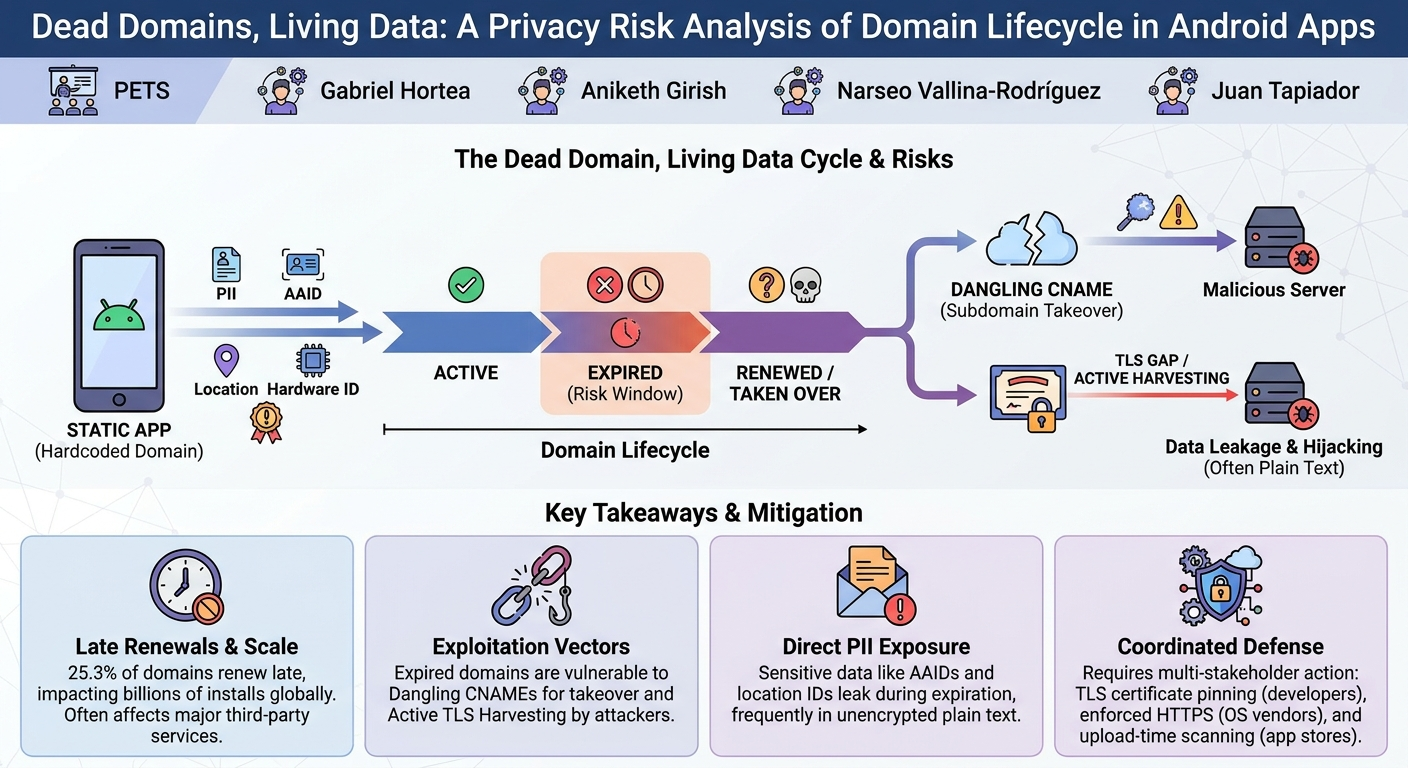
In an era where personal data is both ubiquitous and highly prized, the security and privacy implications of mobile applications continue to be a paramount concern. This talk, "Dead Domains, Living Data: A Privacy Risk Analysis of Domain Lifecycle in Android Apps," presented by Gabriel Hortea alongside co-authors Aniketh Girish, Narseo Vallina-Rodríguez, and Juan Tapiador, unveils a critical yet often overlooked vulnerability in the Android ecosystem: the mismanagement of domain lifecycles for embedded services within mobile applications. The research highlights how the static, long-lived nature of Android apps, combined with the dynamic lifecycle of internet domains, creates a significant privacy exposure risk.
Key moments
- 0:00 Introduction: Dead Domains, Living Data privacy problem
- 2:40 25.3% of domains renewed late, affecting popular apps
- 4:00 Dangling CNAMEs and active TLS certificate harvesting risks
- 6:10 Widespread PII exposure, often in plain text
- 7:15 Case study: Kochava.com leaking PII with dangling CNAMEs
- 8:15 Proposed solutions for developers, OS vendors, and app stores
- 9:00 Conclusion: Coordinated governance needed for mobile data privacy
Dead Domains, Living Data: A Privacy Risk Analysis of Domain Lifecycle in Android Apps
Speakers: Gabriel Hortea (PhD student, Universidad Carlos III de Madrid); Aniketh Girish (Paper author, IMDEA Networks Institute); Narseo Vallina-Rodríguez (Paper author, IMDEA Networks Institute); Juan Tapiador (Paper author, Universidad Carlos III de Madrid)
Conference: PETS
YouTube: https://www.youtube.com/watch?v=ZKzfl6s87vU
Overview
In an era where personal data is both ubiquitous and highly prized, the security and privacy implications of mobile applications continue to be a paramount concern. This talk, "Dead Domains, Living Data: A Privacy Risk Analysis of Domain Lifecycle in Android Apps," presented by Gabriel Hortea alongside co-authors Aniketh Girish, Narseo Vallina-Rodríguez, and Juan Tapiador, unveils a critical yet often overlooked vulnerability in the Android ecosystem: the mismanagement of domain lifecycles for embedded services within mobile applications. The research highlights how the static, long-lived nature of Android apps, combined with the dynamic lifecycle of internet domains, creates a significant privacy exposure risk.
The core premise is stark: when domains hardcoded into mobile applications expire, these apps can continue to transmit sensitive user data to what are effectively "dead" or uncontrolled endpoints. This can lead to a cascade of privacy issues, including broken TLS sessions, the exposure of Personally Identifiable Information (PII), and the potential for domain hijacking. The talk meticulously details the methodologies used to uncover these risks, quantifying the prevalence of late domain renewals, dangling CNAMEs, and PII leakage across a vast dataset of Android applications.
The findings underscore a systemic problem affecting billions of cumulative app installs, often involving high-profile third-party services. Hortea and his colleagues advocate for a multi-stakeholder, coordinated governance approach involving developers, OS vendors, app stores, registrars, and regulators to mitigate these pervasive threats. This research is vital for understanding a silent but significant vector for data compromise, urging the industry to address the inherent mismatch between app longevity and domain transience to better protect user privacy.
Background
▶ Watch: Introduction: Dead Domains, Living Data privacy problem (0:00)
The digital landscape of mobile applications presents a stark contrast to that of the traditional web. On the web, operators possess the agility to rapidly update, upload, or even decommission third-party dependencies with relative ease. Content Delivery Networks (CDNs), dynamic scripting, and robust update mechanisms allow for continuous adaptation and remediation of security or privacy issues. Mobile applications, however, are fundamentally different. They are typically static, long-lived binaries that, once installed, can persist on a user's device for years without updates. This longevity is often coupled with the practice of embedding hardcoded domains directly into the application's binary for critical services such as authentication, analytics, advertising, and backend communication.
This architectural reality creates a significant disconnect when juxtaposed with the dynamic and often unpredictable lifecycle of internet domains. Domains expire, change ownership, or are simply not renewed. When a domain embedded within an app reaches its expiration, the application, oblivious to this change, might continue to send data to that domain. This persistence of data transmission to an uncontrolled or potentially malicious endpoint generates a series of profound privacy and security issues. These include broken TLS sessions, which compromise the confidentiality and integrity of data in transit; the exposure of Personally Identifiable Information (PII) to unintended recipients; and the heightened risk of domain hijacking, where an attacker could register the expired domain and receive all data intended for the original service.
The problem is exacerbated by the sheer scale of the mobile ecosystem and the often opaque nature of third-party dependencies. Users are typically unaware of the myriad domains their apps communicate with, let alone the lifecycle status of those domains. This lack of transparency and control forms the bedrock of the research question posed by Hortea and his team: "How does life cycle mismanagement of embedded domains endpoint impact the privacy of mobile app users and their data?" Addressing this question is crucial for understanding and mitigating a silent yet pervasive privacy threat that undermines user trust and data security in the mobile domain.
Key Findings
▶ Watch: Dangling CNAMEs and active TLS certificate harvesting risks (4:00)
The research yielded several critical findings that collectively paint a concerning picture of privacy risks stemming from domain lifecycle mismanagement in Android applications. The methodical analysis uncovered systemic vulnerabilities across various stages of domain expiration and renewal.
Firstly, the study revealed a significant prevalence of late domain renewals. A striking 25.3% of the observed domains were renewed only after their expiration date, with an average delay of 16.5 hours. While the majority of these late renewals occurred within the typical grace period offered by registrars, a notable portion extended into the redemption phase or even the pending delete phase, where the domain becomes publicly available for re-registration. This period of vulnerability, even if brief, creates a window for potential exploitation. When categorizing these late renewals, 78.7% were found to belong to third-party infrastructure, indicating a widespread issue beyond first-party control. Critically, these third-party domains impacted an astonishing 78 billion cumulative installs on the Google Play Store, underscoring the massive scale of potential user exposure. Furthermore, a substantial 70.8% of these domains were listed in the Tranco top million, with 14.2% even making it into the Tranco top 10K list, signifying that these are not obscure or low-traffic domains but rather well-known and widely used services.
Secondly, the analysis of DNS records exposed a severe vulnerability: dangling CNAMEs. The researchers found that 25.3% of the domains that renewed after expiration had at least one dangling CNAME record pointing to a deallocated resource. This is a critical vector for subdomain takeover, where an attacker can register the deallocated resource and effectively hijack traffic intended for the original domain. Even more concerning, 15.6% of these domains were found to suffer from active TLS harvesting during their downtime. This phenomenon involves attackers issuing new TLS certificates for the expired domains, often using services like Let's Encrypt, during the period when the domain was vulnerable. Such certificates allow attackers to intercept and decrypt traffic, making the takeover appear legitimate to unsuspecting applications and users.
Thirdly, the study identified instances of registrar policy violations. In six specific cases within their dataset, domains remained expired far beyond the grace period stipulated by their respective registrars. These delays in renewal ranged from 42 days up to a full year, significantly exceeding typical grace periods that span from 18 days (e.g., GoDaddy) to a maximum of 45 days. Such prolonged periods of unmanaged expiration amplify the risk of hijacking and data exposure.
Fourthly, the research meticulously examined TLS certificate alignment with domain lifecycles, developing two key metrics:
- Lifetime mismatch: This future risk indicates whether a domain will have a valid TLS certificate when it expires. The study found that 70.5% of domains would suffer from this issue if certificate management is not properly aligned with domain renewal.
- Issuance lack: This metric represents an actual risk, indicating whether a domain had a valid certificate when it was renewed. A significant 70% of domains were found to suffer from this issue, meaning that upon renewal, they were operating without a secure communication channel.
Alarmingly, almost 15% of domains suffered from both issues simultaneously, while a mere 2.7% had no TLS-related problems at all. These pervasive TLS gaps create a "perfect storm" for privacy exposure.
Finally, and perhaps most critically, the research directly observed PII leakage during domain expiration. The study found numerous domains actively transmitting sensitive data during their vulnerable periods. These included:
- Advertising and tracking services leaking AAIDs (Android Advertising IDs), affecting over 5.9 billion cumulative installs.
- Back-end utility services leaking hardware IDs and geolocation IDs, impacting more than 50 billion cumulative installs.
Compounding this issue, roughly half of the domains found transmitting PII were doing so in plain text, meaning they lacked any TLS support. This renders the data vulnerable to passive interception, active tracking, and hijacking attacks, making the exposed PII easily readable by any entity intercepting the traffic.
Technical Deep Dive
▶ Watch: Widespread PII exposure, often in plain text (6:10)
The research methodology employed by Hortea and his team was robust and multi-faceted, designed to systematically identify and quantify the privacy risks associated with domain lifecycle mismanagement in Android apps. The process began with a large-scale data collection and filtering phase, followed by dynamic analysis, active measurements, and a detailed risk assessment.
The initial dataset comprised over 1 million APKs sourced from AndroZoo, a vast repository of Android applications. This extensive collection was then meticulously filtered down to 11,000 apps deemed suitable for dynamic analysis. The dynamic analysis phase involved executing these applications in a controlled environment while performing traffic interception. This allowed the researchers to observe and record all network communications initiated by the apps. From this intercepted traffic, they extracted second-level domains (SLDs) – the core part of a domain name (e.g., example.com from sub.example.com). This process yielded 9,100 unique second-level domains.
With this curated list of domains, the team embarked on an active DNS and TLS measurement campaign. For each unique domain, they performed several crucial checks:
- Whois Database Query: This allowed them to gather information about domain registration, including ownership, registrar, and crucially, expiration dates.
- TLS Certificate Inspection: They checked the validity and properties of any associated TLS certificates, noting issuance and expiration dates.
- DNS Resolution: Standard DNS lookups were performed to understand the current IP addresses and other associated records.
- Dangling CNAME Detection: A critical step involved checking for dangling CNAMEs. A CNAME (Canonical Name) record maps an alias domain name to another canonical domain name. A "dangling" CNAME occurs when the target domain of the CNAME record is no longer active or has been deallocated. This creates a vulnerability where an attacker can register the deallocated target domain and thus "take over" the alias domain, receiving traffic intended for the original service.
Based on the Whois expiration dates, a subset of 3,420 second-level domains was selected because their expiration dates fell within the researchers' observation interval (August 2024 to June 2025). This forward-looking approach allowed them to proactively monitor domains as they approached and passed their expiration.
The final stage was a comprehensive risk analysis, where the selected domains were classified and scrutinized for specific vulnerabilities:
- Domain Classification: Domains were categorized as either first-party (belonging to the app developer) or third-party (belonging to external services like ad networks or analytics providers). The prevalence of third-party domains in late renewals (78.7%) highlighted the systemic nature of the problem, indicating that app developers often rely on external services whose domain management they do not control.
- Registrar Policy Checks: The researchers cross-referenced observed domain renewal delays against the grace periods stipulated by registrars like GoDaddy. Findings of domains remaining expired for months or even a year beyond the grace period underscored severe operational negligence.
- TLS Gap Analysis: The two custom metrics, lifetime mismatch and issuance lack, were key here. Lifetime mismatch identifies domains whose TLS certificates are valid beyond the domain's expiration, creating a false sense of security for applications. Issuance lack, conversely, identifies domains that were renewed but lacked a valid TLS certificate at the time of renewal, leaving a window for unencrypted or compromised communication. The high percentages (70.5% and 70% respectively) illustrate a widespread failure in synchronizing domain and certificate lifecycles.
- PII Exposure Detection: This involved analyzing the content of the intercepted traffic to identify the transmission of sensitive information such as AAIDs (Android Advertising IDs), hardware IDs, geolocation IDs, Android IDs, and Bluetooth MAC addresses. The discovery that roughly half of the PII leakage occurred in plain text (without TLS encryption) was particularly alarming, as it removes any barrier to passive interception and direct exploitation.
The interplay of these technical issues creates a potent "privacy exposure storm." A late-renewed domain with dangling CNAMEs, a missing or expired TLS certificate, and an app still sending PII to it, constitutes a severe security and privacy breach. The research meticulously demonstrated how these individual technical failings combine to create a landscape ripe for data compromise and malicious exploitation.
Demo / Proof of Concept
▶ Watch: Proposed solutions for developers, OS vendors, and app stores (8:15)
While the presentation did not feature a live, interactive demo in the traditional sense, the researchers effectively presented case studies that served as concrete, real-world proof-of-concept examples of the vulnerabilities and risks they identified. These case studies vividly illustrated how dead domains can lead to living data exposure.
The first notable case study involved kochava.com. Kochava is a well-known mobile analytics and attribution platform. The researchers observed that this Polish analytics domain was down for approximately 16 hours. During this downtime, it was found to have three dangling CNAMEs pointing to deallocated resources. Crucially, applications continued to transmit sensitive PII to this domain, including AAIDs (Android Advertising IDs), Android IDs, and Bluetooth MAC addresses. The significance of this case is amplified by Kochava's history; the company had previously faced an FTC lawsuit specifically for selling precise user data. This historical context underscores the severity of data leakage from such a service, indicating that even entities with prior regulatory scrutiny can become vectors for privacy compromise due to domain lifecycle issues. The fact that the domain was still actively leaking such sensitive data during its expired state highlights the persistent risk.
The second compelling case study focused on t.co, the official URL shortener for the X (formerly Twitter) social network. Despite being down for a comparatively shorter period of 5 hours, this high-profile domain was found to have four dangling CNAMEs pointing to deallocated resources. During this period, apps were actively transmitting Android IDs and other identifiers to it. The key takeaway from the t.co example, as emphasized by the presenter, is not the duration of the downtime but rather the scale of applications and users that would have been affected had the domain been successfully hijacked. Given t.co's ubiquitous use across countless applications and websites for link sharing, a successful takeover of this domain, even for a few hours, could have exposed an immense volume of user data and facilitated widespread phishing or malware distribution campaigns.
These case studies served as powerful demonstrations of the research's core findings. They provided tangible evidence of:
- The reality of late domain renewals and downtimes.
- The existence of dangling CNAMEs creating clear opportunities for subdomain takeover.
- The active transmission of various types of PII (AAIDs, hardware IDs, geolocation, Android IDs) to these vulnerable endpoints.
- The potential for plain text data leakage when TLS is absent or mismanaged.
- The heightened risk associated with popular, widely integrated third-party services.
By presenting these specific examples, the researchers effectively moved from statistical findings to concrete, relatable scenarios, making the abstract concept of "dead domains, living data" undeniably real and impactful.
Defensive Implications
▶ Watch: Conclusion: Coordinated governance needed for mobile data privacy (9:00)
The pervasive nature of the privacy risks identified in this research underscores the urgent need for a coordinated, multi-stakeholder approach to mitigation. Gabriel Hortea explicitly stated that there is "no silver bullet" to solve this complex problem, emphasizing that effective defense requires collaboration across the entire mobile ecosystem.
For developers and SDK maintainers, the primary and most robust defense mechanism is TLS certificate pinning. Certificate pinning involves embedding a copy of (or a cryptographic hash of) a server's public key certificate directly within the mobile application. This ensures that the app will only communicate with servers presenting that specific certificate, or one signed by a trusted root specified by the pin. Even if a domain is hijacked and an attacker manages to obtain a valid TLS certificate from a Certificate Authority (like Let's Encrypt, as seen in the TLS harvesting cases), the app would refuse to connect because the certificate would not match the pinned one. This effectively neutralizes the threat of domain hijacking and active TLS harvesting, as the application would simply fail to establish a connection, preventing data transmission to a malicious endpoint. Developers must be diligent in managing these pins, updating them when certificates legitimately change, but the security benefit is substantial.
Operating System (OS) vendors, such as Google for Android, have a crucial role in enforcing a baseline level of security. Their responsibilities include enforcing HTTPS by default for all network communications and implementing robust mechanisms for revoking bad certificates. By making HTTPS mandatory, OS vendors can significantly reduce the instances of plain text PII leakage observed in the study. Furthermore, improving certificate revocation mechanisms (e.g., more efficient Certificate Revocation Lists or OCSP stapling) can help quickly invalidate certificates issued to hijacked domains, preventing attackers from maintaining a facade of legitimacy.
App stores, particularly the Google Play Store, are positioned as critical gatekeepers. They should implement more stringent security checks, including scanning applications at upload time for common vulnerabilities related to domain lifecycle management. This could involve identifying hardcoded domains, checking their current status, and flagging applications that rely on domains with a history of mismanagement. Additionally, app stores could play a proactive role by issuing developer alerts when domains used by their applications are nearing expiration or have expired, prompting developers to take corrective action. This would shift the burden of monitoring from individual developers to a centralized platform with greater visibility.
Finally, registrars and regulators also bear significant responsibility. Registrars, who manage domain registrations and renewals, should work towards standardizing grace periods and making them more transparent. The study highlighted cases where domains remained expired for vastly different durations beyond published grace periods. Clearer, more consistent policies, coupled with better communication to domain owners about impending expirations, could reduce the window of vulnerability. Regulators, on the other hand, need to establish clearer guidelines and potentially penalties for persistent domain mismanagement that leads to privacy breaches, especially for services handling sensitive user data. This would create a stronger incentive for all parties to prioritize responsible domain lifecycle management.
In essence, the defensive strategy is about creating layers of protection: from the application's code (pinning), to the operating system's policies (HTTPS enforcement), to the distribution platform's oversight (app store scanning), and finally to the fundamental infrastructure of the internet itself (registrar policies). Only through such a coordinated and comprehensive approach can the mobile ecosystem truly protect users from the privacy risks posed by dead domains transmitting living data.
Key Takeaways
- Pervasive Risk from Static Apps and Dynamic Domains: Mobile apps' static nature and reliance on hardcoded domains create a significant and often overlooked privacy vulnerability when those domains expire. Apps continue transmitting data, leading to PII exposure and hijacking risks.
- Widespread Late Renewals and Third-Party Impact: A substantial 25.3% of domains are renewed after expiration, with an average delay of 16.5 hours. The majority (78.7%) are third-party services, affecting billions of cumulative app installs, often involving popular and high-ranking domains.
- Critical DNS and TLS Vulnerabilities: Dangling CNAMEs affect 25.3% of late-renewed domains, creating easy subdomain takeover opportunities. Active TLS harvesting (issuing new certificates for expired domains) was observed in 15.6% of cases, making malicious takeovers appear legitimate. Furthermore, 70% of renewed domains lacked a valid TLS certificate at renewal, while 70.5% will have a certificate valid beyond their domain's expiration, creating dangerous TLS gaps.
- Direct PII Leakage, Often Unencrypted: The study directly observed PII leakage during domain expiration, including AAIDs (Android Advertising IDs), hardware IDs, and geolocation IDs, impacting tens of billions of cumulative installs. Alarmingly, approximately half of this sensitive data was transmitted in plain text, making it trivially interceptable and exploitable.
- Need for Coordinated Governance: Solving this complex issue requires a multi-stakeholder effort. Developers must implement TLS certificate pinning, OS vendors should enforce HTTPS and improve certificate revocation, app stores need to enhance upload-time scanning and developer alerts, and registrars/regulators must standardize grace periods and strengthen oversight.
- Protecting User Data in a Fragmented Ecosystem: The core message is that the mobile ecosystem lacks sufficient coordinated governance mechanisms to ensure user personal data remains within its intended, protected infrastructure. Addressing this requires systemic changes to secure the entire lifecycle of domain dependencies in mobile applications.
About the Speaker(s)
The research "Dead Domains, Living Data: A Privacy Risk Analysis of Domain Lifecycle in Android Apps" was a collaborative effort presented by Gabriel Hortea. Gabriel Hortea is a PhD student at Universidad Carlos III de Madrid (UC3M) in Madrid, where he conducted this work with his advisor, Juan Tapiador.
Juan Tapiador is also affiliated with Universidad Carlos III de Madrid.
Their colleagues who co-authored the paper and contributed to this significant research are Aniketh Girish and Narseo Vallina-Rodríguez, both from the IMDEA Networks Institute in Madrid. This joint work between academic institutions highlights a concerted effort to address critical privacy and security challenges in the mobile application landscape.
Reviews
Dr. Zero (Offensive Security Researcher) — MUST SEE
Hortea and the UC3M/IMDEA crew did the heavy lifting to prove just how badly mobile developers mismanage domain lifecycles. We've known about domain takeovers forever, but proving active TLS harvesting on expired hardcoded Android dependencies at this scale makes this a mandatory read.
Heather Calloway (CISO) — MUST SEE
This research exposes a massive blind spot in mobile application supply chains: hardcoded domains that expire and become hostile data sinks. It proves that a forgotten domain renewal by a third-party analytics vendor can trigger a catastrophic privacy breach for any enterprise embedding their SDK. Required reading for anyone managing consumer-facing mobile apps or evaluating vendor risk.
→ Top-rated talks at Privacy Enhancing Technologies Symposium (PETS) 2026
All talks from Privacy Enhancing Technologies Symposium (PETS) 2026