Panoptes: Detecting Out-of-Sight Privacy Exposure in Android
Sajjad Pourali (Paper author · Concordia University), Mohammad Mannan (Paper author · Concordia University)
Privacy Enhancing Technologies Symposium (PETS) 2026 · Day 2 · Beaver
Overview
In the realm of Android privacy research, the focus has traditionally been on data exposure during foreground activities—when users are actively interacting with an application. However, a significant blind spot exists: what happens when an app is minimized, closed, or has never even been opened after installation? This talk introduces Panoptes, a groundbreaking dynamic analysis tool designed to uncover out-of-sight privacy exposure in Android applications. Developed by Sajjad Pourali and Dr. Mohammad Mannan at Concordia University, Panoptes addresses the critical challenge of detecting and attributing privacy-sensitive operations that occur without the user's direct awareness or interaction.
Key moments
- 0:20 Defining out-of-sight privacy exposure in Android apps
- 2:20 Introducing Panoptes: detecting and attributing hidden privacy risks
- 3:40 Novel stack trace injection for network traffic attribution
- 4:40 Analyzing 14,000 Android apps in 5 days
- 6:00 Over half of app connections from hidden background works
- 6:40 Examples of sensitive data collected via background APIs
- 7:40 Critical post-installation vulnerability in Android 13 discovered
- 8:40 Reporting findings to Google and plans for open-sourcing
Panoptes: Detecting Out-of-Sight Privacy Exposure in Android
Speakers: Sajjad Pourali, Concordia University; Mohammad Mannan, Concordia University
Conference: PETS
YouTube: https://www.youtube.com/watch?v=-XZL-QZUAUw
Overview
In the realm of Android privacy research, the focus has traditionally been on data exposure during foreground activities—when users are actively interacting with an application. However, a significant blind spot exists: what happens when an app is minimized, closed, or has never even been opened after installation? This talk introduces Panoptes, a groundbreaking dynamic analysis tool designed to uncover out-of-sight privacy exposure in Android applications. Developed by Sajjad Pourali and Dr. Mohammad Mannan at Concordia University, Panoptes addresses the critical challenge of detecting and attributing privacy-sensitive operations that occur without the user's direct awareness or interaction.
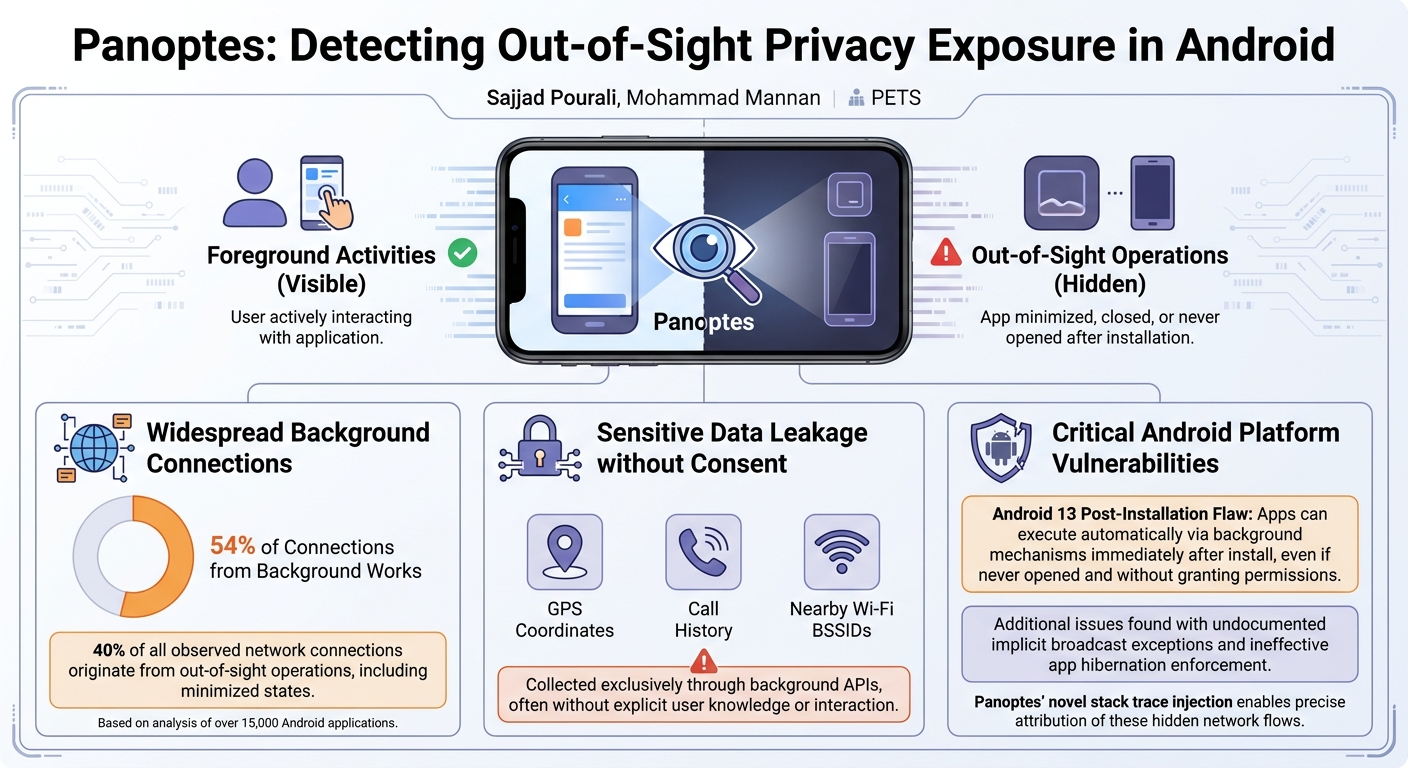
Panoptes is the first tool of its kind to automatically trigger these hidden background operations in a lab environment and precisely attribute network traffic and privacy-sensitive data transmissions to their originating components. This capability is paramount because Android applications, unlike traditional software, leverage various background work mechanisms that enable continuous operation regardless of their foreground status. The research highlights a pervasive issue where apps can surreptitiously collect sensitive user data, ranging from GPS coordinates and call history to nearby Wi-Fi network identifiers, all while remaining invisible to the user.
The significance of Panoptes lies in its ability to expose a widespread, largely undetected vector for privacy leakage. By analyzing over 15,000 popular Android applications, the researchers unveiled that a substantial portion of network connections and data collection activities occur through out-of-sight mechanisms, often without explicit user consent or even knowledge. The findings include critical architectural flaws and vulnerabilities in Android 13 itself, demonstrating that the problem extends beyond malicious apps to the very foundations of the operating system's privacy enforcement. This work not only sheds light on a critical security gap but also provides a concrete methodology and toolset for identifying and mitigating these stealthy privacy risks.
Background
▶ Watch: Defining out-of-sight privacy exposure in Android apps (0:20)
The landscape of Android privacy research has historically concentrated on data exposure that occurs when an application is in the foreground, meaning it's actively displayed and being interacted with by the user. This focus is understandable, as foreground activities are visible and directly involve user engagement. However, this narrow scope overlooks a vast and increasingly critical area of potential privacy compromise: out-of-sight operations. These operations encompass activities performed by an application when it is minimized, running in the background, completely closed, or even immediately after installation without ever being explicitly launched by the user.
Android's architecture, unlike that of traditional desktop operating systems, provides multiple entry points beyond the main activity, specifically designed for background works. These mechanisms allow applications to respond to system events (e.g., airplane mode toggle, new app installation), temporal conditions (e.g., timers, scheduled intervals), or other criteria defined by the app itself. While these features are often intended for legitimate purposes like syncing data or delivering notifications, they present a continuous privacy risk because they can operate independently of the app's current visibility or user interaction.
A major challenge in analyzing these background operations stems from the difficulty of reliably triggering them in a controlled laboratory environment. The criteria for these background works—such as specific system events or precise timing—are often complex and nearly infeasible to replicate consistently. Traditional static analysis struggles to capture the dynamic execution paths and real-world conditions necessary to activate these hidden components. Furthermore, existing dynamic analysis tools often fail to provide the granular detail required to attribute network traffic to its specific originating component.
Another significant hurdle arises from how Android applications handle network communication. Most Android apps heavily utilize asynchronous APIs for establishing network connections. This means that instead of directly executing a connection attempt within the calling code's context, the task is offloaded to an executor. Multiple components, potentially from different parts of the application or even different domains (e.g., alice.example and bob.example), might submit tasks to the same executor. When these tasks are executed, they often share the same process ID (PID), thread ID (TID), and even the same stack trace within the executor's context. This creates a severe attribution blind spot, making it extremely challenging to determine precisely which application component, or which specific piece of code, initiated a particular network connection. This lack of clear attribution prevents security researchers and privacy tools from accurately identifying the source of potentially malicious or privacy-invasive data transmissions. Panoptes was developed to directly address these fundamental limitations and shed light on the pervasive issue of out-of-sight privacy exposure.
Key Findings
▶ Watch: Novel stack trace injection for network traffic attribution (3:40)
Panoptes, as the first dynamic analysis tool capable of automatically triggering background operations and attributing out-of-sight network traffic, yielded significant and often surprising results from its large-scale evaluation. The researchers analyzed over 15,000 Android applications, selecting popular packages from Android rank, and successfully performed 14,000 analyses within five days using two Pixel 7 phones running Android 13.
The evaluation revealed a pervasive pattern of network activity and privacy exposure occurring outside the user's immediate view:
- Widespread Connectivity: A staggering 99% of the analyzed Android applications established at least one network connection, which, while high, is considered normal for modern apps.
- Dominance of Out-of-Sight Connections: For 94% of these applications, connections were established even when the app was not visible on the foreground screen, indicating that background activity is the norm rather than the exception.
- Background Work as a Primary Vector: More critically, 54% of all observed connections were directly attributable to background works. This means that regardless of whether an application was in the foreground, minimized, or entirely closed, its background components were actively initiating network communications.
- Overall Out-of-Sight Impact: In total, 40% of all network connections observed across the study originated from out-of-sight operations, encompassing both minimized states and dedicated background works.
Beyond mere network activity, the study uncovered alarming instances of sensitive data collection:
- Pervasive Data Collection via Background Works: Over 4,000 applications were found to be collecting private information exclusively through background work APIs. This implies these apps could gather data irrespective of their on-screen status.
- Specific Privacy Leaks: The researchers identified concrete examples of highly sensitive data exposure:
- One application was found collecting neighbor BSSIDs (Basic Service Set Identifiers), effectively turning the user's device into a "war driving" machine by passively mapping surrounding wireless networks.
- Another application was observed collecting phone call history, a highly personal data point.
- Approximately 30 applications were collecting GPS coordinates, providing precise location tracking, all through background work APIs, completely bypassing foreground visibility.
The Panoptes analysis also uncovered several critical vulnerabilities and architectural flaws within the Android ecosystem:
- Post-Installation Vulnerability (Android 13): A significant vulnerability was identified in Android 13, allowing an application to execute automatically via its background work mechanisms immediately after installation. This occurred even if the user never opened the app and without granting any explicit permissions. This flaw represents a severe security bypass, enabling apps to begin data collection or malicious operations from the moment they are installed.
- Undocumented Implicit Broadcast Exceptions: The study documented 13 previously undocumented implicit broadcast exceptions. These are system events that Android applications can register to listen for, allowing them to execute code based on various system activities without explicit user interaction or even clear documentation. This obscurity makes it difficult for developers and security researchers to fully understand and audit app behavior.
- App Hibernation Enforcement Problems: Panoptes also revealed issues with Android's app hibernation enforcement. While the system is designed to revoke permissions for apps not used for three months, the researchers found instances where certain permissions were not correctly revoked, potentially leaving dormant apps with excessive privileges.
These findings highlight a systemic problem where the Android framework's flexibility for background operations creates significant blind spots for privacy, which malicious or even overly aggressive applications can exploit. The identification of specific vulnerabilities, particularly the post-installation flaw in Android 13, underscores the need for platform-level improvements to protect user privacy. The researchers reported these issues to Google, who acknowledged the findings, rewarded the team, and committed to fixing the identified problems in future Android releases.
Technical Deep Dive
▶ Watch: Over half of app connections from hidden background works (6:00)
Panoptes is engineered with two primary components: data collection and data processing. This architecture enables it to systematically identify, trigger, and attribute out-of-sight privacy exposures in Android applications.
The data collection phase is responsible for monitoring app behavior and network connections. The core challenge here is to reliably trigger the myriad of potential background works that an Android application might employ. To overcome this, Panoptes employs a multi-pronged approach:
- Initial Manifest Scanning: Panoptes first performs a static analysis of the Android manifest files (
AndroidManifest.xml) of the target application. This provides a baseline understanding of all explicitly declared background work components, such asBroadcastReceivers,Services,JobSchedulerjobs, orWorkManagertasks, along with the system events or conditions they are designed to respond to. - ADB Command-based Triggering: For known background work types and specific criteria identified in the manifest, Panoptes leverages ADB (Android Debug Bridge) commands to programmatically simulate the conditions that would activate these components. While the full list of specific ADB commands is detailed in their paper, this method allows for a controlled and repeatable way to initiate declared background operations.
- Dynamic Monitoring and Trigger Queue: A crucial aspect of Panoptes' data collection is its ability to dynamically monitor the Android runtime for newly registered background works. Applications can register background tasks programmatically at runtime, not just through the manifest. When Panoptes detects such a registration, it adds the newly identified background work to a trigger queue. This queue ensures that all potential background operations, whether statically declared or dynamically registered, are eventually executed and analyzed. The analysis for a given app is considered complete when this trigger queue becomes empty.
The most innovative aspect of Panoptes, particularly for addressing the attribution blind spot in asynchronous network communications, is its novel stack trace injection mechanism. As previously discussed, Android's use of asynchronous APIs for networking often leads to multiple tasks executing within the same executor context, sharing PID, TID, and stack traces, making attribution nearly impossible. Panoptes solves this by:
- Intercepting Network Task Submission: Before a task intended for network communication is submitted to an Android executor (e.g.,
AsyncTask,ExecutorService,OkHttporVolleyinternal threads), Panoptes intercepts this submission. - Wrapping with a Synthetic Object: The original network task is then wrapped within a synthetic object. This custom object acts as a container, carrying additional metadata essential for attribution.
- Embedding Markers and Origin Information: Crucially, this synthetic object is injected with unique markers, along with the thread ID (TID) and process ID (PID) of the original component that initiated the network request. This "origin" information effectively tags the task with its true source.
- Post-Execution Stack Trace Analysis: When the wrapped task eventually executes within the executor, Panoptes' monitoring system detects the presence of these synthetic markers. Because the markers carry the original component's TID and PID, Panoptes can then correlate the network connection established by the executor with the specific component that initially requested it. This effectively creates an "additional record" in the stack trace, allowing Panoptes to cut through the shared executor context and accurately attribute every network connection originating from the Android runtime back to its precise source component.
The data processing phase then takes the collected app behaviors and attributed network connections and maps them against the criteria that triggered the background works. This allows Panoptes to not only identify what data was exposed and when but also why it was exposed (i.e., which system event or temporal condition was responsible). This comprehensive approach ensures that Panoptes provides a complete picture of out-of-sight privacy exposure, from initial trigger to final data transmission and attribution.
Demo / Proof of Concept
▶ Watch: Examples of sensitive data collected via background APIs (6:40)
While the talk itself did not feature a live, step-by-step demonstration of Panoptes in action, the entire evaluation process described by Sajjad Pourali serves as a large-scale, automated proof of concept. The analysis of over 15,000 Android applications, leading to 14,000 successful analyses, unequivocally demonstrated the tool's effectiveness and its capability to uncover widespread privacy exposure.
The "demo" was, in essence, the real-world application of Panoptes against a vast dataset of popular apps, downloaded directly from the Google Play Store and run on physical Pixel 7 devices with Android 13. The reported statistics—94% of connections occurring out-of-sight, 54% from background works, and the identification of specific data leaks like neighbor BSSIDs, phone call history, and GPS coordinates—are the direct results of this automated demonstration. Furthermore, the discovery of critical vulnerabilities in Android 13, such as the post-installation execution without user interaction or permissions, stands as a compelling testament to Panoptes' ability to not only identify app-specific privacy issues but also expose fundamental architectural flaws within the operating system itself. The successful reporting of these issues to Google and their subsequent commitment to fixes further validates the practical impact and efficacy of the Panoptes methodology and tool.
Defensive Implications
▶ Watch: Reporting findings to Google and plans for open-sourcing (8:40)
The findings from Panoptes have profound implications for app developers, Android users, and the platform developers at Google, highlighting critical areas where defensive strategies must be strengthened.
For Android users, the primary takeaway is a heightened awareness of the hidden activities of applications. The assumption that an app is inactive when not in the foreground is dangerously false. Users should:
- Be Skeptical of Permissions: Even if an app doesn't request sensitive permissions upfront, the post-installation vulnerability in Android 13 demonstrated that background works can execute without explicit grants. Users should be mindful of the reputation of apps they install and consider the necessity of any app that doesn't provide clear value.
- Monitor Data Usage: Keep an eye on background data usage through Android's built-in settings. Unexpected spikes in data consumption when an app is not actively used could be a red flag.
- Utilize Privacy Dashboards: Android 12 and later versions offer Privacy Dashboard features. Users should regularly review which apps are accessing sensitive permissions (location, microphone, camera) and when, looking for any anomalous background access.
- Consider App Hibernation: While Panoptes identified flaws in its enforcement, the intent of app hibernation is to revoke permissions for unused apps. Users should ensure this feature is enabled for apps they rarely use.
For app developers, the research underscores the need for greater transparency and stricter adherence to privacy-by-design principles:
- Audit Background Works: Developers must meticulously audit all background work mechanisms (e.g.,
JobScheduler,WorkManager,BroadcastReceivers,Services) to ensure they only collect data absolutely essential for the app's functionality and only when explicitly consented to by the user. - Explicit Attribution in Logging: Implementing robust internal logging that accurately attributes network requests to their originating component, similar to Panoptes' stack trace injection, can help developers debug and identify unintended data leaks.
- Minimize Data Collection: The principle of data minimization should be paramount. If data is not strictly necessary for the app's core function, it should not be collected, especially from background operations.
- Clear Disclosure: Developers should provide exceptionally clear and prominent disclosures about what data their app collects, why, and when, particularly for background operations.
For Google and the Android platform developers, Panoptes' findings demand immediate architectural and policy adjustments:
- Patch Vulnerabilities: The identified post-installation vulnerability in Android 13, the undocumented implicit broadcast exceptions, and the app hibernation enforcement issues must be fully patched and rigorously tested. Google's commitment to fixing these problems is a positive step.
- Enhanced Attribution Mechanisms: The platform could integrate robust, system-level attribution mechanisms for network traffic, perhaps inspired by Panoptes' stack trace injection, to provide greater transparency to both users and developers.
- Stricter Background Work Policies: Google should consider tightening policies and API restrictions around background work, especially for accessing sensitive data, making it more challenging for apps to operate stealthily without explicit, ongoing user consent.
- Improved Developer Tools: Provide developers with better tools and APIs to analyze and debug their own app's background operations, helping them identify and rectify unintended privacy exposures before release.
- Comprehensive Documentation: Fully document all implicit broadcast exceptions and other system events that can trigger background operations, ensuring developers have a complete understanding of potential execution paths.
Ultimately, the work on Panoptes serves as a critical call to action for the entire Android ecosystem to collectively address the pervasive and often invisible threat of out-of-sight privacy exposure.
Key Takeaways
- Out-of-Sight Privacy Exposure is Widespread: A significant portion (40% overall, 54% specifically from background works) of Android app network activity and data collection occurs when apps are minimized, closed, or never opened, posing a continuous privacy risk.
- Attribution is Key and Challenging: Android's asynchronous network APIs create an "attribution blind spot," making it difficult to pinpoint which component initiates a connection. Panoptes' stack trace injection is a novel solution for this.
- Sensitive Data is Leaked Stealthily: Apps were found collecting highly sensitive data like neighbor BSSIDs (war driving), phone call history, and GPS coordinates solely through background work APIs, often without user knowledge.
- Android Platform Vulnerabilities Exist: Panoptes uncovered critical flaws in Android 13, including a post-installation vulnerability allowing apps to execute background work without being opened or granted permissions, and issues with app hibernation enforcement.
- Defensive Measures Are Crucial: Users need greater awareness, developers must rigorously audit background operations for data minimization, and Google must patch platform vulnerabilities and enhance system-level transparency for background activities.
- Panoptes Offers a Solution: As the first dynamic analysis tool to automatically trigger and attribute background operations, Panoptes provides a powerful methodology for identifying and understanding these hidden privacy risks.
About the Speaker(s)
Sajjad Pourali is a researcher from Concordia University, where he conducted the work on Panoptes under the supervision of Dr. Mohammad Mannan. His presentation highlights his expertise in Android security and privacy, focusing on the often-overlooked aspects of background operations and their implications for user data.
Dr. Mohammad Mannan is a faculty member at Concordia University, Montreal. As the supervisor of this research, Dr. Mannan guides cutting-edge work in areas such as Android privacy and security, contributing significantly to the academic understanding and practical mitigation of complex software vulnerabilities. His involvement underscores the rigorous academic foundation of the Panoptes project.
Reviews
Dr. Zero (Offensive Security Researcher) — STRONG ACCEPT
Pourali and Mannan actually solved the asynchronous executor attribution nightmare that has plagued Android dynamic analysis for years. They used their tool to uncover a zero-click, post-installation background execution flaw in Android 13, making this a highly actionable, rigorous piece of academic research.
Heather Calloway (CISO) — MUST SEE
Concordia researchers prove that Android 13 apps can execute and exfiltrate data immediately upon installation, bypassing user interaction and permission prompts entirely. For enterprise security, this means user-centric 'hygiene' and permission reviews are dead controls; if your MDM doesn't strictly allowlist application installations, your mobile fleet is already leaking.
→ Top-rated talks at Privacy Enhancing Technologies Symposium (PETS) 2026
All talks from Privacy Enhancing Technologies Symposium (PETS) 2026