Designing Reflective Thinking-Based Contextual Privacy Policy for Mobile Applications
Shuning Zhang (Paper author · Tsinghua University), Sixing Tao (Paper author · University of Washington), Eve He (Paper author · Independent Researcher), Yuting Yang (Paper author · Independent Researcher), Ying Ma (Paper author · The University of Melbourne), Ailei Wang (Paper author · Tsinghua University), Xin Yi (Paper author · Tsinghua University), Hewu Li (Paper author · Tsinghua University)
Privacy Enhancing Technologies Symposium (PETS) 2026 · Day 2 · Caribou
Overview
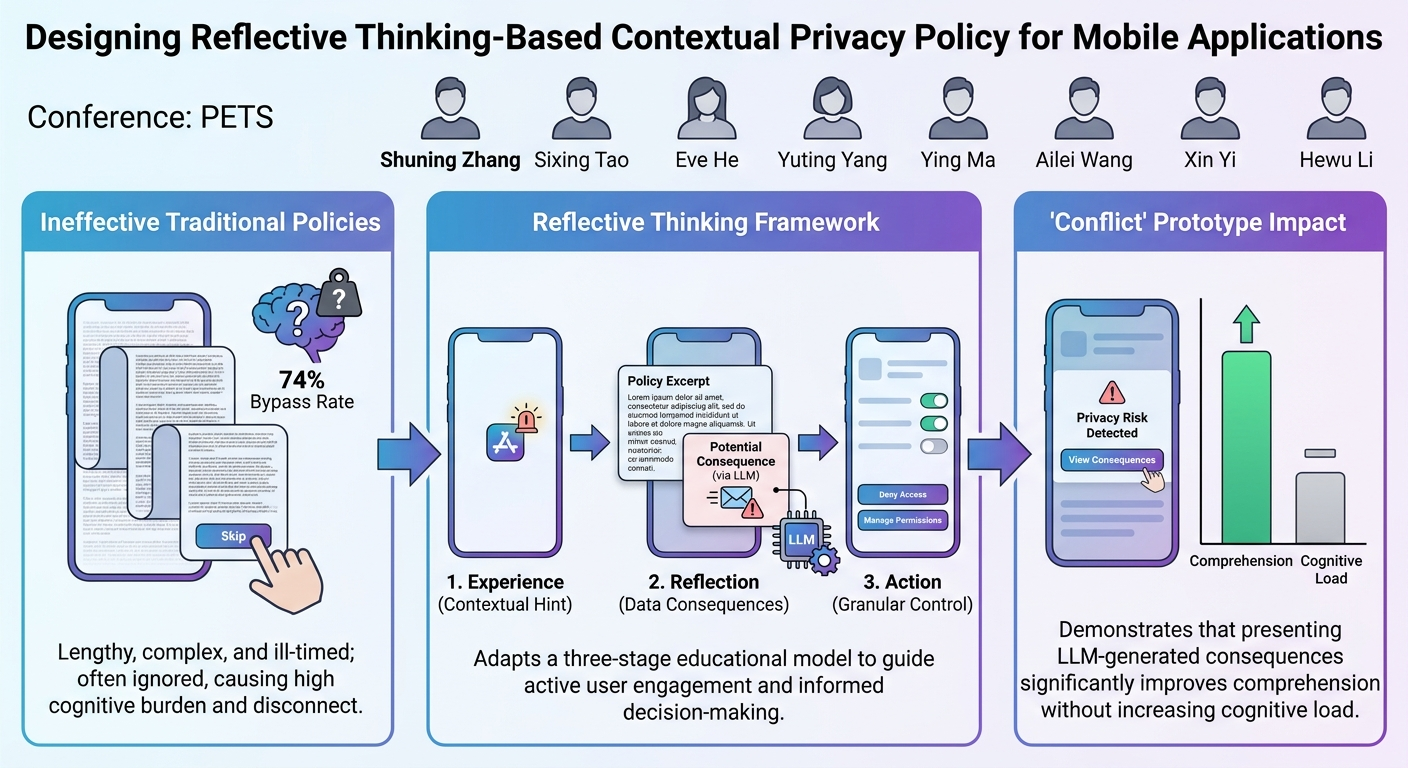
The digital landscape is rife with privacy concerns, yet the primary mechanism for informing users—privacy policies—remains largely ineffective. Traditional privacy policies are notorious for their overwhelming length, often exceeding 4,000 words, and are characterized by legal complexity and abstract language. This inherent opaqueness leads to a significant cognitive burden on users, who frequently encounter these policies at the point of app installation, a moment ill-suited for deep engagement. Compounding this, a staggering 74% of users are reported to completely bypass these documents, highlighting a critical disconnect between policy intent and user comprehension. This talk, presented by Shuning Zhang from Tsinghua University and their collaborators, directly addresses this pervasive problem by proposing a novel approach: reflective thinking-based contextual privacy policies for mobile applications.
Key moments
- 0:00 Introduction: The challenge of traditional privacy policies
- 2:00 Designing contextual policies with reflective thinking framework
- 4:00 Constructing the contextual privacy design space dimensions
- 5:00 Demonstrating the 'Conflict' prototype in action
- 6:00 User study findings: Improved comprehension, no overload
- 7:00 Limitations and future work: Study duration, LLM issues
- 7:50 Addressing large language model hallucinations in policy generation
Designing Reflective Thinking-Based Contextual Privacy Policy for Mobile Applications
Speakers: Shuning Zhang (PhD, Tsinghua University), Sixing Tao (University of Washington), Eve He (Independent Researcher), Yuting Yang (Independent Researcher), Ying Ma (The University of Melbourne), Ailei Wang (Tsinghua University), Xin Yi (Tsinghua University), Hewu Li (Tsinghua University)
Conference: PETS
YouTube: https://www.youtube.com/watch?v=FYxjvprcRj4
Overview
The digital landscape is rife with privacy concerns, yet the primary mechanism for informing users—privacy policies—remains largely ineffective. Traditional privacy policies are notorious for their overwhelming length, often exceeding 4,000 words, and are characterized by legal complexity and abstract language. This inherent opaqueness leads to a significant cognitive burden on users, who frequently encounter these policies at the point of app installation, a moment ill-suited for deep engagement. Compounding this, a staggering 74% of users are reported to completely bypass these documents, highlighting a critical disconnect between policy intent and user comprehension. This talk, presented by Shuning Zhang from Tsinghua University and their collaborators, directly addresses this pervasive problem by proposing a novel approach: reflective thinking-based contextual privacy policies for mobile applications.
The core of this research is to move beyond static, one-time disclosures and instead foster active user reflection and informed decision-making regarding data privacy. By grounding the design of contextual privacy policies in a three-stage reflective thinking framework, previously utilized in educational contexts, the researchers aim to bridge the cognitive gap that prevents users from connecting abstract policy statements to tangible, in-situ privacy risks during app usage. This innovative methodology seeks to transform passive information reception into an active process of engagement, comprehension, and control, thereby empowering users to make more conscious choices about their personal data. The work not only constructs a comprehensive design space for such policies but also instantiates and evaluates a prototype system called "Conflict," demonstrating the potential for this framework to significantly enhance user understanding and interaction with privacy information on mobile devices.
Background
▶ Watch: Introduction: The challenge of traditional privacy policies (0:00)
The challenges associated with privacy policies are well-documented and deeply entrenched in the design of digital services. Beyond their sheer length and legalistic prose, traditional policies suffer from fundamental presentation issues and cognitive barriers. Users are typically confronted with these extensive documents only during the installation phase of an application, a high-pressure moment where the primary goal is often to gain immediate access to the app's functionality, rather than meticulously scrutinizing lengthy legal texts. This temporal disconnect means that users are asked to make broad, abstract decisions about their data usage without the specific context of how that data will be utilized in real-time scenarios. Consequently, the abstract nature of policy language makes it exceedingly difficult for individuals to foresee or comprehend the practical implications and potential risks of data sharing as they interact with an application.
Prior initiatives to improve privacy policy communication have explored various avenues, each with its own merits and limitations. Early visualization efforts focused on machine-readable formats like P3P (Platform for Privacy Preferences Project), which aimed to automate privacy negotiations between websites and users, and more human-digestible formats such as privacy labels (akin to nutrition labels for data). While these approaches offered improvements in standardization and readability, they often failed to address the crucial issue of when privacy information is presented. These formats typically provide a static overview, not appearing at the precise moment a privacy risk materializes, leading to a persistent "temporal disconnect" where relevant information is not available at the point of need.
Subsequent advancements introduced just-in-time notices and contextual privacy policies, which sought to present privacy information directly at the point of interaction or when a specific data operation occurs. This was a significant step forward in addressing the temporal disconnect, ensuring that users received information closer to the relevant action. However, as the authors highlight, "timely delivery does not always mean meaningful engagement." Existing contextual privacy policies often function as mere "static disclosure mechanisms." They present information but do not inherently provoke active reflection, critical inquiry, or support informed decision-making. Users might see a notification, but without deeper engagement, the information can still be passively observed and quickly forgotten. This gap — the failure to connect abstract risks to concrete visualizations and to stimulate active user reflection — forms the critical problem statement that the presented research endeavors to solve, thereby justifying the need for a more cognitively grounded approach to privacy policy design.
Key Findings
▶ Watch: Constructing the contextual privacy design space dimensions (4:00)
The research presented in this talk yielded several significant findings, advancing the understanding and practical application of privacy policy design. At its foundational level, the study successfully constructed a reflective thinking-based design space for contextual privacy policies. Through expert workshops, the team synthesized six core problems that contextual privacy policies are uniquely positioned to solve, systematically mapping these to the three stages of the reflective thinking framework. This structured approach provides a valuable blueprint for future designers seeking to create more effective privacy interfaces.
A key contribution is the instantiation of these design principles into a functional prototype named "Conflict." This system demonstrates the practical feasibility of delivering reflective thinking-based privacy interventions within third-party mobile applications. The user study comparing "Conflict" to traditional contextual privacy policies revealed compelling results:
- Disruption of Habitual Action and Increased Understanding: "Conflict" was found to effectively disrupt users' habitual behaviors and significantly increase their understanding of privacy implications, as measured by widely accepted scales (e.g., Canvas questionnaire) used in Human-Computer Interaction (HCI) and security/privacy research. This indicates that the reflective thinking framework successfully prompted users to pause and consider their actions.
- Enhanced Comprehension Without Cognitive Overload: Crucially, the prototype managed to increase policy comprehension without simultaneously inducing a higher cognitive load. This was evidenced by improved scores on comprehension quizzes and favorable ratings on workload scales, suggesting that the system effectively delivers complex information in a digestible manner.
- Limitations in Short-Term Reflection: Interestingly, the study did not find a significant improvement in "reflection" and "critical reflection" as distinct cognitive processes within the short, one-hour duration of the user study. The researchers acknowledge this limitation, attributing it potentially to novelty effects inherent in short-term lab studies and suggesting the necessity of longitudinal research to observe sustained reflective thinking in realistic settings.
- High Accuracy of LLM-Generated Consequences: The technical evaluation of the system's ability to generate data consequences using Large Language Models (LLMs) demonstrated promising results. With carefully crafted prompts and "few-shot examples," the LLM achieved over 90% accuracy in generating relevant and grounded data consequences, highlighting the potential of AI in automating policy interpretation, while also acknowledging the ongoing challenge of mitigating hallucinations and errors.
- Trade-offs in Design Choices: The detailed analysis of the design space also highlighted inherent trade-offs between different design dimensions, such as effectiveness versus cognitive load. This underscores the need for designers to make informed choices based on specific user needs and application contexts.
In summary, the key findings validate the potential of a reflective thinking-based approach to significantly improve user engagement and comprehension of privacy policies, offering a pathway to more transparent and user-empowering digital experiences, albeit with clear directions for future research.
Technical Deep Dive
▶ Watch: Demonstrating the 'Conflict' prototype in action (5:00)
The technical foundation of this research is deeply rooted in the reflective thinking framework, adapted from educational and learning contexts to the domain of mobile privacy. The authors specifically adopted a three-stage framework (aligned with Jasper's model), which provides a structured approach to guiding users through a process of contemplation and action. These stages are:
- Experience: This initial stage aims to "spark reflection in action." It involves disrupting a user's habitual behavior by presenting a surprise, a contextual nudge, an alert, or a hint when a privacy-sensitive action is about to occur or data is being accessed. The goal is to make the user consciously aware of a potential privacy event, moving them out of passive interaction.
- Reflection: Following the initial disruption, this stage supports "conscientious inquiry into the why and how of data usage." It moves beyond passive observation by providing visualizations of data consequences or privacy risks, or by delivering detailed notifications. This stage helps users understand the implications of data collection and usage, connecting abstract policy statements to concrete personal impacts.
- Action: The final stage "maps insights to meaningful granular controls" that empower users to act. This could involve presenting binary choices (e.g., allow/deny), on-device controls, or on-screen controls that enable users to manage or mitigate the identified privacy risk. This ensures that reflection translates into tangible agency for the user.
To systematically develop this framework, the research followed a robust methodology structured around three primary research questions:
- RQ1: Design Space Construction: What dimensions constitute a reflective thinking-based design space for contextual privacy policies? This involved synthesizing expert insights.
- RQ2: Instantiation: What are the actual interface elements that embody these dimensions? This led to the development of the "Conflict" prototype.
- RQ3: Evaluation: How do users perceive the risk and interactive experience within this framework? This was addressed through user studies.
The methodology combined several approaches:
- Expert Workshops: Three expert workshops were conducted to synthesize user and expert designs, leading to the identification of six core problems that contextual privacy policies can address. These problems were then mapped to the three stages of the reflective thinking framework, visually represented as a Sankey diagram (conceptually, in the paper) to illustrate the flow and connections.
- Design Space Abstraction: The raw expert designs were abstracted into distinct groups for each stage:
- Experience: Encompassed designs like ambient and minimalist cues (subtle indicators), attention-grabbing alerts (more prominent notifications), and contextual hints (information directly relevant to the current app state).
- Reflection: Included summarization (concise overviews of policies), and layout disclosure of contextual information (structured presentation of relevant data usage details).
- Action: Focused on just-in-time granular controls (specific options to manage data at the moment of use) and binary choices (simple yes/no decisions).
- Trade-off Analysis: The study also ranked different designs based on their perceived effectiveness and feasibility, highlighting inherent trade-offs, for instance, between the efficacy of a design and the cognitive load it might impose on users. This guides designers in selecting appropriate interventions based on their specific needs and desired user experience.
- LLM for Consequence Generation: A critical technical component was the integration of Large Language Models (LLMs) for generating data consequences grounded in privacy policies. Recognizing the potential for LLMs to "hallucinate" or produce errors, the researchers implemented technical evaluations. By employing strategic prompting techniques, including the use of "few-shot examples" (providing the LLM with a small number of correct input-output pairs to guide its responses), they achieved an impressive accuracy of over 90%. This capability is crucial for the reflection stage, as it provides users with personalized and context-specific insights into the "why and how" of data usage, rather than generic policy text. However, the reliance on LLMs also necessitates ongoing mitigation strategies for false positives and false negatives, and the current generation process is static, relying solely on privacy risks. Future work aims to integrate user cognitive states and reading comprehension levels for more personalized output.
This comprehensive technical approach, from theoretical framework to practical implementation and evaluation, demonstrates a significant step forward in making privacy policies more comprehensible and actionable for mobile users.
Demo / Proof of Concept
▶ Watch: Limitations and future work: Study duration, LLM issues (7:00)
The practical instantiation of the reflective thinking-based framework is demonstrated through a prototype system named "Conflict." This system serves as a tangible proof of concept, illustrating how the theoretical stages of Experience, Reflection, and Action can be seamlessly integrated into a mobile user's interaction with third-party applications.
"Conflict" is conceptualized as a background service or an overlay application that can operate on third-party apps. Its primary function is to monitor app behavior for potential privacy risks and then provide contextual hints to the user. When a privacy-sensitive event occurs – for example, an app attempting to access contact numbers, financial data, or location information – "Conflict" intervenes.
The user experience with "Conflict" unfolds in a deliberate sequence that mirrors the three stages of reflective thinking:
- Experience (Contextual Hint): By default, when a privacy risk emerges, "Conflict" presents a contextual hint at the side of the screen. This is a minimalist yet attention-grabbing alert designed to disrupt habitual user behavior. For instance, if a game attempts to access the user's contacts, a small notification might appear, highlighting "communication contact numbers" as a privacy risk type. This initial nudge serves to make the user aware that something noteworthy regarding their privacy is happening, sparking their reflection in action.
- Reflection (Detailed Disclosure and Data Consequences): Users are encouraged to click on these contextual hints. Upon interaction, "Conflict" presents a more detailed notification. This notification contains two crucial pieces of information:
- Privacy Policy Excerpts: Relevant sections of the application's privacy policy are displayed, providing the official terms of data usage.
- Data Consequences: Crucially, and uniquely, "Conflict" also presents data consequences. These are plain-language explanations of what could happen if the data is shared, generated by the integrated Large Language Models (LLMs) and grounded in the policy. For example, instead of merely stating "we collect your contacts," it might explain, "sharing your contacts could allow this app to send unsolicited messages to your friends or build a social graph for targeted advertising." This visualization of consequences moves beyond abstract policy language, enabling users to consciously inquire into the "why and how" of data usage.
- Action (Granular Controls): After reflecting on the policy excerpts and potential consequences, users are empowered to act. "Conflict" provides options to dismiss the risk (acknowledging and allowing the action to proceed) or undo/mitigate the risk (exercising granular control over the data access or action). This could involve denying specific permissions or taking other on-screen actions to control their data, thus mapping insights to meaningful control.
The presentation explicitly contrasts "Conflict" with traditional contextual privacy policies, which typically only show a privacy policy excerpt when a risk emerges. By adding the crucial "reflection" stage with consequence visualization and integrating the "action" stage with granular controls, "Conflict" demonstrates a more holistic and effective approach to user privacy empowerment. The system was evaluated across various tasks, from travel booking to browsing, to assess its impact on reflective thinking, policy comprehension, and cognitive workload.
Defensive Implications
▶ Watch: Addressing large language model hallucinations in policy generation (7:50)
The insights gleaned from the "Designing Reflective Thinking-Based Contextual Privacy Policy for Mobile Applications" talk offer significant implications for defenders, ranging from app developers and privacy engineers to security professionals and policymakers. The core message is clear: static, legally-bound privacy policies are failing, and a more dynamic, user-centric approach is desperately needed.
For app developers and designers, this research provides a robust framework to move beyond boilerplate privacy disclosures. Instead of simply presenting legal text, they can leverage the three-stage reflective thinking model to design interfaces that genuinely inform and empower users. This means proactively identifying privacy-sensitive moments within their applications and then implementing contextual nudges (Experience), providing clear, consequence-driven explanations (Reflection), and offering granular controls (Action). This shift can lead to increased user trust and better compliance with privacy regulations, as users are more likely to understand and accept policies they have actively engaged with. Implementing systems like "Conflict" as part of the app's native privacy settings or integrating similar components into operating system-level privacy dashboards could become a standard for user-respecting design.
For security professionals and privacy engineers, the reliance on Large Language Models (LLMs) for generating data consequences introduces both opportunities and challenges. On one hand, LLMs can automate the complex task of translating legal jargon into understandable risks, scaling privacy explanations across numerous features and updates. The reported 90%+ accuracy with "few-shot examples" is promising. On the other hand, the inherent risk of LLM hallucinations (fabricating information) or generating false positives/negatives cannot be overlooked. Defenders must implement rigorous validation pipelines, potentially involving human review, adversarial testing, and continuous monitoring, to ensure the accuracy and trustworthiness of LLM-generated privacy information. A misinformed user, due to an LLM error, could make detrimental privacy decisions. Furthermore, the integration of such a system requires careful consideration of its performance overhead, security against tampering, and seamless operation across diverse mobile environments.
At a broader level, the research highlights the need for dynamic, context-aware privacy interventions. The static nature of current policies is a fundamental flaw. Defenders should advocate for and implement systems that adapt privacy information based on real-time app usage, user context, and even individual user preferences (e.g., cognitive states, reading comprehension levels), as suggested for future work. This personalization could significantly enhance the effectiveness of privacy education.
Finally, the study's call for longitudinal studies is a crucial defensive implication. While short-term lab studies show promising results in comprehension, the long-term effectiveness of such systems in fostering sustained reflective thinking and preventing "novelty effects" needs to be verified in realistic settings. Defenders should invest in or support research that tracks user behavior and privacy outcomes over extended periods to ensure that these advanced policy mechanisms deliver enduring benefits. This will help validate the investment in complex privacy interfaces and ensure they contribute to a more secure and privacy-aware user base in the long run.
Key Takeaways
- Traditional privacy policies are largely ineffective, characterized by overwhelming length, legal complexity, and abstract language, leading to 74% of users completely bypassing them and suffering from significant cognitive burden.
- The research proposes a novel reflective thinking-based contextual privacy policy design, adapting a three-stage framework (Experience, Reflection, Action) from educational contexts to empower users with active engagement and informed decision-making.
- The "Conflict" prototype successfully demonstrates how this framework can be instantiated in mobile applications, showing that contextual hints, detailed disclosures with data consequences, and granular controls can effectively disrupt habitual actions and significantly increase user comprehension.
- Large Language Models (LLMs) can be leveraged to generate context-specific data consequences from privacy policies, achieving over 90% accuracy with few-shot examples, but ongoing vigilance against hallucinations and errors is crucial for trustworthy information.
- While "Conflict" improved comprehension without inducing cognitive overload, the short-term nature of the study (1 hour) did not show significant improvements in "reflection" and "critical reflection," underscoring the need for longitudinal studies to confirm sustained effectiveness and mitigate novelty effects.
- Future advancements should focus on personalization, integrating factors like user cognitive states and reading comprehension levels to tailor privacy information, and expanding support for diverse languages to broaden the impact of reflective privacy design.
About the Speaker(s)
The talk was presented by Shuning Zhang, a PhD candidate from Tsinghua University. Shuning Zhang was the primary speaker and author of the paper, leading the presentation on their collaborative work. They explicitly mentioned being on the job market at the time of the talk, indicating their expertise and ongoing commitment to research in the field. The research itself was a collaborative effort, with contributions from a team of authors including Sixing Tao from the University of Washington, Ying Ma from The University of Melbourne, and Eve He and Yuting Yang as independent researchers, alongside Ailei Wang, Xin Yi, and Hewu Li, also from Tsinghua University. Their collective expertise in privacy, human-computer interaction, and mobile security shaped this detailed exploration into improving contextual privacy policies.
Reviews
Dr. Zero (Offensive Security Researcher) — WEAK
Classic academic HCI research trying to solve the EULA problem. They built a three-stage UI prototype to make users actually think about privacy risks, backed by an LLM parsing the legalese. It's a noble effort, but a one-hour lab study with a third-party overlay app doesn't survive contact with actual mobile OS security models.
Heather Calloway (CISO) — WEAK
This research prototypes a mobile UI that uses LLMs to interrupt users with real-time privacy consequences when an app accesses their data. While the framework is conceptually sound, deploying an LLM to dynamically interpret legal terms introduces significant compliance liability and UX friction. It's a solid academic proof-of-concept for privacy engineers, but not ready for enterprise implementation.
→ Top-rated talks at Privacy Enhancing Technologies Symposium (PETS) 2026
All talks from Privacy Enhancing Technologies Symposium (PETS) 2026