The DNS as National Critical Infrastructure in an Era of Geopolitical Tensions
Michael Hausding (Competence Lead for DNS and DNS Abuse · Switch)
Swiss Cyber Storm 2025 · Day 1 · Arena
Overview
Michael Hausding, Competence Lead for DNS and DNS Abuse at Switch (the operator of the .CH domain), presented a critical analysis of the Domain Name System (DNS) as a national critical infrastructure. The talk, delivered at Swiss Cyber Storm, delves into the intricate relationship between DNS resilience, digital sovereignty, and the escalating geopolitical tensions shaping the modern internet. Hausding meticulously dissects the complex ecosystem of the DNS, revealing hidden dependencies and jurisdictional vulnerabilities that could compromise a nation's ability to control its digital future.
Key moments
- 2:00 Microsoft's ICC email incident: a digital sovereignty wake-up call
- 7:00 Admin.ch example: full Swiss DNS sovereignty chain
- 12:00 Sanctions: hidden risk for domain names outside Switzerland
- 15:30 Canton example: hidden dependencies on foreign DNS providers
- 18:40 Swiss SMI companies' heavy reliance on US DNS providers
- 24:00 DNS used by Switzerland for gambling law enforcement
- 27:00 Q&A: Restoring connectivity after a national DNS cut-off
- 31:00 Q&A: Why DNSSEC adoption has stalled in Switzerland
The DNS as National Critical Infrastructure in an Era of Geopolitical Tensions
Speakers: Michael Hausding, Competence Lead for DNS and DNS Abuse, Switch
Conference: Swiss Cyber Storm
YouTube: https://www.youtube.com/watch?v=azuyEzxTbcM
Overview
Michael Hausding, Competence Lead for DNS and DNS Abuse at Switch (the operator of the .CH domain), presented a critical analysis of the Domain Name System (DNS) as a national critical infrastructure. The talk, delivered at Swiss Cyber Storm, delves into the intricate relationship between DNS resilience, digital sovereignty, and the escalating geopolitical tensions shaping the modern internet. Hausding meticulously dissects the complex ecosystem of the DNS, revealing hidden dependencies and jurisdictional vulnerabilities that could compromise a nation's ability to control its digital future.
This presentation is highly relevant in an increasingly interconnected and volatile world, where digital assets are as crucial as physical ones. As nations grapple with the concept of digital sovereignty—the ability of a state to control its critical infrastructure and prevent unauthorized access to its digital resources—the underlying mechanisms of the internet, particularly the DNS, come under intense scrutiny. Hausding's insights serve as a vital wake-up call, emphasizing that even seemingly robust national digital infrastructures can harbor subtle yet profound dependencies on foreign entities, making them susceptible to external pressures like sanctions or large-scale technical failures.
The talk underscores that resilience in a "mad max world," as the conference theme suggests, is not merely about technical uptime but also about jurisdictional independence and control over the foundational layers of the internet. By illustrating real-world examples, from the impact of sanctions on international organizations to the hidden reliance of major Swiss companies on foreign DNS providers, Hausding provides a compelling argument for a more deliberate and sovereign approach to national DNS management. His expertise, stemming from Switch's role in operating the .CH domain, lends significant weight to the technical and policy recommendations presented.
Background
▶ Watch: Microsoft's ICC email incident: a digital sovereignty wake-up call (2:00)
The concept of resilience in critical infrastructure operations is not new, but its application to the digital realm, particularly the DNS, gains heightened urgency in today's geopolitical landscape. Hausding frames his discussion within the broader context of digital sovereignty, a term currently under parliamentary discussion in Switzerland, aiming to define the state's control over its digital assets. An AI-assisted definition provided in the talk describes digital sovereignty as "the ability of a state or nation to have control over its critical infrastructure," particularly to prevent unauthorized access.
A stark illustration of this vulnerability emerged six months prior to the talk, when Microsoft abruptly halted email services for the International Criminal Court (ICC). While the ICC's specific .int domain (managed by IANA) wasn't directly targeted, the incident served as a "wake-up call for digital sovereignty." It demonstrated that reliance on infrastructure or services from another jurisdiction, even for an international organization, can lead to immediate cessation of service with little recourse. The ICC subsequently adopted Proton Mail, though MX records later indicated a return to Microsoft services, suggesting a resolution to the sanctions. This event highlighted the precariousness of digital dependencies.
The talk acknowledges the audience's basic understanding of the DNS as a critical infrastructure, reminding them of the "completely dark" internet that results from DNS failure, as evidenced by a recent AWS outage where DNS issues were a significant factor. Hausding then re-establishes the fundamental DNS ecosystem:
- Registrant: The owner of a domain name.
- Registrar: The entity where a domain name is purchased or registered.
- Registry: The operator of a Top-Level Domain (TLD), e.g., Switch for
.CH. - Name Servers:
- Root Servers: 13 logical servers worldwide (with hundreds of physical instances), the starting point for DNS resolution, telling recursive resolvers which server is responsible for a TLD.
- TLD Name Servers: Servers responsible for a specific TLD (e.g., Switch's servers for
.CH), directing queries to authoritative name servers. - Authoritative Name Servers: The servers holding the definitive records for a specific domain (e.g.,
swisscyberstorm.com). - Recursive Resolver: The server (often operated by an Internet Service Provider (ISP) or a public service like Google DNS) that performs the iterative queries to root, TLD, and authoritative servers to find the correct IP address for a queried domain.
Historically, the control over this system has been a point of contention. Hausding references the IANA transition in 2014, when oversight of IANA (the organization maintaining the root file) shifted from the US telecommunication regulation authority to the multi-stakeholder IANA community. This move, met with opposition from figures like Mr. Rubio concerned about the US losing control, underscores the geopolitical significance of the DNS root. More recently, Ukraine's request to IANA to remove .RU and other Russian domains from the root zone file was rejected, with IANA asserting it was not its role to make such political decisions and emphasizing the need for consent for country code TLD (ccTLD) changes. Hausding believes such a removal is highly unlikely, as it would fragment the internet and diminish IANA's, and by extension, US, influence. However, sanctions remain a potent threat, as demonstrated by a reseller 10 years ago who, upon moving to US jurisdiction, was forced to cease business with registrants from sanctioned countries like Iran, Cuba, and North Korea, effectively leading to the loss of their domain names. This highlights that while direct TLD removal is improbable, indirect disruption via sanctions on registrars or registries is a very real danger.
Key Findings
▶ Watch: Sanctions: hidden risk for domain names outside Switzerland (12:00)
Hausding's talk reveals several critical findings regarding Switzerland's DNS resilience and digital sovereignty, highlighting both strengths and significant vulnerabilities:
- Strong Legal Foundation for .CH: Switzerland possesses a robust legal framework through its Ordinance on Internet Domain Names, making it one of the first countries with such a law. This provides legal clarity and places
.CHdomains explicitly under Swiss jurisdiction, making it highly improbable for foreign courts to adjudicate disputes over them. This strong domestic control contrasts with generic TLDs (gTLDs) like.SWISSor.ZURICH, which are subject to both Swiss law and IANA rules. - Dominant but Dependent .CH Market Share: The
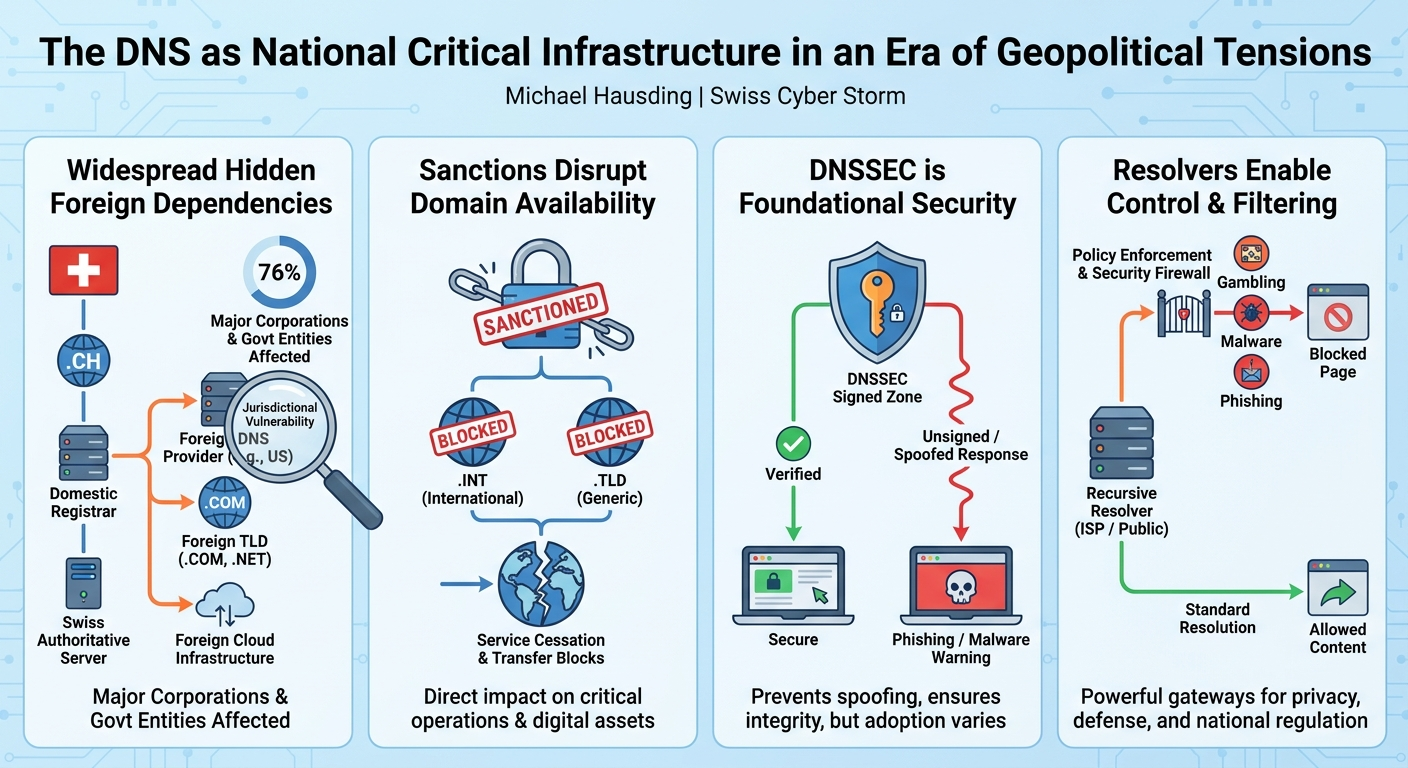
.CHdomain holds a significant market share of 58% in Switzerland, according to CENTR (Council of European National Top-Level Domain Registries) statistics. However, despite this domestic prevalence, many Swiss entities, including major corporations, exhibit surprising dependencies on foreign, predominantly US, infrastructure for their DNS resolution. - Ubiquitous Hidden Dependencies:
- Cross-Border TLD Reliance: Many Swiss entities, even those using a
.CHdomain, rely on name servers hosted within other TLDs, notably.COM. For instance, Nestle.ch uses name servers withinnestle.com, creating a dependency on Verisign (the.COMregistry, a US-based company). - Foreign DNS Providers: Canton Appenzell Ausserrhoden, despite being a Swiss government entity, uses Azure as its DNS provider, leading to queries going to US entities. Furthermore, Azure's use of multiple TLDs (
.ORG,.INFO,.COM,.NET) for its name servers creates four additional dependencies on US-controlled TLDs, significantly increasing the attack surface. - Industrial Dependencies on US Giants: A global statistic from APNIC shows that 76% of all authoritative DNS traffic flows to US providers. This trend is mirrored in Switzerland, where 80% of the 20 companies on the Swiss Market Index (SMI) rely on US-based authoritative DNS operators like AWS and Cloudflare. Only 20% use Swiss providers, primarily Swisscom.
- Swisscom's Internal .COM Dependency: Even Swisscom, a major Swiss ISP and the primary Swiss authoritative DNS provider for SMI companies, relies on the
.COMdomain for its own name servers (e.g.,swisscom.com). This means companies using Swisscom's DNS services are indirectly dependent on the.COMTLD and, by extension, US jurisdiction. A past outage for Swisscom customers occurred when an internal domain (iplus.net) used for name servers was not renewed, highlighting the fragility of such dependencies. - Varied DNSSEC Adoption: While Switzerland boasts a respectable DNSSEC adoption rate of 52% for
.CHdomains, significantly higher than the global average of 5-6%, the growth has stalled after addressing the "low-hanging fruits." Major Swiss ISPs (Swisscom, Sunrise) validate DNSSEC, protecting users from spoofing. However, fragmentation in the registrar/hosting market and occasional lapses (e.g.,admin.chtemporarily removing its DNSSEC signature) hinder broader adoption. - Rising Use of Public Recursive Resolvers: APNIC data shows a growing trend of Swiss users opting for public recursive resolvers like Google DNS (8.8.8.8), Cloudflare (1.1.1.1), or Quad9 (9.9.9.9), rather than their ISP's resolvers. While 80% still use ISP resolvers, the blue line indicating public resolver usage is rising. This shift has implications for privacy and national control over DNS traffic.
- DNS as a Nation-State Control Point: Switzerland itself utilizes DNS for regulatory control. The Money Gambling Law (Gill Gazettes) redirects users attempting to access unlicensed gambling sites (e.g.,
365bs.com) to a splash page from the Comlot commission. Furthermore, major Swiss ISPs (Swisscom, Sunrise) implement DNS firewalls to protect customers from phishing and malware by blocking access to known malicious domains, often redirecting them to a warning page. Switch's Quad9 service offers a free, privacy-focused DNS firewall alternative.
Technical Deep Dive
▶ Watch: Swiss SMI companies' heavy reliance on US DNS providers (18:40)
The technical architecture of the DNS is a multi-layered system, crucial for understanding its vulnerabilities. Hausding illustrates this with the three primary layers of authoritative name servers:
- Root Servers: Globally, there are 13 logical root servers, operated by various entities. In Switzerland, there are nine physical instances of these anycast root servers, located in Zurich and CERN. While physically present in Switzerland, none of the operating organizations are Swiss; they include entities like NASA, the University of Maryland, Verisign (US), and RIPE NCC (European). A recursive resolver's first step is to query a root server to find the authoritative name servers for a specific TLD.
- TLD Name Servers: Once the root server points to the correct TLD, the recursive resolver queries the TLD's name servers. For
.CH, Switch operates these servers within Switzerland, ensuring that this layer of the resolution chain remains under Swiss jurisdiction. - Authoritative Name Servers: The TLD server then directs the resolver to the authoritative name servers for the specific domain (e.g.,
swisscyberstorm.com). These servers hold the actual IP address mapping for the domain.
Hausding highlights that sovereignty issues arise when these layers cross jurisdictional boundaries. For instance, swisscyberstorm.com is a .COM address, meaning its TLD registry and authoritative servers are operated by Verisign, a US-based company, placing it under US law. Even a Swiss registrar like Swiss Sonic, now part of a Belgian consortium, doesn't negate this fundamental dependency.
A comparison between admin.ch and nestle.ch starkly illustrates these dependencies. For admin.ch, the Swiss Confederation has meticulously ensured a fully sovereign DNS chain:
- Registrar: Swiss-based registrar in Basel.
- Registry: Switch (
.CH), operated in Switzerland. - TLD Name Servers: Run by Switch in Switzerland.
- Authoritative Name Servers: Run by the Bundesamt für Informationstechnologie (Federal Office of Information Technology) in Switzerland.
- Name Server Entries: Crucially, the name server entries for
admin.chare within theadmin.chdomain and the.CHTLD, meaning no "outside jump" to other TLDs occurs. - Recursive Resolver: If a user is on a Swiss ISP network, the entire resolution chain remains within Swiss sovereignty.
In contrast, nestle.ch, despite being a prominent Swiss company with a .CH domain, demonstrates significant foreign dependencies:
- Registrar: Cumlauder, based in the UK.
- DNS Provider: A US entity.
- Name Server Entry: The critical dependency lies in its name server entry, which is within
nestle.com. This means that fornestle.chto resolve, the.COMTLD operated by Verisign (US) must function, creating a direct dependency on a US entity. If Verisign were compromised or subject to US sanctions,nestle.chcould become unreachable.
The speaker addresses the geopolitical question of whether IANA can be forced to remove a ccTLD from the root zone file. While Ukraine's request concerning Russian domains was rejected, the underlying concern about US influence over IANA remains. Hausding argues that such an action is highly improbable because it would "break the whole system," render IANA irrelevant, and diminish US influence over the internet, a scenario the US is unlikely to pursue. However, he reiterates that sanctions on registrars or registries, as seen with the reseller example, can effectively lead to domain loss for registrants in sanctioned territories, even if the TLD itself is not removed from the root.
DNSSEC (Domain Name System Security Extensions) is presented as a vital technical defense mechanism. DNSSEC adds cryptographic signatures to DNS data, allowing resolvers to verify the authenticity and integrity of responses. If a TLD or authoritative server were compromised and provided incorrect answers, a DNSSEC-validating resolver would detect the missing or invalid cryptographic key and reject the spoofed information, preventing users from being directed to malicious sites. With 52% of .CH domains signed and most major Swiss ISPs validating DNSSEC, Swiss internet users are relatively well-protected against DNS spoofing. The speaker notes that despite the open-source availability of robust DNS software like BIND, PowerDNS, NSD, and Unbound (for both authoritative and recursive functions), running one's own servers requires resources and expertise.
Finally, Hausding shifts focus to the recursive resolver part of the DNS, emphasizing its role in user privacy and security. While traffic to recursive resolvers can be encrypted, the resolver itself must see the queries to provide answers, raising privacy concerns. Furthermore, a malicious resolver can intentionally return fake answers. The increasing use of public resolvers (Google, Cloudflare, Quad9) over ISP-provided ones highlights a shift in control over this critical component. Nation-states, including Switzerland, have recognized resolvers as powerful control points, implementing DNS firewalls to enforce gambling laws and protect users from phishing and malware. This demonstrates the dual nature of DNS control: a tool for both national policy enforcement and user protection.
Demo / Proof of Concept
▶ Watch: DNS used by Switzerland for gambling law enforcement (24:00)
While the talk did not feature a live, interactive technical demonstration or a proof of concept exploit, Michael Hausding effectively demonstrated the core concepts through detailed, real-world examples of DNS resolution chains. He visually walked the audience through the multi-layered dependencies for various domains, including admin.ch, swisscyberstorm.com, and nestle.ch. These examples served as a powerful illustrative demonstration, highlighting how queries traverse different jurisdictions and revealing the "hidden dependencies" on foreign registrars, registries, and DNS providers. This methodical breakdown of DNS paths, complete with specific organizational and TLD examples, functioned as a clear and practical demonstration of the theoretical vulnerabilities and dependencies discussed.
Defensive Implications
▶ Watch: Q&A: Why DNSSEC adoption has stalled in Switzerland (31:00)
For any organization or nation concerned with digital sovereignty and resilience, Hausding's talk offers crucial defensive implications:
- Map Your Entire DNS Resolution Chain: Organizations must conduct a thorough audit to understand every component in their DNS resolution path, from registrar and registry to authoritative DNS providers and even the recursive resolvers used by their employees. Tools like DNSvis can help visualize the dependencies, though jurisdictional information often requires manual
whoisqueries. Identifying all cross-border and cross-TLD dependencies is paramount. - Prioritize Sovereign Infrastructure for Critical Assets: For critical national infrastructure and sensitive organizational domains, prioritize .CH domains (for Swiss entities) with Swiss-based registrars and registries. The legal clarity and jurisdictional control offered by the Swiss Ordinance on Internet Domain Names provide a significant layer of protection against foreign legal challenges or sanctions.
- Implement and Mandate DNSSEC: DNSSEC is a non-negotiable security measure. Organizations should ensure all their critical domains are DNSSEC-signed. Nations should actively promote and potentially mandate DNSSEC adoption for government and critical infrastructure domains. Resolvers should be configured to validate DNSSEC to protect users from spoofing and cache poisoning attacks.
- Diversify Authoritative DNS Providers: Relying on a single authoritative DNS provider, especially a foreign one, creates a single point of failure and a jurisdictional dependency. Organizations should consider using multiple, geographically diverse providers, ideally including a domestic one, or even running their own authoritative name servers using robust open-source software like BIND, PowerDNS, NSD, or Unbound.
- Scrutinize Recursive Resolver Usage: Recognize that recursive resolvers are powerful control points. Organizations should evaluate the privacy and security policies of the resolvers they use or recommend. For national digital sovereignty, promoting the use of trusted, domestic recursive resolvers (like those offered by Swiss ISPs or services like Quad9 from a Swiss foundation) can enhance privacy and provide a mechanism for national security filtering against malware and phishing.
- Be Aware of Hidden TLD Dependencies: Even if an organization uses a domestic authoritative DNS provider, check if that provider's name servers are themselves hosted under a foreign TLD (e.g.,
swisscom.com). This creates an indirect but significant dependency. Where possible, strive for name server entries to reside within the primary domain's TLD or a domestically controlled TLD. - Proactive Risk Assessment for Sanctions: Organizations with international operations or dependencies should conduct proactive risk assessments regarding potential sanctions. Understand how geopolitical events could impact their ability to maintain or transfer domain names if their registrar, registry, or DNS provider falls under a hostile jurisdiction or sanction regime.
- Leverage DNS Firewalls: Utilize DNS firewalls provided by ISPs or public services (like Quad9) to enhance protection against phishing, malware, and other cyber threats. For national defense, these can be a scalable tool to protect citizens, as demonstrated by Switzerland's use for gambling law enforcement.
Key Takeaways
- DNS is a Critical, Underestimated Infrastructure: The Domain Name System is the backbone of the internet, and its resilience is paramount for national security, economic stability, and digital sovereignty. Failures or compromises can lead to widespread outages, as evidenced by AWS incidents.
- Digital Sovereignty is Complex and Multi-Layered: Achieving true digital sovereignty requires control not just over physical infrastructure but also over the logical layers of the DNS, from registrars and registries to authoritative and recursive resolvers.
- Hidden Dependencies on Foreign Jurisdictions are Widespread: Even for countries like Switzerland with strong domestic TLDs and legal frameworks, significant portions of their critical digital infrastructure, including major corporations, rely heavily on foreign (predominantly US) DNS providers and TLDs, creating vulnerabilities to external control and sanctions.
- Sanctions Pose a Real and Immediate Threat: Geopolitical sanctions can directly impact domain name availability and transferability, even if a TLD is not directly removed from the root zone. Organizations must understand their exposure to such risks.
- DNSSEC is a Foundational Security Measure: Implementing and validating DNSSEC is crucial for protecting against DNS spoofing and ensuring the integrity of DNS responses, although broader adoption still faces challenges.
- DNS Resolvers are Powerful Control Points: Recursive resolvers, whether operated by ISPs or public providers, represent significant control points for privacy, security (via DNS firewalls), and national policy enforcement (e.g., content filtering for gambling laws).
About the Speaker(s)
Michael Hausding is the Competence Lead for DNS and DNS Abuse at Switch, the organization responsible for operating the .CH domain. He is recognized as one of the leading DNS experts, particularly concerning the resilience and operational aspects of the DNS. His role at Switch places him at the forefront of managing Switzerland's national internet infrastructure, providing him with deep insights into the technical, legal, and geopolitical challenges surrounding digital sovereignty and DNS security.
Reviews
Dr. Zero (Offensive Security Researcher) — STRONG ACCEPT
Most 'digital sovereignty' talks are pure political theater, but Hausding actually did the work to map the geopolitical supply chain of the DNS. He proves that buying a ccTLD doesn't protect you from foreign sanctions if your name servers still route through US jurisdictions. It is a sobering, highly concrete reality check for policy folks whose threat models are completely detached from operational reality.
Heather Calloway (CISO) — STRONG ACCEPT
Hausding brilliantly reframes DNS from a network engineering commodity into a critical third-party and jurisdictional risk. Every CISO and General Counsel dealing with international operations or digital sovereignty mandates needs to understand these hidden dependencies. It exposes a massive blind spot in how we measure vendor concentration and legal exposure.