How the Internet Improves Humanity
Eric Goldman (Santa Clara University School of Law)
USENIX Enigma Conference 2023 · Day 2 · Grand Ballroom
Overview
In an era dominated by narratives of online toxicity and digital despair, Eric Goldman, a distinguished legal scholar from Santa Clara University, presented a refreshingly contrarian perspective at USENIX Enigma. His talk, "How the Internet Improves Humanity," challenges the pervasive "dumpster fire" metaphor often applied to the internet, proposing instead that User Generated Content (UGC) can fundamentally elevate the human species. Goldman argues that the widespread belief that the internet inherently makes us worse or merely amplifies our existing flaws misses a crucial point: the comparison must always be made compared to the offline baseline. He posits that humanity is not starting from a pristine state, and the internet, through its unique technological affordances, offers mechanisms to reduce anti-social behavior below what is observed in physical interactions.
Key moments
- 0:00 Introduction: Internet improves humanity vs. 'dumpster fire'
- 1:28 Core thesis: User-generated content can improve humanity
- 2:15 Crucial qualifier: Compared to the offline baseline
- 4:30 Argument: Internet can slow down our worst tendencies
- 7:15 Mechanism: Civility prompts for pro-social behavior
- 10:45 Policy: Unrealistic expectations from regulators
- 12:25 Warning: Shift to broadcasting, deepening digital divide
- 18:00 Call to action: Fight for the internet, hold politicians accountable
How the Internet Improves Humanity
Speakers: Eric Goldman, Santa Clara University School of Law
Conference: USENIX Enigma
YouTube: https://www.youtube.com/watch?v=tFl2kA9gF3s
Overview
In an era dominated by narratives of online toxicity and digital despair, Eric Goldman, a distinguished legal scholar from Santa Clara University, presented a refreshingly contrarian perspective at USENIX Enigma. His talk, "How the Internet Improves Humanity," challenges the pervasive "dumpster fire" metaphor often applied to the internet, proposing instead that User Generated Content (UGC) can fundamentally elevate the human species. Goldman argues that the widespread belief that the internet inherently makes us worse or merely amplifies our existing flaws misses a crucial point: the comparison must always be made compared to the offline baseline. He posits that humanity is not starting from a pristine state, and the internet, through its unique technological affordances, offers mechanisms to reduce anti-social behavior below what is observed in physical interactions.
Goldman's ambitious project, titled "Net Benefit," aims to systematically collect empirical evidence spanning over two decades to demonstrate how online platforms can foster pro-social conduct. This talk served as an early stage presentation of his research, seeking to reframe the public and regulatory discourse around the internet. By meticulously examining how the "wire in the middle"—the mediating technology of the internet—can introduce capabilities like civility prompts, Goldman illustrates a path towards a more constructive digital future. His core message is an urgent call to recognize and actively cultivate the internet's potential for good, rather than allowing a deficit-focused narrative to stifle its most beneficial aspects.
Background
▶ Watch: Introduction: Internet improves humanity vs. 'dumpster fire' (0:00)
The prevailing sentiment regarding the internet, particularly its impact on human interaction, is overwhelmingly negative. Many perceive online spaces as breeding grounds for hate speech, misinformation, and anti-social behavior, often encapsulated by the "dumpster fire" meme. This perspective frequently assumes that the internet either corrupts an otherwise pristine human nature or, at best, merely serves as a mirror reflecting the worst aspects of humanity that were previously hidden offline. The libertarian counter-response, as Goldman notes, suggests that the internet doesn't make us worse; it simply reveals our inherent terribleness, forcing us to confront behaviors we might otherwise ignore in physical space. This view, while acknowledging existing human flaws, still frames the internet as a passive amplifier or transparent medium, rather than an active agent of potential improvement.
Goldman's research directly confronts this prevailing negativity by introducing a critical analytical framework: the offline baseline. He argues that discussions about online behavior frequently neglect to establish a comparable benchmark for human conduct in the physical world. Humanity, he asserts, has always been flawed, engaging in anti-social behaviors long before the advent of the internet. The internet did not introduce these flaws; it merely provided a new arena for their expression. Therefore, to accurately assess the internet's impact, one must compare online interactions to the existing level of "bad behavior" observed offline.
The problem, as Goldman identifies it, is that policymakers and the general public often demand an unrealistic "Zero Tolerance" approach from internet services. They expect platforms to eliminate anti-social behavior entirely, ignoring the fact that such behavior is deeply ingrained in the human species and persists offline. This expectation is not only unrealistic but also dangerous, as it drives regulatory efforts that could inadvertently dismantle the very mechanisms that allow the internet to improve human interaction. The failure to acknowledge and account for the offline baseline leads to an imbalanced discourse, where the internet's potential for "net benefit" is overlooked in favor of an exclusive focus on its problems.
Key Findings
▶ Watch: Crucial qualifier: Compared to the offline baseline (2:15)
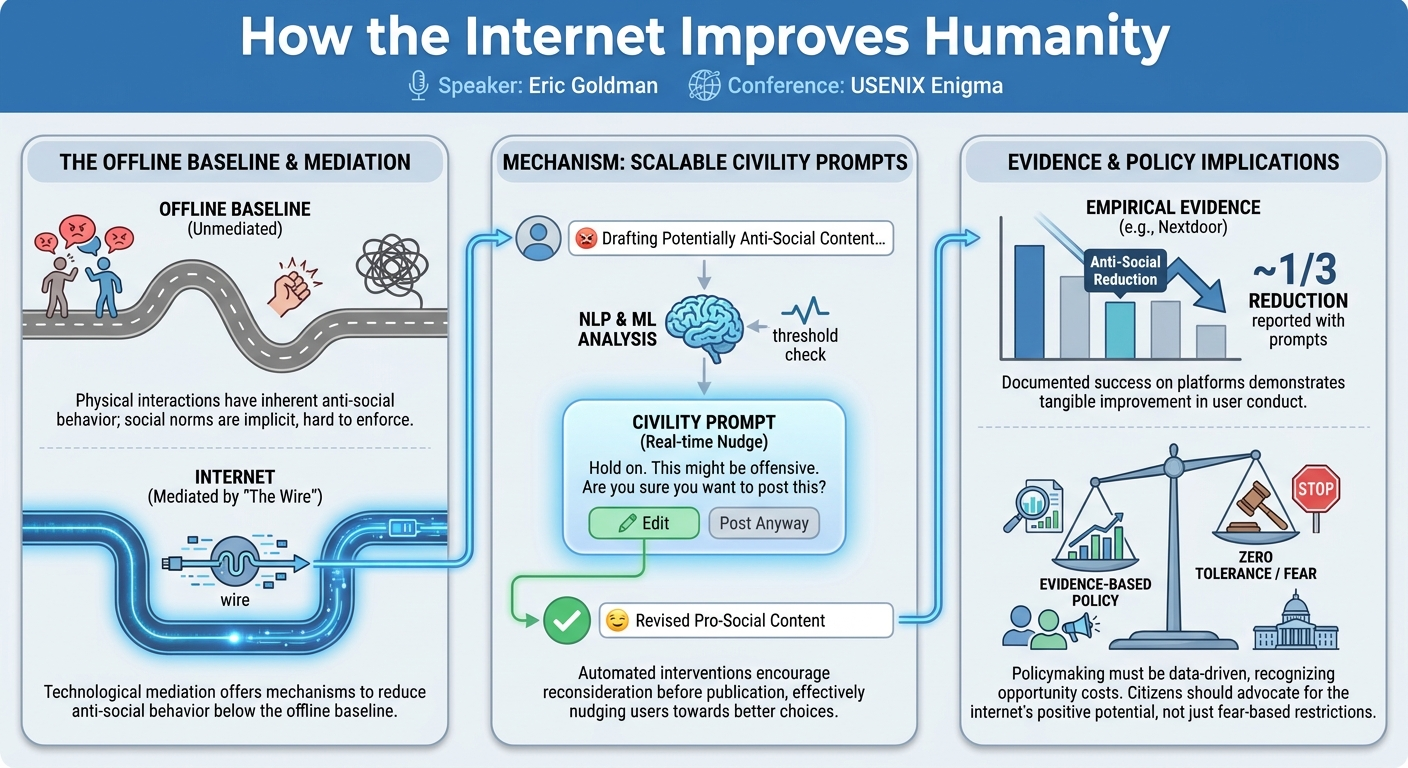
Goldman's central finding is that the internet possesses unique characteristics that enable it to reduce anti-social behavior below the inherent offline baseline. He argues that the digital medium is not merely a neutral conduit for human interaction but rather a powerful mediator that can actively shape and improve conduct. The critical concept here is the "wire in the middle"—a metaphorical representation of the technological infrastructure that mediates online communication. Unlike face-to-face interactions, where social norms and reputational mechanisms are largely implicit and unassisted, the "wire" introduces new capabilities and limitations. These capabilities can be leveraged to implement interventions that encourage pro-social behavior in ways that are difficult, if not impossible, to replicate offline.
The most compelling empirical evidence presented by Goldman revolves around civility prompts. These are technological interventions designed to monitor online conversations and interject when a user is about to post potentially anti-social content, encouraging them to reconsider. Goldman cited several examples:
- Nextdoor, the local social media platform, implemented technology that monitors posts for potentially racist or anti-social language. When detected, the system presents a prompt asking the user, "What you're saying might be considered racist, are you sure you want to say that?" or similar questions. Nextdoor found that these prompts led to a remarkable one-third reduction in the total incidence of racist or anti-social behavior. This demonstrates a direct, measurable improvement in user conduct facilitated by the platform's technology.
- Pre-Musk Twitter also experimented with similar civility prompts. Their findings not only mirrored Nextdoor's success in encouraging better choices at the moment of posting but also revealed a persistent effect: users who received prompts made better choices in their interactions for several days thereafter. This suggests that these interventions can have a lasting positive impact on user behavior, extending beyond the immediate interaction.
- Goldman also provided a historical context, referencing Eudora, an email client from over two decades ago. Eudora famously implemented a "three Chili Pepper" system, an early form of civility prompt that warned users about potentially inflammatory language (e.g., "Hey, careful," "This is getting a little spicy," "Do you really, really, really want to do that?"). While some users might have tried to "get the fourth Chili Pepper" by pushing boundaries, Eudora's initiative showcased an early recognition of the internet's potential for behavioral nudging.
These examples collectively demonstrate that the internet is not just a mirror or an amplifier of human flaws. Instead, its mediating "wire" can act as a "good little angel on your shoulder," proactively encouraging users to make better, more pro-social choices than they might have made in an unmediated offline context. This challenges the negative narrative and forms the bedrock of Goldman's argument for the internet's "net benefit" to humanity.
Technical Deep Dive
▶ Watch: Mechanism: Civility prompts for pro-social behavior (7:15)
The core technical concept underpinning Eric Goldman's argument is the "wire in the middle," which represents the unique capabilities and limitations introduced by the internet as a mediator of human communication. Unlike unmediated, face-to-face interactions where social conventions and reputational mechanisms are largely implicit and difficult to enforce at scale, the digital "wire" allows for explicit, scalable, and often automated interventions. This enables platforms to go beyond merely reflecting human behavior and instead actively shape it towards pro-social outcomes.
The primary mechanism highlighted is civility prompts, which are essentially real-time, context-aware nudges. These prompts leverage Natural Language Processing (NLP) and Machine Learning (ML) models to analyze user-generated content before it is published. When a user drafts a message, comment, or post, the system performs a rapid assessment against predefined criteria for anti-social, aggressive, or offensive language. This analysis is akin to an automated "angel on your shoulder" that can detect potential breaches of civility.
Here’s a breakdown of the technical process:
- Content Ingestion and Analysis: As a user types, or just before they click "post," the platform's systems process the textual content. Modern implementations often use deep learning models (e.g., transformer-based architectures) trained on vast datasets of human conversation, including labeled examples of polite, neutral, and anti-social communication. These models learn to identify patterns, sentiment, and specific keywords or phrases associated with various forms of problematic content (e.g., hate speech, harassment, racism).
- Thresholding and Triggering: The ML model outputs a probability score indicating the likelihood that the content violates platform guidelines or falls into an "anti-social" category. If this score exceeds a predetermined threshold, the system triggers a prompt. This threshold can be finely tuned to balance between being overly intrusive and effectively catching problematic content.
- User Interface Intervention: Upon triggering, a pop-up, banner, or notification appears on the user's screen. The message is carefully crafted to be non-accusatory but encourages reconsideration. Examples include:
- "This post may contain language that some find offensive. Are you sure you want to share it?" (General civility)
- "Your comment appears to use terms associated with racism. Would you like to review or edit your post?" (Specific to Nextdoor's implementation)
- "Is this something you really want to say?" (Eudora's "Chili Pepper" approach, albeit simpler).
- Feedback Loop and Behavioral Nudge: The prompt introduces a moment of reflection. Users can then choose to:
- Edit: Modify their content to be more civil.
- Discard: Delete the post entirely.
- Proceed: Publish the content as is, consciously overriding the prompt.
The effectiveness of these prompts lies in this moment of interruption and cognitive re-engagement. It shifts the user from an impulsive reaction to a more deliberate decision-making process, often leading to self-correction.
The "wire in the middle" enables this in several critical ways:
- Scalability: Automated systems can monitor millions of interactions simultaneously, something impossible with human moderators alone in real-time for pre-publication review.
- Immediacy: Prompts appear before content is published, preventing the initial dissemination of harmful material and the subsequent negative impact.
- Anonymity/De-escalation: The prompt is delivered by an impersonal system, potentially reducing the defensiveness a user might feel if corrected by another human.
- Data Collection and Improvement: The "wire" allows platforms to collect data on prompt effectiveness, user responses, and behavioral changes, enabling continuous improvement of the ML models and prompt strategies.
Historically, Eudora's "Chili Pepper" system, while rudimentary, demonstrated the early recognition of this potential. It manually analyzed keywords or simple patterns to issue warnings. Modern systems, like those used by Nextdoor and pre-Musk Twitter, represent a significant leap, leveraging sophisticated AI to understand nuance and context, thereby making the interventions more intelligent and effective. This technical capability to intervene, not just moderate post-publication, is what distinguishes the internet's potential for improvement from offline interactions, where no such pervasive, real-time "angel on your shoulder" exists.
Demo / Proof of Concept
▶ Watch: Policy: Unrealistic expectations from regulators (10:45)
While Eric Goldman's talk did not feature a live technical demonstration or a new, custom-built proof of concept, his presentation served as a conceptual framework supported by compelling real-world examples. The "proof of concept" for his thesis lies in the documented successes of existing internet platforms that have already implemented the very "pro-social techniques" he advocates.
Specifically, the efficacy of civility prompts on platforms like Nextdoor and pre-Musk Twitter acts as empirical evidence validating his claims. Nextdoor's reported one-third reduction in racist or anti-social behavior directly attributable to its prompts demonstrates that the "wire in the middle" can indeed facilitate a measurable improvement in user conduct. Similarly, Twitter's findings regarding the immediate and persistent positive effects of their interventions further underscore the viability of these mechanisms. Even the historical example of Eudora's "three Chili Pepper" system illustrates an early, albeit simpler, demonstration of the principle that technological mediation can influence user behavior towards greater civility. These are not theoretical constructs but results from large-scale deployments on widely used services, providing tangible evidence for the internet's potential to improve humanity compared to the offline baseline.
Defensive Implications
▶ Watch: Call to action: Fight for the internet, hold politicians accountable (18:00)
The "defensive implications" of Eric Goldman's talk extend beyond traditional cybersecurity to encompass the defense of the internet's fundamental architecture and its positive societal impact against detrimental policy and public perception. Goldman argues that current regulatory trends, fueled by an unrealistic "Zero Tolerance" expectation, pose a significant threat to the very mechanisms that allow the internet to foster pro-social behavior.
For Policymakers and Regulators:
- Adopt Evidence-Based Policymaking: Regulators must abandon emotional or anecdotal approaches and instead base policies on robust data. This requires establishing an offline baseline for comparison and conducting rigorous cost-benefit analyses for any proposed internet intervention. Demanding the impossible—the complete eradication of anti-social behavior online—is counterproductive and leads to policies that stifle innovation and free expression.
- Recognize Opportunity Costs: The current narrative primarily highlights internet problems, obscuring its vast pro-social benefits. Policymakers must be educated on the opportunity costs of over-regulation, understanding what positive societal contributions are lost when platforms are forced to retreat from User Generated Content (UGC).
- Fund and Disseminate Research: Governments should play an active role in funding research into pro-social techniques and mechanisms that genuinely improve online interactions. Furthermore, they should facilitate the diffusion of this knowledge across platforms, rather than solely focusing on punitive measures.
For Internet Platforms and Developers:
- Prioritize Pro-Social Design: Platforms should actively invest in and expand the adoption of proven pro-social techniques like civility prompts. This includes refining Natural Language Processing (NLP) and Machine Learning (ML) models to make these interventions more effective, nuanced, and less intrusive. The goal should be to nudge users towards better behavior, not just to censor.
- Document and Share Successes: To counter the negative narrative, platforms must proactively document and publicly share the empirical data demonstrating the positive impact of their pro-social initiatives. This evidence is crucial for informing policy debates and shifting public perception.
For Citizens and Advocates:
- Fight for the Internet: Goldman issues a stark call to action: citizens must actively engage with their elected politicians and advocate for the internet, not just against its perceived problems. This means pushing back against politicians who rubber-stamp anti-internet legislation without considering its broader benefits.
- Hold Politicians Accountable: Beyond mere advocacy, citizens need to hold politicians accountable for policies that undermine the internet's capacity for good. This could involve voting decisions or direct feedback that challenges the political calculus that currently incentivizes anti-internet stances.
- Understand the Shift to Broadcasting: The risk of driving platforms away from UGC towards a "broadcasting model" (where only professional producers publish content) is profound. This shift would reify existing power structures, deepen the digital divide by introducing more paywalls, and stifle the diverse voices that have flourished through UGC. Defending UGC is defending a more equitable and participatory internet.
- Bridge the Generational Divide: Recognizing that Gen Z and Millennials often equate online bad behavior with all bad behavior (due to growing up digitally saturated), there's a need to educate about the historical offline baseline and the internet's unique potential for improvement. This helps prevent a future where technologically literate generations inadvertently support policies that harm the internet.
Ultimately, the defensive implication is about safeguarding the internet's capacity to be a net positive for humanity. It's about shifting from a reactive, punitive approach to a proactive, evidence-based strategy that fosters constructive online environments while preserving the internet's open and participatory nature.
Key Takeaways
- The internet, specifically User Generated Content (UGC), has the potential to improve humanity by reducing anti-social behavior compared to the offline baseline.
- The "wire in the middle" — the technological mediation of the internet — enables unique pro-social interventions that are not possible in unmediated offline interactions.
- Civility prompts, such as those used by Nextdoor and pre-Musk Twitter, have been empirically shown to effectively reduce anti-social behavior (e.g., Nextdoor saw a one-third reduction).
- Current regulatory approaches, driven by unrealistic "Zero Tolerance" expectations and a failure to consider the offline baseline, are counterproductive and threaten the future of UGC.
- Policymaking regarding the internet must be evidence-based, utilizing cost-benefit analysis and recognizing the significant opportunity costs of stifling pro-social online mechanisms.
- Citizens have a crucial role in advocating for the internet's benefits to their elected politicians and holding them accountable for policies that undermine its positive potential.
About the Speaker(s)
Eric Goldman is a Professor of Law at Santa Clara University School of Law, where his work focuses on internet law, intellectual property, and privacy. He is deeply engaged in understanding the complex interplay between technology, law, and society. Goldman is currently embarking on a significant research project titled "Net Benefit: How the Internet Improves Humanity," which aims to compile extensive empirical evidence over 25 years demonstrating the internet's positive contributions. His goal is to articulate these findings in a forthcoming book, challenging prevailing negative narratives and informing more balanced policy discussions about the internet's role in human progress.
Reviews
Dr. Zero (Offensive Security Researcher) — SOLID
Goldman takes a sledgehammer to the "internet is a dumpster fire" legislative narrative by reminding us that humans were already garbage offline. It’s a useful policy framing for Enigma, even if his core technical thesis—that pop-up boxes asking "are you sure?" will save the species—is charmingly naive. Worth watching if you write platform policy, but it won't survive contact with actual threat actors.
Heather Calloway (CISO) — WEAK
An academic argument aimed at regulators, making the case that automated user nudges manage platform risk better than zero-tolerance legislation. It provides useful air cover for Trust & Safety budgets, but inflates basic UX friction into a civilization-level thesis.