Characterizing and Measuring Misleading and Harmful Online Ad Content at Scale
Eric Zeng (postdoc · Carnegie Mellon University)
USENIX Enigma Conference 2023 · Day 2 · Grand Ballroom
Overview
Online advertising forms the bedrock of the modern web, enabling countless websites to offer free content and services while providing businesses a vital channel to promote their products. However, this essential ecosystem is increasingly marred by a pervasive problem: "bad ads." In his USENIX Enigma talk, Eric Zeng, a postdoc at Carnegie Mellon University, presented groundbreaking research from his PhD at the University of Washington that systematically characterizes and measures these misleading, harmful, or simply unpleasant advertisements at scale. Zeng's work sheds critical light on a "dumpster fire" within the digital landscape, moving beyond the traditional focus on privacy and tracking to address the direct impact of ad content quality on user experience and security.
Key moments
- 0:00 Introduction and the problem of 'bad ads'
- 4:55 User-defined reasons for disliking online ads
- 9:00 Prevalence: Top problematic ad categories on news sites
- 11:00 Native ad networks as primary source of bad ads
- 12:00 Distributed ad tech ecosystem enables bad ads
- 16:00 Proposed solutions for improving online ad quality
- 18:00 Future research: Bad ads targeting vulnerable populations
Characterizing and Measuring Misleading and Harmful Online Ad Content at Scale
Speakers: Eric Zeng, Postdoc, Carnegie Mellon University
Conference: USENIX Enigma
YouTube: https://www.youtube.com/watch?v=ACMgwi6VDS4
Overview
Online advertising forms the bedrock of the modern web, enabling countless websites to offer free content and services while providing businesses a vital channel to promote their products. However, this essential ecosystem is increasingly marred by a pervasive problem: "bad ads." In his USENIX Enigma talk, Eric Zeng, a postdoc at Carnegie Mellon University, presented groundbreaking research from his PhD at the University of Washington that systematically characterizes and measures these misleading, harmful, or simply unpleasant advertisements at scale. Zeng's work sheds critical light on a "dumpster fire" within the digital landscape, moving beyond the traditional focus on privacy and tracking to address the direct impact of ad content quality on user experience and security.
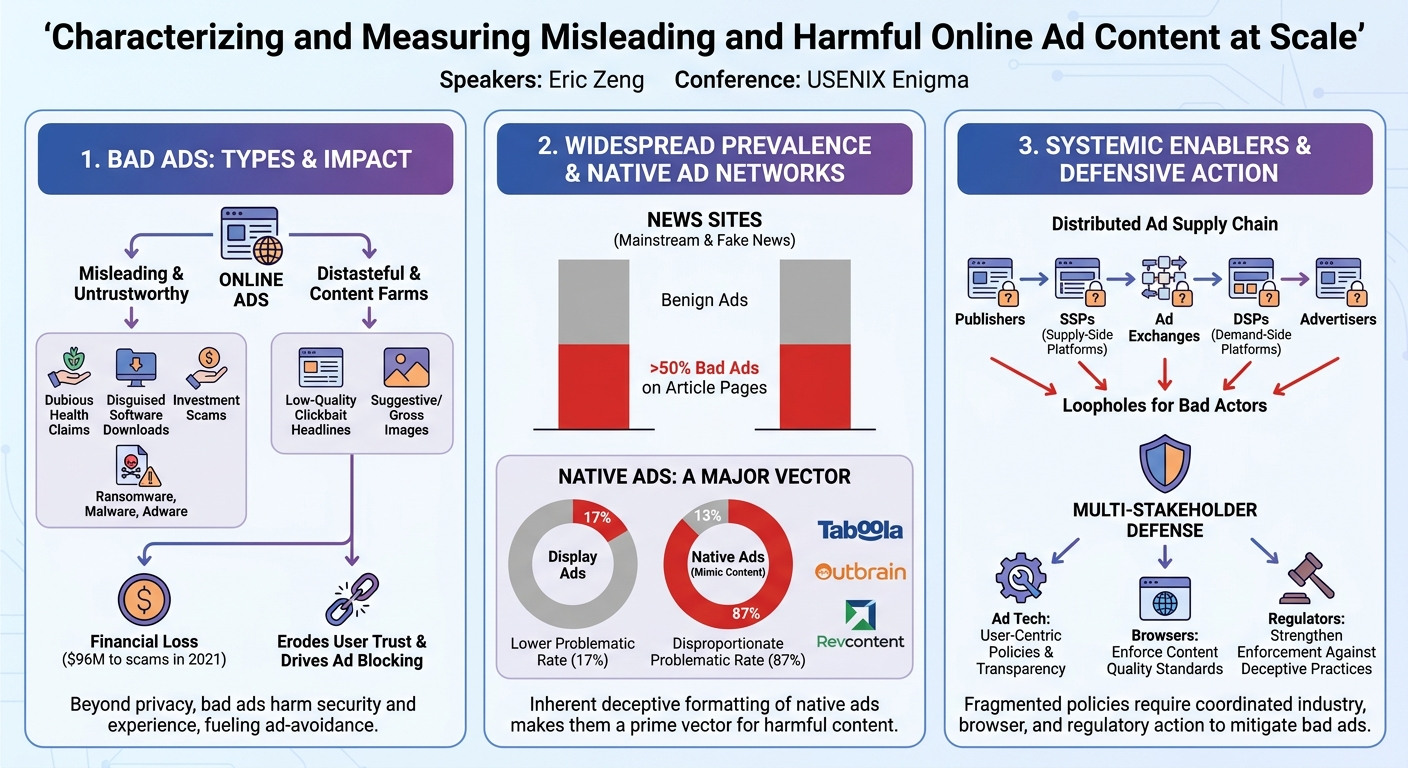
The significance of this research cannot be overstated. "Bad ads" are not merely an annoyance; they represent a tangible threat to users and the integrity of the web. The Federal Trade Commission (FTC) reported that in 2021 alone, consumers lost a staggering $96 million to scams propagated through online ads and pop-ups. Beyond financial fraud, these ads serve as vectors for distributing ransomware, malware, and adware, posing severe cybersecurity risks. Furthermore, their prevalence erodes user trust in online platforms and drives an increasing adoption of ad-blocking software, ultimately threatening the economic model that sustains much of the open web. Zeng's talk meticulously addresses four core questions: what constitutes a bad ad, how prevalent they are, what systemic factors enable their proliferation, and crucially, what actionable steps can be taken to mitigate their impact.
Background
▶ Watch: Introduction and the problem of 'bad ads' (0:00)
The problem of "bad ads" stems from a fundamental tension between the web's ad-driven revenue model and user experience. While legitimate advertising fuels the internet, a significant portion of online advertisements fall into a problematic "gray area"—content that, while not explicitly illegal or in violation of platform policies, is widely perceived as misleading, untrustworthy, or distasteful. This distinction is crucial because existing regulatory frameworks and content moderation efforts by advertising platforms often fail to address this pervasive category of undesirable content, leaving users vulnerable and frustrated.
Prior academic research on online advertising has largely concentrated on issues of privacy and web tracking, leaving a significant blind spot regarding the actual content and quality of the ads themselves. Zeng's research fills this void by systematically defining and quantifying the phenomenon of bad ads. The motivation for this study emerged from anecdotal observations, particularly in the post-2016 era, where "crappy looking ads" were noticeably prevalent on news websites, including those associated with "fake news." This highlighted the urgent need to understand the characteristics of these ads, their prevalence across different types of sites, and the underlying mechanisms that allow them to flourish. The harms are multifaceted: financial exploitation through scams, the distribution of malicious software, and a broader erosion of user trust that pushes individuals towards ad-avoiding behaviors like installing ad blockers, thereby undermining the very ecosystem that supports free online content.
Key Findings
▶ Watch: Prevalence: Top problematic ad categories on news sites (9:00)
Zeng's research methodology combined both qualitative and quantitative approaches, yielding a comprehensive understanding of problematic online advertisements.
Qualitative Characterization of Bad Ads:
The initial phase involved two systematic qualitative surveys to understand user perceptions. In the first survey, 60 participants evaluated 30 ads, providing open-ended reasons for their likes and dislikes. This led to the development of a taxonomy of nine distinct reasons why people dislike ads:
- Boring / Not relevant
- Unclear
- Poorly designed / Ugly
- Promotes products they don't like
- Politicized
- Offensive / Uncomfortable / Distasteful
- Misleading:
- Uses clickbait tactics
- Appears untrustworthy
- Uses a pushy or manipulative tone
A larger labeling survey with 1,000 participants then applied this taxonomy to 500 ads to associate ad content with these dislike categories. The findings revealed that the most negative reactions were consistently linked to ads perceived as untrustworthy or distasteful.
- Untrustworthy ads commonly included:
- Dietary supplements making dubious health claims.
- Software downloads disguised as part of the webpage.
- Investment advice promising exaggerated returns.
- Distasteful ads frequently featured:
- Content farms (e.g., celebrity news, listicles) that maximize page views and ad revenue with low-quality, attention-grabbing headlines, often accompanied by suggestive or explicit images.
- Health-related and supplement ads employing "gross images" to capture attention.
Conversely, ads that users tended to like were typically well-designed, simple, relevant, and from familiar brands, covering consumer products and streaming services. A significant correlation was also observed: users who generally disliked ads were more prone to using ad blockers, suggesting that unchecked ad quality directly drives ad-avoiding behaviors.
Quantitative Measurement on News Websites:
To quantify the prevalence of these "bad ads," Zeng conducted a large-scale measurement study focusing on news websites, which anecdotally showed a high incidence of problematic content. The study involved:
- Generating a list of mainstream and "fake news" websites using sources like the Alexa top 1 million and fact-checker data.
- Building a web crawler to visit these sites and scrape encountered ads.
- Qualitatively coding a dataset of 2,419 ads as either "benign" or "problematic," with further sub-categorization for problematic ads.
The key quantitative findings were:
- Most Common Problematic Categories: The top three categories of problematic ads observed across all news websites were:
- Content Farms: 11.7% of all ads.
- Dietary Supplements: 10.6% of all ads.
- Sponsored Search: 8.1% of all ads (a form of affiliate marketing arbitrage using clickbait).
- Prevalence Across News Types: Over half of the ads (more than 50%) on the article pages of both mainstream and fake news websites were classified as problematic. This crucial finding demonstrated that the issue is not confined to low-quality or disreputable sites; even mainstream outlets like USA Today and The Washington Post were found to run a significant number of "bad ads," indicating a widespread compromise on ad quality for revenue.
- Ad Network Responsibility: The study identified a critical distinction between display ads (standard banners) and native ads.
- Native ads, typically found at the bottom or side of articles under sections like "sponsored content" or "around the web," are specifically designed to imitate the look and feel of news article recommendations. This inherent deceptive formatting makes them a prime vector for problematic content.
- A staggering 87% of native ads were labeled as problematic, compared to only 17% of display ads.
- The most prevalent ad networks responsible for serving these problematic native ads were explicitly named: Taboola, Outbrain, and Revcontent. This highlights that specific players in the ad ecosystem bear a disproportionate responsibility for the proliferation of misleading and harmful content.
Technical Deep Dive
▶ Watch: Native ad networks as primary source of bad ads (11:00)
The proliferation of "bad ads" is deeply rooted in the complex, distributed, and often opaque technical architecture of the online advertising ecosystem. Unlike vertically integrated platforms such as Facebook, the open web's ad supply chain lacks a single, centralized gatekeeper, creating systemic vulnerabilities that bad actors readily exploit.
The advertising supply chain involves several distinct entities:
- Websites (Publishers): To monetize their content, publishers integrate code (often an iframe) from a Supply-Side Platform (SSP) onto their pages. The SSP manages the inventory of ad space and facilitates its sale.
- Advertisers: Brands or individuals wishing to promote products or services engage with a Demand-Side Platform (DSP). DSPs allow advertisers to bid on ad impressions, target specific audiences, and manage their campaigns.
- Ad Exchanges: When a user visits a webpage, the SSP initiates a request to an Ad Exchange. The exchange acts as a marketplace, soliciting bids from various DSPs in real-time auctions. The highest bidder wins the impression, and their ad is loaded onto the page.
This multi-party, distributed architecture means that numerous ad tech companies can be involved in serving a single ad. Websites can choose from multiple SSPs, and advertisers can run campaigns through various DSPs. Crucially, each of these entities—SSPs, DSPs, and ad exchanges—can have its own content policies and standards. This fragmentation of responsibility creates a significant challenge for content moderation. There isn't one central authority enforcing consistent quality guidelines across the entire chain.
This distributed nature allows for "space for bad actors." Some ad platforms, particularly the native ad networks like Taboola, Outbrain, and Revcontent, may adopt less stringent content standards, effectively becoming conduits for lower-quality or misleading ads. Similarly, some websites, driven by the need to fill ad inventory or maximize revenue, may be willing to run these lower-quality ads, even if they compromise user experience or site reputation.
The technical mechanism of native ads further exacerbates the problem. Unlike traditional banner ads, native ads are designed to seamlessly blend with surrounding editorial content. They often appear at the bottom or side of articles, labeled vaguely as "sponsored content" or "around the web," and are formatted to resemble genuine news article recommendations. This deceptive formatting is not an accidental byproduct but an inherent design feature intended to trick users into clicking. This intentional mimicry leverages user trust in editorial content, making it difficult for users to distinguish between legitimate articles and paid advertisements, a practice that directly contributes to their high problematic rate of 87% as identified in the study. The technical integration allows these ads to bypass immediate scrutiny that might be applied to more obviously "ad-like" content, embedding problematic content deep within the user's browsing experience.
Demo / Proof of Concept
▶ Watch: Proposed solutions for improving online ad quality (16:00)
While the talk did not feature a live software demonstration or an exploit proof-of-concept in the traditional cybersecurity sense, the core of Zeng's presentation was built upon rigorous empirical evidence derived from systematic research methodologies. The "proof" for his findings came directly from the data gathered through these methods:
- Qualitative Surveys: The initial surveys involving 60 participants reviewing 30 ads, and a larger labeling survey with 1,000 participants evaluating 500 ads, served as the primary proof of how users perceive and categorize "bad ads." The resulting taxonomy and the identified types of untrustworthy and distasteful content were direct outputs of this qualitative data analysis.
- Web Crawler and Measurement Study: The development and deployment of a web crawler to visit mainstream and "fake news" websites, scrape ads, and then systematically code 2,419 ads for their problematic nature constituted the quantitative proof-of-concept. This large-scale data collection and analysis directly supported the claims regarding the prevalence of different bad ad categories, their distribution across various news site types, and the specific ad networks responsible.
These methodologies, while not a "demo" of a tool, provided the concrete, reproducible evidence necessary to characterize the phenomenon of misleading and harmful online advertising at scale, forming the bedrock of the research's findings.
Defensive Implications
▶ Watch: Future research: Bad ads targeting vulnerable populations (18:00)
Addressing the pervasive issue of "bad ads" requires a multi-faceted approach involving various stakeholders across the online ecosystem. Eric Zeng outlined several key defensive implications and potential avenues for intervention:
For the Ad Tech Industry:
- Adopt User-Centric Content Policies: Ad platforms should move beyond merely enforcing legal and explicit policy violations. They need to integrate user feedback and research findings (like Zeng's taxonomy) to develop content policies that more closely align with what users genuinely find misleading, untrustworthy, uncomfortable, or distasteful. This would involve a proactive shift towards prioritizing user experience over purely commercial incentives.
- Improve Coordination and Standards: Given the distributed nature of the ad supply chain, greater cooperation among SSPs, DSPs, and ad exchanges is crucial. Establishing and adhering to higher, more consistent content quality standards across the industry could significantly reduce the opportunities for bad ads to propagate.
- Increase Transparency: For independent researchers and auditors, the ad tech industry should provide greater transparency into ad content, targeting mechanisms, and tracking practices. This would enable external scrutiny, facilitate accountability, and allow for more effective identification of problematic advertising trends and actors.
For Web Browsers:
- Enforce Ad Quality Standards: Browsers, which already implement mechanisms to block ads based on performance criteria (e.g., excessive CPU usage), could extend these capabilities to enforce content quality standards. By integrating intelligence about problematic ad characteristics, browsers could act as a crucial line of defense directly at the user's endpoint, blocking ads identified as misleading or harmful based on their content and presentation.
For Regulators:
- Strengthen Enforcement Against Deceptive Practices: Regulatory bodies like the FTC need to bolster enforcement efforts against deceptive advertising techniques, particularly those inherent in native advertising. The inherent design of native ads to mimic editorial content is fundamentally misleading, and stronger legal and punitive measures against such practices are warranted.
Addressing Structural Factors (Long-Term / "Pipe Dream"):
- Reconsider the Web's Revenue Model: Ultimately, the prevalence of bad ads is driven by economic incentives. A more radical, long-term solution could involve a fundamental re-evaluation of the web's revenue model, exploring alternatives to the current ad-centric system. Reducing the absolute dependence on advertising revenue could alleviate the pressure on websites and ad platforms to compromise on quality and user privacy, thereby diminishing the incentives for bad ads to exist. While an "enormous lift," this points to the root cause of the problem.
Zeng also highlighted areas for future research that could further inform defensive strategies, including investigating whether bad ads are disproportionately used in sensitive contexts (e.g., political ads targeting partisan websites) or aimed at vulnerable populations (e.g., health-related ads targeting individuals with specific health conditions who might be more susceptible to false claims). Understanding these dynamics could lead to more targeted and effective protective measures.
Key Takeaways
- "Bad ads" are a distinct and significant problem: Beyond illegal or policy-violating content, a vast "gray area" of misleading, untrustworthy, or distasteful ads erodes user trust, causes financial harm ($96M lost to scams in 2021), and spreads malware.
- User perception is paramount: A qualitative taxonomy reveals that ads perceived as "untrustworthy" (e.g., dubious health claims, disguised software downloads) and "distasteful" (e.g., content farms with suggestive images) are most disliked, driving users to adopt ad blockers.
- Problematic ads are widespread, even on reputable sites: Over half of ads on article pages of both mainstream and "fake news" websites were found to be problematic, indicating a systemic issue impacting even major news outlets like USA Today and The Washington Post.
- Native ad networks are major enablers of deception: Native ads, inherently designed to mimic editorial content, account for a disproportionate 87% of problematic ads. Specific networks like Taboola, Outbrain, and Revcontent are heavily responsible for this content.
- The distributed ad ecosystem complicates moderation: The multi-party nature of online advertising (SSPs, DSPs, Ad Exchanges) means fragmented content policies and accountability, creating loopholes for bad actors and lower-quality ads to thrive.
- Multi-stakeholder action is needed for defense: Solutions require the ad tech industry to adopt user-centric policies and increase transparency, browsers to enforce content quality standards, regulators to strengthen enforcement against deceptive practices (especially native advertising), and a long-term consideration of the web's revenue model.
About the Speaker(s)
Eric Zeng is a Postdoc at Carnegie Mellon University, where his research focuses on usable security and privacy, as well as web measurement. The detailed work presented in this talk on characterizing and measuring misleading and harmful online ad content at scale was conducted during his PhD studies at the University of Washington, highlighting his expertise in understanding and addressing complex issues within the online ecosystem.
Reviews
Dr. Zero (Offensive Security Researcher) — SOLID
Zeng brings a thousand-user survey and a web crawler to prove what every security practitioner already knows: the ad-tech ecosystem is a malware delivery network dressed up as a business model. It's a solid measurement study that actually names the worst offenders, but the defensive recommendations are pure academic fantasy.
Heather Calloway (CISO) — SOLID
Zeng provides empirical proof for what security teams have long suspected: the online advertising ecosystem is structurally compromised. By demonstrating that over half the ads on mainstream news sites are problematic, this research validates the necessity of enterprise-wide ad blocking as a core security control rather than a user preference.