A New Process to Tackle Misinformation on Social Media: Prevalence-Based Gradation
Kamesh Shekar (Lead, Privacy and Data Governance Vertical · The Dialogue)
USENIX Enigma Conference 2023 · Day 2 · Grand Ballroom
Overview
In an era where information can spread globally in seconds, the distinction between truthful and fabricated content has become increasingly blurred, leading to significant societal challenges. Kamesh Shekar, leading the Privacy and Data Governance Vertical at The Dialogue, delivered a compelling presentation at USENIX Enigma, introducing a novel approach to combat the pervasive issue of misinformation and disinformation on social media platforms. Titled "A New Process to Tackle Misinformation on Social Media: Prevalence-Based Gradation," Shekar's talk critically examines the limitations of current content moderation strategies and proposes a process-level intervention designed to enhance efficiency, accuracy, and fairness.
Key moments
- 0:00 Introduction and the misinformation problem
- 4:00 Limitations of current content-level moderation
- 6:04 Proposing a proactive process-level intervention
- 7:40 Explaining the prevalence-based gradation process
- 10:48 Calibrated ex-ante scrutiny and corrective actions
- 14:08 Benefits: Reducing false negatives, increasing transparency
- 16:04 Addressing cons, expanding corrective action toolkit
A New Process to Tackle Misinformation on Social Media: Prevalence-Based Gradation
Speakers: Kamesh Shekar, Lead, Privacy and Data Governance Vertical, The Dialogue
Conference: USENIX Enigma
YouTube: https://www.youtube.com/watch?v=k11bn7AVtRk
Overview
In an era where information can spread globally in seconds, the distinction between truthful and fabricated content has become increasingly blurred, leading to significant societal challenges. Kamesh Shekar, leading the Privacy and Data Governance Vertical at The Dialogue, delivered a compelling presentation at USENIX Enigma, introducing a novel approach to combat the pervasive issue of misinformation and disinformation on social media platforms. Titled "A New Process to Tackle Misinformation on Social Media: Prevalence-Based Gradation," Shekar's talk critically examines the limitations of current content moderation strategies and proposes a process-level intervention designed to enhance efficiency, accuracy, and fairness.
The core of Shekar's proposal revolves around a prevalence-based gradation process, which aims to move beyond reactive, content-level moderation towards a more proactive and calibrated system. This innovative framework suggests that social media platforms should evaluate content not just by its nature, but by its potential reach and impact, enabling a more strategic allocation of resources and the application of appropriately severe corrective actions. This approach is particularly crucial for "high-stake" information, such as content related to elections or public health, where the consequences of unchecked falsehoods can be catastrophic for individuals and communities alike.
The significance of this talk lies in its potential to redefine how social media platforms approach their immense responsibility in managing information disorder. By offering a structured, data-driven methodology, Shekar addresses the inherent difficulties platforms face in balancing freedom of expression with the need to curb harmful content at scale. The proposed process seeks to mitigate common pitfalls like false negatives (harmful content slipping through) and false positives (legitimate content being suppressed), ultimately fostering a more trustworthy and secure online environment for users worldwide.
Background
▶ Watch: Introduction and the misinformation problem (0:00)
The proliferation of information in the digital age, while offering unprecedented access to knowledge, has simultaneously created fertile ground for the spread of disinformation and misinformation. Kamesh Shekar meticulously distinguishes between these two phenomena: disinformation occurs when individuals intentionally produce baseless and misleading information to deceive their audience, whereas misinformation arises when unsuspecting followers share this misleading content, believing it to be true, often reinforcing pre-existing biases. The latter, though lacking malicious intent, acts as a chain reaction, amplifying the initial disinformation into a widespread "wild forest fire."
Social media platforms have undeniably accelerated this information disorder. Shekar cites the information war between Ukraine and Russia and the U.S. Capitol attack on January 6, 2021, as stark examples where the rapid, unchecked dissemination of false narratives had critical real-world consequences. Despite efforts by platforms to flag or remove demonstrably false election-related information, the events of January 6th underscored the inadequacy of existing measures. The problem is particularly acute for "high-stake" information, including election integrity and health-related content, where inaccuracies can directly harm individuals and destabilize communities.
Currently, the responsibility for tackling information disorder is fragmented across various actors, including governments, users, multi-stakeholder groups, and intergovernmental organizations. However, Shekar argues that the role of social media platforms themselves demands greater scrutiny. Their innovative interventions often raise questions of competency and can lead to unintended consequences, such as infringing on freedom of expression or suppressing legitimate dissent. Many centralized and decentralized platforms primarily rely on content-level hard moderation, employing systems to make decisions about content and accounts. These systems leverage a range of technological measures, including word filters, automated hashtagging, geoblocking, content IDs, and predictive machine learning tools, to detect unlawful or borderline content, such as child sexual imagery and disinformation.
While these technological measures offer speed and scale, they are far from perfect. Shekar highlights two critical failures: false negatives, where harmful content evades detection (as seen with the U.S. Capitol attack), and false positives, where legitimate content is erroneously removed. The infamous instance of a social media platform taking down an award-winning image of a naked girl fleeing a napalm bomb during the Vietnam War, later reinstated, serves as a powerful illustration of how content-level moderation can hamper freedom of expression and misinterpret context. The fundamental flaw, Shekar asserts, is that platforms are "presently confined to a content level intervention in absence of the process level clarity and intervention within the content moderation pipeline." This deficiency leads to inefficient resource utilization and a reactive, rather than proactive, approach to content moderation.
Key Findings
▶ Watch: Proposing a proactive process-level intervention (6:04)
Shekar's presentation at USENIX Enigma spotlights a critical gap in contemporary content moderation practices: the over-reliance on content-level intervention and a reactive posture. The central finding is that while existing technological measures for "hard moderation" (e.g., content removal, account suspension) possess merits for acting swiftly and at scale, they are inherently limited by their inability to effectively address borderline content like disinformation and misinformation, which is often highly contextual. This limitation frequently results in both false negatives, allowing harmful narratives to spread, and false positives, inadvertently suppressing legitimate expression.
The core contribution of Shekar's talk is the proposal of a process-level intervention designed to refine the content moderation pipeline. This new process, termed prevalence-based gradation, fundamentally shifts the paradigm from merely evaluating the nature of content to also considering its potential reach and impact. By doing so, platforms can move beyond generic "hard moderation" to a more nuanced, calibrated, and efficient system. The key insight is that not all misleading information poses the same level of threat; its danger is directly proportional to its prevalence and the sensitivity of the topic it addresses.
The proposed system aims to:
- Elevate the detection of contextual content: By focusing on prevalence, the system can prioritize scrutiny for information that is gaining significant traction, allowing human moderators and advanced AI to delve deeper into context where it matters most.
- Optimize resource utilization: Instead of expending equal effort on all flagged content, resources can be strategically directed towards high-prevalence, high-stake information, ensuring that the most impactful falsehoods are addressed first.
- Enable calibrated corrective actions: Moving beyond a limited toolkit of content removal or flagging, the process allows for a range of interventions proportionate to the content's prevalence and potential harm, from minor warnings to severe restrictions.
- Foster transparency and accountability: By clearly defining the stages and criteria for intervention, the process seeks to make moderation decisions more understandable to users, thereby building trust and deterring malicious actors.
Ultimately, Shekar argues that implementing such a process-level intervention is not merely an incremental improvement but a foundational shift required to strengthen the internet's trustworthiness. It tackles the problem of scale that plagues soft moderation (recommendation systems) by integrating prevalence as an integral element for hard moderation, thereby enabling platforms to respond more effectively to narrative harms.
Technical Deep Dive
▶ Watch: Explaining the prevalence-based gradation process (7:40)
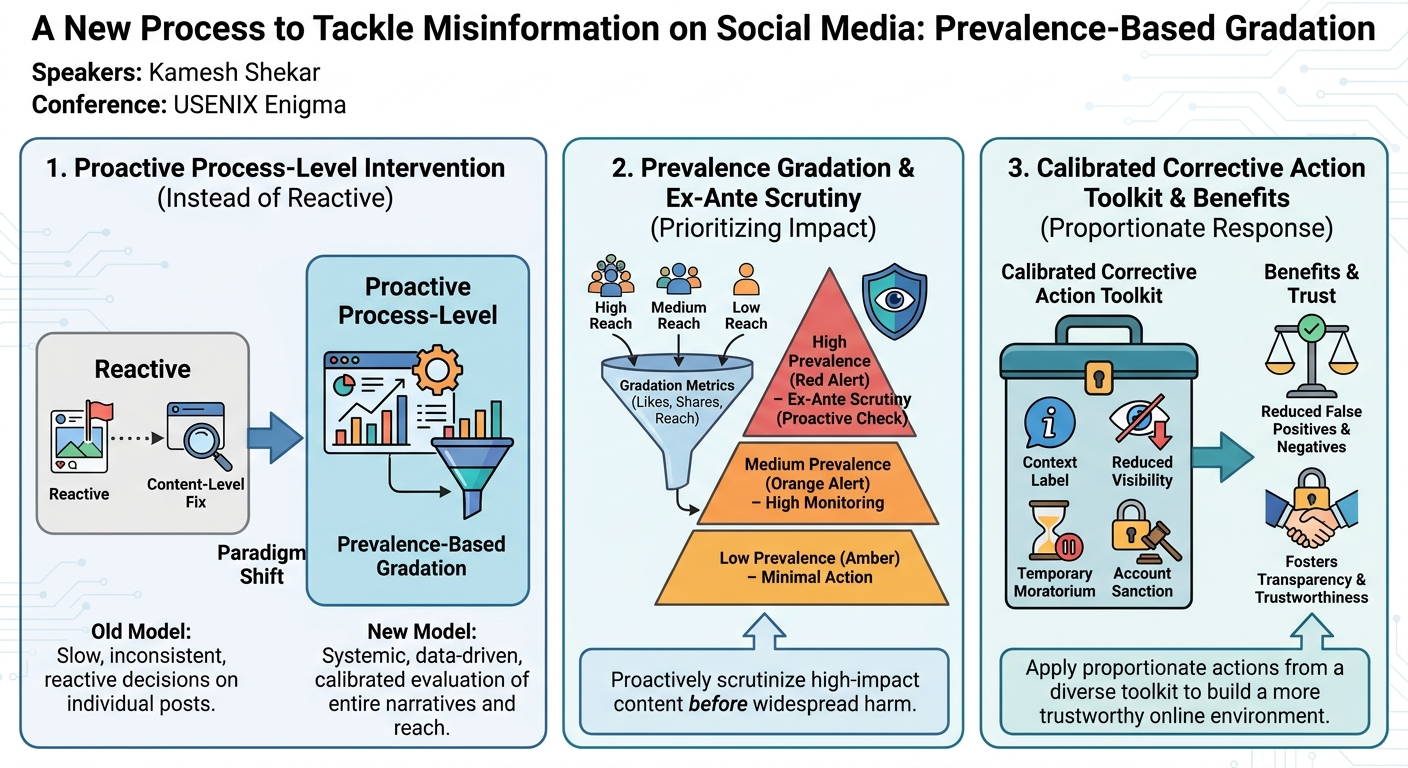
The cornerstone of Kamesh Shekar's proposed solution is the prevalence-based gradation process, a sophisticated framework designed to revolutionize how social media platforms evaluate and act upon misleading information. This process aims to move beyond the current binary approach of "allow" or "remove" by introducing a nuanced, data-driven methodology that considers the exposure level or prevalence of information in real-time.
At its heart, the process is about applying ex-ante measures to content based on its prevalence, leading to optimal corrective actions in a calibrated format. Shekar emphasizes that "prevalence" here is not merely popularity but a carefully calibrated metric. To achieve this, the system uses a gradation metrics table, which buckets high-stake information (e.g., election-related, health-related) into different levels of prevalence, ranging from low to high.
The gradation metrics table, as visually represented in the talk, categorizes content into nine buckets, often color-coded for intuitive understanding:
- Buckets 9 and 8 (Not in Radar): Lowest prevalence, requiring minimal immediate action.
- Bucket 7 (Amber): Rising prevalence, moving towards requiring attention.
- Buckets 6, 5, 4 (Orange - High Alert): Significant prevalence, necessitating close monitoring and potential pre-emptive action.
- Buckets 3, 2, 1 (Red - High Alert, requiring Ex-Ante Scrutiny): Highest prevalence, demanding immediate and rigorous intervention.
The bucketing mechanism relies on a comprehensive set of data points collected on individuals and content interactions. These include, but are not limited to, follower levels of the sharing individual, the number of likes, shares, and comments a piece of content receives. By analyzing these real-time engagement metrics, platforms can dynamically assign content to an appropriate prevalence bucket. Shekar notes that while the presented table is a simple illustration, platforms, with their extensive data collection capabilities, could develop far more nuanced and granular gradation processes.
Once content is categorized, particularly into the higher prevalence buckets (e.g., 1, 2, 3), it triggers ex-ante scrutiny. This is a critical departure from reactive moderation. Ex-ante scrutiny means that platforms proactively evaluate content for disinformation or misinformation before it causes widespread harm or is flagged by a significant number of users. While pre-screening every piece of information is impractical and disproportionate, infringing on freedom of expression, applying ex-ante scrutiny proportionately to highly prevalent content ensures that resources are focused where the potential for harm is greatest. For instance, information in buckets 1-3 would automatically be subjected to this rigorous, proactive evaluation. Content in buckets 4-6, while not immediately subjected to ex-ante scrutiny, would remain on "high alert," indicating a need for continuous monitoring.
Following ex-ante scrutiny, if content is confirmed as misleading or false, the process mandates calibrated corrective actions. Shekar argues that platforms currently use a very limited range of actions (e.g., content deletion, user blocking, flagging), which often do not align with the specific enforcement goals of hard moderation. The proposed system calls for a diversified corrective action toolkit that allows for a spectrum of responses tailored to the severity of the misinformation and its prevalence level. This could include:
- Moratorium for deterrence: Temporarily limiting content spread or user activity.
- Contextual labels: More informative flags explaining why content is misleading.
- Reduced visibility/demotion: Algorithmically lowering the content's reach.
- Removal of specific elements: Deleting only the misleading parts of a post.
- Account-level sanctions: Temporary suspensions or permanent bans for repeat offenders.
The determination of harm for corrective action should be broad, encompassing both tangible harms (e.g., financial losses, health repercussions) and intangible harms (e.g., emotional distress, psychological impact, reputational damage). Crucially, causation of harm should not be the only factor; corrective actions must be taken ex-ante (before harm is fully realized) and even speculatively (addressing long-term concerns, as with content in buckets 4-6 on high alert). The calibration principle dictates that information in bucket 1 should not be treated the same as information in bucket 2 or 3; increasingly severe actions should correspond to higher prevalence. For example, while initial flagging might suffice for bucket 3, content in bucket 1 might warrant immediate removal and account restrictions.
The final, indispensable step in this process is transparent communication of the moderation decisions to individuals. This ensures that the entire process is not a one-way street but fosters accountability and allows users to understand the rationale behind the measures enforced by platforms. By adopting this comprehensive, prevalence-based gradation process, platforms can create a more robust, equitable, and effective system for tackling information disorder.
Demo / Proof of Concept
▶ Watch: Benefits: Reducing false negatives, increasing transparency (14:08)
The talk delivered by Kamesh Shekar at USENIX Enigma primarily focused on proposing a conceptual framework and a process-level intervention for content moderation, rather than demonstrating a live system or a proof of concept. The presentation meticulously outlined the theoretical model for how social media platforms could implement prevalence-based gradation, detailing the logical flow, decision points, and potential mechanisms. While no direct demonstration of software or a working prototype was part of the presentation, Shekar's clear articulation of the "gradation metrics" table and the step-by-step application of "ex-ante scrutiny" and "calibrated corrective actions" served as a comprehensive conceptual blueprint for implementation. The emphasis was on the process itself, providing a structured approach for platforms to consider adopting and developing into their operational pipelines.
Defensive Implications
▶ Watch: Addressing cons, expanding corrective action toolkit (16:04)
Kamesh Shekar's proposed prevalence-based gradation process offers several critical defensive implications for social media platforms and the broader digital ecosystem, addressing long-standing challenges in combating misinformation and disinformation.
Firstly, this process directly tackles the problem of false negatives. By introducing a systematic method to scrutinize high-prevalence, high-stake information ex-ante, platforms can significantly reduce instances where harmful content slips through the cracks. This proactive approach ensures that content with the greatest potential for damage receives immediate and thorough attention, cutting down on the "positive reinforcement for negative behaviors" (i.e., malicious actors seeing their content spread unchecked). When users face repercussions for sharing misleading information, it creates a deterrent effect, fostering a more responsible online environment.
Secondly, the process aims to create a more transparent and accountable environment. By clearly defining the stages of intervention and linking moderation actions to the prevalence of information, platforms can provide users with a clearer understanding of how and why certain measures are enforced. This transparency is currently lacking, leading to user frustration and distrust. An explicit gradation system helps demystify content moderation, potentially increasing user confidence in platform decisions.
Thirdly, by prioritizing resources based on prevalence, the system indirectly aids in reducing false positives. When platforms can efficiently identify which content most urgently needs attention, they gain more time and resources to understand the context of other flagged information. This enhanced capacity for contextual analysis can prevent the erroneous takedown of legitimate content, thereby protecting freedom of expression while still addressing genuine threats. The efficient utilization of resources, especially for monitoring "narrative harms," means platforms can allocate personnel and computational power more effectively.
Moreover, the framework encourages platforms to expand their corrective action toolkit. Moving beyond simple content removal or flagging allows for a more nuanced response that can be tailored to the specific nature and prevalence of the misinformation. This graduated response capability enables platforms to apply proportionate measures, reserving the most severe actions for the most egregious and widespread violations, while offering softer interventions for less impactful or ambiguous content.
However, Shekar also frankly addresses the defensive challenges and potential cons of such a system. He highlights the risk of white-listing, where certain influential individuals or groups might be exempt from moderation, leading to discrimination or the suppression of underrepresented voices. This underscores the need for equitable application of the process. Furthermore, the extent to which data points can be used for gradation, including the establishment of clear threshold boundaries, must be carefully considered and ideally not left solely to platform discretion. There is a critical need for democratically expanding the corrective action toolkit, involving various policy actors to ensure that the enforcement goals are aligned with broader societal values and human rights.
In essence, by intervening at the application layer of the internet with a process-level intervention, Shekar argues that platforms can strengthen the foundational element of the internet's success: trustworthiness. This ultimately contributes to a more secure and reliable internet experience for individuals.
Key Takeaways
- Shift from Reactive to Proactive Moderation: Current content moderation is primarily reactive and content-level, leading to inefficiencies and failures. The proposed prevalence-based gradation process advocates for a proactive, process-level intervention that evaluates content based on its potential reach and impact.
- Calibrated Intervention Based on Prevalence: Misinformation's threat is proportional to its spread. The system introduces gradation metrics to bucket content by prevalence (using data points like likes, shares, followers), enabling ex-ante scrutiny for high-prevalence, high-stake information before it causes widespread harm.
- Diverse and Proportionate Corrective Actions: Platforms need to move beyond a limited set of moderation tools. The talk calls for an expanded calibrated corrective action toolkit, allowing for a range of responses—from contextual flagging to content demotion or removal—that are proportionate to the content's prevalence and potential for both tangible and intangible harms.
- Increased Transparency and Resource Efficiency: By clearly defining the moderation process and prioritizing resources for the most impactful content, the system aims to reduce false negatives (harmful content slipping through) and false positives (legitimate content being suppressed). This fosters a more transparent environment for users and optimizes resource allocation.
- Addressing Ethical Considerations and Bias: The framework acknowledges potential pitfalls such as white-listing and discrimination against underrepresented voices. It emphasizes the need for democratic input in defining data usage boundaries and expanding the corrective action toolkit to ensure fairness and prevent unintended consequences.
- Strengthening Internet Trustworthiness: Ultimately, this process-level intervention is designed to fortify the internet's foundation of trustworthiness, providing individuals with a more secure and reliable online experience by tackling information disorder systematically at the application layer.
About the Speaker(s)
Kamesh Shekar is the Lead for the Privacy and Data Governance Vertical at The Dialogue, a prominent think tank based out of Delhi, India. In his role, Shekar is deeply involved in researching and developing policy frameworks related to data privacy, governance, and the responsible use of technology. His work focuses on addressing critical challenges in the digital sphere, such as misinformation and its societal impact. His presentation at USENIX Enigma underscores his expertise in proposing innovative, process-oriented solutions to complex problems at the intersection of technology, policy, and human rights.
Reviews
Dr. Zero (Offensive Security Researcher) — WEAK
This is an academic policy brief pretending to be a novel operational framework. The speaker proposes routing social media content for human review based on its virality and potential harm—a concept Trust and Safety teams at every major platform have already been doing for half a decade.
Heather Calloway (CISO) — WEAK
A structured policy argument for moving Trust and Safety moderation from binary takedowns to a calibrated, prevalence-based triage model. Worth the time if your organization runs user-generated platforms and needs to defend its moderation pipeline to regulators.