The Not Fake News Hour
Riana Pfefferkorn (Stanford Internet Observatory)
USENIX Enigma Conference 2023 · Day 2 · Grand Ballroom
Overview
Riana Pfefferkorn's "The Not Fake News Hour" at USENIX Enigma defied the conventional conference talk format, presenting a satirical news broadcast that masterfully dissected the absurdities, hypocrisies, and systemic failures rampant within the cybersecurity, privacy, and tech policy landscapes. Far from a dry technical presentation, Pfefferkorn leveraged sharp wit and incisive humor to highlight critical issues, from the ethical quandaries of ransomware operators to the convoluted state of government cybersecurity initiatives and the pervasive user experience failures in security products. This unconventional approach served not only to entertain but also to provoke deeper thought about the real-world implications of the industry's ongoing challenges.
Key moments
- 0:00 Welcome to 'The Not Fake News Hour'
- 3:00 CPRA's unusual 'Purge' clause explained
- 4:00 Federal cyber czars arm wrestle for power
- 6:29 Edward Snowden joins from Moscow
- 7:57 AI-generated 'news' from ChatGPT
- 9:00 LastPass hack communication: 'Really?' segment
The Not Fake News Hour
Speakers: Riana Pfefferkorn, Research Scholar, Stanford Internet Observatory
Conference: USENIX Enigma
YouTube: https://www.youtube.com/watch?v=LUeATgX6_wI
Overview
Riana Pfefferkorn's "The Not Fake News Hour" at USENIX Enigma defied the conventional conference talk format, presenting a satirical news broadcast that masterfully dissected the absurdities, hypocrisies, and systemic failures rampant within the cybersecurity, privacy, and tech policy landscapes. Far from a dry technical presentation, Pfefferkorn leveraged sharp wit and incisive humor to highlight critical issues, from the ethical quandaries of ransomware operators to the convoluted state of government cybersecurity initiatives and the pervasive user experience failures in security products. This unconventional approach served not only to entertain but also to provoke deeper thought about the real-world implications of the industry's ongoing challenges.
The talk's unique structure, mimicking a cable news show complete with segments like "sports" and "international news," allowed Pfefferkorn to rapidly pivot between diverse topics, exposing the common threads of human error, bureaucratic inertia, and a disconnect between policy and practical reality. By framing these complex issues within a familiar, yet distorted, news narrative, the presentation made otherwise dense or politically charged subjects accessible and memorable. It underscored the speaker's profound understanding of the cybersecurity ecosystem, using satire as a powerful lens to critique and inform an audience often inundated with technical jargon.
Ultimately, "The Not Fake News Hour" was a potent commentary on the state of information security, privacy legislation, and government oversight. Pfefferkorn's performance was a call to action, subtly urging the audience to recognize the underlying problems that enable such farcical scenarios in the real world. It served as a reminder that sometimes, the most effective way to address serious issues is through the mirror of humor, revealing uncomfortable truths that might otherwise be overlooked in more formal discussions.
Background
▶ Watch: Welcome to 'The Not Fake News Hour' (0:00)
The landscape of cybersecurity and privacy is inherently complex, marked by a constant cat-and-mouse game between attackers and defenders, rapid technological evolution, and a labyrinthine web of regulations. This environment often leads to situations that, when viewed from a critical distance, appear illogical, contradictory, or even farcical. The "fake news" phenomenon itself, a term popularized in recent years, highlights a broader societal struggle with information veracity and the challenge of discerning truth from fabrication, particularly in the digital realm.
Against this backdrop, satire has long served as a crucial tool for social commentary, allowing creators to critique power structures, expose hypocrisy, and articulate complex grievances in an engaging and memorable way. From Jonathan Swift's "A Modest Proposal" to modern late-night comedy, using humor to dissect serious issues can bypass audience resistance and embed critical messages more deeply than direct argumentation. In the context of a security conference like USENIX Enigma, where attendees are typically immersed in highly technical discussions, a satirical approach offers a refreshing and impactful method for addressing systemic, non-technical problems that often underpin technical vulnerabilities.
Prior work in cybersecurity communication has largely focused on translating technical risks into understandable language for non-technical audiences. However, Pfefferkorn's approach shifts this paradigm, using a familiar media format to critique the entire ecosystem of cybersecurity, including the actions of nation-states, corporations, regulators, and end-users. This talk implicitly builds upon the frustration many practitioners feel regarding the persistent challenges in areas like incident response transparency, effective policy implementation, and user education, problems that often seem to defy straightforward technical solutions and instead point to deeper organizational and human factors. The choice of a "news hour" format specifically taps into the contemporary anxiety surrounding media integrity and the ease with which narratives can be manipulated, making it a particularly relevant and poignant vehicle for discussion.
Key Findings
▶ Watch: Federal cyber czars arm wrestle for power (4:00)
While "The Not Fake News Hour" did not present traditional research findings in the scientific sense, it delivered a series of profound satirical observations that acted as "findings" regarding the current state of cybersecurity, privacy, and governance. These insights, revealed through various comedic segments, highlight persistent and often overlooked issues across the industry.
Firstly, the talk underscored the ethical ambiguity and PR-driven opportunism within the cybercriminal underworld. The LockBit ransomware gang's apology to Toronto's Hospital for Sick Children, offering a free decrypter and blocking a partner, satirizes the bizarre "moral codes" some ransomware groups attempt to project. This finding suggests that even malicious actors are sensitive to public perception and may attempt to navigate complex ethical landscapes, albeit for self-serving reasons. It also implicitly critiques the idea of a "free market" in healthcare IT services, as posited by the fictional US hospital system head, highlighting stark ideological differences in critical infrastructure protection.
Secondly, the presentation revealed a pervasive governmental struggle with effective cybersecurity policy and inter-agency coordination. The segment on memory safety legislation, misinterpreted by a fictional former president, points to a fundamental disconnect between legislative intent and practical understanding. More dramatically, the "Cyber Czars Arm Wrestle" segment vividly illustrated the fragmented and often contentious ownership of cyber issues within the federal government. This "finding" suggests that the sheer number of high-ranking officials with cyber portfolios leads to power struggles and public confusion, impeding a cohesive national cybersecurity strategy. The humorous predictions of winners based on physical prowess or past training (Judo, Army service) further emphasize the absurdity of the current, often ill-defined, allocation of cyber responsibility.
Thirdly, the talk exposed significant shortcomings in privacy legislation and corporate incident response. The California Privacy Rights Act (CPRA) segment, with its "Purge"-like suspension clause, satirizes the overly complex, potentially arbitrary, and occasionally nonsensical provisions that can emerge in privacy regulations. This highlights the challenge of crafting effective laws that genuinely protect individuals without creating unintended loopholes or burdens. Most pointedly, the "Really?" segment on the LastPass breach served as a damning indictment of botched incident communication and inadequate security practices. The "two-punch" of delaying disclosure from August to December 22nd, combined with the revelation of only "five password iterations," revealed a critical lack of transparency and a failure to meet basic security hygiene expectations, profoundly eroding user trust.
Finally, the talk implicitly found that human factors remain the weakest link in the security chain, exacerbated by ineffective advice and emerging AI capabilities. The FTC's guidance to "stay off the internet" for data breach avoidance, or the average person using only five passwords for 200 accounts, highlights the persistent challenge of user education and adherence to basic security principles. The ChatGPT-generated news items, while comedic, also subtly explored the potential for AI to generate plausible, yet absurd or dangerous, policy proposals and misinformation, hinting at future challenges in distinguishing automated content from human-authored news. Through these "findings," Pfefferkorn painted a picture of an industry grappling with internal contradictions, external threats, and an often-bewildering response from those tasked with protecting it.
Technical Deep Dive
▶ Watch: Edward Snowden joins from Moscow (6:29)
While "The Not Fake News Hour" is a satirical performance rather than a traditional technical presentation, its "deep dive" lies in its analytical dissection of the underlying technical and systemic issues that create the fodder for its humor. Pfefferkorn expertly uses comedic scenarios to illuminate complex problems in security architecture, protocol implementation, and user interaction, offering a unique form of technical critique.
One key area of "technical deep dive" revolves around ransomware operations and incident response protocols. The LockBit ransomware incident at the Toronto Hospital for Sick Children, while fictionalized, touches on real-world dilemmas. LockBit, a notorious Ransomware-as-a-Service (RaaS) operator, is known for its sophisticated attack infrastructure and affiliate model. The talk's portrayal of LockBit "blocking the partner responsible" for the attack and offering a "free decrypter tool" satirizes the internal governance and public relations strategies sometimes employed by these criminal enterprises. While LockBit's actual motivations are purely financial, the scenario highlights the complex decision-making processes that even illicit organizations engage in, balancing profit with potential reputational damage or unwanted scrutiny. From a technical standpoint, the offering of a decrypter implies the successful encryption of data, a core function of ransomware, and the ability to selectively reverse it, showcasing the technical control these groups wield over compromised systems. The implied "monetization" of the attack, which LockBit supposedly prevented, refers to the typical extortion model where payment is demanded for the decrypter key.
Another "technical" discussion point, albeit through a political lens, is memory safety. The mention of Congress passing an Appropriations bill that included the "first ever mentioned in federal law of memory safety" is a direct reference to a critical class of software vulnerabilities. Memory safety issues, such as buffer overflows, use-after-free errors, and integer overflows, are fundamental flaws in how programs manage memory, often leading to arbitrary code execution or denial-of-service attacks. Languages like C and C++ are particularly susceptible to these vulnerabilities, which have historically been the root cause of countless exploits. The US government, through agencies like CISA, has indeed been advocating for the adoption of memory-safe programming languages (e.g., Rust, Go, Swift) to reduce the attack surface. The fictional former president's misinterpretation of memory safety as a legal tactic ('I don't recall') humorously underscores the vast chasm between technical security principles and political understanding, a significant barrier to effective implementation of secure coding practices.
The talk also delves into the complexities of data privacy regulations and their practical implementation, using the California Privacy Rights Act (CPRA) as a case study. The CPRA, which built upon the California Consumer Privacy Act (CCPA), introduced new rights for consumers and expanded the scope of privacy protections. The satirical "obscure provision" suspending the law for one day a year for "The Purge" highlights the intricate and sometimes convoluted nature of legal frameworks designed to protect data. Technically, implementing such a law requires significant changes to data processing, storage, and access controls within organizations. Companies must develop robust data mapping capabilities to identify and track personal information, implement consent management platforms, and establish processes for handling data subject access requests (DSARs). The "Purge" scenario, while absurd, metaphorically points to the potential for unintended consequences or loopholes in complex legal texts, which could, in a less extreme form, lead to temporary lapses in privacy protections if not carefully designed and enforced.
Finally, the most direct "technical deep dive" into a specific incident concerns the LastPass breach and its implications for password management and incident communication. LastPass, a popular password manager, is designed to securely store user credentials using strong encryption and a master password. The core "technical" failure highlighted was the company's communication strategy following the breach, particularly the delay from an initial August announcement to a full disclosure on December 22nd that "entire password vaults had been stolen." This suggests a failure in incident response planning and transparency protocols. Critically, the revelation of "five password iterations" for key derivation is a significant technical detail. Password iterations (or rounds) in cryptographic key derivation functions like PBKDF2 or Argon2 increase the computational cost of brute-forcing the master password, making it harder for attackers to crack stolen password hashes. A low number like five iterations is considered grossly inadequate in modern security standards, where millions of iterations are typically recommended. This technical misstep points to a fundamental flaw in LastPass's security architecture for protecting sensitive user data, undermining the very purpose of a password manager. The "bigger is better" argument, applied to password iterations, directly contrasts with this technical inadequacy, emphasizing the critical importance of robust cryptographic parameters in security product design.
Through these varied "news items," Pfefferkorn provides a unique technical critique, dissecting the practical challenges, policy shortcomings, and architectural flaws that plague the modern cybersecurity landscape.
Demo / Proof of Concept
▶ Watch: AI-generated 'news' from ChatGPT (7:57)
Riana Pfefferkorn's "The Not Fake News Hour" did not feature a traditional technical demonstration or proof of concept in the manner of showcasing a vulnerability exploit or a new security tool. Instead, the entire performance served as a meta-demonstration of how satire and unconventional communication can be a powerful "proof of concept" for conveying complex and often uncomfortable truths in the cybersecurity and privacy domains.
The "demo" was the live act itself: a meticulously crafted, fully immersive fake news broadcast that leveraged familiar media tropes to dissect serious issues. This approach proved that an audience, even one accustomed to highly technical presentations, can be engaged and educated through humor, irony, and theatrical delivery. The speaker demonstrated that by adopting a persona and building a narrative world, it's possible to critique industry-wide failures—from corporate negligence in incident response to governmental bureaucracy—without resorting to jargon or dry analysis. The effectiveness of this "demo" lay in its ability to make the audience laugh while simultaneously prompting critical reflection on the real-world implications of the scenarios presented, thus proving the viability of satire as a potent communication tool in a technical context.
Defensive Implications
▶ Watch: LastPass hack communication: 'Really?' segment (9:00)
"The Not Fake News Hour," despite its satirical nature, offers profound defensive implications for organizations and individuals navigating the complex cybersecurity landscape. The talk's humorous critiques translate directly into actionable strategies for improving security posture, incident response, and regulatory compliance.
Firstly, the LastPass "Really?" segment provides a stark lesson in incident communication and fundamental security hygiene. Defenders must prioritize transparency and timely disclosure in the event of a breach. Delaying critical information, as LastPass allegedly did from August to December, erodes user trust and can exacerbate the impact of an attack. Organizations should develop robust incident response plans that clearly define communication protocols, ensuring that users are informed promptly and accurately about the scope of a breach and necessary remediation steps. Furthermore, the critique of "five password iterations" for key derivation highlights the critical need for strong cryptographic practices in all security products. Defenders should audit their systems and third-party tools to ensure they employ industry-standard, high-iteration key derivation functions and strong multi-factor authentication (MFA) to protect user credentials. This extends beyond password managers to any system handling sensitive authentication data.
Secondly, the talk's commentary on the LockBit ransomware group underscores the importance of proactive defense against ransomware and cautious engagement with threat actors. While LockBit's fictional apology was satirized, the underlying threat of ransomware is very real. Defenders must implement multi-layered security strategies, including robust backups (offline and immutable), endpoint detection and response (EDR), network segmentation, and user education on phishing and social engineering. The scenario also implicitly warns against negotiating with ransomware groups, as their "ethics" are fluid and ultimately serve their financial interests. Defensive strategies should focus on prevention and recovery, rather than relying on the dubious goodwill of attackers.
Thirdly, the discussions around memory safety and privacy legislation (CPRA) emphasize the need for secure development practices and meticulous regulatory compliance. The push for memory safety in federal law, however misinterpreted, points to a fundamental defensive strategy: adopting memory-safe programming languages (e.g., Rust, Go) for new development and rigorously auditing existing codebases for common vulnerabilities like buffer overflows. This proactive approach reduces the attack surface significantly. Regarding privacy laws, organizations must move beyond superficial compliance. The CPRA's complexities suggest that defenders need dedicated legal and technical teams to understand and implement nuanced provisions, ensuring that data handling practices genuinely protect user privacy and are not susceptible to unintended loopholes. This includes robust data mapping, consent management, and efficient data subject request (DSR) processes.
Finally, the satire concerning government cyber czars and the FTC's simplistic advice ("stay off the internet") highlights the need for clear internal cybersecurity governance and effective user education. Organizations should strive for well-defined roles and responsibilities within their cybersecurity teams to avoid internal power struggles and ensure a cohesive defensive strategy. For employees, generic advice is insufficient. Defensive efforts must include tailored, ongoing security awareness training that addresses specific threats, promotes strong password hygiene (far more than "five iterations"), encourages vigilance against phishing, and educates on the risks associated with emerging technologies like cryptocurrencies, as satirized by the SEC's PSA. Ultimately, effective defense requires not just technical controls, but also robust processes, clear governance, and an educated user base capable of making informed security decisions.
Key Takeaways
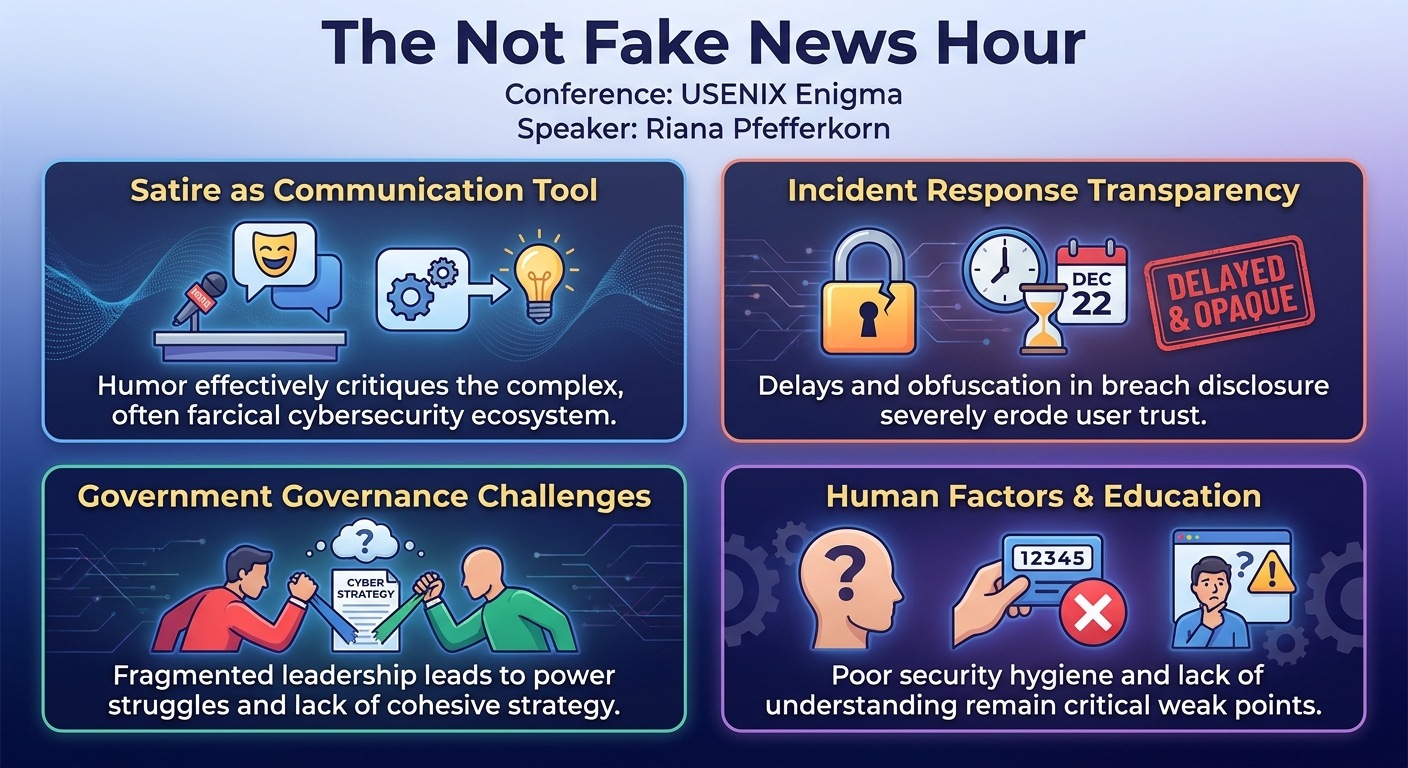
- Satire is a Powerful Communication Tool: Complex cybersecurity and privacy issues can be effectively conveyed and critiqued through humor, making them more accessible and memorable than traditional technical discussions.
- Incident Response Needs Transparency and Speed: Delays and obfuscation in breach disclosure, as highlighted by the LastPass critique, severely erode user trust and can worsen the impact of a security incident. Organizations must prioritize clear, timely communication.
- Fundamental Security Practices Remain Critical: Basic security hygiene, such as adequate password iterations and robust authentication mechanisms, are non-negotiable and often overlooked, leading to significant vulnerabilities.
- Government Cybersecurity Faces Governance Challenges: The proliferation of "cyber czars" and fragmented responsibilities within government agencies can lead to inefficiency, power struggles, and a lack of cohesive national cybersecurity strategy.
- Privacy Regulations Are Complex and Can Be Flawed: While well-intentioned, privacy laws like CPRA can be overly intricate, potentially containing obscure provisions or unintended consequences that complicate compliance and effective protection.
- Human Factors and Education Are Paramount: Despite technological advancements, user behavior, political understanding, and the ability to discern reliable information remain critical weak points in the overall security posture, requiring continuous and effective education.
About the Speaker(s)
Riana Pfefferkorn is a Research Scholar at the Stanford Internet Observatory. Her work typically focuses on the intersection of law, policy, and technology, particularly in areas concerning government surveillance, encryption, and cybersecurity. At the Stanford Internet Observatory, she contributes to research that analyzes the abuse of information technologies, including issues related to misinformation, election integrity, and the security of online platforms. Her presentation style, as demonstrated in "The Not Fake News Hour," showcases her ability to blend deep analytical insight with engaging and accessible communication, making complex topics digestible for a wide audience.
Reviews
Dr. Zero (Offensive Security Researcher) — SOLID
Normally I'd walk out of a 'comedy' talk in five minutes, but Pfefferkorn brought a flamethrower to Enigma. She bypassed the usual policy platitudes to roast the exact industry bullshit we all complain about at the hotel bar. It's not dropping zero-days, but it's a desperately needed reality check on corporate incident response and DC incompetence.
Heather Calloway (CISO) — MUST SEE
Pfefferkorn uses a satirical news broadcast to dissect the systemic failures in our industry, from botched incident communications to fragmented government policy. It is an uncomfortable but necessary mirror for security leadership. I would make my executive team watch the LastPass segment specifically to understand how delayed transparency destroys institutional trust.