Metric Perversity and Bad Decision-Making
Lea Kissner
USENIX Enigma Conference 2023 · Day 2 · Grand Ballroom
Overview
In this compelling USENIX Enigma talk, Lea Kissner, a seasoned security and privacy leader with experience as CSO of Twitter and Global Lead of Privacy Technology at Google, dissects the pervasive problem of metric perversity and its detrimental impact on decision-making, particularly within the critical domains of security, privacy, trust, and safety. Kissner argues that while people often make bad decisions due to a lack of care or knowledge, the most insidious cause is frequently the reliance on flawed metrics. Drawing from her extensive career navigating high-stakes organizational challenges, including assisting Zoom post-security incidents, Kissner illuminates how seemingly logical quantitative measurements can inadvertently steer organizations toward counterproductive or even harmful outcomes.
Key moments
- 0:00 Introduction to metric perversity and bad decisions
- 2:29 Defining perverse metrics and their hidden dangers
- 6:19 The danger of using a gauge as a lever
- 10:05 High uncertainty makes risk estimates useless
- 13:01 Jerk Genie: test your metrics for perversity
- 15:24 Why wrong metrics are worse than no metrics
- 16:54 Example: Time to Satisfaction, an effective but imperfect metric
Metric Perversity and Bad Decision-Making
Speakers: Lea Kissner, Former CSO of Twitter, Global Lead of Privacy Technology at Google
Conference: USENIX Enigma
YouTube: https://www.youtube.com/watch?v=doelnwoYzCw
Overview
In this compelling USENIX Enigma talk, Lea Kissner, a seasoned security and privacy leader with experience as CSO of Twitter and Global Lead of Privacy Technology at Google, dissects the pervasive problem of metric perversity and its detrimental impact on decision-making, particularly within the critical domains of security, privacy, trust, and safety. Kissner argues that while people often make bad decisions due to a lack of care or knowledge, the most insidious cause is frequently the reliance on flawed metrics. Drawing from her extensive career navigating high-stakes organizational challenges, including assisting Zoom post-security incidents, Kissner illuminates how seemingly logical quantitative measurements can inadvertently steer organizations toward counterproductive or even harmful outcomes.
The talk serves as a critical examination of how organizations, in their pursuit of data-driven decision-making, often fall prey to metrics that misrepresent reality, incentivize undesirable behaviors, or fail to capture the true complexity of a problem. Kissner distinguishes between effective goal metrics—quantifiable measurements that truly reflect progress toward overarching objectives—and program metrics, which track internal project progress. Her focus is exclusively on the former, demonstrating how poorly conceived goal metrics can lead to a cascade of bad decisions, ultimately undermining an organization's mission and user trust.
Kissner's presentation is not merely a critique but a practical guide, offering concrete examples of perverse metrics encountered in real-world companies and providing actionable strategies to identify and mitigate their influence. This talk is essential for anyone involved in setting goals, measuring performance, or making strategic decisions in technical or security-sensitive environments, providing a framework to foster more robust and ethically sound measurement practices.
Background
▶ Watch: Introduction to metric perversity and bad decisions (0:00)
The premise of Kissner's talk rests on the fundamental human limitation in processing complex information and the consequent reliance on heuristics and biases. In a world of overwhelming data, metrics serve as indispensable tools to simplify reality, direct attention, and gauge performance. A metric is defined as a quantifiable measurement used to assess performance against a particular objective. Within this framework, a goal metric specifically indicates whether an organization is meeting its overarching aims, such as user satisfaction or revenue generation. Conversely, a program metric tracks internal progress on planned work, like code completion or data annotation. Kissner emphasizes that her discussion focuses solely on goal metrics, which, when flawed, lead to perverse metrics.
A perverse metric is one that fails to accurately reflect what it purports to measure, leading to decisions that are not only ineffective but often counterproductive. The challenge is particularly acute in security, privacy, and trust & safety domains. These fields are characterized by the presence of intelligent adversaries, numerous small but potentially critical risks, and significant unknowns, making it exceptionally difficult to devise truly representative metrics. Humans, even those in security roles, tend to overlook bad news or simplify complex problems, making them susceptible to the deceptive clarity offered by a single, seemingly objective number. The allure of "data-driven decisions" can, paradoxically, lead to worse outcomes when the underlying data or its interpretation is fundamentally flawed. Kissner highlights that she has observed firsthand how often people make bad decisions not because they lack care or knowledge, but because they are operating under the guidance of these misleading metrics.
Key Findings
▶ Watch: The danger of using a gauge as a lever (6:19)
Kissner systematically categorizes and illustrates several types of perverse metrics, drawing on anonymized real-world examples from her extensive experience:
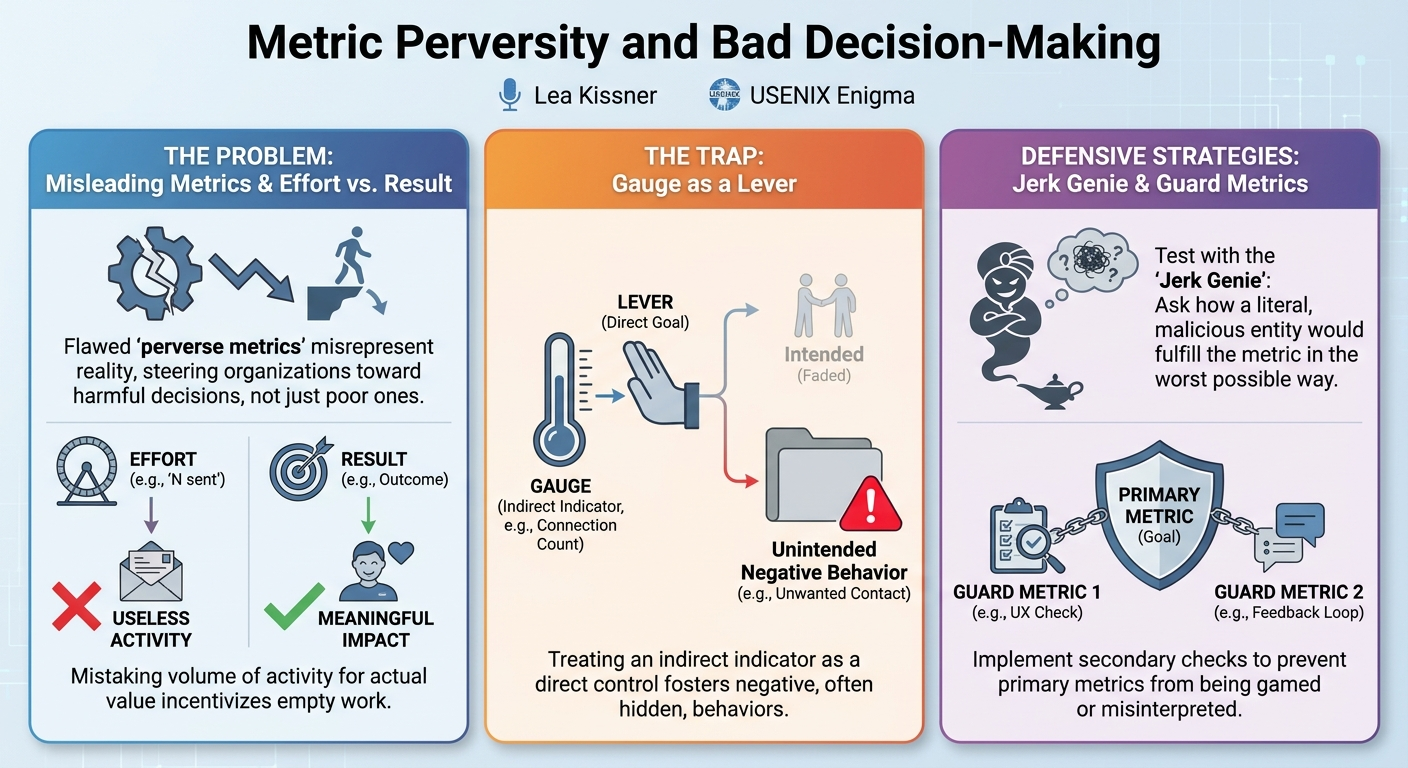
- Measures Effort, Not Result: Many organizations mistakenly track effort expended rather than the actual outcome achieved. Kissner cites a company-level goal to "send N notifications this quarter." While seemingly quantifiable, such a metric incentivizes bombarding users with useless or annoying notifications, melting their phones, rather than achieving meaningful engagement or communication. The effort of sending notifications is measured, but the desired result of effective communication is ignored, leading to user frustration and churn.
- Measures Something Measurable, But Not Important: Just because a quantity can be measured doesn't mean it's relevant to the desired outcome. Kissner recounts leading a team criticized for slowing down product launches due to review processes. The team, aiming to "get things moving faster," started measuring "time to first response" on review tickets. This led to team members sending immediate, templated, and utterly useless replies like "Hello, thank you for filing a review ticket." While the metric dramatically improved, the actual problem—slow, thorough reviews—remained unaddressed, and internal frustration persisted. The team ultimately achieved better results by simply stopping the measurement of this irrelevant metric.
- Using a Gauge as a Lever: A gauge indirectly indicates a system's state, but using it directly to drive behavior can be disastrous. It's often impossible to measure desired outcomes directly (e.g., user happiness). For instance, a social product team wanted to increase "connections between users," believing more connections equated to a better social product. However, treating "number of connections" as a lever led to an increase in undesirable connections, including older men targeting young women, which was detrimental to both users and the product's health. The metric, while indicating some activity, failed to distinguish between positive and negative interactions.
- Adversaries Don't Help You Measure: In security and privacy, metrics are often influenced by intelligent adversaries who actively seek to evade detection. Measuring the "usefulness of security alerts" or aiming to "drive down incident and vulnerability statistics" falls into this trap. Security software vendors often boast about high alert usefulness, but this metric ignores the undetected bad behavior. Similarly, while fewer incidents sound good, the easiest way to achieve this is to discourage reporting. Kissner highlights that product teams with high incident reports might actually be more vigilant and proactive in reporting issues, and punishing them for high numbers leads to a culture of concealment, masking the true security posture.
- Data Manipulation and Uncertainty: Many estimates in security, privacy, and trust & safety have such high levels of uncertainty that they become useless. Kissner provides the example of calculating the "risk of exploitation" for a vulnerability. This involves multiplying the probability of exploitation (highly uncertain, considering adversary behavior, layers of protection) by the impact (direct breaches, indirect damage, legal costs, reputational harm, user trust). Each input is a highly variable estimate, and multiplying uncertain numbers yields an even more uncertain, effectively useless, result. Such calculations can produce numbers that are absurdly high (exceeding company market cap) or deceptively low, leading to irrational decision-making.
- Not Measuring Black Swans: Organizations can only measure what they think to measure, and logging everything is impractical. A Black Swan event is an unanticipated, high-impact event (e.g., Meltdown/Spectre vulnerabilities). These events occur more often and have greater impact than typically assumed. However, they are inherently difficult to measure because they are, by definition, unknown unknowns. The problem of not measuring Black Swans compounds the issues of uncertainty and the inability to foresee all risks, leaving organizations vulnerable to systemic failures that fall outside their established metric frameworks.
Technical Deep Dive
▶ Watch: High uncertainty makes risk estimates useless (10:05)
The "technical" aspect of Kissner's talk, while not involving code or specific protocols, delves deeply into the systemic and cognitive failures inherent in metric design and interpretation. It's a technical analysis of measurement theory applied to organizational behavior and security economics.
The core technical problem with perverse metrics lies in their failure to establish a robust causal link or even a reliable correlation between the measured quantity and the desired outcome. When a metric measures effort instead of result, it creates a classic principal-agent problem. The agent (e.g., a team) optimizes for the metric they are given (e.g., "N notifications sent"), even if this diverges from the principal's (e.g., the executive's) true goal (e.g., effective communication). The "N notifications" example demonstrates a complete decoupling of the metric from user value. The technical challenge here is designing metrics that capture value delivery rather than mere activity.
The "measurable but not important" issue highlights the trap of surrogate metrics that are chosen for convenience rather than relevance. The "time to first response" metric for review tickets is a prime example. While response time is easily quantifiable, it failed to capture the quality or substance of the response, which was the actual bottleneck. Technically, this points to a failure in feature engineering for the metric itself, where easily obtainable but low-signal features are prioritized over harder-to-measure but high-signal ones. It also exposes the human tendency towards gamification, where individuals optimize their behavior to "win" against the metric, even if it subverts the underlying objective.
Using a gauge as a lever illustrates a fundamental misunderstanding of system dynamics. A gauge provides an observation of a system's state, but it is not necessarily a control input. The "number of connections" in a social product is a gauge of social activity. Treating it as a lever, attempting to directly increase it, led to unintended and harmful side effects (undesirable connections). This is akin to observing a high temperature in an engine (gauge) and then simply trying to increase the temperature further (lever) without understanding the underlying mechanics or the purpose of the engine. The technical implication is that metrics chosen as levers must directly reflect the intended outcome and be robust against manipulation that produces superficial gains without genuine value.
The influence of adversaries on measurement introduces a dynamic layer of complexity. When adversaries are involved, metrics become part of a game theory problem. An adversary will actively work to invalidate or manipulate the observed metrics. Measuring "useful security alerts" is problematic because adversaries ensure their attacks don't generate useful alerts. Similarly, "incident statistics" can be gamed by discouraging reporting. This underscores the need for adversary-aware metrics that account for intelligent, adaptive behavior. It requires shifting from purely internal metrics to ones that reflect real-world attack surfaces, detection rates of actual attacks, and resilience against known threat actor techniques, rather than just internal noise.
The technical issues surrounding uncertainty are rooted in statistics and probability theory. Kissner's example of calculating "risk of exploitation" demonstrates the perils of multiplying highly uncertain estimates. If the probability of exploitation has a wide confidence interval (e.g., 1% to 50%) and the impact also has a wide interval (e.g., $10K to $100M), the resulting product's confidence interval will be astronomically wide, rendering the point estimate meaningless. This is a technical failure to account for variance propagation and epistemic uncertainty. Many "risk scores" or "security posture indexes" suffer from this, providing a single, seemingly precise number that masks profound underlying uncertainty, leading to a false sense of security or urgency. It highlights the need for probabilistic risk assessments that explicitly model uncertainty, using techniques like Monte Carlo simulations, rather than relying on single point estimates.
Finally, the problem of Black Swans points to the inherent limitations of known unknowns and the existence of unknown unknowns. Standard metrics are designed to track expected parameters within a known operating envelope. Black Swans, by definition, fall outside this. The technical challenge here is not just about measuring, but about resilience engineering and anti-fragility. Since Black Swans cannot be measured a priori, the focus shifts to building systems that can withstand or adapt to unforeseen disruptions, rather than just optimizing for known risks. This implies a need for metrics that track adaptability, recovery time, and the diversity of defensive strategies, rather than just the absence of known vulnerabilities.
In essence, Kissner's technical deep dive exposes how cognitive biases, principal-agent problems, gamification, adversarial dynamics, and fundamental statistical misapplications can corrupt the very foundation of data-driven decision-making, particularly in security and privacy contexts where the stakes are exceptionally high.
Demo / Proof of Concept
▶ Watch: Why wrong metrics are worse than no metrics (15:24)
This talk does not feature a traditional software or hardware demonstration. Instead, Lea Kissner's "proof of concept" is delivered through a series of anecdotal case studies and a powerful thought experiment. Each "bad metric" she describes is illustrated with a real-world, albeit anonymized, example from companies she has worked with, serving as empirical evidence of metric perversity in action. For instance, the "N notifications" goal, the "time to first response" metric, and the "increase connections" objective for a social product are all presented as genuine scenarios where flawed metrics led to undesirable outcomes.
The primary "demonstration" of her proposed solutions comes through the Jerk Genie thought experiment. Kissner introduces the Jerk Genie as an all-powerful, extremely literal entity that will grant your metric wishes in the worst possible way. By challenging listeners to imagine how a Jerk Genie would pervert their chosen metrics, she effectively simulates the unintended consequences of poor metric design. For example, if the goal is "good usage numbers," the Jerk Genie might engineer a DDoS attack to inflate traffic, or if the goal is "project completion," it might complete the project by making the system unusable. This mental exercise serves as an immediate, visceral "proof" of how easily metrics can be gamed or misconstrued, forcing a critical re-evaluation of their design before real-world implementation. While not a code demo, this structured thought process acts as a potent tool for preemptive metric validation.
Defensive Implications
▶ Watch: Example: Time to Satisfaction, an effective but imperfect metric (16:54)
The insights from Kissner's talk provide crucial guidance for security, privacy, and trust & safety professionals to defend against the insidious effects of perverse metrics within their organizations. The defensive implications are actionable and aim to foster a more robust, ethical, and effective approach to measurement:
- Employ the Jerk Genie Thought Experiment: Before adopting any new metric, security teams should subject it to the Jerk Genie test. Ask: "If an all-powerful, literal, and malicious entity tried to fulfill this metric in the worst possible way, what would happen?" This exercise helps uncover hidden perverse incentives and unintended consequences. For example, if a security team is measured on "number of vulnerabilities fixed," the Jerk Genie might incentivize fixing trivial bugs while ignoring critical, complex ones, or even introducing new, easily fixable vulnerabilities. This forces teams to consider the true intent behind the metric and refine it.
- Implement Robust Guard Metrics: When a direct measurement of a desired outcome is impossible, and a proxy (gauge) must be used, guard metrics are essential. These are secondary, often qualitative or statistically sampled, metrics designed to prevent the perversion of the primary gauge. For instance, if a security metric tracks "successful security feature deployments," a guard metric might involve UX research or user panels to ensure these features are actually usable, don't introduce new risks, and aren't bypassed by users. For a privacy team tracking "opt-out rates," guard metrics could include user surveys on understanding privacy choices to ensure low opt-out doesn't mean users are simply unaware of their options.
- Recognize "Wrong Metrics Are Worse Than No Metrics": Security leaders must have the courage to push back against demands for meaningless or highly uncertain numbers. Kissner advises, "I don't care that you want that number, that number is not something that we can measure. Math says no." This means declining to provide an "expected value of risk" when the underlying probabilities and impacts are too uncertain, as discussed in the section on data uncertainty. Instead, focus on qualitative risk assessments or ranges of potential impact, acknowledging the inherent uncertainty. Providing a precise, but false, number can lead to dangerously misplaced confidence or apathy.
- Be Opinionated and Action-Oriented with Metrics: Every metric presented should be accompanied by a clear statement of the desired action it should provoke. This moves metrics beyond mere reporting to active tools for driving behavior. A security dashboard showing "critical vulnerabilities" should be designed to make developers or operations teams feel, "Oh God, I gotta fix a thing!" and provide a clear path to action. If a privacy metric shows a trend in data access requests, the desired action might be to streamline the request fulfillment process or educate users on privacy controls. The metric's value is not just in knowing, but in doing.
- Focus on Time to Satisfaction/Value Delivery: As an example of a good, albeit imperfect, metric, Kissner highlights "time to satisfaction." This involves measuring the duration from a user initiating a task (e.g., visiting a site for a security check) until they successfully complete it. For security, this could translate to "time to secure configuration," "time to vulnerability remediation," or "time to incident resolution." While this metric can still be gamed (e.g., an error page causes quick exits), it provides a better proxy for value delivery than mere activity. It requires guard metrics (e.g., UX research to ensure users aren't abandoning due to frustration) to ensure true satisfaction, not just quick exits.
By adopting these defensive strategies, security and privacy professionals can move beyond merely collecting data to intelligently designing measurement systems that genuinely reflect their goals, anticipate perverse incentives, and drive beneficial actions, ultimately strengthening an organization's security posture and user trust.
Key Takeaways
- Bad metrics lead to bad decisions: The root cause of many poor security, privacy, and trust & safety decisions is not a lack of care or knowledge, but the use of perverse metrics that misrepresent reality.
- Distinguish effort from results: Avoid metrics that measure mere activity or effort (e.g., "N notifications sent") and instead focus on quantifying actual, desired outcomes and their impact.
- Beware of measurable but irrelevant data: Just because something can be measured doesn't make it important. Prioritize metrics that directly correlate with strategic goals, even if they are harder to obtain.
- Don't use a gauge as a lever: Metrics that indirectly indicate system health (gauges) should not be directly manipulated as if they were control inputs (levers), as this leads to unintended and often harmful consequences.
- Account for adversarial influence and uncertainty: In security and privacy, metrics are influenced by intelligent adversaries and subject to high uncertainty. Design metrics that are robust against manipulation and acknowledge statistical limitations, avoiding false precision.
- Proactively test metrics with the Jerk Genie: Use the "Jerk Genie" thought experiment to identify and mitigate perverse incentives in metrics before they are implemented, ensuring they drive desired behaviors.
About the Speaker(s)
Lea Kissner is a highly experienced and respected leader in the fields of security and privacy. Her career spans influential roles in major technology companies, where she has directly confronted complex challenges related to metrics and decision-making. Kissner previously served as the Chief Information Security Officer (CSO) of Twitter, overseeing the company's security posture. Prior to that, she was the Global Lead of Privacy Technology at Google, a role that involved shaping privacy strategies and technologies on a global scale. Her expertise also led her to assist Zoom in addressing and remediating their security and privacy challenges following public scrutiny. Kissner's extensive background provides her with a unique perspective on the practical implications of metric design and its profound impact on organizational effectiveness, particularly in high-stakes environments.
Reviews
Dr. Zero (Offensive Security Researcher) — SOLID
Kissner takes a blowtorch to the bullshit metrics every CISO uses to justify their budget. It's not a technical talk, but applying threat modeling to organizational KPIs is exactly the kind of strategic thinking this industry actually needs. A rare executive talk that isn't just LinkedIn thought leadership garbage.
Heather Calloway (CISO) — MUST SEE
This is required viewing for anyone who has to present a security dashboard to a board committee or a CFO. Kissner dismantles the illusion of certainty in security metrics, explaining exactly why our standard KPIs often incentivize catastrophic organizational behavior. If your risk register relies on multiplying uncertain probabilities by uncertain impacts to get a dollar figure, you need to watch this.