What Public Interest AI Auditors Can Learn from Security Testing: Legislative and Practical Wins
Justin Brookman (Consumer Reports)
USENIX Enigma Conference 2023 · Day 2 · Grand Ballroom
Overview
In an era where artificial intelligence increasingly mediates critical aspects of daily life, the need for independent, public interest auditing of these complex systems has become paramount. This talk, delivered by Justin Brookman of Consumer Reports, delves into the essential lessons that emerging AI auditors can glean from the established history of security research. Brookman highlights the long-standing policy and practical challenges faced by security researchers and proposes how these experiences can inform and strengthen the burgeoning field of AI testing.
Key moments
- 0:00 Introduction to Consumer Reports' AI auditing mission
- 2:08 Challenges of auditing black-box AI systems
- 4:09 Why public interest AI testing is crucial
- 6:00 Famous examples of public interest AI auditing
- 7:00 Methods and challenges for AI testing
- 10:00 Legal impediments to AI system testing
- 12:56 Policy wins improving security testing environment
- 16:21 Future policy directions for AI auditing
What Public Interest AI Auditors Can Learn from Security Testing: Legislative and Practical Wins
Speakers: Justin Brookman, Consumer Reports
Conference: USENIX Enigma
YouTube: https://www.youtube.com/watch?v=MXKVAvlRjkM
Overview
In an era where artificial intelligence increasingly mediates critical aspects of daily life, the need for independent, public interest auditing of these complex systems has become paramount. This talk, delivered by Justin Brookman of Consumer Reports, delves into the essential lessons that emerging AI auditors can glean from the established history of security research. Brookman highlights the long-standing policy and practical challenges faced by security researchers and proposes how these experiences can inform and strengthen the burgeoning field of AI testing.
Consumer Reports, an organization with an 85-year legacy of rigorous product testing, has progressively expanded its focus from traditional consumer goods to digital products, emphasizing attributes like privacy and security in connected devices. With AI systems now influencing everything from credit scoring and tenant screening to hiring processes, the organization recognizes the critical imperative to audit these "black box" algorithms for potential biases, lack of effectiveness, and other detrimental outcomes. The talk emphasizes that robust, external accountability is indispensable, as self-regulation often falls short in addressing the inherent complexities and potential for "AI snake oil."
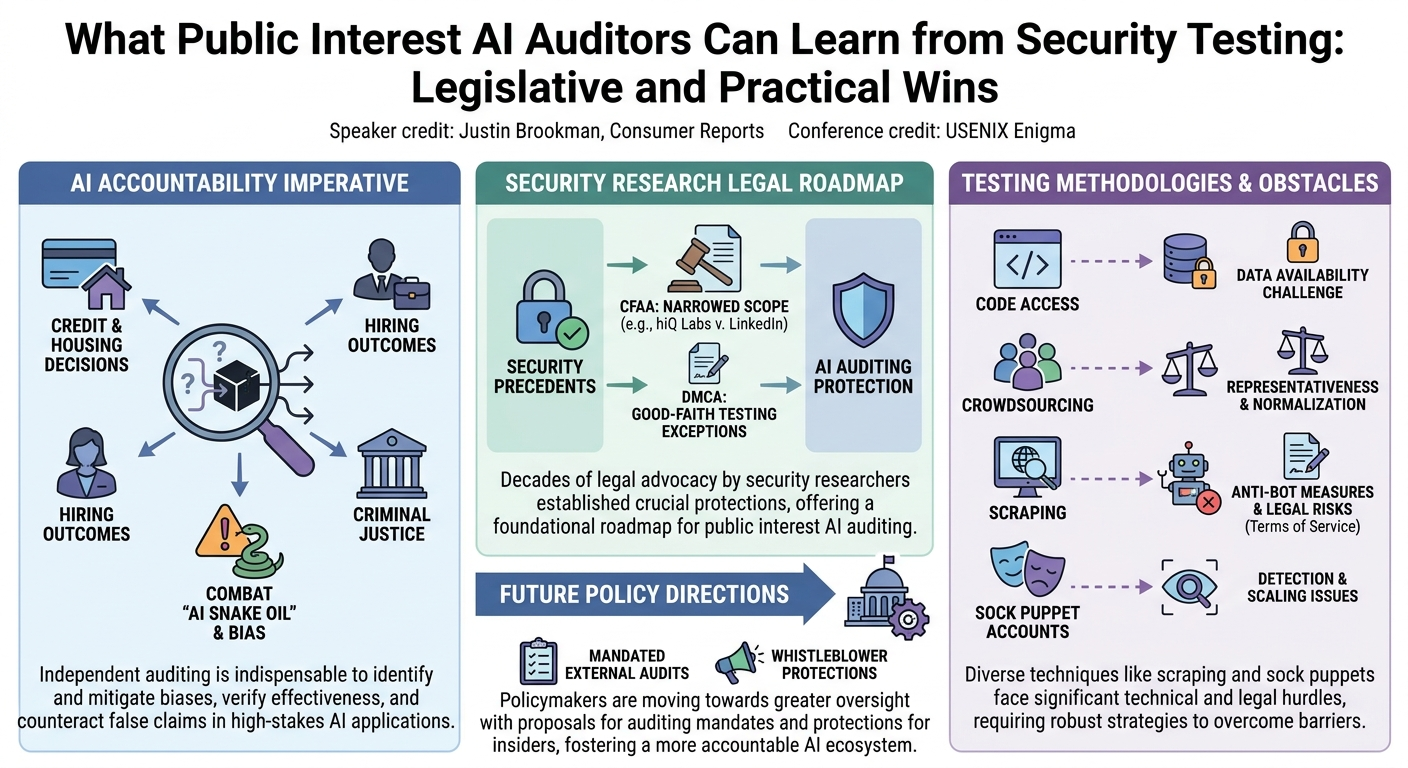
The presentation outlines the various methodologies available for AI auditing, from code analysis and crowdsourcing to scraping and the use of "sock puppet" accounts, each fraught with its own technical and legal hurdles. Crucially, Brookman meticulously charts the legislative and judicial victories that have incrementally improved the environment for security researchers, particularly concerning the Computer Fraud and Abuse Act (CFAA) and the Digital Millennium Copyright Act (DMCA). These precedents offer a roadmap for advocating for a more permissive and protective landscape for public interest AI auditors, ensuring that these powerful systems can be effectively scrutinized for the benefit of society.
Background
▶ Watch: Introduction to Consumer Reports' AI auditing mission (0:00)
Consumer Reports' journey into auditing complex software systems began several years ago, evolving from its traditional role of evaluating physical products like cars and appliances. Recognizing the growing prevalence of internet-connected devices, the organization started testing for privacy and security attributes in products like Smart TVs and fertility apps. A notable incident in 2015 involved a fertility app found to expose sensitive user data due to multiple vulnerabilities, prompting Consumer Reports to formalize its research into ratings that now include privacy and security scores. This expansion naturally leads to the current frontier: auditing AI systems.
The motivation for public interest AI testing stems from the pervasive and often opaque influence of AI in critical sectors. Algorithms now determine credit scores, tenant screening decisions, and hiring outcomes, often employing sophisticated, less explainable methods than traditional deterministic systems. Without external scrutiny, these systems risk perpetuating and even amplifying societal biases, as evidenced by Amazon's famously biased hiring algorithm that favored male candidates with specific backgrounds, or the well-documented racial bias in COMPAS sentencing algorithms highlighted by ProPublica. Beyond bias, there is a significant concern about the proliferation of "AI snake oil"—systems that promise advanced capabilities like self-driving but fail to deliver in real-world environments. Brookman stresses that internal self-regulation is often insufficient due to limited visibility into complex systems and a lack of sufficient motivation for companies to expose their own flaws.
The talk draws heavily from a paper titled "Opening Black Boxes," co-authored by Nandita Sampath, which explores the legal impediments to AI testing. It categorizes AI testing methodologies based on the work of Christian Sandvig:
- Code Access: Directly examining the algorithm's source code. While valuable, as seen with Twitter's face cropping algorithm (which exhibited bias towards lighter faces and was subsequently open-sourced), it can be overwhelming for complex systems like Google Search. Moreover, code alone is often insufficient without access to the training data that shapes the AI's behavior, which can embed historical biases.
- Crowdsourcing: Collecting user experiences and data from a large group. Consumer Reports has utilized this for studies on insurance pricing, revealing disparities in traditionally redlined areas. However, scaling and normalizing data from diverse sources, and ensuring a representative sample, pose significant practical challenges.
- Scraping: Automatically collecting publicly available data. NYU's Ad Observatory, which collected political ad targeting data from Facebook and YouTube, is a prime example. This method, however, frequently runs into legal ambiguities surrounding terms of service and robots.txt directives.
- Sock Puppet Accounts: Creating fake accounts to interact with and test AI systems under controlled conditions, allowing researchers to simulate diverse demographics or behaviors. The main hurdles here are the difficulty of scaling such operations to achieve statistically significant results and companies' legitimate reasons to block inauthentic activity, which can hinder testing.
These methodologies, while powerful, are consistently met with legal and practical obstacles, underscoring the necessity of learning from the historical struggles and triumphs of security researchers.
Key Findings
▶ Watch: Why public interest AI testing is crucial (4:09)
The central finding of this talk is that the evolving legal and policy landscape, shaped by decades of security research, offers crucial precedents and a more favorable environment for public interest AI auditing than previously existed. Despite ongoing challenges, significant legislative and judicial wins have created pathways for external scrutiny of complex systems.
One of the most impactful developments concerns the Computer Fraud and Abuse Act (CFAA), which historically posed a significant threat to security researchers due to its broad definition of "unauthorized access." Recent court decisions have substantially narrowed its scope. The hiQ Labs v. LinkedIn case established that scraping publicly available data, even in violation of terms of service, does not constitute "hacking" under the CFAA. More definitively, the Supreme Court's ruling in Van Buren v. United States clarified that an individual does not violate the CFAA by accessing a computer system for an improper purpose if they are otherwise authorized to access that system. Furthermore, the Department of Justice (DOJ) issued a policy statement explicitly stating it would not prosecute good-faith security research under the CFAA. While these federal interpretations are favorable, the speaker notes that state-level anti-hacking statutes often remain vague and less interpreted.
Similar progress has been made with the Digital Millennium Copyright Act (DMCA), which prohibits the circumvention of technological protection measures (TPMs). The Library of Congress, which periodically issues exceptions to the DMCA, has consistently included good-faith security testing in recent rounds. This critical exception allows researchers to bypass copy-protection or access controls for legitimate security analysis without incurring legal penalties.
In the realm of Consumer Protection Law, several victories have bolstered the rights of testers and reviewers. State Attorneys General have successfully challenged "Oracle Clauses"—contractual provisions that prohibit users from publishing negative reviews or test results—as deceptive and unenforceable. Cases involving McAfee and Blue Coat demonstrated that imposing such clauses is not only unenforceable but can also be deemed a deceptive business practice. The Federal Trade Commission (FTC) took similar action in the Rock Labs case against clauses that demanded consumers assign copyright for any reviews they published. Congress further solidified these protections with the Consumer Review Fairness Act (CRFA), affirming consumers' right to publish good-faith reviews without contractual impediments.
However, significant challenges persist. The legal standing of robots.txt directives (which signal a website's scraping preferences) remains an open question. More critically, the legality of "actions to evade testing" is largely unresolved. Companies like Volkswagen (with its "defeat devices" for emissions tests) and Uber (with its "Greyball" tool to evade regulators) have demonstrably altered system behavior when under scrutiny. While Volkswagen faced penalties for false advertising, the broader question of whether "deceiving a tester" is an unfair or deceptive business practice lacks clear legal guidance.
Despite these ambiguities, there is a growing recognition among policymakers of the necessity for external AI auditing. Emerging legislative proposals at federal and state levels (e.g., in D.C., California, and Washington) are beginning to consider auditing mandates for certain high-stakes AI systems and whistleblower protections for insiders who report wrongdoing. These nascent policy vehicles suggest a future where AI systems are not only subject to external review but where the legal framework actively encourages and protects such scrutiny.
Technical Deep Dive
▶ Watch: Methods and challenges for AI testing (7:00)
The technical aspects of public interest AI auditing primarily revolve around the methodologies employed to probe black-box systems and the legal frameworks that either enable or impede these techniques. The core challenge lies in gaining sufficient visibility and control to accurately assess an AI's behavior, performance, and biases, especially when internal code and training data are proprietary.
As outlined, the primary testing methodologies include:
- Code Access: While ideal for complete transparency, obtaining the source code for complex AI systems is rare. Twitter's decision to open-source its face-cropping algorithm after bias allegations (it disproportionately cropped to lighter-skinned faces) is an exception. Even with code, true understanding requires access to the training data, which often contains the historical biases that AI models learn. Without this, the code alone might appear neutral, but its learned behavior could be discriminatory.
- Crowdsourcing: This involves aggregating data and experiences from a large user base to identify patterns or biases. Consumer Reports' study on insurance pricing, which revealed higher rates in historically redlined areas even after accounting for other factors, exemplifies this. Technically, the challenge here is data normalization—standardizing information collected from disparate sources—and ensuring the representativeness of the crowd to avoid skewed results.
- Scraping: Automated collection of publicly accessible data from websites or applications. NYU's Ad Observatory used this to gather data on political ad targeting. Technically, scrapers must contend with website structures, anti-bot measures, and the legal implications of robots.txt files, which signal a website's preference regarding automated access. The legal clarity provided by hiQ Labs v. LinkedIn regarding the CFAA helps, but civil claims for breach of contract (violating terms of service) remain a risk.
- Sock Puppet Accounts: Creating synthetic user profiles to interact with AI systems in a controlled manner, allowing researchers to test specific demographic groups or behaviors. For instance, to test for bias in a hiring algorithm, researchers might create profiles with varying gender, race, or educational backgrounds. Technically, this requires sophisticated methods to evade anti-inauthentic activity detection systems, which might flag multiple accounts from a single IP address, unusual behavior patterns, or lack of genuine human interaction. Companies have legitimate reasons to prevent spam or fraud, but these measures can inadvertently block legitimate research.
The legal environment directly impacts the feasibility and risk of these technical approaches:
- Computer Fraud and Abuse Act (CFAA): This federal statute criminalizes unauthorized access to computer systems. The hiQ Labs and Van Buren Supreme Court decisions have significantly narrowed its scope, making it less likely that scraping publicly available data or using sock puppet accounts (which might violate terms of service but not necessarily "unauthorized access") will lead to federal criminal charges. However, state laws can be more ambiguous.
- Digital Millennium Copyright Act (DMCA): The DMCA prohibits the circumvention of technological protection measures (TPMs), which could apply to systems designed to prevent scraping or account creation. The triennial exceptions issued by the Library of Congress, which now specifically allow for good-faith security testing, are crucial here. Advocacy aims to expand these exceptions to explicitly cover public interest AI auditing.
- Contract Law (Terms of Service): Companies often embed clauses that prohibit specific testing activities, such as scraping, creating fake accounts, or publishing negative results ("Oracle Clauses"). While the Consumer Review Fairness Act and state AG actions have weakened the enforceability of publication restrictions, other contractual prohibitions can still lead to civil lawsuits for breach of contract or liquidated damages.
- Evasion of Testing: A significant technical and ethical challenge is when AI systems are designed to detect and alter their behavior during testing. Examples include Volkswagen's "defeat devices" that reduced emissions only during official tests, cell phone benchmarks that run "hotter" when detecting testing environments, or Uber's "Greyball" tool that showed regulators a different version of its app. This requires auditors to develop covert testing methods that are indistinguishable from normal user interaction, raising complex legal questions about whether "deceiving a tester" is legally actionable as an unfair or deceptive practice.
In essence, the technical deep dive into AI auditing reveals a constant cat-and-mouse game between auditors seeking transparency and systems designed for opacity or even evasion, all operating within a complex and evolving legal framework.
Demo / Proof of Concept
▶ Watch: Legal impediments to AI system testing (10:00)
This talk focuses on the policy and legal landscape surrounding public interest AI auditing, drawing parallels with security testing. As such, it does not feature a live technical demonstration or proof of concept of an AI audit. Instead, it discusses various methodologies for auditing AI systems and the legal precedents and challenges associated with them, referencing real-world examples of successful and contested audits to illustrate its points.
Defensive Implications
▶ Watch: Future policy directions for AI auditing (16:21)
The insights presented by Justin Brookman offer crucial implications for various stakeholders involved in the development, deployment, and oversight of AI systems.
For AI Developers and Companies:
- Proactive Internal Auditing: Companies should move beyond basic testing and implement robust, continuous internal auditing for bias, fairness, and effectiveness. This includes scrutinizing training data for historical biases and regularly evaluating model outputs against diverse demographic groups.
- Embrace Transparency: Consider adopting practices like open-sourcing algorithms (as Twitter did with its face-cropping algorithm) or participating in algorithmic bug bounty programs. These initiatives can build trust, identify flaws faster, and demonstrate a commitment to ethical AI.
- Design for Auditability: AI systems should be designed from the ground up with auditability in mind. This means avoiding "defeat devices" or "evasion of testing" mechanisms (like Volkswagen's or Uber's "Greyball"), as these not only erode trust but can lead to severe legal and reputational consequences.
- Engage with Researchers: Establish clear, safe, and legal channels for independent researchers and public interest groups to report findings. This includes providing researchers with appropriate access (within legal and privacy boundaries) and ensuring they are not met with legal threats for good-faith testing.
- Review Contractual Clauses: Companies should review their Terms of Service and end-user license agreements to remove overly restrictive "Oracle Clauses" or copyright assignment demands that hinder independent review and testing.
For Public Interest Auditors and Researchers:
- Leverage Legal Precedents: Understand and strategically utilize the favorable interpretations of the CFAA and DMCA to mitigate legal risks associated with scraping or circumventing technical measures for good-faith research.
- Advocate for Policy Reform: Actively engage with policymakers to push for broader DMCA exceptions to explicitly include AI auditing, advocate for auditing mandates for high-stakes AI systems, and support robust whistleblower protections for those who expose AI system flaws internally.
- Methodological Rigor: Be acutely aware of the technical challenges, such as ensuring data representativeness in crowdsourced studies, overcoming anti-bot measures in scraping, and designing sock puppet accounts that can evade detection while yielding statistically significant results. The goal is to produce scientifically legitimate and defensible findings.
- Document and Disclose: Meticulously document methodologies, findings, and any interactions with companies or legal challenges encountered. Transparent disclosure of research methods enhances credibility and contributes to the collective knowledge base.
For Regulators and Policymakers:
- Mandate External Audits: Implement legislation requiring independent, third-party audits for AI systems used in critical applications (e.g., credit, employment, criminal justice) where errors or biases can have significant societal impact.
- Strengthen Whistleblower Protections: Enact and enforce strong protections for insiders who come forward with evidence of problematic AI system behavior, recognizing that internal visibility often surpasses external capabilities.
- Clarify Legal Ambiguities: Address the legal gray areas, particularly regarding the legality of "deceiving a tester" (i.e., when AI systems detect and evade auditing) and the enforceability of robots.txt directives in the context of public interest research.
- Enforce Consumer Protection: Continue to challenge and invalidate deceptive contractual clauses that stifle independent research and consumer reviews, ensuring that the Consumer Review Fairness Act is robustly applied.
By taking these defensive and proactive measures, all stakeholders can contribute to fostering a more accountable, transparent, and ultimately safer AI ecosystem.
Key Takeaways
- AI Auditing is Critical for Accountability: As AI permeates vital societal functions like credit scoring, hiring, and criminal justice, independent public interest auditing is indispensable to identify and mitigate biases, verify effectiveness, and combat "AI snake oil."
- Security Research Offers a Legal Roadmap: Decades of advocacy and legal battles by security researchers have yielded crucial precedents, particularly in narrowing the scope of the CFAA and securing DMCA exceptions for good-faith testing, providing a foundation for AI auditors.
- Diverse Methodologies Face Technical and Legal Hurdles: Techniques like code access, crowdsourcing, scraping, and sock puppet accounts each present unique challenges related to data availability, representativeness, anti-bot measures, and legal risks under contract law and state statutes.
- Company Transparency and Proactivity are Key: Companies can foster trust and improve their AI systems by considering open-sourcing algorithms, implementing algorithmic bug bounty programs, and designing systems to be auditable rather than evasive.
- Policymakers are Recognizing the Need for Oversight: There is growing momentum for legislative action, with emerging proposals for auditing mandates and whistleblower protections for AI systems, signaling a shift towards greater external accountability.
- Continued Advocacy is Essential: While progress has been made, ongoing advocacy is crucial to clarify legal ambiguities (e.g., "deceiving a tester," robots.txt), expand legal protections for public interest researchers, and ensure that consumer protection laws effectively prevent clauses that stifle independent review.
About the Speaker(s)
Justin Brookman is a representative of Consumer Reports, a venerable organization with a long history of consumer advocacy and product testing. He possesses a legal and policy background, rather than a technical one, and has been actively involved in the realm of privacy testing. Brookman delivered this talk on behalf of his colleague, Nandita Sampath, who authored the paper "Opening Black Boxes" which largely informed the presentation, and who has since transitioned to a full-time role in AI testing.
Reviews
Dr. Zero (Offensive Security Researcher) — SOLID
Brookman maps the hard-fought legal wins of the infosec community—like surviving the CFAA and DMCA 1201 exemptions—onto the emerging Wild West of AI auditing. It's a competent policy briefing that explains how to scrape APIs and run sock-puppets without catching a federal indictment. Good for the AI safety crowd, but a bit of a legal rerun for anyone who has been in security for the last decade.
Heather Calloway (CISO) — SOLID
This talk maps the hard-won legal protections of security vulnerability research onto the emerging field of AI auditing. It is highly relevant for leadership teams building AI governance programs. If you are deploying algorithmic systems, you need to understand how external researchers will probe your models before the regulators mandate it.