Why Is Our Security Research Failing? Five Practices to Change!
Marcus Botacin (Texas A&M University)
USENIX Enigma Conference 2023 · Day 2 · Grand Ballroom
Overview
In this insightful USENIX Enigma talk, Marcus Botacin from Texas A&M University critically examines the current state of security research, asking a provocative question: "Why Is Our Security Research Failing?" Drawing from an extensive review of over 400 papers published in top security venues over two decades, Botacin identifies five systemic practices that he argues hinder the field's progress, impact, and reproducibility. Rather than merely pointing fingers, this presentation serves as a reflective exercise, acknowledging that even his own work has encountered some of these pitfalls, and aims to foster a much-needed discussion on how to collectively strengthen security research.
Key moments
- 2:10 Research basis: Reviewing 400+ papers on security challenges
- 3:10 First practice: Diversify research types, more observational studies
- 6:05 Second practice: Engage with market and industry needs
- 8:15 Third practice: Avoid blindly relying on industry solutions
- 11:10 Fourth practice: Develop stronger methodology and standards
- 13:00 Fifth practice: Addressing the security research reproducibility crisis
- 14:50 Proposed solutions: Diversify, standardize, focus on reproducibility
Why Is Our Security Research Failing? Five Practices to Change!
Speakers: Marcus Botacin, Texas A&M University
Conference: USENIX Enigma
YouTube: https://www.youtube.com/watch?v=7XUKwSExJG0
Overview
In this insightful USENIX Enigma talk, Marcus Botacin from Texas A&M University critically examines the current state of security research, asking a provocative question: "Why Is Our Security Research Failing?" Drawing from an extensive review of over 400 papers published in top security venues over two decades, Botacin identifies five systemic practices that he argues hinder the field's progress, impact, and reproducibility. Rather than merely pointing fingers, this presentation serves as a reflective exercise, acknowledging that even his own work has encountered some of these pitfalls, and aims to foster a much-needed discussion on how to collectively strengthen security research.
Botacin's core argument is that while past research has undoubtedly made the world more secure, the field faces significant challenges that impede its ability to address contemporary threats effectively. He highlights a growing disconnect between academic output and industry needs, a pervasive reproducibility crisis, and fundamental flaws in experimental methodologies. The talk is a call to action for researchers, reviewers, and the community at large to reconsider established norms, diversify research approaches, and develop clearer standards to ensure security research remains relevant, rigorous, and impactful in an ever-evolving threat landscape.
This article delves into Botacin's five key practices that require change, exploring the underlying issues and proposing actionable solutions for researchers and the security community. It unpacks the implications of these research shortcomings for both academic advancement and practical defensive strategies, ultimately aiming to contribute to a more robust and effective future for security science.
Background
▶ Watch: Research basis: Reviewing 400+ papers on security challenges (2:10)
The challenges facing security research are not new, but their scale and implications are becoming increasingly critical. Marcus Botacin contextualizes his critique by referencing long-standing concerns within both industry and academia. Practitioners frequently lament the slow pace of research developments, the difficulty in transitioning research outcomes into practice, and perceived failures in educating future security professionals. Within academia, the "science of security" movement has, for years, highlighted severe limitations in reporting experimental results and ensuring reproducibility. Botacin's talk, therefore, builds upon a recognized foundation of concern, seeking to quantify and categorize the specific pitfalls that contribute to these systemic issues.
His analysis is rooted in a paper he previously published, titled "Challenges and Pitfalls in Our Research," where he meticulously reviewed over 400 security papers from the last two decades. While his personal background is in malware analysis, specifically investigating Brazilian malware samples which he discussed at a previous Enigma conference, he emphasizes that the identified problems extend across nearly all security domains. The core problem, as Botacin frames it, is that security research often operates under flawed assumptions and practices, leading to a body of work that, despite good intentions, struggles with relevance, rigor, and real-world applicability. This creates a cycle where limited observational studies fail to inform engineering solutions, ad-hoc decisions replace standardized methodologies, and a lack of reproducibility undermines scientific progress.
Key Findings
▶ Watch: Second practice: Engage with market and industry needs (6:05)
Botacin identifies five critical practices that, if changed, could significantly improve the quality and impact of security research. These findings are the culmination of his extensive literature review and personal observations within the field.
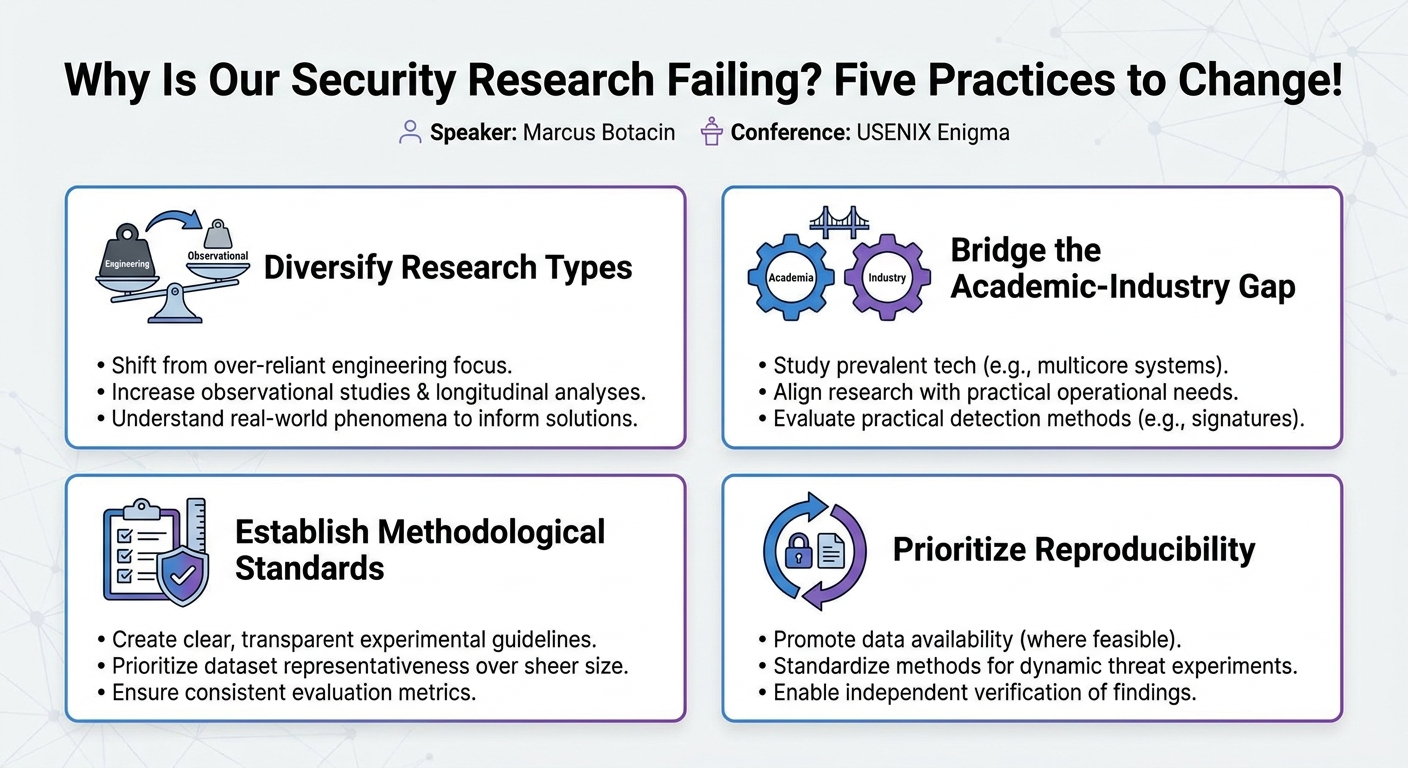
1. Stop Focusing on the Same Research Types
The first major issue is the imbalance in research types. Botacin categorizes security research into three main types: engineering solutions (typically defenses), offensive work, and observational studies. His review found a stark prevalence of engineering solutions, often outnumbering all other research types combined. This imbalance is problematic because the ideal scientific and engineering method dictates that observation of phenomena should precede hypothesis generation and solution development. Observational studies are crucial for identifying real-world problems, understanding their nuances, and informing the parameters for effective engineering solutions.
The current situation suggests that researchers often develop solutions based on ad-hoc decisions rather than being informed by prior observational data. This leads to solutions that may not perfectly match operational scenarios, requiring constant refinement and potentially leading to more published papers on similar, slightly refactored solutions. The scarcity of high-quality observational studies creates a vicious cycle, hindering the development of truly relevant and effective defenses.
2. Look More to the Market and Industry
A significant gap exists between academic research and the practical needs of the industry. Botacin highlights two key examples:
- Target Platforms: While 99% of users carry multicore systems in their pockets, less than 1% of published academic works cover these systems. This creates a vast "understanding gap" regarding phenomena like multicore malware or distributed threats. While single-core solutions might serve as proofs-of-concept, the lack of fundamental research into real-world, prevalent architectures means academic work often misses critical operational contexts.
- Antivirus Detection Approaches: The antivirus industry largely relies on signatures for their effectiveness, compactness, and speed, despite their drawbacks. In contrast, academic research overwhelmingly favors more flexible machine learning approaches, capable of detecting zero-days, but often with performance limitations. This practical divide means academics are frequently not studying the very solutions and problems that are actively used and faced in the real world, limiting the potential impact of their work.
3. Stop Blindly Relying on Industry/Market Solutions
While looking to the market is important, Botacin cautions against blindly relying on industry solutions or data, as this can introduce significant biases and flaws into experiments.
- Goodware Data Collection: Researchers often collect goodware data (benign files) by crawling internet repositories and marketplaces, aiming to reflect popular applications. However, there's no guarantee these repositories are free from malware, corrupted applications, or bundled spyware. This can lead to biased classifiers that inadvertently learn unintended behaviors as benign, compromising the validity of machine learning models.
- Antivirus Labels: Researchers frequently rely on antivirus labels to train machine learning models or to benchmark their own tools. However, antivirus labels are not homogeneous; different solutions can provide varying labels for the same sample, and the meaning of these labels can differ. Furthermore, antivirus solutions rarely disclose the underlying detection engines (e.g., signature-based vs. machine learning-based). This makes fair comparisons extremely difficult, potentially leading to overstating or understating research results when comparing against an opaque industry black box.
4. Develop Stronger Methodologies and Standards
The absence of stronger methodologies, standards, and guidelines is a pervasive issue. Botacin illustrates this with the example of data set size in experiments. There is no clear pattern or consensus in the literature regarding an ideal data set size, with authors making ad-hoc decisions and even presenting contradictory results (e.g., one million samples being "enough" versus "the bare minimum").
This leads to an effect called anchor bias, where in the absence of clear guidelines, previous studies establish an "anchor" for future developments, leading to an ever-increasing demand for "bigger" data sets. Botacin argues that bigger is not necessarily better; what is needed is a representative data set size that accurately reflects the target population, not just a voluminous one. The lack of such standards undermines the rigor and comparability of research.
5. Address the Reproducibility Crisis
Security research, like other scientific fields, faces a reproducibility crisis, but with unique human and technological factors.
- Human Factors: Data sets, especially malicious ones, often come from crawling internet repositories or from partner companies. However, many companies are reluctant to disclose how they were breached or their commercial secrets, leading to researchers operating under Non-Disclosure Agreements (NDAs). Consequently, the majority of data sets used in published works are not available, making immediate reproduction of experiments impossible.
- Technological Factors: Even with access to all samples, the dynamic nature of threats poses a challenge. There's no guarantee that a malware sample will download the same payload in the future, that command-and-control (C2) servers will remain reachable, or that they won't have been sinkholed. This means running the same experiment at a later date might yield different results, highlighting the need for widely established methods to reproduce experiments involving dynamic threats.
Technical Deep Dive
▶ Watch: Third practice: Avoid blindly relying on industry solutions (8:15)
While Botacin's talk is a meta-analysis of security research practices, it delves into the technical implications of these practices, particularly concerning experimental design, data collection, and analysis. The core technical argument is that the current approach often deviates from a sound scientific method, which merges observation with rigorous engineering.
The scientific method, as applied to security, ideally starts with observational studies to identify an undesired phenomenon (e.g., a security violation). This observation informs the development of a hypothesis, which then needs to be tested through ingenious and complex engineering solutions or proofs of concept. However, the observed prevalence of engineering solutions over observational studies (as noted in the Key Findings) indicates a reversal or omission of this crucial observational step. This leads to solutions that are less grounded in real-world phenomena and more in theoretical constructs or ad-hoc problem definitions.
Technically, this manifests in several ways:
- Misaligned Research Focus: The neglect of multicore systems in academic research for instance, is a technical oversight. Given that modern computing is predominantly multicore, research focusing solely on single-core architectures fails to address the unique concurrency issues, shared memory vulnerabilities, and inter-process communication threats inherent in multicore environments. Similarly, the academic preference for machine learning detection over industry-standard signature-based detection creates a technical disconnect. While ML offers flexibility for zero-day detection, it often comes with performance trade-offs, adversarial robustness challenges, and a need for extensive, carefully curated training data that signature-based systems, for all their limitations, do not share to the same degree.
- Flawed Data Collection for Machine Learning: When training machine learning classifiers for malware detection, the quality of goodware (benign) and malware (malicious) datasets is paramount. Botacin highlights the technical flaw in collecting goodware from public repositories without stringent vetting. These repositories can harbor packed executables, trojanized applications, or software bundled with spyware, inadvertently biasing the classifier to learn malicious behaviors as benign. This directly impacts the false positive rate and false negative rate of the model, rendering it less effective in real-world deployment.
- The Antivirus Label Dilemma: The reliance on antivirus labels for ground truth in ML training or for benchmarking is technically problematic due to label heterogeneity. Different antivirus engines employ diverse detection heuristics, ranging from static signature matching and dynamic sandboxing to behavioral analysis and proprietary machine learning models. A sample labeled "malicious" by one vendor might be "clean" by another, or classified as a different malware family. Without knowing the underlying detection logic (e.g., "this label was generated by a heuristic engine, not a signature"), researchers cannot perform a fair technical comparison. This lack of transparency obscures whether a new ML-based detection method is truly superior to existing signature logic, or simply being compared against a less effective engine type.
- Data Set Size and Representativeness: The technical debate around data set size for ML model training is crucial. While larger datasets can help prevent overfitting and improve model generalization, Botacin argues that representativeness is more critical than sheer volume. A massive dataset that only covers a narrow subset of real-world malware families or attack vectors (e.g., only Windows executables, neglecting Linux, macOS, or mobile threats) is technically less valuable than a smaller, but more diverse and representative one. The "anchor bias" leading to ever-larger datasets without critical evaluation of their composition is a technical pitfall, as it can lead to models that perform well on specific, large, but unrepresentative benchmarks, yet fail dramatically in diverse operational environments.
- Reproducibility Challenges in Dynamic Analysis: The reproducibility crisis has distinct technical dimensions in security. For dynamic malware analysis, the execution environment, network conditions, and the state of external infrastructure (e.g., Command and Control (C2) servers, payload download sites) are critical. If a malware sample downloads a different payload on a subsequent run, or if its C2 server is sinkholed or offline, the observed behavior will change. This makes it technically challenging to reproduce results based on dynamic analysis without sophisticated environment control, network simulation, or archiving of dynamic artifacts. The lack of standardized methodologies for capturing and replaying such dynamic interactions directly impedes the validation and verification of research findings.
In essence, the technical deep dive reveals that many of the observed failures stem from a lack of scientific rigor in defining problems, collecting data, designing experiments, and reporting results, all of which have direct and significant technical consequences for the validity and applicability of security research.
Demo / Proof of Concept
▶ Watch: Fifth practice: Addressing the security research reproducibility crisis (13:00)
This talk is a critical analysis of the methodologies and practices within security research rather than the presentation of a new tool, technique, or exploit. Therefore, a traditional demonstration or proof of concept was not part of Marcus Botacin's presentation. His work is a meta-study, focusing on identifying systemic issues rather than showcasing a specific technical solution.
Defensive Implications
▶ Watch: Proposed solutions: Diversify, standardize, focus on reproducibility (14:50)
The implications of Botacin's critique extend directly to the defensive posture of organizations and the effectiveness of security practitioners. If security research is failing, it means that the knowledge base informing defenses is potentially flawed, irrelevant, or slow to adapt to real-world threats. Addressing these issues is paramount for strengthening collective cybersecurity.
- Demand for Relevant Research: Defenders need academic research that directly addresses real-world problems and operational environments. This means a greater emphasis on observational studies that document actual attack trends, prevalent malware families, and critical vulnerabilities in widely used systems (like multicore architectures). Industry practitioners should actively engage with academia to communicate their challenges, fostering research that is immediately actionable and relevant to their defensive strategies.
- Informed Tool Development: The disconnect between academic solutions (e.g., machine learning) and industry practices (e.g., signatures) means defenders might be missing out on valuable insights or struggling to integrate cutting-edge academic work. Academics must consider the deployment constraints and performance requirements of defensive tools. Conversely, defenders should be aware of the strengths and weaknesses of different detection approaches, understanding when a flexible ML model might be appropriate versus a robust signature-based system.
- Critical Evaluation of Security Products: Botacin's warning against blindly relying on industry solutions, particularly concerning antivirus labels and goodware collection, has direct implications for security product selection and evaluation. Defenders should be wary of marketing claims based on opaque benchmarks or evaluations that don't disclose underlying methodologies. A deeper understanding of how security products are tested and validated, including their data sources and detection engines, is crucial for making informed purchasing decisions and configuring systems effectively.
- Adoption of Stronger Methodologies: The call for stronger methodologies and standards in research translates into a need for more reliable and robust security tools and practices. When research provides clear guidelines for representative datasets and reproducible experiments, it leads to more trustworthy findings. Defenders can then confidently implement recommended controls, knowing they are based on sound scientific principles. This also means being critical of internal security assessments and penetration tests, ensuring they follow rigorous, transparent methodologies.
- Prioritizing Reproducibility for Trust: The reproducibility crisis directly impacts trust in security research. If a defensive technique or vulnerability finding cannot be independently verified, its utility is severely diminished. Defenders rely on verifiable information to make critical decisions. Therefore, the push for greater data availability (within ethical and privacy boundaries) and standardized methods for reproducing dynamic threat behaviors is vital. This allows defenders to validate research claims, adapt solutions to their specific contexts, and build more resilient systems based on transparently validated knowledge.
- Focus on Phenomena, Not Just Files: Botacin's ultimate takeaway — to study populations and phenomena rather than just individual files — encourages defenders to think beyond individual indicators of compromise (IOCs). Understanding the broader attack campaigns, attacker motivations, and the prevalence of certain vulnerabilities across their network allows for more strategic and proactive defense. This shift in perspective, informed by robust observational studies, can lead to more effective threat intelligence and risk management strategies.
In summary, the defensive implications underscore the symbiotic relationship between research and practice. By addressing the systemic flaws in security research, the community can produce more relevant, reliable, and actionable insights, directly empowering defenders to build more effective and resilient cybersecurity postures.
Key Takeaways
- Diversify Research Types: The security research community needs to shift away from an over-reliance on engineering solutions and significantly increase the number of observational studies and longitudinal analyses to better understand real-world phenomena and inform solution development.
- Bridge the Academia-Industry Gap: Research must be more attuned to industry needs, focusing on prevalent technologies like multicore systems and understanding the practical applications of different detection methods, including signature-based approaches.
- Critically Evaluate Data Sources: Researchers and practitioners should avoid blindly relying on industry data (e.g., unverified goodware repositories, opaque antivirus labels) and instead develop stronger, transparent methodologies for data collection and benchmarking to prevent bias.
- Establish Methodological Standards: The field urgently requires clear guidelines and standards for experimental design, particularly regarding data set representativeness (over sheer size) and robust evaluation metrics, to ensure consistency and comparability across studies.
- Prioritize Reproducibility: Addressing the reproducibility crisis is crucial. This involves promoting data availability (where feasible), developing standards for reproducing experiments involving dynamic threats, and focusing research on studying populations and phenomena rather than immutable individual samples.
- Focus on Impact and Relevance: The ultimate goal of security research should be to produce knowledge that is scientifically sound, practically relevant, and capable of informing effective defensive strategies in the ever-evolving threat landscape.
About the Speaker(s)
Marcus Botacin is a researcher from Texas A&M University, deeply engaged in the field of cybersecurity. He is known for his work as a malware analyst, with a particular focus on investigating Brazilian malware samples. His prior experience includes presenting at the USENIX Enigma conference two years before this talk, where he highlighted the need for more region-specific observational studies due to the lack of detailed literature on certain malware populations. Botacin is the author of a significant paper that reviewed over 400 security research papers published in top venues over the last 20 years, meticulously identifying common challenges and pitfalls, which served as the foundation for the insights shared in this presentation. His work consistently advocates for a more rigorous, relevant, and reproducible approach to security research.
Reviews
Dr. Zero (Offensive Security Researcher) — STRONG ACCEPT
Botacin did the grueling work of analyzing 400 top-tier security papers to prove what practitioners have known for a decade: academic security research is deeply broken. He torches the academic obsession with unverified datasets, irreproducible machine learning toys, and zero-context engineering. This is a mandatory reality check for every program committee member in the circuit.
Heather Calloway (CISO) — SOLID
An empirical teardown of why academic security research often fails to translate into effective enterprise defenses. Botacin's review of 400 papers exposes the flawed datasets and operational disconnects underlying many modern security tools, making this essential viewing for leaders managing vendor risk and procurement.