Understanding Trust and Security Processes in the Open Source Software Ecosystem
Dominik Wermke (usable security and privacy researcher · CISPA Helmholtz Center for Information Security)
USENIX Enigma Conference 2023 · Day 2 · Grand Ballroom
Overview
In this compelling USENIX Enigma talk, Dominik Wermke, a usable security and privacy researcher at the CISPA Helmholtz Center for Information Security, delves into the complex and often opaque world of open source software (OSS) security. Wermke presents a synthesis of past and ongoing research, challenging the conventional linear "supply chain" metaphor for OSS and instead proposing a more accurate analogy: a giant bowl of spaghetti, with intertwined, interdependent strands. The core of his presentation revolves around understanding how trust and security processes are managed—or mismanaged—within the OSS ecosystem, from the perspective of both project maintainers and industry consumers.
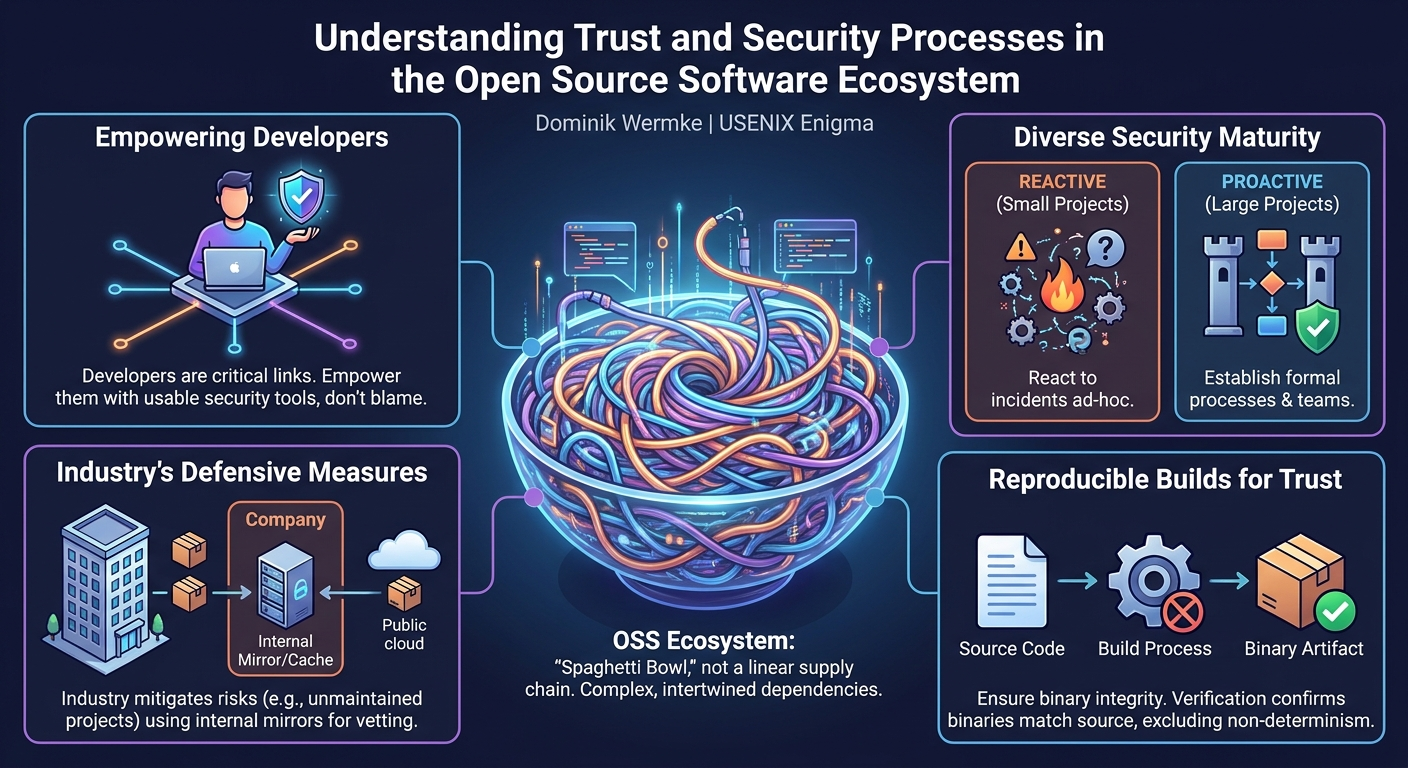
Key moments
- 0:00 The growing threat of software supply chain attacks.
- 2:30 Why usable security for developers is crucial.
- 7:00 Findings on trust and security in open source projects.
- 9:55 Understanding reproducible builds for trusted software artifacts.
- 13:00 Industry challenges with open source component security.
- 14:00 Software supply chain: A giant bowl of spaghetti.
Understanding Trust and Security Processes in the Open Source Software Ecosystem
Speakers: Dominik Wermke, Usable Security and Privacy Researcher, CISPA Helmholtz Center for Information Security
Conference: USENIX Enigma
YouTube: https://www.youtube.com/watch?v=IOTg_oI4b6M
Overview
In this compelling USENIX Enigma talk, Dominik Wermke, a usable security and privacy researcher at the CISPA Helmholtz Center for Information Security, delves into the complex and often opaque world of open source software (OSS) security. Wermke presents a synthesis of past and ongoing research, challenging the conventional linear "supply chain" metaphor for OSS and instead proposing a more accurate analogy: a giant bowl of spaghetti, with intertwined, interdependent strands. The core of his presentation revolves around understanding how trust and security processes are managed—or mismanaged—within the OSS ecosystem, from the perspective of both project maintainers and industry consumers.
The talk highlights the critical role of developers as potential weakest links in the software supply chain, emphasizing the need for robust, usable security solutions tailored to their unique challenges. Wermke argues that by supporting and empowering these impactful experts, security improvements can propagate to millions of end-users. Through the lens of three distinct research projects—one focusing on OSS maintainers, another on reproducible builds, and a third on industry's consumption of OSS—he uncovers the diverse, often reactive, and sometimes contradictory approaches to security and trust within this ubiquitous but vulnerable ecosystem.
Ultimately, Wermke's research underscores the pervasive nature of open source software in our daily lives and the escalating threats it faces, from nation-state attacks to unnoticed malware. The talk serves as a vital call to action for researchers, developers, and industry stakeholders to collaboratively address the systemic security challenges inherent in OSS, advocating for direct developer involvement in shaping future security research and solutions.
Background
▶ Watch: The growing threat of software supply chain attacks. (0:00)
The contemporary software landscape is characterized by an ever-growing reliance on open source components, making the software supply chain a prime target for malicious actors. Wermke opens by citing alarming headlines: "Hundreds of US news sites push malware in supply chain attack," "Microsoft says nation-state threats and zero-day attacks are increasing," and "NPM malware attack goes unnoticed for a year." These incidents underscore the severe implications of vulnerabilities introduced into widely used software, particularly open source projects. Developers, often operating with individual setups and diverse skill sets, are identified as high-value targets and a potential weakest link in this chain, capable of amplifying vulnerabilities to thousands, if not millions, of users.
Wermke positions his work within the field of usable security for developers. He contrasts this with traditional security research, which historically blamed end-users for failing to adopt security technologies. Instead, usable security posits that researchers are responsible for developing approaches that are inherently more usable. Extending this philosophy to developers, Wermke argues against blaming them for security struggles. Instead, the goal is to "support and empower them towards building more secure software." This focus on experts—developers, administrators, maintainers, team leads—is strategic because their actions have a disproportionately large impact, potentially affecting numerous projects, countless lines of code, and millions of end-users.
Despite their expertise, developers are not inherently security knowledgeable, as evidenced by major vulnerabilities like Log4j, Logjam, Heartbleed, and Shellshock. Even advanced security tools like firewalls and password managers are ultimately dependent on being correctly developed, deployed, and used by experts. The LastPass breach, originating from credentials stolen from an employee, serves as a stark reminder of human factors in security. The sheer scale of the OSS ecosystem further compounds these challenges: GitHub's 2020 State of the Octoverse report revealed that most companies rely on OSS, and the NPM ecosystem alone has a median of 683 dependencies per project, creating an enormous attack surface. Wermke emphasizes that open source software forms the foundation, glue, and tooling across virtually all modern software stacks, permeating everyday life far beyond conscious awareness, making its security a universal concern.
Key Findings
▶ Watch: Findings on trust and security in open source projects. (7:00)
Wermke's talk synthesizes findings from three distinct research projects, offering a multi-faceted view of security and trust in the open source ecosystem.
The first project, "Committed to Trust," investigated how open source project maintainers handle security and trust behind the scenes, based on interviews with 27 owners, team leads, maintainers, and contributors. A significant finding was that a large majority of participants had not encountered a trust incident by their own definition, though specific examples included drive-by cryptocurrency miner commits and fake background checks. Most projects relied on meritocracy for establishing trust with new contributors, often assuming trustworthiness by default to encourage participation. Larger, likely older, projects were more likely to have experienced incidents and consequently established more specific strategies. Similarly, the majority of maintainers had not experienced an outright security incident, though many were familiar with challenges like suspicious or low-quality commits and vulnerabilities introduced by dependencies. Regarding processes, general contribution guidance, programming language-specific guidance (e.g., code styling), and project setup/build infrastructure guidance were most common. However, opinions on the helpfulness of written guidance diverged, with some citing significant programmer hours required for documentation. Larger projects mentioned dedicated security teams, while smaller ones relied on a security contact channel, and most included some form of disclosure policy. Overall, projects exhibited high diversity in their security measures and trust processes, with growing scope and contributors driving increased needs for formal processes, while smaller projects tended to establish processes reactively.
The second project explored the reproducible build ecosystem through interviews with 24 experts. Inspired by Ken Thompson's famous quote about trusting the people who wrote the software, the project focused on ensuring that software artifacts can be validated as having been built from specific source code without manipulation. Key motivations for pursuing reproducible builds included the expectation that "same input should always compile to same output" and a desire to address "broken expectations" about computer behavior. Participants generally reported positive experiences with upstream projects, emphasizing the need for patience and good communication. The most common obstacles identified were the inclusion of timestamps and other time values in files, as well as build directory names inadvertently affecting the resulting artifacts. These findings highlight the subtle technical complexities involved in achieving true build reproducibility.
The third, ongoing project investigated how industry projects consume open source components, based on interviews with 25 developers, software architects, and engineers. A stark finding here was that almost everyone interviewed had encountered a security challenge or inconvenience due to an open source component. Common examples included no longer maintained projects, breaking updates, and projects delaying or never patching vulnerabilities. When selecting open source projects, participants commonly cited popularity measures (e.g., downloads, GitHub stars), signs of an active or large community, and the availability of specific features. A small majority of companies used internal mirrors or similar setups for their dependencies, indicating a proactive approach to managing their supply chain. Further insights revealed that some participants felt their management did not fully grasp the benefits and challenges of open source, while others reported their companies actively supported utilized OSS components through donations, developer hours, knowledge, or code, often following a guideline of contributing back. This project paints a picture of industry grappling with the dual nature of OSS—its immense utility juxtaposed with significant security and maintenance burdens.
Technical Deep Dive
▶ Watch: Understanding reproducible builds for trusted software artifacts. (9:55)
The research presented by Dominik Wermke offers several technical insights into the practical challenges and solutions within the open source software supply chain. The concept of meritocracy in open source projects, highlighted in "Committed to Trust," is a key social-technical mechanism. New contributors typically gain trust and increased permissions (e.g., commit access) through consistent, high-quality contributions over time, rather than formal background checks. This process, while fostering community, also presents a potential attack vector if initial vetting is insufficient or if a trusted contributor's account is compromised. Larger, more mature projects often formalize this with dedicated security teams or specific security contact channels (e.g., [email protected] or a dedicated PGP key for vulnerability disclosure), allowing for a more structured response to incidents compared to smaller projects that react ad-hoc. The lack of standardized guidance and policies across projects, particularly for security, means that developers often rely on implicit knowledge or learn through experience, which can lead to inconsistent security practices.
The investigation into reproducible builds delves into specific technical hurdles. The core idea is that given the same source code, build environment, and inputs, the resulting binary artifact should be bit-for-bit identical every time. However, this is notoriously difficult due to factors like non-deterministic outputs. Wermke notes that timestamps are a primary culprit: build tools often embed the current build time into compiled binaries, metadata files, or archives (e.g., .zip, .tar.gz), making successive builds unique. Similarly, file orders within archives or even on the filesystem during compilation can alter hash sums if not explicitly sorted. Build directory names being embedded into debug symbols or path information also break reproducibility. Other sources of randomness can include compiler flags that vary based on the host system, environment variables, or even compiler versions. Achieving reproducibility requires meticulous control over the build environment, including specific versions of compilers, libraries, and operating systems, and often involves patching build tools to remove non-deterministic elements. The motivation stems from a desire to ensure software integrity – that the distributed binary truly corresponds to the public source code, preventing supply chain attacks where malware might be injected during the build process itself.
From the industry perspective, the technical strategies for managing open source components are equally critical. The finding that almost everyone encountered security challenges due to OSS components points to systemic issues beyond individual project security. Unmaintained projects pose a significant risk; a company might rely on a library that suddenly stops receiving updates, leaving critical vulnerabilities unpatched. Breaking updates introduce instability and require significant re-engineering effort, highlighting the need for robust dependency management. Companies employing internal mirrors or caches for their open source dependencies implement a crucial security control. Instead of directly pulling from public repositories (e.g., npmjs.com, Maven Central), they download and store vetted versions internally. This strategy allows for:
- Vulnerability scanning: Components can be scanned for known CVEs before being approved for internal use.
- License compliance: Legal teams can review licenses.
- Stability: Ensures that if an upstream project disappears or introduces a breaking change, the company has a stable, known-good version.
- Tamper protection: Reduces the risk of a malicious package being injected into the public repository and immediately affecting internal builds.
This technical approach effectively creates a controlled internal software supply chain segment. The observation that some companies actively contribute back to the open source projects they use is not just altruistic; it's a strategic technical investment. By contributing code, bug fixes, or developer hours, companies can influence the direction of critical dependencies, address specific security concerns, and ensure the longevity and health of projects vital to their own operations. This collaborative model transforms passive consumption into active participation, strengthening the overall ecosystem.
Demo / Proof of Concept
▶ Watch: Industry challenges with open source component security. (13:00)
The talk by Dominik Wermke focuses on presenting the findings and implications of his research into the open source software ecosystem. It is a research-oriented presentation, and as such, it does not include a live demo or a proof of concept of a specific tool or exploit. The content is primarily based on qualitative data from interviews and analysis of existing processes.
Defensive Implications
▶ Watch: Software supply chain: A giant bowl of spaghetti. (14:00)
The insights from Dominik Wermke's research provide critical defensive implications for various stakeholders across the software supply chain.
For Open Source Project Maintainers:
- Proactive Security Planning: Instead of reacting to incidents, establish clear security policies and processes before major incidents occur. This includes defining trust strategies for new contributors, setting up dedicated security contact channels (e.g.,
[email protected]), and formalizing vulnerability disclosure policies. - Invest in Documentation: While challenging, providing clear, usable guidance for contributors on security best practices, code styling, and build setup can significantly reduce vulnerabilities and improve overall project security. This also helps standardize security expectations.
- Consider Reproducible Builds: Strive for reproducible builds to enhance software integrity and allow independent verification of binaries. This requires addressing non-deterministic elements like timestamps and build directory paths, and potentially utilizing tools and practices from the reproducible builds community.
For Developers (both OSS and Industry):
- Dependency Vetting: Do not blindly trust external dependencies. Actively vet open source components based on criteria beyond just popularity, such as community activity, maintenance status, and security track record. Use Software Composition Analysis (SCA) tools to identify known vulnerabilities (CVEs) in dependencies.
- Stay Informed: Be aware of the security posture of the open source projects you rely on. Monitor for security advisories and commit to timely updates, understanding the risks associated with unmaintained or unpatched components.
- Contribute Back: Where feasible, contribute bug fixes, security patches, or even documentation back to the open source projects you use. This strengthens the ecosystem for everyone and helps ensure the longevity of critical components.
For Industry Consumers of Open Source Software:
- Implement Internal Mirrors/Caches: Establish internal repositories for open source dependencies. This allows for centralized vetting, vulnerability scanning, license compliance checks, and provides a stable, controlled source of components, mitigating risks from upstream changes or malicious injections into public repositories.
- Educate Management: Bridge the gap in understanding between technical teams and management regarding the benefits and inherent security challenges of open source software. Advocate for resources (time, money, developer hours) to manage OSS security effectively, including funding for internal vetting processes and contributions back to critical projects.
- Strategic Dependency Management: Treat open source dependencies as critical assets. Develop clear policies for their selection, approval, and lifecycle management, including plans for handling unmaintained projects or severe vulnerabilities.
- Prioritize Usable Security: When selecting or developing security tools and processes, prioritize usability for developers. Complex, cumbersome security measures are often bypassed or incorrectly used, undermining their effectiveness.
Overall, Wermke's "spaghetti bowl" analogy underscores that a linear, top-down approach to software supply chain security is insufficient. Defenders must adopt a holistic, multi-layered strategy that acknowledges the interconnectedness and distributed nature of the open source ecosystem. This involves fostering a culture of shared responsibility, empowering developers with usable security practices, and implementing robust technical controls to manage external dependencies effectively.
Key Takeaways
- The "Spaghetti Bowl" Analogy: The open source software ecosystem is not a linear supply chain but a highly intertwined "bowl of spaghetti," making clear discernment of origins and ends impossible. This complexity necessitates a nuanced, rather than simplistic, approach to security.
- Developers as Critical Links: Developers are often the weakest link in the software supply chain, making them high-value targets. Empowering them with usable security tools and processes is paramount for widespread security improvements.
- Diversity in OSS Security Practices: Open source projects exhibit vast diversity in their security measures and trust processes. Smaller projects tend to react to incidents, while larger, older projects are more likely to have established proactive strategies, highlighting a maturity gap.
- Industry Grapples with OSS Risks: Industry heavily relies on open source but frequently encounters security challenges like unmaintained projects, breaking updates, and unpatched vulnerabilities. Proactive measures like internal mirrors and strategic contributions are crucial.
- Reproducibility for Trust: Reproducible builds are a vital technical approach to ensuring software integrity, allowing independent verification that binaries are built from specific, untampered source code. Overcoming obstacles like timestamps and build path inclusions is key.
- Usable Security is Essential: Security solutions for experts must be usable. Blaming developers for security failures is counterproductive; instead, research and development should focus on making secure practices intuitive and integrated into their workflows.
About the Speaker(s)
Dominik Wermke is a usable security and privacy researcher at the CISPA Helmholtz Center for Information Security in Germany. His research focuses on understanding and improving security and privacy practices for developers and other software experts within the open source ecosystem. He aims to support and empower these individuals to build more secure software by addressing the usability challenges of security technologies.
Reviews
Dr. Zero (Offensive Security Researcher) — PASS
You spent a USENIX Enigma slot telling us the open-source supply chain is a mess, timestamps break reproducible builds, and companies use internal mirrors. We didn't need 75 academic interviews to confirm what every release engineer has known since 2010. It's an academic validation of common sense that gives practitioners zero new signal.
Heather Calloway (CISO) — SOLID
Wermke's research exposes the gap between how open source projects actually operate and how enterprise risk models assume they operate. It provides hard data on maintainer security practices and makes a compelling case for overhauling how we consume third-party code. This is required viewing for your head of AppSec and your engineering leadership.