Protecting Whistleblower Information
Shanna Devine (Director · Office of Whistleblower Ombuds in the U.S. House of Representatives)
USENIX Enigma Conference 2023 · Day 2 · Grand Ballroom
Overview
In an era defined by complex digital landscapes and the ever-present threat of corporate and governmental malfeasance, the role of whistleblowers has never been more critical. Shanna Devine, Director of the Office of Whistleblower Ombuds in the U.S. House of Representatives, delivered a compelling presentation at USENIX Enigma, shedding light on the indispensable function of whistleblowers in upholding public trust and ensuring accountability. Her talk, "Protecting Whistleblower Information," delved into the multifaceted challenges faced by individuals who expose abuses of power and outlined the crucial role of Congress, supported by the Office of Whistleblower Ombuds, in safeguarding these vital sources of information.
Key moments
- 0:00 Introduction to the Office of Whistleblower Ombuds
- 6:45 Why whistleblowers hesitate: fear of futility and retaliation
- 8:00 Guiding principles for Congress working with whistleblowers
- 12:15 House policy on protecting whistleblower identity and information
- 15:45 Practical tips for whistleblowers to protect their communications
- 18:40 Vision for institutionalizing whistleblower best practices in Congress
Protecting Whistleblower Information
Speakers: Shanna Devine, Director, Office of Whistleblower Ombuds in the U.S. House of Representatives
Conference: USENIX Enigma
YouTube: https://www.youtube.com/watch?v=dEjZiAGM7YY
Overview
In an era defined by complex digital landscapes and the ever-present threat of corporate and governmental malfeasance, the role of whistleblowers has never been more critical. Shanna Devine, Director of the Office of Whistleblower Ombuds in the U.S. House of Representatives, delivered a compelling presentation at USENIX Enigma, shedding light on the indispensable function of whistleblowers in upholding public trust and ensuring accountability. Her talk, "Protecting Whistleblower Information," delved into the multifaceted challenges faced by individuals who expose abuses of power and outlined the crucial role of Congress, supported by the Office of Whistleblower Ombuds, in safeguarding these vital sources of information.
The core of Devine's presentation centered on the delicate balance between empowering whistleblowers to come forward and protecting them from severe personal and professional repercussions. She highlighted how the Office of Whistleblower Ombuds advises House offices on best practices for engaging with whistleblowers from both public and private sectors, offering guidance on everything from initial intake procedures to secure communication strategies. The talk underscored the profound impact whistleblowers have on oversight and policy, using high-profile examples like Twitter's former Chief Security Officer, Peiter "Mudge" Zatko, whose disclosures gripped public attention and spurred legislative action. Ultimately, Devine's address served as a powerful reminder of the systemic vulnerabilities that whistleblowers expose and the collective responsibility to create a secure environment for their disclosures.
Background
▶ Watch: Introduction to the Office of Whistleblower Ombuds (0:00)
Historically, Congress has relied heavily on whistleblowers to conduct effective oversight, serving as crucial conduits for uncovering waste, fraud, abuse, and corruption that might otherwise remain hidden. However, this reliance has often been juxtaposed with a significant gap: the lack of clear, consistent guidelines for safely and effectively working with these individuals. This absence of established protocols has, at times, led to unintentional harm, deterring potential whistleblowers and compromising the integrity of critical disclosures. Recognizing this systemic vulnerability, the Office of Whistleblower Ombuds was established in the 116th Congress as an independent, nonpartisan support office within the House of Representatives, operating under the jurisdiction of the Committee on House Administration.
The decision to blow the whistle is rarely taken lightly; it is often described as one of the most difficult decisions an individual will make in their career. Many whistleblowers do not initially identify with the label, often believing they are simply doing their job or protecting their organization's mission. Yet, the reality they face is frequently one of immense personal and professional risk. As Devine illustrated, whistleblowers commonly experience gaslighting, professional ostracization, and even retaliatory criminal investigations. She cited the cases of former NSA contractor Edward Loomis, who faced a retaliatory criminal investigation after reporting government waste on an ineffective surveillance program, and his colleague Thomas Drake, threatened with 35 years under the Espionage Act for legally providing an unclassified briefing to a reporter. These examples underscore the profound risks, including career destruction and legal jeopardy, that whistleblowers assume. Research further indicates that the primary reasons potential whistleblowers hesitate are a fear of futility – the belief their disclosures won't make a difference – and an overwhelming fear of retaliation. The Office of Whistleblower Ombuds aims to mitigate these fears by institutionalizing best practices, ensuring that when individuals do step forward, their efforts are impactful and their information is protected.
Key Findings
▶ Watch: Guiding principles for Congress working with whistleblowers (8:00)
The Office of Whistleblower Ombuds has identified and implemented several key findings to improve Congress's engagement with whistleblowers. Central to their guidance are foundational principles grounded in establishing trust. The first rule is "Do no harm," emphasizing that an individual should ideally be better off, or at least not worse off, after contacting a Congressional office. This principle is supported by establishing clear ground rules with whistleblowers regarding information handling and desired levels of confidentiality. Managing expectations is also crucial, with offices advised to clearly communicate the limits of their capabilities (e.g., inability to provide legal advice) while offering guiding resources, such as a menu of whistleblower support organizations. Honoring commitments, no matter how small, is stressed as vital for building confidence in the working relationship.
A significant finding is the importance of partnering on oversight. Whistleblowers, as subject matter experts, are invaluable allies in follow-up investigations. Instead of directly asking for documents, offices are advised to request a "roadmap of documents" that Congress can then formally request from the employer, carefully avoiding specificity that could trace back to the source. Encouraging whistleblowers to identify colleagues who can corroborate their concerns is also highlighted, as "solidarity is key to survival" and makes it harder for employers to discredit multiple witnesses. Perhaps the most critical finding is the absolute necessity of standing by sources, as members of Congress who develop strong reputations for protecting whistleblowers become "magnets for future whistleblowers." The office also coaches Congressional offices on utilizing powerful tools to hold retaliators accountable, including the ability to cut off the salary of federal employees who attempt to gag whistleblowers.
The office's latest model resource, a sample whistleblower confidentiality policy, reflects key guidance. It highlights a recent development in the House Code of Conduct that prohibits the public identification of a protected whistleblower without their advanced written consent, with guidelines for compliance. Whistleblowers also have the right to the integrity and security of their information, which means sharing and storing information only through secure official House accounts to trigger protections under the Speech and Debate Clause. Access to this information must be limited on a need-to-know basis. Furthermore, whistleblowers have the right to review information in advance of its use by an office, ensuring accuracy and addressing confidentiality concerns. This includes screening information for metadata, such as IP addresses or watermarks, to prevent compromise, as tragically occurred with Reality Winner. Lastly, whistleblowers retain the right to object to the use or sharing of their information, requiring Congressional offices to obtain consent before further dissemination.
Technical Deep Dive
▶ Watch: House policy on protecting whistleblower identity and information (12:15)
While the talk was not about developing new security tools, it provided a critical framework for applying existing security principles and technologies to protect sensitive whistleblower information. The technical guidance is informed by team members with backgrounds in network engineering and technical security, such as a team member, ensuring practical and effective strategies.
A primary technical safeguard stressed by the Office of Whistleblower Ombuds is the exclusive use of secure official House accounts for sharing and storing whistleblower information. This practice is not merely about general security; it is specifically designed to trigger protections under the Speech and Debate Clause of the U.S. Constitution, which provides legal immunity for members of Congress and their staff for legislative acts. By channeling communications and data through these official systems, the information gains a layer of legal protection against external subpoenas or demands, which might otherwise compromise a whistleblower's identity or the integrity of their disclosures.
Crucial to maintaining information control is the principle of limiting access to whistleblower data on a need-to-know basis. This involves strict internal protocols to ensure that only authorized personnel directly involved in the oversight matter can view or handle the sensitive information. This limits the potential attack surface and reduces the risk of accidental disclosure or malicious exfiltration from within the Congressional office.
Perhaps one of the most technically nuanced areas of guidance involves screening information for metadata. As demonstrated by the case of Reality Winner, an Air Force veteran whose anonymity was compromised after she provided classified documents concerning Russian interference in U.S. elections, metadata can be a whistleblower's "signature." Winner's documents contained tiny yellow dots, invisible to the naked eye, which encoded the printer's serial number, the date, and time of printing, allowing authorities to trace the document back to her. Devine highlighted the critical importance of Congressional offices partnering with whistleblowers to meticulously screen all submitted information for potential identifying markers, including IP addresses, watermarks, embedded author information, or other digital forensic artifacts. This proactive scrubbing process is essential to "camouflaging The Whistleblower as the source of information" while accurately capturing their underlying disclosures.
For direct communication between whistleblowers and Congressional staff, the talk strongly advocated for the use of encrypted communication platforms that offer end-to-end encryption. Specific examples cited were Signal and Wicker apps. These platforms ensure that communications cannot be monitored by employers or other adversaries, protecting the content of the messages and often the metadata associated with the communication itself. This advice applies equally to both the whistleblower and the Congressional office, ensuring a secure channel from both ends.
Beyond direct digital communication, whistleblowers are advised to consider alternative channels for sharing evidence. This includes leveraging their attorney or another trusted entity that can serve as a buffer, helping to reduce the digital "paper trail" that could lead back to them. Attorneys, bound by attorney-client privilege, can act as secure intermediaries, receiving documents from a whistleblower and then relaying them to Congress in a manner that further obscures the original source.
Finally, a strategic technical approach to document requests was emphasized. Instead of asking a whistleblower for specific documents, which could be traced, offices are coached to ask for a "roadmap" of documents. This allows Congressional offices to formulate broadened information requests directly to the employer. For instance, if a whistleblower identifies a specific internal report, the Congressional office might request all reports of that type over a broader timeframe or across multiple departments. This makes it significantly more difficult for an employer to pinpoint the exact source, especially if several employees might have access to similar information. This strategy leverages the whistleblower's expertise while creating a defensive obfuscation layer around their identity.
Demo / Proof of Concept
▶ Watch: Practical tips for whistleblowers to protect their communications (15:45)
The talk "Protecting Whistleblower Information" did not include a traditional live technical demonstration or proof of concept in the manner often seen at security conferences, such as exploiting a vulnerability or showcasing a new tool. Instead, the "demonstration" of the Office of Whistleblower Ombuds' effectiveness and the validity of its guidance lies in its operational impact and the resources it provides.
Shanna Devine highlighted the office's publicly accessible website, whistleblower.house.gov, which serves as a central repository for their "whistleblower survival tips," desk guides, templates, and model policies, including the sample whistleblower confidentiality policy. These resources, organized for both Congressional and whistleblower audiences, function as a practical "proof of concept" for their methodologies. Furthermore, the talk's concluding remarks provided a compelling measure of success: in the 117th Congress, approximately two-thirds of all House member offices and committees utilized the office's services. This widespread adoption demonstrates the demand for their expertise and the tangible value of their guidance in institutionalizing safe and effective practices for working with whistleblowers. The office's vision is to continue expanding this engagement, aiming for at least one staff member in each office to be certified in their "working with whistleblowers" curriculum, further solidifying the practical implementation of their protective strategies.
Defensive Implications
▶ Watch: Vision for institutionalizing whistleblower best practices in Congress (18:40)
The insights shared by Shanna Devine carry significant defensive implications for a range of stakeholders, from Congressional offices to potential whistleblowers themselves, and by extension, the broader public interest. Understanding and implementing these strategies is crucial for strengthening accountability and transparency.
For Congressional offices and staff, the primary defensive implication is the imperative to adopt and rigorously adhere to the best practices outlined by the Office of Whistleblower Ombuds. This includes establishing clear confidentiality policies with whistleblowers at the outset, ensuring all information is handled through secure official House accounts to leverage Speech and Debate Clause protections, and limiting access to information on a need-to-know basis. Training staff on how to identify whistleblower matters, understand the associated risks, and meticulously screen for metadata in submitted documents (e.g., IP addresses, watermarks) is not merely good practice but a critical defense against inadvertent source compromise. Furthermore, offices must be prepared to utilize their legislative tools to hold retaliators accountable, demonstrating a firm commitment to standing by their sources.
For potential whistleblowers, the defensive implications are deeply personal and revolve around self-protection. The "whistleblower survival tips" are a defensive roadmap:
- Seek experienced legal counsel as early as possible to develop a safe plan.
- Prioritize encrypted communication platforms like Signal or Wicker for all digital interactions with Congress or counsel, ensuring end-to-end encryption to prevent employer monitoring.
- Be acutely aware of the risks associated with metadata in any document or digital file shared. Proactively scrub or seek expert advice on how to remove identifying information before submission.
- Consider in-person meetings in discreet locations when sensitive discussions are required, minimizing digital footprints.
- Utilize attorneys or trusted entities as buffers to transmit information, effectively reducing the direct paper trail between the whistleblower and Congress.
- Coach Congressional offices on how to make broadened document requests to employers, rather than asking for highly specific documents that could easily be traced back to a single source.
More broadly, the defensive implications extend to the democratic process itself. By institutionalizing robust protections for whistleblowers, Congress strengthens its own oversight capabilities, making it more difficult for powerful entities—whether in government or the private sector—to conceal abuses. This creates a deterrent effect, as potential wrongdoers know that there are secure avenues for their actions to be exposed. Ultimately, the defense of whistleblower information is a defense of public trust and the foundational principles of accountability in a free society.
Key Takeaways
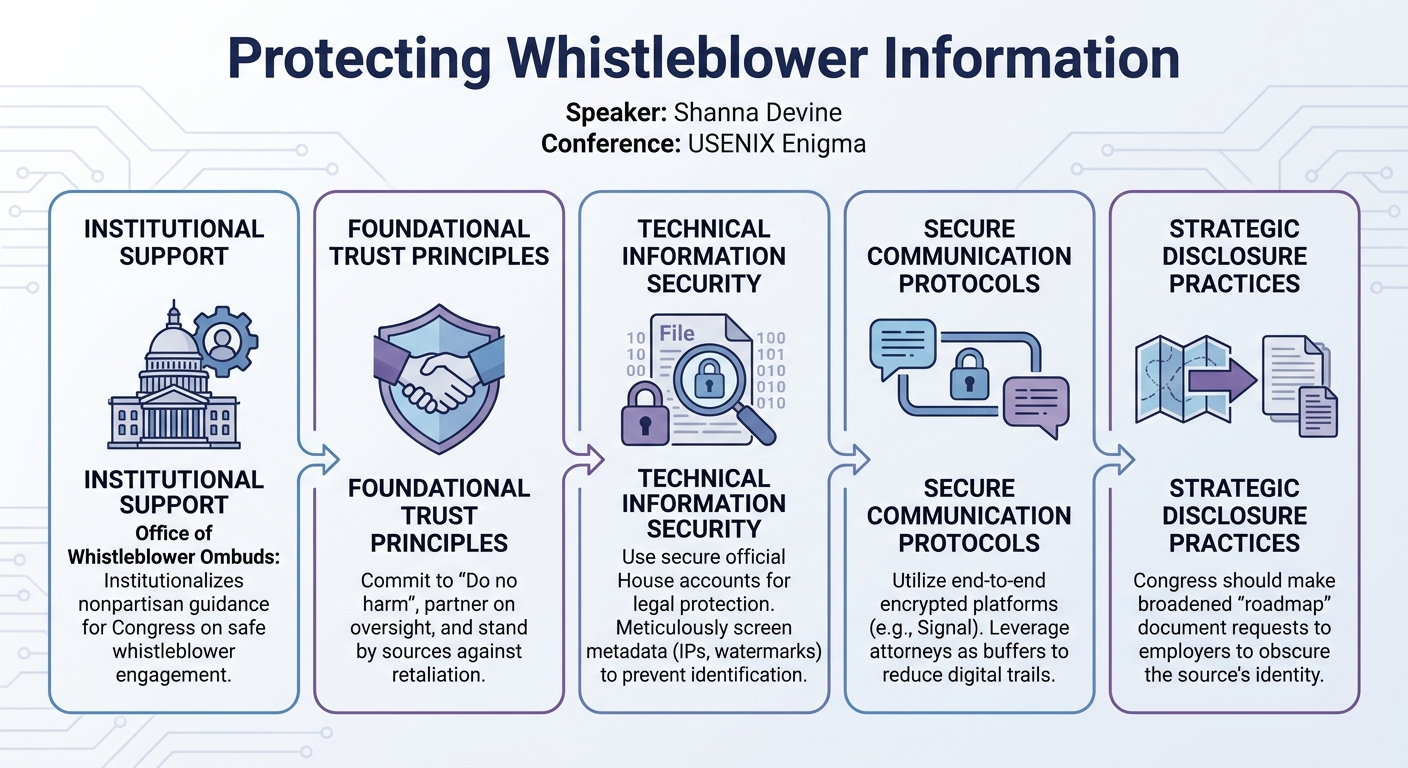
- Institutionalized Support for Whistleblowers: The Office of Whistleblower Ombuds in the U.S. House of Representatives provides critical, nonpartisan guidance and resources to Congressional offices, addressing a historical gap in safely and effectively working with whistleblowers.
- Foundational Principles for Trust: Building and maintaining trust with whistleblowers is paramount, guided by principles such as "Do no harm," managing expectations, honoring commitments, actively partnering on oversight, and unequivocally standing by sources to prevent retaliation.
- Technical Measures for Information Security: Protecting whistleblower anonymity requires stringent technical safeguards, including the exclusive use of secure official House accounts (triggering Speech and Debate Clause protections), limiting information access on a need-to-know basis, and meticulous screening of all submitted information for metadata like IP addresses and watermarks.
- Secure Communication Protocols: Both whistleblowers and Congressional staff are advised to utilize encrypted communication platforms (e.g., Signal, Wicker) for end-to-end encryption, and whistleblowers should consider leveraging legal counsel or trusted intermediaries to reduce digital footprints and provide an additional layer of protection.
- Strategic Disclosure Practices: Whistleblowers can guide Congress on how to request documents from employers in a broad manner, making it difficult to trace the source, and should seek legal counsel early to plan their disclosure strategy effectively.
- Legal Protections and Accountability: The House Code of Conduct now prohibits public identification of protected whistleblowers without consent, and Congress possesses powerful tools to hold retaliators accountable, reinforcing the legal framework designed to safeguard those who expose wrongdoing.
About the Speaker(s)
Shanna Devine is the Director of the Office of Whistleblower Ombuds in the U.S. House of Representatives. In this role, she leads an independent and nonpartisan office established to advise House offices on best practices for working with whistleblowers from both public and private sectors. Her team provides training, develops intake procedures, offers confidential consultations, and provides technical expertise around whistleblower legislation. Devine's leadership is instrumental in institutionalizing safe, effective, and consistent practices for Congress's engagement with whistleblowers, furthering their Article 1 oversight and constituent responsibilities. The office's work is informed by a collective 35 years of experience supporting Congress's work with whistleblowers, with one team member specifically bringing a unique background in network engineering and technical security to the guidance provided.
Reviews
Dr. Zero (Offensive Security Researcher) — STRONG ACCEPT
Government policy talks usually make me want to walk into traffic, but Devine brought actual operational security to the bureaucratic swamp of Congress. She isn't preaching awareness—she's weaponizing the Speech and Debate Clause and forcing metadata scrubbing to keep sources out of federal prison. Essential viewing if you ever plan on dropping docs.
Heather Calloway (CISO) — STRONG ACCEPT
Devine outlines how Congress protects and operationalizes whistleblower data, providing a masterclass in source protection for sensitive disclosures. For enterprise security leaders, this is a mirror to hold up to our own internal ethics and insider risk programs. If your employees feel safer going to a regulator or a committee than to your compliance hotline, your board has a material risk problem.