So You're Going to Blow the Whistle? Communications Dos and Don'ts for Whistleblowers.
Emily Schwartz (Vice President of Communications · Bryson Gillette)
USENIX Enigma Conference 2023 · Day 2 · Grand Ballroom
Overview
In this compelling talk at USENIX Enigma, Emily Schwartz, Vice President of Communications at Bryson Gillette, provides invaluable insights into the intricate world of whistleblower communications. Drawing from her direct experience orchestrating the public disclosure strategy for Facebook whistleblower Frances Haugen, Schwartz demystifies the complex process of engaging with media, legal counsel, and the public when exposing corporate or governmental wrongdoing. Her presentation is a pragmatic guide, offering critical "dos and don'ts" for individuals contemplating the monumental decision to blow the whistle.
Key moments
- 0:00 Introduction and speaker's unique comms background
- 3:10 Introduction to Frances Haugen's Facebook whistleblowing
- 5:00 Timeline of Frances Haugen's strategic media rollout
- 7:20 Key strategic decisions behind the Haugen case
- 10:50 Defining your whistleblowing goal: public vs. private
- 13:50 Essential support network for potential whistleblowers
- 17:50 Understanding journalist conversation statuses (on/off record)
- 21:00 Distilling your core message: the messaging triangle
So You're Going to Blow the Whistle? Communications Dos and Don'ts for Whistleblowers.
Speakers: Emily Schwartz, Vice President of Communications, Bryson Gillette
Conference: USENIX Enigma
YouTube: https://www.youtube.com/watch?v=CCBn-TEI-28
Overview
In this compelling talk at USENIX Enigma, Emily Schwartz, Vice President of Communications at Bryson Gillette, provides invaluable insights into the intricate world of whistleblower communications. Drawing from her direct experience orchestrating the public disclosure strategy for Facebook whistleblower Frances Haugen, Schwartz demystifies the complex process of engaging with media, legal counsel, and the public when exposing corporate or governmental wrongdoing. Her presentation is a pragmatic guide, offering critical "dos and don'ts" for individuals contemplating the monumental decision to blow the whistle.
Schwartz highlights that effective communication is not merely a supplementary aspect of whistleblowing but a foundational pillar for achieving desired impact. She underscores that even the most meticulously researched disclosures can fall short if not communicated strategically and authentically. The talk serves as a crucial resource for anyone in the security and privacy community who might one day face the ethical imperative to disclose sensitive information, emphasizing that the success of such an endeavor often hinges on a well-executed public relations strategy.
The importance of this talk extends beyond individual whistleblowers, offering a lens through which to understand the mechanics of high-stakes public information campaigns. For organizations, it implicitly outlines the power of internal dissent when channeled effectively, providing a framework for understanding potential reputational and regulatory challenges. For the broader public, it reveals the strategic machinations behind significant disclosures that shape policy and public discourse, exemplified by the far-reaching implications of the Frances Haugen case.
Background
▶ Watch: Introduction and speaker's unique comms background (0:00)
The decision to blow the whistle is, as Emily Schwartz describes, "a lonely and often brutal decision," fraught with personal and professional risks. This inherent difficulty, coupled with the high stakes of exposing powerful entities, creates a critical need for strategic communication. Schwartz’s personal journey into communications underscores this need: after years as a policy wonk at institutions like the U.S. Senate, the World Trade Organization, and leading data policy at Uber, she observed that even brilliant, hard work often failed to achieve its intended impact due to poor communication. Her motivation was to help people ensure their efforts were seen and understood, with authenticity and intentionality.
The problem, as she articulates, is that individuals with critical information often lack the expertise to effectively translate their detailed findings into a public narrative that resonates and incites change. Whistleblowers, by definition, operate against powerful adversaries who possess vast resources for public relations and legal defense. Without a sophisticated communications strategy, their message can be diluted, distorted, or dismissed, failing to achieve systemic change or even risking severe personal repercussions.
Prior work in this domain is often viewed through the lens of high-profile cases like Edward Snowden or Mudge (Peiter Zatko), figures who became synonymous with their disclosures. However, Schwartz emphasizes that not every whistleblower needs to become a public face. The specific goals of the whistleblower—whether seeking personal accountability or massive public and regulatory change—should dictate the level of public exposure. The case of Frances Haugen, whom Schwartz met in mid-2021, provided a unique opportunity to apply sophisticated PR strategies to a high-impact disclosure, demonstrating how a carefully orchestrated campaign can achieve significant legislative and public awareness goals while managing the whistleblower's personal risk profile. This talk aims to bridge the gap between having critical information and effectively communicating it to achieve desired outcomes in a hostile environment.
Key Findings
▶ Watch: Timeline of Frances Haugen's strategic media rollout (5:00)
Emily Schwartz's talk reveals several key findings and strategic principles for effective whistleblower communications, all grounded in her experience with Frances Haugen:
- Goal-Driven Public Profile: The level of public exposure for a whistleblower should be directly tied to their ultimate goal. While documenting events or seeking personal accountability might be achievable privately, "massive public pressure and regulatory change" almost invariably requires a public presence. Frances Haugen, despite initial reluctance, embraced a public role because her objective was systemic regulatory reform.
- Strategic Disclosure for Maximum Impact: The Haugen case demonstrated a meticulously planned disclosure strategy. This included coordinating with multiple news organizations (over 30 globally) to ensure comprehensive coverage of more than 20,000 pages of documents, rather than relying on a single publication. The sequencing of disclosures, from an anonymous Wall Street Journal series to a 60 Minutes reveal and subsequent global media embargo, was crucial.
- Risk Mitigation Through Controlled Narrative: A significant finding was the intentional decision to limit Haugen's U.S. TV appearances for over three months post-reveal. This was a calculated move to reduce the "surface area of personal attacks," allowing the documents and their implications to speak for themselves rather than turning the focus onto Haugen personally. This strategy is particularly vital for women whistleblowers who often face disproportionate personal scrutiny.
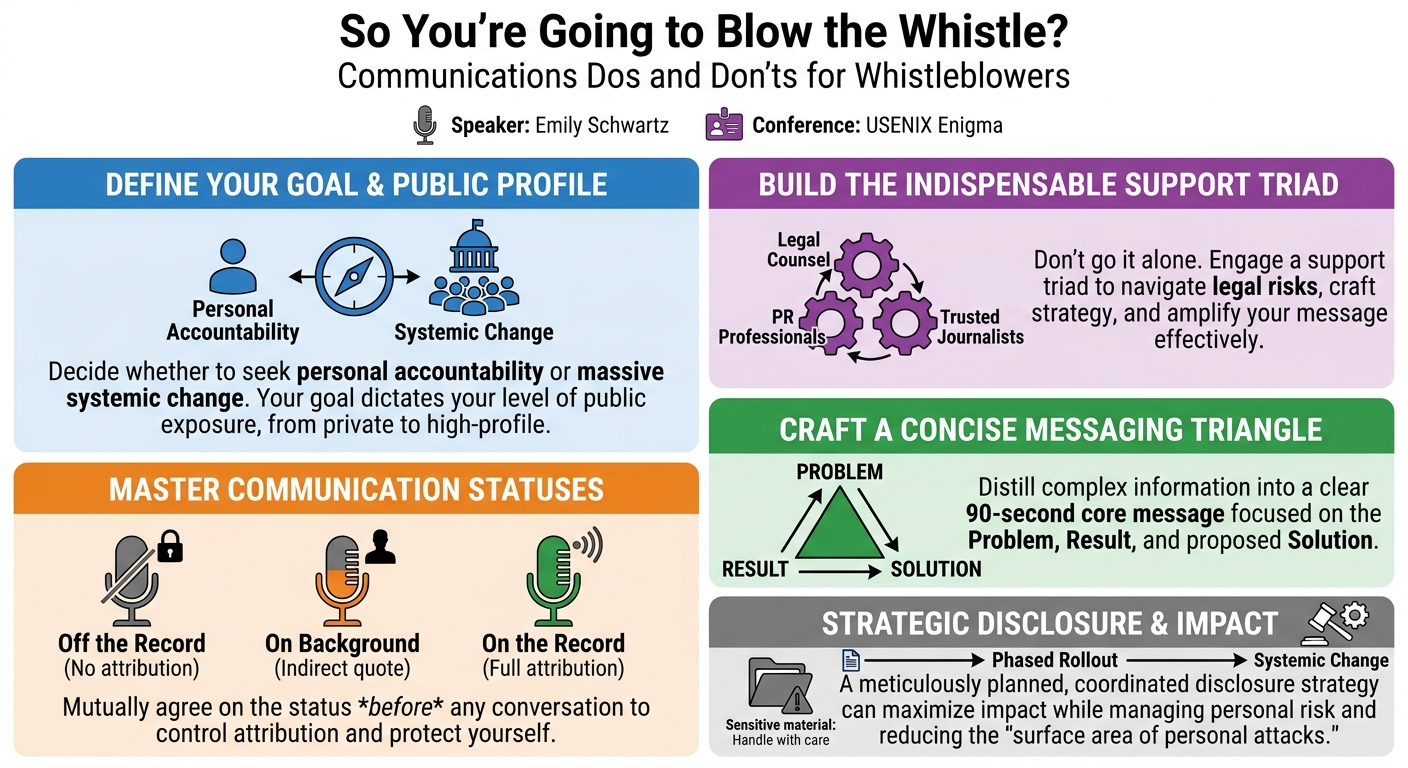
- The Indispensable "Three Key Players": Successful whistleblowing campaigns rely on a triad of support:
- Trusted Journalists/Publications: Crucial for amplifying the message and providing an authoritative platform. Whistleblowers must understand journalists' motivations (clicks, juicy stories) and build relationships based on trust, ensuring alignment on the overarching narrative.
- Legal Counsel: Essential for navigating legal risks, protecting the whistleblower, and advising on disclosure strategies. Non-profit organizations like Whistleblower Aid and Signals Network, as well as law firms like Constantine & Cannon, specialize in this area.
- PR Professionals: While Schwartz humbly states they are "by far the least important," a professional PR team is vital for crafting messages, managing media interactions, and executing a strategic rollout.
- Mastering Communication Statuses: A fundamental "technical" skill for interacting with journalists is understanding and mutually agreeing upon off the record, on background, and on the record statuses before any conversation. This is critical for controlling attribution and protecting the source.
- The Messaging Triangle: To cut through complexity and ensure a clear, impactful message, Schwartz advocates for a "messaging triangle" framework: clearly define the Problem, its Result, and the proposed Solution. This helps distill complex narratives into a concise, 90-second core message suitable for headlines and public consumption.
These findings collectively underscore that successful whistleblowing is not an accidental event but a meticulously planned strategic endeavor where communication plays a central, technical role in achieving systemic change.
Technical Deep Dive
▶ Watch: Defining your whistleblowing goal: public vs. private (10:50)
While not "technical" in the traditional sense of code or exploit development, Emily Schwartz’s talk delves deeply into the technical architecture and protocols of high-stakes strategic communication. The Frances Haugen case serves as the primary case study, illustrating a meticulously engineered public relations campaign designed for maximum impact and systemic change.
The core of Haugen's disclosure involved over 20,000 pages of internal Facebook documents, outlining a myriad of harms. These included devastating impacts on teen mental health from Instagram, accusations of deceit towards investors and the oversight board, the timeline of actions (or inaction) surrounding January 6th, and critically, the lack of investment in safety systems in non-English speaking countries, leading to real-world violence in places like India, Myanmar, and Ethiopia. Haugen's overarching goal was "massive systemic change."
The PR strategy unfolded as a carefully choreographed sequence of events:
- Initial Anonymity (September 13th): The campaign began with the Wall Street Journal publishing its first story in a series titled "The Facebook Files." Crucially, Haugen's identity remained unknown, allowing the gravity of the documents to establish the narrative without immediate personal attacks on the source.
- Public Reveal and Congressional Engagement (October 3rd-5th): Approximately two weeks later, 60 Minutes publicly revealed Haugen's identity. This was swiftly followed by her six-hour testimony before the U.S. Senate, where she answered questions spanning national security, teen impact, and advertising. Schwartz's team was instrumental in prepping her for this testimony and drafting it.
- Global Media Blitz (Two weeks later): Recognizing that even the Wall Street Journal could not fully encompass the breadth and depth of 20,000 documents, the team orchestrated a global media embargo. Over 30 global news organizations agreed to this embargo, resulting in over 70 stories published in a single day. This global reach was further amplified by Haugen's testimonies before the UK Parliament and the European Union.
- Legislative Impact (April 2022): The strategic focus on Europe directly contributed to the passage of the EU Digital Services Act (DSA) in April 2022, a significant regulatory win and a concrete outcome of the whistleblowing effort.
Key strategic choices underpinned this "technical" execution:
- Document Management and Risk Mitigation: The PR team, including Schwartz, never physically handled the documents, operating solely on public information or trusted summaries. This was a deliberate choice to mitigate legal risks for the communications professionals.
- Controlled Media Exposure: Despite immense demand, Haugen intentionally avoided further U.S. TV interviews for over three months after her public reveal. This tactic reduced the "surface area of personal attacks," allowing the factual content of the documents to drive the conversation, rather than personality. The documents, as Schwartz noted, "spoke for themselves."
- Publication Selection: The initial choice of the Wall Street Journal, a right-leaning publication, was strategic. This aimed to prevent the narrative from being immediately pigeonhoholed as a "left-leaning conversation," broadening its appeal and credibility across the political spectrum.
Beyond the Haugen case, Schwartz detailed the "technical protocols" for interacting with journalists:
- Communication Statuses:
- Off the Record: Information cannot be attributed to the source, nor can the source be described. Used for providing context or background without personal risk.
- On Background: Information cannot be directly quoted but can be used, often with a generic description of the source (e.g., "a person inside the company"). The specific description must be negotiated.
- On the Record: The default status. Anything said can be quoted directly, with full attribution (name, title).
- The Mutual Agreement Protocol: Critically, the communication status must be mutually agreed upon before the conversation starts. Failing to do so defaults to "on the record" and can lead to severe misattributions.
- The Messaging Triangle Framework: This is a communication architecture for distilling complex information:
- Problem: Clearly articulate the issue at hand.
- Result: Explain the consequences or impact of the problem.
- Solution: Propose a concrete path forward or desired change.
This framework aims to simplify an 18-minute explanation into a concise, impactful 90-second core message, ensuring clarity and journalistic appeal.
These "technical" aspects of communication strategy, from the phased rollout to the careful management of media interactions and message construction, are as critical to the success of a whistleblower as any exploit or defensive measure is to cybersecurity.
Demo / Proof of Concept
▶ Watch: Essential support network for potential whistleblowers (13:50)
While this talk does not feature a traditional software or hardware demonstration, its entire premise is built upon a real-world, high-impact "proof of concept": the successful execution of the communications strategy for Facebook whistleblower Frances Haugen. The detailed timeline and outcomes of this campaign serve as a powerful demonstration of the principles and tactics Emily Schwartz advocates.
The tangible results of this strategic approach include:
- The widespread global coverage of the "Facebook Files," stemming from the initial Wall Street Journal series and the subsequent global media embargo involving over 30 news organizations publishing 70+ stories in a single day.
- The direct engagement with legislative bodies, including Haugen's six-hour testimony before the U.S. Senate and appearances before the UK Parliament and the European Union.
- The ultimate legislative achievement of the EU Digital Services Act (DSA) in April 2022, which Schwartz explicitly highlights as a significant victory and a direct outcome of the concerted effort to push for legislation in Europe.
This successful campaign validates the necessity of a professional communications strategy for whistleblowers aiming for systemic change. It demonstrates that by carefully managing the narrative, controlling media exposure, and strategically engaging with key stakeholders, a whistleblower can transform internal documents into a catalyst for global regulatory reform. The Frances Haugen case is, in essence, the live "demo" of how the communication "dos and don'ts" presented in this talk can lead to profound real-world impact.
Defensive Implications
▶ Watch: Distilling your core message: the messaging triangle (21:00)
For various stakeholders, Emily Schwartz's insights into whistleblower communications carry significant defensive implications.
For potential whistleblowers, this talk serves as an essential defensive playbook. It equips them with the "technical" knowledge to protect themselves, their message, and their mission:
- Personal and Professional Protection: Understanding the importance of legal counsel (e.g., Whistleblower Aid, Signals Network, Constantine & Cannon) is paramount. These organizations offer not just legal advice but also personal security and emotional support, acting as a crucial shield against retaliation.
- Message Integrity and Impact: The Messaging Triangle (Problem, Result, Solution) is a defensive tool against message dilution or misinterpretation. It ensures that the whistleblower's core message remains clear, concise, and impactful, preventing journalists or the public from losing the thread of the disclosure amidst complex details.
- Controlling the Narrative: Mastering the protocols of communication statuses (off the record, on background, on the record) is a critical defensive measure. It allows whistleblowers to control how their words are attributed, minimizing personal exposure and ensuring information is released under mutually agreed-upon terms. This prevents accidental "on the record" statements that could be used against them.
- Strategic Alliance Building: The advice on selecting trusted journalists and publications is key. Whistleblowers must vet journalists by reading their work and assessing their audience, ensuring that their message reaches the intended recipients (e.g., Tech Insiders vs. Media Elite) and is handled by someone who understands and respects the gravity of the disclosure. Choosing a publication like the Wall Street Journal, as in the Haugen case, can also be a defensive move against political pigeonholing.
For organizations (companies, governments) that might be the subject of a whistleblowing disclosure, the talk provides an implicit defensive understanding:
- Proactive Risk Management: By understanding the strategic methodologies whistleblowers employ, organizations can better anticipate and manage potential disclosures. This includes fostering internal cultures of transparency, addressing ethical concerns proactively, and establishing robust internal reporting mechanisms to mitigate the likelihood of external disclosures.
- Crisis Communications Preparedness: The meticulous planning seen in the Haugen case highlights the need for organizations to have equally sophisticated crisis communication plans. This includes rapid response teams, legal counsel specializing in such events, and a clear strategy for addressing public allegations.
- Ethical Posture and Accountability: Ultimately, the most robust defense against whistleblowing is an unwavering commitment to ethical conduct and accountability. Whistleblowers like Frances Haugen often emerge when internal systems fail to address documented harms. Acknowledging and rectifying issues internally can prevent them from escalating into public disclosures with significant regulatory and reputational consequences, as seen with the EU Digital Services Act.
In essence, this talk provides defensive capabilities for both sides of the whistleblowing equation: empowering individuals to protect themselves and their truth, and implicitly urging organizations to fortify their ethical foundations to prevent the conditions that necessitate whistleblowing.
Key Takeaways
- Define Your Goal First: Before embarking on any disclosure, clearly articulate whether your aim is personal accountability or massive public and regulatory change, as this will dictate your communication strategy and level of public exposure.
- Don't Go It Alone: Whistleblowing is a high-stakes endeavor that requires a support system. Engage trusted legal counsel, experienced PR professionals, and reputable journalists to navigate the complex landscape.
- Master Journalist Communication Statuses: Always mutually agree on "off the record," "on background," or "on the record" status before any conversation with a reporter to control attribution and protect yourself.
- Craft a Clear, Concise Message: Utilize the "Messaging Triangle" (Problem, Result, Solution) to distill complex information into a compelling 90-second core message that resonates with the public and media.
- Strategic Disclosure Maximizes Impact: Learn from the Frances Haugen case, where a phased, globally coordinated disclosure, coupled with intentional control over media appearances, led to significant legislative outcomes like the EU Digital Services Act.
- Protect Your Personal Surface Area: Be intentional about your public profile. Limiting personal media exposure can reduce the risk of personal attacks and keep the focus on the substance of your disclosure.
About the Speaker(s)
Emily Schwartz is the Vice President of Communications at Bryson Gillette, a full-service digital media and PR agency. Her professional journey began far from the world of public relations, with a background rooted in policy. She spent time at the U.S. Senate and the World Trade Organization, and most recently led data policy at Uber. Schwartz transitioned into communications driven by a desire to help others effectively convey their hard work and ideas, observing that brilliant policy often lacked impact due to poor communication. She brings a unique blend of policy expertise and strategic communications acumen, notably having played a pivotal role in orchestrating the public relations strategy for Facebook whistleblower Frances Haugen.
Reviews
Dr. Zero (Offensive Security Researcher) — MUST SEE
Normally I'd walk out of a PR executive's keynote, but Schwartz orchestrated the Frances Haugen Facebook leak. This isn't marketing fluff; it's a tactical playbook for weaponizing internal documents and burning a target to the ground without destroying your own life in the process.
Heather Calloway (CISO) — STRONG ACCEPT
This is required viewing for your General Counsel, Head of Insider Risk, and corporate communications team. It deconstructs the exact playbook used in the Frances Haugen Facebook leak, proving that modern whistleblowing is no longer a random document dump—it is a highly engineered, globally coordinated regulatory campaign.