Open Source Software and Journalism: Field Notes from a Global Perspective
Harlo Holmes (Freedom of the Press Foundation)
USENIX Enigma Conference 2023 · Day 2 · Grand Ballroom
Overview
In a compelling talk at USENIX Enigma, Harlo Holmes, the Chief Information Security Officer and Director of Digital Security at the Freedom of the Press Foundation (FPF), illuminated the critical role of open-source software in safeguarding journalistic integrity and protecting confidential sources globally. The presentation, titled "Open Source Software and Journalism: Field Notes from a Global Perspective," delved into the unique security challenges faced by newsrooms and whistleblowers, emphasizing the inherent "asymmetry of preparedness" that often puts sources at severe risk. Holmes, whose organization counts figures like Edward Snowden and Daniel Ellsberg on its board, underscored the FPF's mission to empower journalists with the tools and knowledge necessary to navigate an increasingly hostile digital landscape.
Key moments
- 0:00 Freedom of the Press Foundation's mission
- 2:55 The 'asymmetry of preparedness' challenge
- 4:45 Why open source is fundamental for journalism
- 10:30 Signal and best practices for investigative units
- 13:00 SecureDrop workflow and Qubes OS integration
- 15:00 COVID-19's impact on secure journalism workflows
- 16:50 Open source tools for safe document analysis
- 22:30 Conclusion: Metadata challenges and press freedom
Open Source Software and Journalism: Field Notes from a Global Perspective
Speakers: Harlo Holmes, CSO and Director of Digital Security, Freedom of the Press Foundation
Conference: USENIX Enigma
YouTube: https://www.youtube.com/watch?v=sJCbO36QHOQ
Overview
In a compelling talk at USENIX Enigma, Harlo Holmes, the Chief Information Security Officer and Director of Digital Security at the Freedom of the Press Foundation (FPF), illuminated the critical role of open-source software in safeguarding journalistic integrity and protecting confidential sources globally. The presentation, titled "Open Source Software and Journalism: Field Notes from a Global Perspective," delved into the unique security challenges faced by newsrooms and whistleblowers, emphasizing the inherent "asymmetry of preparedness" that often puts sources at severe risk. Holmes, whose organization counts figures like Edward Snowden and Daniel Ellsberg on its board, underscored the FPF's mission to empower journalists with the tools and knowledge necessary to navigate an increasingly hostile digital landscape.
Holmes articulated that while whistleblowers are often prepared for extreme personal sacrifice, they rarely anticipate the loss of their livelihoods, making robust source protection paramount. The talk meticulously outlined how FPF's work, spanning engineering, advocacy, and direct services, provides essential digital security training, auditing, and consulting to newsrooms worldwide. Through this lens, Holmes showcased a suite of open-source technologies—from secure communication platforms to document analysis tools—that are not merely preferable but fundamental for maintaining confidentiality, ensuring anonymity, and enabling vital investigative journalism in an era of pervasive surveillance and legal pressure.
Background
▶ Watch: Freedom of the Press Foundation's mission (0:00)
The landscape of investigative journalism is fraught with unique perils, largely stemming from what Harlo Holmes terms the "asymmetry of preparedness." A potential whistleblower, often an ordinary individual with a job outside of security or law, lacks the expertise, legal counsel, and technical sophistication that a seasoned journalist might possess. Their job is not to be a whistleblower, and consequently, they are often ill-equipped to handle the complexities of secure communication, inadvertently exposing themselves through common digital practices. This disparity extends to technology: a source's endpoint security is almost invariably inferior to a journalist's, with work computers managed by IT departments posing significant risks if used for sensitive communications.
Newsrooms themselves operate under considerable constraints that further complicate security. Budgets, even for major investigative units, are often insufficient to acquire expensive enterprise security suites. This financial reality pushes journalists towards readily available, cost-effective solutions. Furthermore, there is a deep-seated distrust within the journalistic and internet freedom communities regarding enterprise solutions. Proprietary platforms like WhatsApp, despite offering end-to-end encryption, are scrutinized for their metadata handling, ties to larger social graphs, and compliance with legal intercept requests, rendering them less trustworthy than truly open alternatives like Signal. This skepticism is rooted in a fundamental philosophy: open-source software, developed in the open with community love and a commitment to freedom, aligns directly with the values of transparency and accountability that journalism upholds. This ethos, born out of the circumvention technology movement, dictates that software should be free, auditable, and built for the communities it serves, making it the natural choice for tools designed to protect sensitive information and human lives.
Key Findings
▶ Watch: Why open source is fundamental for journalism (4:45)
The central revelation of this talk is the indispensable nature of open-source software as the bedrock for secure, confidential, and effective investigative journalism. Holmes demonstrated that proprietary solutions often fall short on budget, trust, and adaptability, rendering them unsuitable for the high-stakes environment of source protection. The core findings can be distilled into several critical areas:
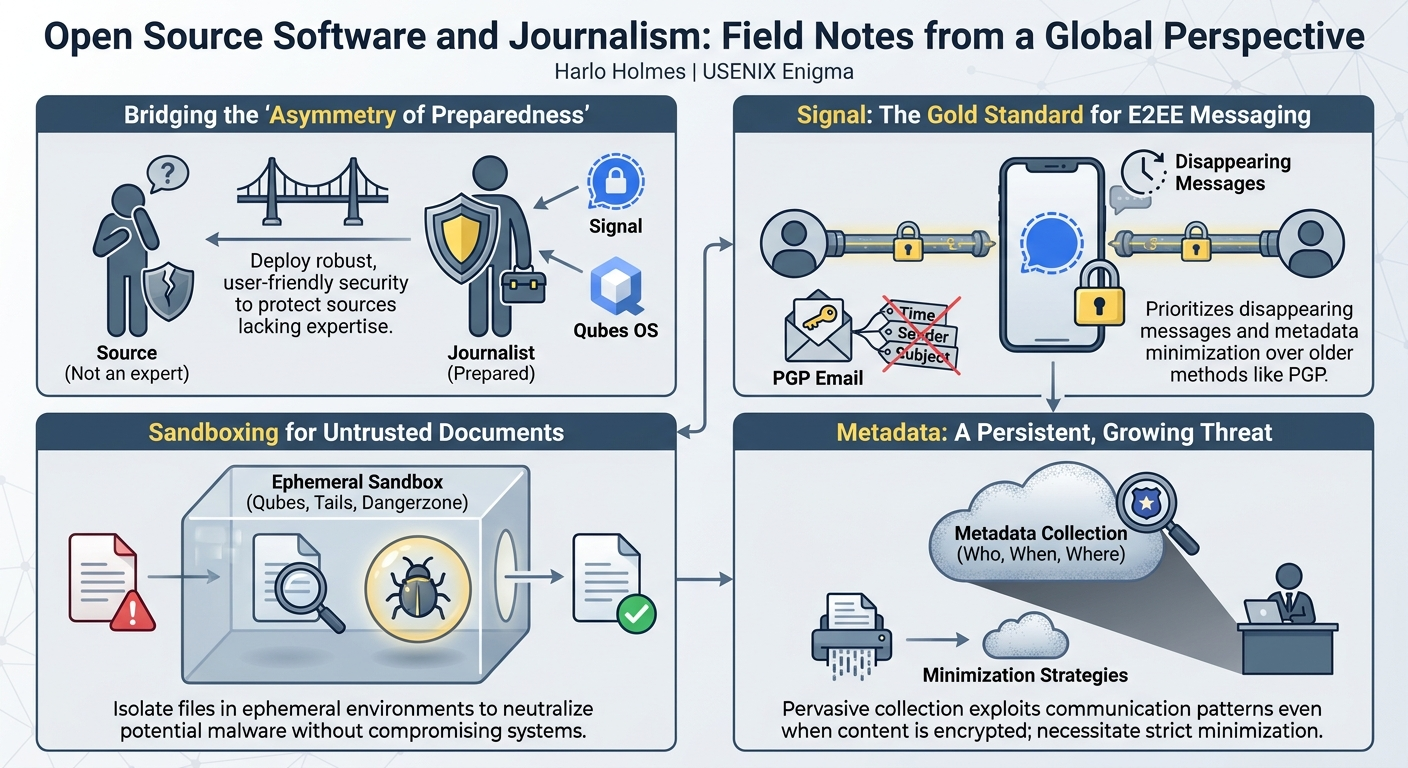
Firstly, a stark recognition of the "asymmetry of preparedness" dictates that journalists must assume their sources are not security experts. This necessitates robust, journalist-side security protocols and user-friendly tools that minimize the burden on whistleblowers while maximizing their protection.
Secondly, end-to-end encrypted messaging applications, specifically Signal, have emerged as the current gold standard for real-time confidential communication. While older methods like PGP email are still in use, their inherent weaknesses regarding metadata exposure, lack of forward secrecy, and complex usability make them largely unsustainable for modern journalism.
Thirdly, the secure handling of potentially malicious or sensitive documents requires specialized, isolated environments. The FPF's work highlights Qubes OS, Tails OS, and Dangerzone as essential tools for creating ephemeral, sandboxed spaces that prevent malware infection and data leakage, even when dealing with documents of unknown provenance.
Fourthly, the COVID-19 pandemic exposed significant vulnerabilities in traditional physical security protocols, particularly for systems like SecureDrop. The shift to remote work made air-gapped procedures untenable, underscoring the urgent need for adaptable, distributed security solutions that can function effectively without direct physical access to infrastructure.
Finally, the talk underscored the overwhelming threat of metadata collection. Whether from communication platforms, collaboration tools, or distributed remote work setups, metadata provides a rich archive for law enforcement and state actors, posing a continuous and growing risk to journalistic sources and press freedom globally. The US Press Freedom Tracker further quantifies this threat, showing substantial increases in subpoenas, warrants, and equipment seizures targeting journalists, especially during periods of increased reliance on digital platforms.
Technical Deep Dive
▶ Watch: SecureDrop workflow and Qubes OS integration (13:00)
The technical core of Holmes's presentation revolved around a curated ecosystem of open-source tools designed to address specific vulnerabilities in the journalistic workflow.
For secure communication, the discussion began with the limitations of PGP (Pretty Good Privacy) for email. Despite its historical significance, PGP suffers from fundamental flaws: it does not protect metadata (sender, recipient, subject lines, timestamps), lacks forward secrecy (a compromised key decrypts all past communications), and is notoriously difficult to configure correctly. Holmes highlighted the common misconception that using a service like ProtonMail automatically guarantees end-to-end encryption to a journalist's standard email client, which is often not true due to unconfigured PGP keys on the recipient's side. However, for those still using PGP, tools like Mailvelope offer a browser-based solution to "shoehorn" PGP into web clients, while Enigmail, now integrated into Thunderbird, provides a more robust client-side implementation. The OpenPGP Group has also addressed issues like the "Web of Trust" model to improve usability.
Moving to messaging applications, Holmes presented a decision-making matrix balancing confidentiality with applicability/availability. Signal emerged as the unequivocal "best defense" for end-to-end encrypted (E2EE) communication. Key Signal features for investigative units include verification of contacts, enabling disappearing messages (especially in groups), careful use of Signal Desktop (ensuring full disk encryption on the underlying device), and instructing sources to use Notes to Self for encrypted note-taking (including voice, images, video) across linked devices. Crucially, the use of virtual phone numbers prevents journalists from exposing their personal numbers or linking multiple investigations. For scaling Signal usage, Holmes mentioned Signal D and Signal CLI, community-maintained open-source libraries that wrap Signal's core components, allowing for custom integrations and experiences. In contrast, WhatsApp was critiqued for its metadata policies and legal intercept capabilities, while iMessage was noted for its lack of identity verification mechanisms (making man-in-the-middle attacks harder to detect) and the susceptibility of its metadata to warrants, particularly on managed enterprise devices.
Secure document handling is another critical component. FPF's flagship product, SecureDrop, facilitates anonymous submissions from whistleblowers via the Tor Browser to a newspaper's dedicated webpage. The journalist then boots the Tails operating system from a USB stick, transfers the submission to another USB stick, and performs a "sneaker-net" transfer to an air-gapped computer for decryption using basic PGP. While effective, this process is cumbersome. FPF is actively investing in Qubes OS to unify these functions onto a single machine. Holmes lauded Qubes as her "favorite operating system," explaining its power in creating isolated "qubes" or virtual machines where each window can connect to the internet in a different way (e.g., via a proxy, or not at all). This allows for opening suspicious documents in ephemeral and fully sandboxed spaces, ensuring that any malware or exploits are contained and vanish upon closing the window. Tails OS itself is a live, anonymity-focused Debian-based distribution that can be run from a USB stick, enabling secure operations from any computer, anywhere. For less specialized environments, Dangerzone, an FPF-maintained project by Micah Lee, allows safe opening of untrusted documents on Mac or Windows machines by converting them into safe PDFs via sandboxed virtual machines, also including OCR (Optical Character Recognition) capabilities.
For data analysis, Holmes highlighted several open-source projects: Overview, developed by Jonathan Stray out of Columbia's Tow Center (now managed by AP), and Aleph by OCCRP. Both provide natural language processing (NLP) capabilities, including heat mapping and entity extraction, to help journalists glean insights from large document sets. Rico, an older but still maintained tool, offers bare-bones functionality that is nimble and can be easily containerized (e.g., via Docker) for deployment in air-gapped environments. Holmes also described a past project where she packaged various open-source tools into a persistent Tails environment for Reuters, significantly enhancing their investigative capabilities.
Finally, for collaboration and large file transfer, especially critical during the COVID-19 pandemic when teams were distributed globally, FPF recommends CryptPad and Nextcloud. Both are open-source alternatives to proprietary cloud services, offering collaborative editing, file storage, calendaring, and spreadsheets, which can be self-hosted for maximum control. For secure, film-quality interviews, Jitsi Meet is recommended. Its open-source nature allows newsrooms to spin up their own hardened servers on owned domains, enforcing E2EE, waiting rooms with passcodes, and other security measures. To manage secure access to these distributed servers, Holmes emphasized the use of Tailscale with WireGuard as its underlying protocol, another open-source project facilitating secure, private networks over the internet, even for tasks like RDP (Remote Desktop Protocol).
Demo / Proof of Concept
▶ Watch: COVID-19's impact on secure journalism workflows (15:00)
While Harlo Holmes's presentation did not feature a live, interactive demonstration of the tools discussed, the talk itself served as a comprehensive conceptual proof of concept for an open-source security workflow tailored for investigative journalism. Holmes meticulously walked the audience through the operational mechanics and capabilities of various platforms, effectively demonstrating their practical application in real-world scenarios.
For instance, the intricate, multi-step process of SecureDrop was detailed, illustrating how a whistleblower uses the Tor Browser to submit documents, and how a journalist then navigates the Tails OS, USB transfers, and an air-gapped machine for decryption. This description, while not a live demo, clearly outlined the robust security model and the physical separation it enforces.
Similarly, the capabilities of Qubes OS were vividly described. Holmes explained how Qubes enables the creation of isolated, ephemeral environments for opening suspicious documents, showcasing its power to mitigate malware risks by confining potential threats to a disposable "qube." The explanation of Qubes' network isolation features, where different application windows can have distinct network connections or no connection at all, served as a powerful conceptual demonstration of its defensive posture.
The functionality of Dangerzone was also "demonstrated" through its described workflow: taking an untrusted document (e.g., a PDF, Word document) and converting it into a safe, viewable PDF within a sandboxed environment, thereby neutralizing embedded exploits. This detailed explanation of the tool's operation, alongside its OCR capabilities, presented a clear picture of its utility for newsrooms.
In essence, the talk functioned as an architectural and operational blueprint, clearly outlining how these open-source tools integrate into a secure workflow, providing a strong conceptual demonstration of their collective power to protect sources and facilitate high-stakes investigative reporting.
Defensive Implications
▶ Watch: Conclusion: Metadata challenges and press freedom (22:30)
The insights shared by Harlo Holmes offer critical defensive implications for news organizations, individual journalists, and whistleblowers navigating the treacherous waters of modern information security.
For news organizations, the primary implication is the urgent need to fully embrace open-source software as a cornerstone of their digital security strategy. This means not only adopting tools like Signal, Qubes OS, Tails OS, and SecureDrop but also actively investing in their deployment, maintenance, and the training of all staff. Newsrooms should prioritize building or leveraging hardened, self-hosted instances of collaboration tools like CryptPad and Nextcloud, and secure video conferencing solutions like Jitsi Meet, rather than relying on commercial cloud providers whose data handling policies may compromise source confidentiality. Implementing robust full disk encryption (FDE) on all journalistic devices and establishing clear policies for managing secure communication channels are non-negotiable. Furthermore, the talk highlighted the importance of establishing internal protocols for handling sensitive documents, including using sandboxed environments like Qubes or Dangerzone for initial review, to prevent malware infections from compromising the newsroom's network. The pandemic's impact on physical security protocols for SecureDrop also underscores the need for flexible, distributed security architectures that can adapt to changing operational environments.
Journalists must internalize the "asymmetry of preparedness" and take proactive steps to educate themselves and guide their sources. This includes instructing sources on the most secure communication methods (e.g., Signal, avoiding work devices), the importance of disappearing messages, and the dangers of metadata. Journalists should utilize virtual phone numbers to compartmentalize investigations and protect their personal identity. A deep understanding of the tools' capabilities and limitations, such as the metadata exposure inherent in PGP email, is crucial for making informed risk assessments.
For whistleblowers and sources, the message is clear: your job is not to be a security expert, but you must be aware of the fundamental risks. Always assume that any communication not explicitly designed for end-to-end encryption and metadata minimization is compromised. Signal should be the default for all sensitive communications. Never use work devices for whistleblowing activities, as they are managed and monitored by IT departments. Be cognizant that even seemingly innocuous actions, like using a personal email from a work network, can leave a digital trail.
More broadly, the talk serves as a stark warning about the pervasive and growing threat of metadata collection. As digital interactions become more ubiquitous, the volume of metadata generated creates a vast archive that is increasingly leveraged by law enforcement through subpoenas, warrants, and equipment seizures. The data from the US Press Freedom Tracker vividly illustrates this trend, emphasizing that even when content is encrypted, the "who, what, when, and where" of communication can be sufficient to identify and prosecute sources. Therefore, a defensive posture must extend beyond content encryption to rigorous metadata minimization across all stages of journalistic inquiry. This also implies a broader call to action for the security community to continue supporting and developing open-source tools that address these evolving threats, ensuring that the critical function of investigative journalism can persist in an increasingly surveilled world.
Key Takeaways
- Open-source software is foundational for journalistic security: Due to budget constraints, distrust of proprietary solutions, and a shared ethos, open-source tools offer the transparency, flexibility, and control necessary for protecting sources and conducting investigations.
- Asymmetry of preparedness demands robust journalist-side security: Journalists must assume sources lack security expertise and implement strong protocols and user-friendly tools (like Signal, Qubes OS) to bridge this gap.
- Signal is the current gold standard for secure communication: Its end-to-end encryption, disappearing messages, and focus on metadata minimization make it the most recommended tool, especially when combined with virtual phone numbers and full disk encryption.
- Secure document handling requires isolation and sandboxing: Tools like Qubes OS, Tails OS, and Dangerzone are critical for safely opening, analyzing, and processing sensitive documents from unknown sources without compromising the newsroom's infrastructure.
- Metadata is a persistent and growing threat: Even with content encryption, metadata (who, when, where) provides law enforcement with powerful tools to identify sources, necessitating rigorous metadata minimization strategies across all digital workflows.
- Operational adaptability is crucial, especially for remote work: The COVID-19 pandemic exposed the fragility of traditional physical security protocols, highlighting the need for distributed, hardened open-source solutions for collaboration and secure access.
About the Speaker(s)
Harlo Holmes is a leading expert in digital security for journalists, serving as the CSO (Chief Information Security Officer) and Director of Digital Security at the Freedom of the Press Foundation (FPF). In this role, she is responsible for the organization's overall security posture and spearheads the services program, which provides vital digital security training, auditing, and consulting to newsrooms of varying sizes across the globe. Her work is dedicated to equipping journalists with the necessary tools and knowledge to maintain confidentiality when working with whistleblowers and other sensitive sources. Holmes is deeply involved with FPF's core initiatives, including the development and deployment of SecureDrop, an open-source whistleblower submission system. Her expertise also extends to advocacy for press freedom and contributing to the US Press Freedom Tracker, which documents cases where journalists' rights have been infringed upon. Holmes is a passionate advocate for the open-source philosophy, believing in free, openly developed software that serves and protects its communities.
Reviews
Dr. Zero (Offensive Security Researcher) — MUST SEE
Holmes isn't dropping 0-days, she's dropping reality. When your threat model involves hostile intelligence agencies trying to jail your sources, you don't buy enterprise vendor trash, you build isolated workflows with Qubes and Dangerzone. This is a masterclass in applied defense for targets who can't afford to fuck up.
Heather Calloway (CISO) — SOLID
Harlo Holmes delivers a masterclass in extreme threat modeling for high-risk, low-resource environments. While the context is journalism, the operational realities she outlines around whistleblower protection and metadata exposure apply directly to corporate insider threat and ethics programs.