Privacy Policies, by Lawyers, for Lawyers. What about Everyone Else?
Hannah Poteat (Moderator), Holly Hogan (Panelist · Automattic), Miju Han (Panelist · Google), Emily Jones (Panelist · Simmons & Simmons), Gabriela Zanfir-Fortuna (Panelist · Future of Privacy Forum)
USENIX Enigma Conference 2023 · Day 3 · Grand Ballroom
Overview
The USENIX Enigma panel, "Privacy Policies, by Lawyers, for Lawyers. What about Everyone Else?", delves into the pervasive challenges of privacy policies in the digital age. Moderated by Hannah Poteat, the discussion features a diverse group of experts from legal, policy, and product backgrounds, including Holly Hogan of Automattic, Miju Han of Google, Emily Jones of Simmons & Simmons LLP, and Gabriela Zanfir-Fortuna from the Future of Privacy Forum. The talk critically examines why these legally mandated documents, intended to foster transparency, often fail to inform users and even internal company teams, leading to a significant gap between legal compliance and practical user comprehension.
Key moments
- 0:00 Introduction: Why privacy policies are problematic
- 4:40 In-house challenges: Communicating privacy to users
- 9:45 Future legislative outlook: Meaningful transparency
- 17:50 Evolving user sensitivity and granular control
- 22:15 Disclosing AI/ML use and explainability
- 31:50 Examples of good and bad privacy UI/UX
- 34:10 Using AI (ChatGPT) for privacy policy drafting
- 42:25 Advocating for meaningful and layered transparency
Privacy Policies, by Lawyers, for Lawyers. What about Everyone Else?
Speakers: Hannah Poteat (Moderator), Holly Hogan (General Counsel, Automattic), Miju Han (Ads Privacy, Google), Emily Jones (Partner, Simmons & Simmons LLP), Gabriela Zanfir-Fortuna (VP Global Privacy, Future of Privacy Forum)
Conference: USENIX Enigma
YouTube: https://www.youtube.com/watch?v=7yMFYLyh4H8
Overview
The USENIX Enigma panel, "Privacy Policies, by Lawyers, for Lawyers. What about Everyone Else?", delves into the pervasive challenges of privacy policies in the digital age. Moderated by Hannah Poteat, the discussion features a diverse group of experts from legal, policy, and product backgrounds, including Holly Hogan of Automattic, Miju Han of Google, Emily Jones of Simmons & Simmons LLP, and Gabriela Zanfir-Fortuna from the Future of Privacy Forum. The talk critically examines why these legally mandated documents, intended to foster transparency, often fail to inform users and even internal company teams, leading to a significant gap between legal compliance and practical user comprehension.
The core of the problem, as highlighted by the panelists, lies in the tension between increasingly prescriptive global privacy regulations and the need for policies to be clear, concise, and accessible to a general audience. This disconnect not only undermines user trust but also creates internal friction for product developers and UX designers attempting to implement privacy-by-design principles. The discussion explores the cultural nuances of privacy expectations, the complexities introduced by emerging technologies like AI, and proposes innovative, user-centric approaches to reshape privacy communication for a more transparent and understandable future.
Background
▶ Watch: Introduction: Why privacy policies are problematic (0:00)
The existence of privacy policies is rooted in fundamental legal requirements for transparency regarding the collection, use, and sharing of personal data. As Emily Jones explains, laws like the General Data Protection Regulation (GDPR) in the EU and UK, which came into force in 2018, have become increasingly prescriptive, mandating a long list of specific disclosures. This trend is not isolated to Europe; Gabriela Zanfir-Fortuna confirms that similar general data protection laws, such as Brazil's LGPD, are being adopted worldwide, all emphasizing granular notice requirements. The consensus among lawmakers is that transparency is paramount, forming the core of privacy as a right.
However, this legal mandate for comprehensive disclosure has inadvertently led to the creation of "walls of text" – lengthy, complex, and often impenetrable documents. The panel points out that these policies are rarely read or understood by their intended audience; Pew Research indicates that only 9% of people actually read or glance at privacy policies. This lack of engagement is not limited to external users; Miju Han emphasizes that even internal stakeholders like engineers and UX designers struggle to interpret these policies, leading to inconsistencies in product design and functionality. For instance, the implications of a simple "consent checkbox" can be technically complex, with different interpretations of whether it applies to current data, future data, or historical data.
Beyond legal frameworks and internal communication, the panel underscores that privacy expectations are deeply cultural and highly contextual. Emily Jones highlights how privacy comfort levels can differ even across European countries, while Gabriela Zanfir-Fortuna shares her personal shock at the public availability of home addresses in the U.S. compared to the EU. Miju Han further elaborates on how data sensitivity evolves over time and context, citing the trans community's varied views on targeted ads or the increasing awareness around the sensitivity of precise location data. The rapid advancement of technologies like Artificial Intelligence (AI) and Machine Learning (ML) further complicates matters, creating "complex and unexpected use cases" that demand even greater transparency and explainability, especially when these systems make "solely automated decisions that have a significant impact on the individual" as per GDPR.
Key Findings
▶ Watch: Future legislative outlook: Meaningful transparency (9:45)
The panel discussion illuminated several critical findings regarding the current state and future direction of privacy policies:
Firstly, a fundamental disconnect exists between legal requirements and user comprehension. While global privacy laws like GDPR and LGPD are increasingly prescriptive, demanding detailed disclosures, these mandates result in policies that are lengthy, complex, and largely unread. As Miju Han noted, only 9% of users engage with privacy policies, rendering them ineffective in their primary goal of informing individuals. This creates a "privacy policy paradox" where the pursuit of comprehensive legal compliance inadvertently hinders meaningful transparency.
Secondly, privacy policies are not just external documents but also critical internal governance tools that often fail to guide product development. Engineers and UX designers frequently struggle to translate legal text into actionable product features and user experiences. Miju Han recounted an instance where a room full of engineers had differing interpretations of a consent checkbox's implications, highlighting the need for clearer internal communication and privacy-by-design principles.
Thirdly, the concept of privacy is culturally nuanced and context-dependent, making a "one-size-fits-all" global privacy policy an elusive "holy grail." Emily Jones and Gabriela Zanfir-Fortuna emphasized how cultural backgrounds shape expectations of data use and disclosure. Miju Han added that data sensitivity evolves over time and context, citing examples like precise location data or the trans community's varied perspectives on targeted advertising. This fluidity necessitates dynamic and adaptable privacy communications.
Fourthly, the advent of AI and ML introduces significant explainability challenges. As Emily Jones pointed out, when AI is used in "complex and unexpected use cases," especially those with a "significant impact on someone," companies face a greater burden to explain the underlying logic. Gabriela Zanfir-Fortuna referenced the GDPR's requirement to be transparent about the "logic involved" in automated decision-making, signaling a future where explainability statements will become increasingly vital.
Finally, the panel identified a strong imperative and several promising avenues for novel, user-centric privacy communication. These include prioritizing the most sensitive information upfront, adopting layered approaches (e.g., icons, short summaries, FAQs), and designing meaningful, contextual controls within user interfaces. Holly Hogan's experiment with ChatGPT also suggested its potential as a tool for rephrasing complex legal text into more accessible language, though not for generating policies from scratch. The consensus was that privacy communication must evolve beyond static legal documents into dynamic, interactive, and user-empowering experiences.
Technical Deep Dive
▶ Watch: Disclosing AI/ML use and explainability (22:15)
The challenges and proposed solutions discussed in the panel have profound implications for technical architecture, product design, and engineering practices. The legal frameworks, such as the GDPR (EU/UK) and LGPD (Brazil), mandate granular transparency, requiring companies to disclose specific details about data collection, usage, sharing, and data subject rights. This legal requirement directly translates into a need for robust data governance and data lifecycle management systems.
One of the primary technical challenges highlighted by Miju Han is the implementation of consent management. The question of whether a consent checkbox applies to current, future, or historical data exposes the complexity of propagating policy decisions across diverse data stores and processing pipelines. This necessitates sophisticated privacy engineering that bakes consent logic directly into data flows, potentially requiring attribute-based access control (ABAC) or similar mechanisms to enforce user preferences dynamically. Ensuring that consent decisions are consistently applied across microservices, databases, and third-party integrations is a non-trivial architectural task.
The panel's emphasis on contextual privacy also demands advanced technical solutions. The idea that location data might be acceptable for a maps application but inappropriate for a flashlight app implies the need for context-aware data processing. This could involve:
- Granular Permissions: Operating systems like iOS (as shown with the Apple UI example) already offer this, but applications must be designed to request and respect context-specific permissions.
- Dynamic Policy Enforcement: Backend systems need to assess the context of data use in real-time and enforce permissions accordingly, potentially using policy engines that evaluate rules based on application, user, and data type.
- Data Minimization by Design: Architectures should inherently limit data collection and retention to only what is strictly necessary for a given context and purpose, reducing the surface area for privacy violations.
The discussion around AI and Machine Learning explainability presents a particularly complex technical frontier. Emily Jones referenced the UK Information Commissioner's Office (ICO) guidance, and Gabriela Zanfir-Fortuna highlighted GDPR's requirement to explain the "logic involved in a particular type of automated decision-making" that significantly impacts individuals. From a technical perspective, this means:
- Model Interpretability: Moving beyond black-box models, engineers may need to employ interpretable AI (XAI) techniques such as LIME (Local Interpretable Model-agnostic Explanations) or SHAP (SHapley Additive exPlanations) to understand and articulate the factors influencing an AI's decision.
- Data Lineage and Auditability: Robust systems for tracking data provenance and how data feeds into and influences AI models are crucial for providing an audit trail and explaining outcomes.
- Explainability Statements: While these are ultimately legal documents, their creation relies on deep technical understanding and the ability to abstract complex model behavior into understandable terms. This could involve generating natural language explanations directly from model analysis.
Finally, the proposed shift towards layered privacy notices and user-friendly UIs for control necessitates significant front-end and back-end development. A layered approach (e.g., icons, short videos, FAQs, full policy) requires a sophisticated content management system capable of serving dynamic, user-specific, and jurisdiction-aware privacy information. The examples of simplified ad settings (Miju Han's UI) and proactive contextual prompts (Apple's location notification) demonstrate the need for:
- Robust Preference Management Systems: Backend systems that store and enforce user choices across various services.
- Real-time Monitoring and Notification: Operating systems and applications designed to monitor data access and proactively inform users, enabling just-in-time privacy decisions.
- User-Centric UI/UX Design: Treating privacy settings as a "first-class consumer product" requires iterative design, A/B testing, and user research to ensure clarity and effectiveness, moving away from overwhelming "settings pages for privacy that are super long."
Demo / Proof of Concept
▶ Watch: Examples of good and bad privacy UI/UX (31:50)
While the session was a panel discussion rather than a live technical demonstration, the speakers effectively illustrated their points using visual examples and conceptual walkthroughs of user interfaces and tool capabilities. These served as crucial "proofs of concept" for both problematic and effective privacy communication.
Miju Han presented a compelling example of a "bad ad" she encountered: an advertisement promoting "tummy fat by age." As she was 5 months pregnant, the ad was not only irrelevant but also deeply insensitive, highlighting a failure in personalized advertising algorithms and a lack of user control over sensitive ad categories. This stark example underscored the real-world impact of opaque data usage and the need for better user agency.
In contrast, Miju Han then showcased two examples of effective user interfaces for privacy management. The first was a conceptual UI for ad settings, featuring a "very clean interface with only five choices for sensitive categories." This simplified design allowed users to easily "turn off like, no, don't quit showing me weight loss ads," demonstrating how focused and intuitive controls can empower users to manage their preferences for sensitive data. The second was an image of an iPhone displaying Apple's contextual location prompt, asking the user whether to allow Maps to use their location "While Using App," and a subsequent notification stating that "Dark Sky has been using your location in the background two times over the last 3 days." This illustrated a powerful combination of just-in-time consent and proactive, retrospective transparency, allowing users to make informed decisions about background data access.
Holly Hogan provided a unique "demo" of ChatGPT's capabilities as a tool for refining privacy policy language. She described an experiment where she fed paragraphs from Automattic's privacy policy into ChatGPT, asking it to simplify the text or rewrite it in the style of various authors like Hemingway, Don Quixote, or Tony Morrison. While acknowledging that it's not a replacement for legal drafting, she found it "wildly entertaining" and useful for generating "copy editing" suggestions and gaining a "different perspective" on how to make complex legal text more conversational and accessible, potentially even helping to write at a middle school reading level.
These visual and conceptual demonstrations effectively reinforced the panel's arguments, providing tangible insights into both the pitfalls of current practices and the potential for innovative, user-centric solutions in privacy communication.
Defensive Implications
▶ Watch: Advocating for meaningful and layered transparency (42:25)
The insights from this panel offer critical guidance for organizations aiming to strengthen their privacy posture and build user trust. Defenders must recognize that privacy policies are not merely legal obligations but central to a company's relationship with its users and its internal operational integrity.
Firstly, organizations must adopt a user-centric approach to privacy communication. This means moving beyond legal boilerplate to actively design policies and settings that are understandable, accessible, and meaningful to the average user. This involves conducting user research, employing plain language, utilizing visuals, and adopting layered privacy notices that present critical information upfront (e.g., data sale, precise location data, law enforcement demands), as advocated by Holly Hogan. The goal is to ensure that users are genuinely informed, not just legally notified.
Secondly, privacy-by-design must be integrated into the product development lifecycle from inception. Miju Han's anecdote about engineers disagreeing on consent checkbox implications underscores the need for clear internal guidelines and robust collaboration between legal, product, and engineering teams. Privacy considerations should inform architectural decisions, data flow designs, and user experience from the outset, rather than being an afterthought. This includes implementing granular and contextual controls that allow users to manage data use based on specific applications and situations, mirroring Apple's proactive location prompts.
Thirdly, companies deploying AI and Machine Learning must develop clear explainability frameworks. As Emily Jones and Gabriela Zanfir-Fortuna highlighted, for AI systems making "solely automated decisions that has a significant impact on the individual," vague disclosures are insufficient. Organizations should prepare to publish explainability statements that detail the logic, data inputs, and potential impacts of these systems. This may involve investing in interpretable AI (XAI) techniques to ensure that even complex models can be understood and justified.
Fourthly, establishing continuous feedback loops with users is essential for calibrating privacy communications. Holly Hogan noted that Automattic solicits user comments on blog posts announcing policy updates, using this feedback to clarify confusing language. This iterative process allows organizations to adapt to evolving user expectations and sensitivities (e.g., precise location data, new views on targeted ads), ensuring that privacy policies remain relevant and effective.
Finally, while tools like ChatGPT can aid in simplifying language and exploring different communication styles, legal teams must maintain strict oversight. As Gabriela Zanfir-Fortuna cautioned, using AI to generate policies from scratch risks creating generic, non-compliant, and ultimately deceptive documents. AI should be treated as a copy-editing assistant to make existing, legally accurate policies more digestible, not as a replacement for expert legal drafting that mirrors actual business processes and complies with specific legal terminologies. A risk-based approach to global compliance, acknowledging cultural differences and high-risk jurisdictions, will also be crucial, moving away from the elusive "holy grail" of a single global policy.
Key Takeaways
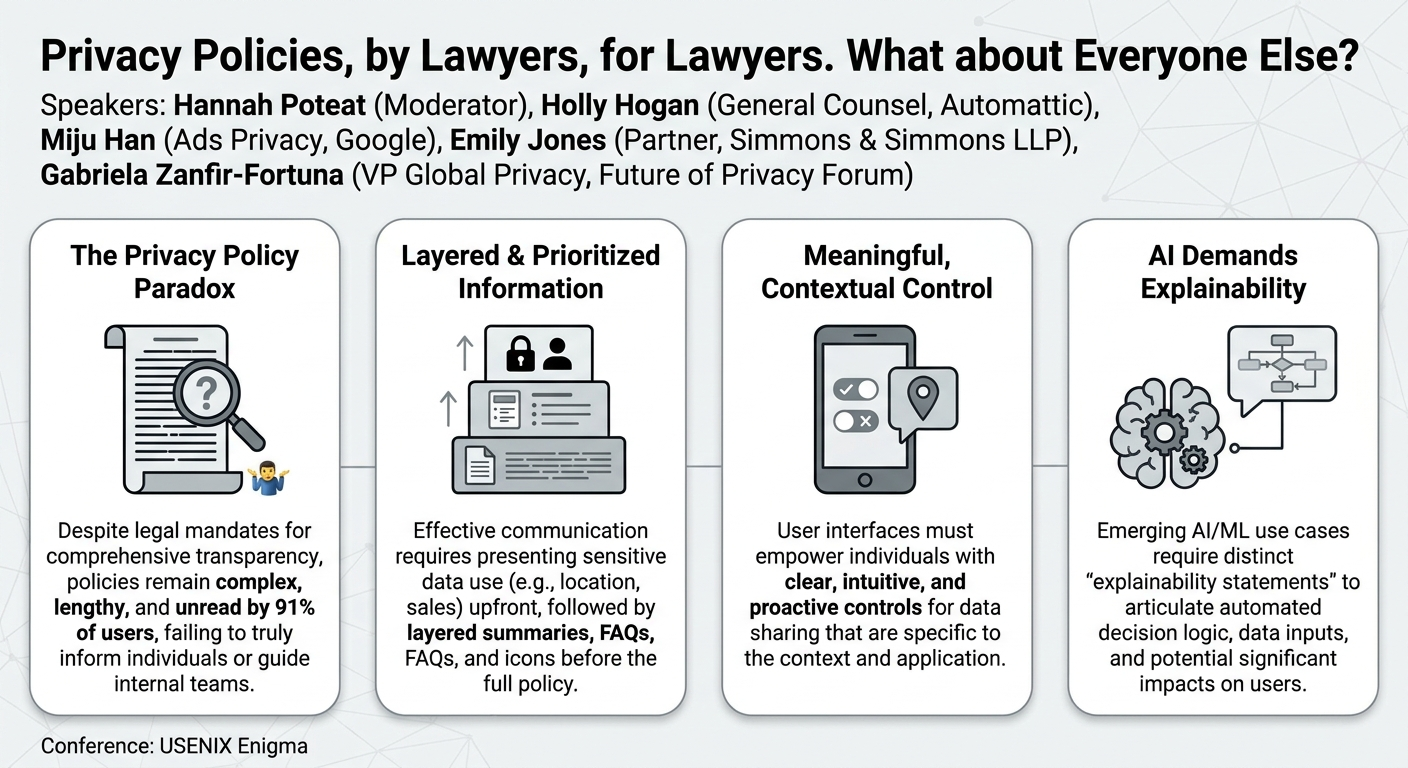
- The Privacy Policy Paradox: Despite legal mandates for transparency, current privacy policies are often lengthy, complex, and unread by the vast majority of users (only 9% according to Pew Research), failing to achieve their core purpose.
- Contextual & Cultural Nuance: Privacy expectations are deeply influenced by culture and evolve with context and technology (e.g., precise location data), making a static, "one-size-fits-all" global policy increasingly ineffective.
- Prioritize and Layer Information: Effective privacy communication requires prioritizing sensitive information upfront and adopting layered approaches (e.g., icons, short summaries, FAQs, videos) to deliver information progressively and contextually.
- Design for Meaningful Control: User interfaces must empower users with clear, simple, and proactive controls for sensitive data (e.g., Apple's contextual location prompts), treating privacy settings as a "first-class consumer product."
- AI Demands Explainability: The increasing use of AI and machine learning necessitates dedicated "explainability statements" to clearly articulate the logic and impact of automated decisions, especially those with significant user impact, as required by GDPR.
- AI as an Aid, Not a Replacement: While tools like ChatGPT can assist in rephrasing complex legal text for better readability, they should not be used to generate privacy policies from scratch, as policies must accurately reflect specific business processes and legal terminology.
About the Speaker(s)
The panel featured a diverse group of experts offering multifaceted perspectives on privacy policies:
Hannah Poteat served as the moderator, guiding the discussion and prompting the panelists on key issues surrounding privacy policy design and communication.
Holly Hogan is the General Counsel at Automattic, the company behind WordPress.com and Tumblr. Her insights provided an in-house legal perspective on the practical challenges of drafting policies for a global user base, especially regarding sensitive topics like law enforcement demands, and explored novel approaches to prioritizing information for users.
Miju Han (listed as Miju Han in the introduction, but Miju Han in the speaker list) is involved with ads privacy at Google. She brought a product and user experience (UX) lens to the discussion, emphasizing how policies inform product development and UX design, the importance of giving users meaningful control, and showcased examples of effective and ineffective privacy UIs.
Emily Jones is a partner at Simmons & Simmons LLP, a law firm. Her expertise lies in EU and UK GDPR, as well as broader global privacy laws. She offered a legal consultant's view on the prescriptive nature of regulations, the complexities of creating global policies, and the emerging challenges of explaining AI usage to users.
Gabriela Zanfir-Fortuna is the Vice President of Global Privacy at the Future of Privacy Forum. Her contributions centered on the legislative outlook for privacy worldwide, drawing comparisons across different jurisdictions (e.g., Brazil's LGPD, India's proposed bill), and advocating for meaningful transparency through innovative formats like icons and layered notices.
Reviews
Dr. Zero (Offensive Security Researcher) — WEAK
A panel of policy experts gathered at Enigma to deliver the shocking revelation that nobody reads privacy policies. It's a rehash of the exact same 'we need better UI and layered notices' talking points the industry has regurgitated since GDPR dropped in 2018. If you've survived a single compliance meeting in the last decade, you already know everything said here.
Heather Calloway (CISO) — SOLID
A clear-eyed diagnosis of why privacy policies fail both users and the business. The panel maps the critical friction between global regulatory compliance and actual product design, making it clear that a policy your engineering team can't translate into code is a regulatory fine waiting to happen.