Meaningful Hardware Privacy for a Smart and Augmented Future
Marcus Hodges (Security Partner · Meta)
USENIX Enigma Conference 2023 · Day 3 · Grand Ballroom
Overview
In an era defined by the proliferation of smart devices, wearables, and the nascent emergence of augmented reality (AR) products, ensuring user privacy at the hardware level has become a paramount concern. This talk, delivered by Marcus Hodges, a Security Partner at Meta supporting their augmented reality division, delves into the critical design considerations and inherent complexities of implementing robust hardware privacy features. Specifically, Hodges focuses on the sensor mute switch and the record indication LED, two seemingly straightforward mechanisms that, upon closer inspection, reveal layers of technical challenges and semantic ambiguities.
Key moments
- 0:00 Introduction: Hardware privacy for smart devices
- 1:45 Two key hardware privacy features: mute switch and LED
- 7:20 Best way to disable a camera: holding it in reset
- 9:00 Real-world mute switch examples: MacBooks and Amazon Echo
- 12:40 Advanced mute switch design in custom silicon
- 18:00 Augmented Reality: The complex semantics of record LEDs
- 20:50 Call to action: Industry standards for AR/VR privacy
Meaningful Hardware Privacy for a Smart and Augmented Future
Speakers: Marcus Hodges, Security Partner, Meta
Conference: USENIX Enigma
YouTube: https://www.youtube.com/watch?v=UZ8gg-rrhgY
Overview
In an era defined by the proliferation of smart devices, wearables, and the nascent emergence of augmented reality (AR) products, ensuring user privacy at the hardware level has become a paramount concern. This talk, delivered by Marcus Hodges, a Security Partner at Meta supporting their augmented reality division, delves into the critical design considerations and inherent complexities of implementing robust hardware privacy features. Specifically, Hodges focuses on the sensor mute switch and the record indication LED, two seemingly straightforward mechanisms that, upon closer inspection, reveal layers of technical challenges and semantic ambiguities.
The core premise of the presentation is that as devices with always-on sensors become ubiquitous in our most private spaces—from living rooms to medical clinics—the risks posed by malware and overly permissive applications escalate dramatically. Hodges argues that software-only controls are insufficient against sophisticated threats, necessitating hardware-backed assurances. While current implementations in smart speakers and laptops offer valuable lessons, the advent of augmented reality, with its multitude of environmental, tracking, and input sensors, threatens to overwhelm existing privacy paradigms, demanding industry-wide alignment on design and semantics to maintain meaningful user control and transparency.
Background
▶ Watch: Introduction: Hardware privacy for smart devices (0:00)
The landscape of modern technology is increasingly populated by devices deeply integrated into our daily lives and personal spaces. Smart speakers with cameras and voice assistants, virtual reality headsets with immersive sensor arrays, and early AR wearables like Ray-Ban Stories are collecting vast amounts of data. These devices often feature always-on sensors and reside in private or semi-private environments—homes, offices, public restrooms, or medical clinics—where individuals hold a strong expectation of privacy. This pervasive data collection introduces significant security and privacy risks, including potential exploitation by malware or malicious applications with excessive sensor permissions, leading to unauthorized surveillance or data exfiltration.
To counter these threats, two hardware-centric privacy features are gaining prominence: the sensor mute switch and the record indication LED. The sensor mute switch provides users with a direct, manual override to physically disable sensors like cameras and microphones, offering a fundamental level of control. The record indication LED, conversely, aims to provide transparent feedback to users and bystanders, indicating when sensors are actively recording. However, as Hodges points out, the exact meaning, color, and blink pattern of this LED can be deceptively simple, often failing to convey the full scope of sensor activity.
At the heart of designing these features lies the concept of hardware security assurance. A system offers hardware security assurance if it is both immutable and isolated. Immutability, a unique property of hardware, ensures that the initial boot ROMs are secure and enables features like secure boot. This immutability, coupled with isolation, is crucial for protecting against software attacks at all privilege levels, even in the event of a compromised operating system or firmware. The inherent challenge, however, is that immutable systems cannot be updated, demanding that their design be simple, effective, and rigorously validated from the outset to avoid unpatchable vulnerabilities.
Key Findings
▶ Watch: Best way to disable a camera: holding it in reset (7:20)
Marcus Hodges's talk elucidates several critical findings regarding the design and implementation of hardware privacy features, particularly in the context of emerging AR technologies:
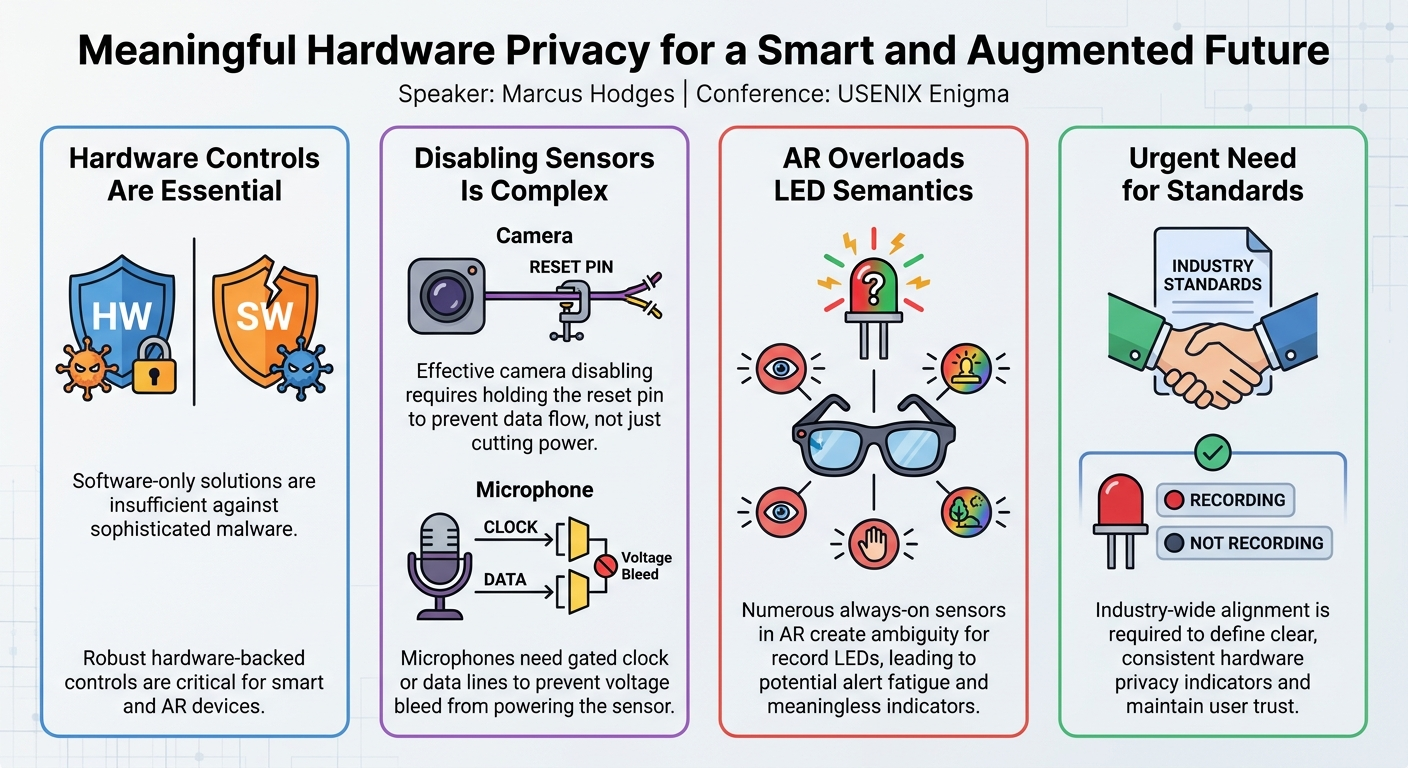
- Disabling sensors is technically complex: Simply cutting power is often insufficient and can cause electrical instability or disable unintended system components. Effective hardware-level sensor disabling requires specific techniques tailored to the sensor type.
- Optimal Camera Disabling: For cameras, holding the reset pin in a continuous reset state is identified as the most effective and elegant single-wire solution, preventing data flow and camera operation without detrimental side effects (07:44).
- Microphone Vulnerabilities and Solutions: Certain microphone manufacturers produce devices where internal voltage bleed from the clock signal can power the sensor even when the main power is cut. The secure approach for microphones is to gate the clock or data lines, or both, to ensure complete disablement (08:14).
- The Mute Switch vs. Record LED Complement: While distinct, the sensor mute switch and record indication LED complement each other. The mute switch provides definitive control, while the LED offers transparency, especially in scenarios where complex processing (like wake word detection) occurs without explicit recording.
- Trade-offs in System Design: Achieving hardware security assurance often conflicts with design goals like preserving optionality (e.g., late-binding sensor configurations). Solutions like one-time programmable microcontrollers (CPLDs) can bridge this gap by offering late-stage programmability while maintaining immutability post-programming (12:00).
- Custom Silicon Benefits and Drawbacks: Integrating hardware privacy controls directly into custom silicon within a System-on-Chip (SoC) offers significant space efficiency and robust security. However, this approach dramatically increases the difficulty for external researchers to validate the security claims, raising concerns about transparency (14:00).
- Augmented Reality Overloads LED Semantics: The most profound finding is that AR's pervasive use of diverse, always-on sensors for environmental processing, mapping, tracking, and user input fundamentally breaks the simple "on/off" or "recording/not recording" semantics of traditional record indication LEDs. The meaning of an AR device's privacy LED becomes ambiguous, leading to potential alert fatigue and reducing its utility (18:00).
- Urgent Need for Industry Standards: The inherent complexities and semantic ambiguities, particularly with AR, highlight an urgent need for industry-wide alignment on standards for how hardware privacy features are designed, communicated, and understood by users (21:00).
Technical Deep Dive
▶ Watch: Real-world mute switch examples: MacBooks and Amazon Echo (9:00)
The technical intricacies of implementing meaningful hardware privacy features reveal why these controls are far from trivial. Hodges systematically breaks down the challenges, starting with basic sensor disabling and scaling up to complex system-on-chip integrations and the semantic dilemma posed by augmented reality.
Sensor Mute Switch Design
The initial, intuitive approach to disabling a sensor—cutting its power—is fraught with issues. Abruptly severing power can induce voltage spikes and other detrimental electrical phenomena. Furthermore, many components may share a single power rail, meaning disabling one sensor could inadvertently disable half the system. Modern devices often employ a Power Management Integrated Circuit (PMIC) to smoothly manage power transitions, but this does not inherently provide granular control over individual sensors.
The true objective of a sensor mute switch is to prevent the flow of private data. An alternative considered is disabling data wires. However, most electrical buses transmit data in parallel over multiple wires, requiring a gate or transistor on each wire, increasing complexity. High-speed data transmission lines are also highly sensitive to electrical properties like impedance, making it challenging to insert additional components without degrading performance or causing unintended side effects (06:00). Moreover, severing data connections mid-communication can have firmware-level consequences, akin to cutting a phone line during a conversation.
For camera sensors, Hodges explains that the typical pin-out includes pins for power, clock, reset, and ground, alongside data buses like MIPI (for pixel data) and I²C (for command and control). After exploring various options, holding the camera's reset pin in a continuous reset state emerged as the superior method. This effectively keeps the camera in a rebooted, non-functional state, preventing data capture. It's an elegant "single-wire solution" that avoids the pitfalls of power or data line manipulation (07:44).
Microphones, particularly PDM (Pulse Density Modulation) microphones, typically have a simpler pin-out: power, clock, data, and ground. Hodges revealed a surprising finding: certain microphone manufacturers design devices where sufficient internal voltage bleed from the clock signal can power the sensor and allow data transmission even if the main power is completely cut. This bypasses a simple power-off mechanism. Therefore, for microphones, the recommended secure approach is to gate the clock, the data line, or both, ensuring no signal can be modulated or transmitted (08:14).
Real-world Implementations and System-level Challenges
Hodges illustrates these principles with existing products:
- Apple MacBooks feature a hardware microphone disconnect integrated with the lid. When the lid is closed, the microphone is physically disabled, resilient to all software attacks, including a compromised OS. The camera's field of view is also naturally obstructed (08:40).
- Amazon Smart Speakers utilize a mute button that switches power between the microphone and a red LED. Only one can be powered at a time, ensuring the microphone is off when the LED is on. This design necessitates an LED to indicate the system's state, as a momentary button doesn't provide persistent visual feedback (09:20).
Scaling these features to devices with many sensors introduces further complexity. Simply daisy-chaining sensors to a switch is problematic. The operating system and device drivers need notification before sensors abruptly disappear. More fundamentally, identifying which sensors to disable is non-trivial. For example, an Inertial Measurement Unit (IMU) can sometimes pick up audio, and temperature sensors could monitor health characteristics. Disabling a temperature sensor, however, might render a device unsafe. These decisions involve significant trade-offs with usability, as many smart devices rely heavily on sensors for user input (e.g., muting a smart speaker's microphone prevents voice interaction) (10:00).
A key design tension arises between preserving optionality (e.g., late-stage manufacturing configuration of which sensors are affected by a mute switch) and hardware security assurance (which demands immutability). Hodges proposes using a one-time programmable microcontroller, such as a CPLD (Complex Programmable Logic Device). This allows for late-binding logic over sensor disablement, while still providing hardware security assurance once programmed, as it becomes immutable. Such a microcontroller can also implement a time delay, allowing the OS and drivers to cleanly shut down sensors before the hard disablement (12:00). The downside is the physical space required for a CPLD and its associated wiring, especially in compact form factors like AR glasses.
To address space constraints, the ultimate solution involves integrating the design into custom silicon within the System-on-Chip (SoC). Here, the mute switch is wired directly to the SoC. Internally, the signal is routed to an uninterruptible timer (to provide a brief delay) and the root of trust firmware. This firmware is responsible for gracefully notifying the OS and bringing down related components before the hardware disablement. Instead of holding external cameras in reset, this design holds the internal CSI-2 receivers (the components cameras directly interface with) in reset. This achieves the same effect—disabling the sensor—but takes up significantly less physical space (13:00). The trade-off, however, is that validating the security of such custom, internal silicon becomes much harder for external researchers, raising the bar for independent verification.
Record Indication LED Design and AR Complications
The record indication LED also presents nuanced challenges. In Ray-Ban Stories, the LED is hardwired directly to the camera sensor power. If the camera is powered on, the LED is on, and vice-versa. This is simple, understandable, and provides robust hardware security assurance. The implication, however, is that the camera must be powered off when not actively recording, otherwise the light would be constantly on (15:00). This highlights a critical distinction between a sensor being "powered on" and "actively recording" (i.e., data bits flowing).
Amazon Smart Speakers adopt a different approach for their microphone LED. The microphone is normally on, listening for a wake word (e.g., "Alexa"), with the LED off. The LED only activates once a wake word is detected, and data begins streaming to the cloud. This design, while providing restricted functionality without constant illumination, is significantly harder to implement with hardware security assurance due to the higher-order concept of wake word processing. It demonstrates how a mute switch and a record LED can complement each other, with the mute switch providing definitive control even when the LED is off for wake word listening (16:00).
The true complexity emerges with augmented reality. Future AR glasses will feature a multitude of cameras and sensors beyond simple photo/video capture: environmental processing, spatial mapping, location detection, hand tracking, eye tracking, and hands-free voice control (18:00). This sensor proliferation creates an overwhelming problem for LED semantics:
- What does the LED signify? That any sensor is on? Which ones? For what purpose?
- Does "actively recording" mean bits flowing, data streaming to the cloud, or data being persisted locally?
- Should the LED be on for machine perception tasks like wake word detection, spatial mapping, hand tracking, or general computer vision, even if no user-initiated recording is occurring?
Answering these questions requires deep consideration of privacy implications: Is the feature always-on or user-activated? Is data processed ephemerally, in a secure enclave, or persisted? What is the fidelity of the data, and how is it being used? If the LED is constantly illuminated for every background sensing task, it will quickly lead to alert fatigue, rendering it meaningless. Defining where to draw this line is a critical, unresolved challenge (20:00).
Demo / Proof of Concept
▶ Watch: Augmented Reality: The complex semantics of record LEDs (18:00)
While Marcus Hodges's presentation did not include a live demonstration or a novel proof-of-concept tool, the talk effectively utilized existing commercial devices as real-world "proofs of concept." The discussion of Apple MacBooks' hardware microphone disconnect, Amazon Smart Speakers' mute button and LED behavior, and Ray-Ban Stories' hardwired camera LED served to illustrate the principles, challenges, and varying approaches to implementing hardware privacy features. These examples highlighted both successful implementations and the inherent design trade-offs in current consumer electronics. The focus was less on showing a new capability and more on analyzing the technical underpinnings of existing ones and projecting future complexities, especially with AR.
Defensive Implications
▶ Watch: Call to action: Industry standards for AR/VR privacy (20:50)
The insights from Marcus Hodges's talk provide crucial guidance for defenders in the rapidly evolving landscape of smart and augmented devices. The primary implication is the absolute necessity of hardware-backed privacy controls. Relying solely on software permissions or operating system safeguards is insufficient against sophisticated attackers who can compromise higher privilege levels. Defenders must advocate for and implement robust sensor mute switches that leverage the most secure techniques, such as holding camera reset pins or gating microphone clock/data lines, ensuring these controls are resilient to even kernel-level exploits.
Furthermore, the design of record indication LEDs must be approached with deliberate clarity. For current devices, a hardwired LED that directly reflects sensor power state (as seen in Ray-Ban Stories) offers the highest assurance, even if it implies that sensors must be powered off when not in active use. As AR devices emerge, defenders must push for industry standards that define LED semantics clearly and consistently. This includes distinguishing between user-initiated recording, background machine perception, and ephemeral data processing. Without such standards, users will suffer from alert fatigue, and the LED will lose its protective value, creating a blind spot for potential surveillance.
Organizations developing new hardware, particularly in the AR/VR space, should make significant investments in security and privacy design from the earliest stages. This involves:
- Prioritizing Hardware Security Assurance: Embedding immutability and isolation into the core design.
- Careful Trade-off Analysis: Balancing security with usability and manufacturing optionality, potentially utilizing one-time programmable microcontrollers (e.g., CPLDs) where flexibility is needed without compromising post-programming immutability.
- Transparency and Auditability: While custom silicon offers efficiency, its difficulty for external validation is a defensive concern. Companies should consider mechanisms to provide transparency or third-party auditability for these critical hardware privacy features.
- Engaging with the Research Community: Actively participating in industry discussions, bug bounty programs, and research initiatives (like Meta's annual RFP for AR/VR security and privacy research) to collectively address emerging threats and establish best practices.
Ultimately, defenders need to shift their mindset from patching software vulnerabilities to ensuring foundational hardware integrity. This proactive approach is critical to building trustworthy AR and VR products that respect user privacy in an increasingly sensor-rich world.
Key Takeaways
- Hardware privacy features are essential, not optional: In a world of ubiquitous smart and AR devices, robust hardware-backed sensor mute switches and record indication LEDs are critical to mitigating security and privacy risks posed by malware and overly permissive software.
- Sensor disabling is technically complex: Simple solutions like cutting power are often ineffective or problematic. Secure camera disabling relies on holding the reset pin, while microphones require gating clock or data lines to prevent voltage bleed exploitation.
- Design involves critical trade-offs: Achieving hardware security assurance (immutability) often conflicts with design flexibility (optionality) and physical space constraints. Solutions like one-time programmable microcontrollers or custom SoC integration offer compromises, but the latter can hinder external validation.
- Augmented Reality poses a semantic crisis for privacy indicators: The sheer number and diverse functions of always-on sensors in AR devices fundamentally complicate the meaning of a "record indication" LED, risking alert fatigue and rendering the indicator meaningless without clear, standardized semantics.
- Industry-wide alignment on standards is urgently needed: To ensure hardware privacy features remain meaningful and secure in the AR era, the industry must collaborate to define clear standards for LED semantics, sensor control, and user transparency.
- Active research and community engagement are vital: There is a significant opportunity for researchers and the security community to influence the design of future trustworthy AR/VR products by scrutinizing existing devices, participating in bug bounty programs, and contributing to open questions in hardware privacy.
About the Speaker(s)
Marcus Hodges is a Security Partner at Meta, where he plays a crucial role in supporting the company's augmented reality division. His work focuses on the intersection of hardware security and user privacy, particularly as new AR technologies emerge and integrate into daily life. His expertise lies in understanding the complex technical challenges of designing secure and private hardware features for a future dominated by smart and immersive devices.
Reviews
Dr. Zero (Offensive Security Researcher) — SOLID
Meta lecturing on privacy usually makes me reach for the whiskey, but Hodges actually brought receipts. This isn't a policy fluff piece; it's a concrete hardware engineering talk about why building a real sensor kill switch is an electrical nightmare. It forces the industry to confront the fact that AR is about to break every visual privacy indicator we rely on.
Heather Calloway (CISO) — SOLID
Hodges breaks down the electrical and semantic realities of hardware privacy switches in AR wearables. It is a direct look at why existing physical security policies will fail when confronted with next-generation smart devices. Required viewing for any leadership team drafting BYOD or facility policies for the next five years.