Technical Metamorphosis: The 3 Stages of DSAR Automation
Alon Levy (Engineering Manager · Uber)
USENIX Enigma Conference 2023 · Day 3 · Grand Ballroom
Overview
In this insightful USENIX Enigma talk, Alon Levy, an Engineering Manager on Uber's technical privacy team, delves into the critical journey of automating Data Subject Access Requests (DSARs). Levy, who leads the team responsible for building systems to export user data, outlines a pragmatic, three-stage approach to DSAR automation, sharing Uber's own learnings and architectural decisions along the way. The talk emphasizes that while providing users with agency over their data is inherently the right thing to do, the rapidly evolving global regulatory landscape – with its stringent response times and potentially colossal penalties reaching "hundreds of millions of dollars or more" – makes automation not just a best practice, but a business imperative.
Key moments
- 0:30 What is a Data Subject Access Request (DSAR)?
- 3:00 Understanding the manual DSAR fulfillment process
- 4:10 Key considerations for Building vs. Buying DSAR solutions
- 7:00 Why partial automation is not a sustainable solution
- 8:10 Uber's core requirements for an automated DSAR system
- 12:40 Scaling DSAR with 'Cuboids' and checkpointing
- 16:10 Final takeaways: Build, quantify, and scale your system
Technical Metamorphosis: The 3 Stages of DSAR Automation
Speakers: Alon Levy, Engineering Manager, Uber
Conference: USENIX Enigma
YouTube: https://www.youtube.com/watch?v=PWrEvap5HZs
Overview
In this insightful USENIX Enigma talk, Alon Levy, an Engineering Manager on Uber's technical privacy team, delves into the critical journey of automating Data Subject Access Requests (DSARs). Levy, who leads the team responsible for building systems to export user data, outlines a pragmatic, three-stage approach to DSAR automation, sharing Uber's own learnings and architectural decisions along the way. The talk emphasizes that while providing users with agency over their data is inherently the right thing to do, the rapidly evolving global regulatory landscape – with its stringent response times and potentially colossal penalties reaching "hundreds of millions of dollars or more" – makes automation not just a best practice, but a business imperative.
The core of Levy's presentation is a strategic roadmap for organizations looking to move beyond manual or partially automated DSAR processes towards a fully robust, scalable, and cost-effective solution. He argues that proactive investment in automation is crucial for preemptively building compliance and fostering trust with customers. By detailing the challenges of each stage and presenting Uber's architectural solutions, Levy provides a valuable template for other engineering teams grappling with the complexities of managing personal data at scale in an increasingly regulated world.
This article will explore the evolution of DSAR handling, from its rudimentary manual beginnings to sophisticated, automated systems. It will highlight Uber's architectural choices, including their use of templates and cuboids for efficient data processing, and discuss the broader defensive implications for organizations aiming to navigate the intricate demands of data privacy regulations.
Background
▶ Watch: What is a Data Subject Access Request (DSAR)? (0:30)
The necessity for robust DSAR mechanisms stems from a global proliferation of data privacy regulations, such as the GDPR in Europe and CCPA in California. These laws grant individuals the legal right to access their personal data held by businesses, demanding transparency and control. However, as Levy illustrates with a global regulatory map, this landscape is "disparate," with each regulation imposing unique requirements, varying penalties, and critically, stringent response times. Complying with this mosaic of legal obligations poses a significant challenge for any business, particularly large enterprises like Uber that process vast quantities of user data across numerous services.
In the early stages, organizations often resort to a manual fulfillment process. This typically involves users submitting a DSAR, which is then triaged and handed off to support staff. Fulfillment might entail running analytics queries on platforms like Presto, executing SQL queries against databases, or making direct calls against various service APIs where data resides. For each request, agents must manually compose, run, and format outputs, a process Levy describes as "time consuming and cost prohibitive." This approach is unsustainable, especially when faced with escalating demand, potentially thousands of user requests, which quickly expose the limitations of agent-driven, templatized query execution.
Furthermore, defining "what data to provide" is a complex task in a large organization. Uber addresses this through a privacy review process. A cross-functional team comprising privacy architects, legal experts, engineers, and data analysts reviews data processing activities for every new feature or product. This ensures that the export backlog remains holistic and continuously updated, determining which data points fall within the scope of DSAR fulfillment.
A critical decision point for any organization embarking on DSAR automation is the "build versus buy" dilemma. While numerous vendor solutions exist, Levy, speaking as an engineer, admits a natural inclination to build in-house, especially with a supportive team and leadership. However, he acknowledges that not every organization possesses the resources or engineering bandwidth for such an undertaking. When evaluating vendor solutions, key criteria include the complexity of the system (Uber's microservices architecture, for instance, is incredibly intricate), whether the use case is static or continuously evolving, and crucially, how well the solution integrates with existing tech stacks and infrastructure. Levy cites a VentureBeat use case where a hospitality company's vendor-based proof of concept failed to reach production due to concerns that long-term maintenance costs would exceed savings, highlighting a common problem where "out of the box" solutions struggle to fit complex, continuously evolving environments.
The transition from manual to partial automation often sees engineers stepping in to provide bespoke solutions for querying key data sources, supplementing the support agents' efforts. While this might process more requests temporarily, it introduces new problems: increased coordination overhead across multiple departments (legal, engineering, support) and engineers actively participating in fulfillment, which yields a poor return on investment and is not a viable long-term strategy. The overarching challenge, Levy points out, is making the proactive business case for full automation before demand "starts heating up." Organizations must effectively quantify the full cost of manual fulfillment and communicate the risks to secure necessary investments.
Key Findings
▶ Watch: Key considerations for Building vs. Buying DSAR solutions (4:10)
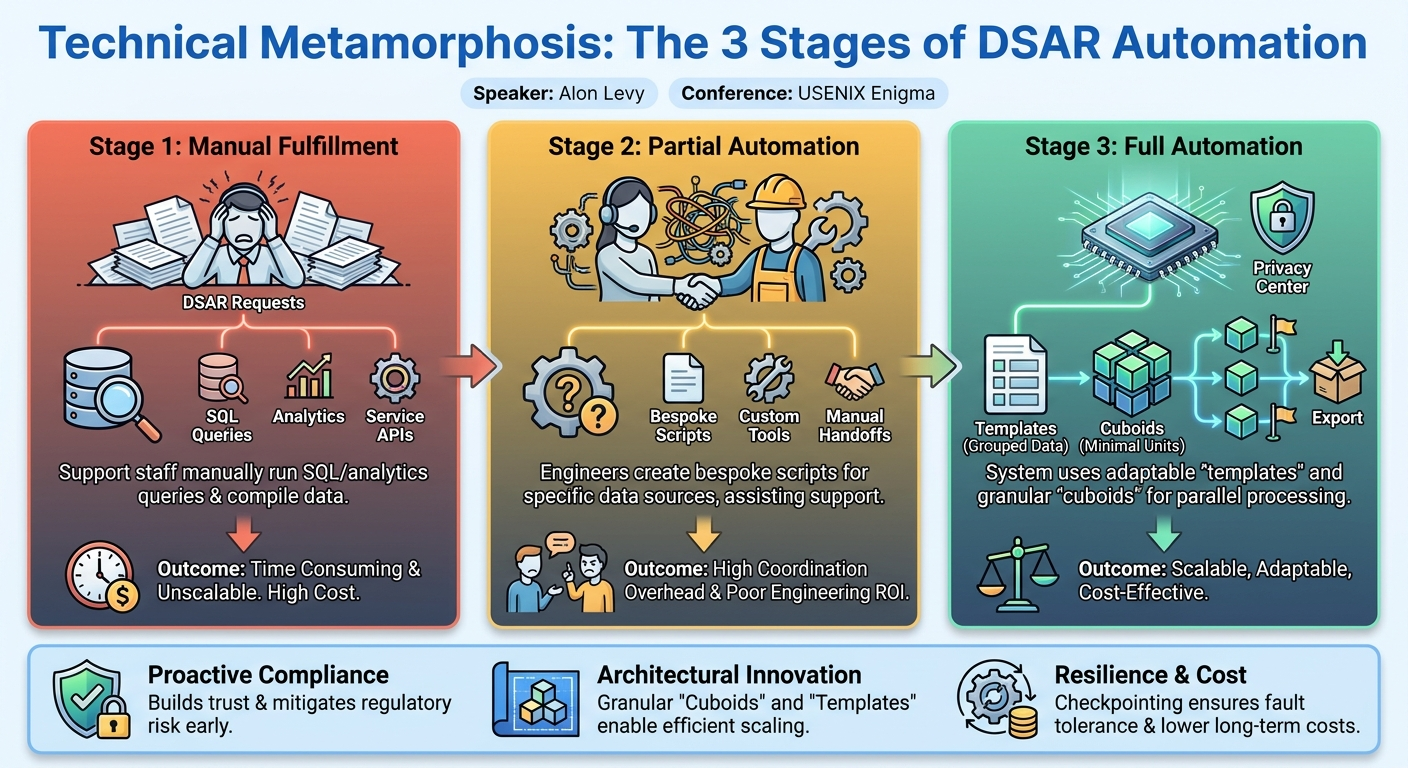
Alon Levy's presentation outlines a clear progression through three stages of DSAR handling, culminating in a robust, fully automated system that serves as the talk's primary contribution. The core findings highlight the necessity of strategic architectural design to meet the demands of scale, adaptability, and cost-efficiency.
Firstly, the talk implicitly identifies the three stages of DSAR automation:
- Manual Fulfillment: Characterized by support staff manually executing queries and compiling data, proving time-consuming and unscalable.
- Partial Automation: An interim stage where engineering teams provide temporary, often bespoke, solutions to query specific data sources, leading to coordination overhead and inefficient use of engineering resources.
- Full Automation: The desired state, achieved through dedicated internal systems designed for adaptability, scale, and cost-effectiveness.
Secondly, Uber's experience underscores the importance of a proactive approach to privacy. By investing in internal tooling and automation, they aim to get ahead of regulatory requirements, minimize legal risks, and build customer trust. This contrasts with a reactive stance that often leads to costly, piecemeal solutions.
Thirdly, Levy outlines three core requirements for any successful automated DSAR system:
- Adaptability: The system must easily onboard new data sources and off-board discontinued ones as business practices and features evolve.
- Scale: It must accommodate growing demand without requiring fundamental architectural overhauls.
- Cost: Minimizing operational, opportunity, and compute resource costs is paramount.
Fourthly, the concept of templates is introduced as a crucial mechanism for simplifying the request submission process. By grouping commonly requested data (e.g., "writer template" for trip information, profile details, feedback), agents can select a wide array of data with a single click, drastically reducing manual effort and potential errors.
Finally, the talk reveals the cuboid as a fundamental innovation for achieving scalability in data processing. A cuboid represents the "minimal unit of execution" – a grouping of users, a specific data source, and a defined time range for which a pipeline exports data. This granular breakdown allows for parallel processing, fault tolerance through checkpointing, and configurable scaling across multiple dimensions, ensuring the system can handle thousands of concurrent requests efficiently. The ability to reconstruct original requests from these independently processed cuboids is key to the system's resilience and performance.
Technical Deep Dive
▶ Watch: Why partial automation is not a sustainable solution (7:00)
Uber's fully automated DSAR solution, representing Stage 3 of their "technical metamorphosis," is engineered for high throughput, adaptability, and resilience. The system primarily focuses on offline warehouse data, though Levy acknowledges that similar principles could apply to real-time database systems or service APIs.
The solution is anchored by an internal tool featuring a user interface (UI) that allows agents to initiate DSARs. On the left side of the UI, agents select the subject(s) for the request, while on the right, they choose the specific data required. This intuitive interface enables the submission of a high volume of requests covering a wide array of data "pretty trivially," a stark contrast to the manual, query-by-query approach of Stage 1.
Underpinning this UI are two main architectural components:
- API Layer: This component accepts requests from the UI. Each request specifies a user or group of users and the required data. The API layer is responsible for storing these requests in Uber's metadata storage.
- Batch Processing Orchestrator: This critical component operates on a fixed, time-based recurrence. It reads all previously queued requests from the metadata storage, batches them together, and then breaks them down into individual composite export operations. This orchestrator is central to managing the lifecycle of DSAR fulfillment.
To enhance the efficiency of request setup, Uber introduced the concept of templates. Data requests often repeat, and templates allow for logical grouping of related data. For example, a "writer template" might bundle all commonly requested data for drivers, such as trip information, profile details, and feedback. In the UI, selecting this template translates to a single tick box selection that retrieves all associated data. This mechanism directly addresses the requirement for adaptability in the system.
The data model supporting these templates is designed for easy modification. At the base, there are data source entities, which represent the underlying data. These entities specify details like the source table name and the required columns. Above these, template entities act as containers for data sources. For instance, an "eater template" could group data sources like order details and historical promotion information, allowing for rapid creation and modification of data groupings without altering the underlying data structures. The API facilitates easy updates to templates, template memberships, data sources, or columns, ensuring the system remains current with evolving business needs.
The true technical innovation for handling thousands of user requests covering dozens of data sources, which are inherently "long running and computationally expensive," lies in the concept of the cuboid. A cuboid is defined as the minimal unit of execution. It encapsulates a specific grouping of users, a particular data source, and a defined time range, for which a dedicated pipeline exports data. This granular abstraction is key to Uber's ability to scale.
The system is highly configurable along several dimensions of the cuboid:
- Number of users: Process more or fewer users per cuboid.
- Time range: Adjust the historical period covered by each cuboid.
- Number of data sources: Determine how many data sources are grouped within a cuboid.
- Parallel operations: Customize the number of cuboid operations running concurrently.
This configurability allows the system to scale its processing capacity in direct relation to available compute resources. Levy illustrates this with an example: a single DSAR for users 1-300 requesting data from data source 1 (2013-2017) and data source 2 (2015-2022) might be broken down into multiple cuboids. For instance, Cuboid 1 could cover users 1-150, data source 1, and years 2013-2015, while Cuboid 2 covers the same users and data source but for years 2016-2017. Each of these cuboids runs independently. Once all constituent cuboids for an original request have completed successfully, the orchestrator reconstructs and composes the final output.
A crucial feature for system resilience is checkpointing. If a request broken into several cuboids experiences a failure in one cuboid (e.g., due to an infrastructure issue), discarding the entire request would lead to significant loss of processing time. With checkpointing enabled, the system can pick up from the latest failure, retrying only the failed cuboids while salvaging the results of previously successful operations. This approach protects the system from overload and prevents cascading failures, ensuring efficient resource utilization and reliable completion of DSARs.
Demo / Proof of Concept
▶ Watch: Scaling DSAR with 'Cuboids' and checkpointing (12:40)
While the talk does not feature a live, interactive demonstration in the traditional sense, Alon Levy effectively "demonstrates" Uber's fully automated DSAR system by presenting screenshots and detailed descriptions of its functionality. The core "demo" is the internal tool's user interface used by agents.
Levy walks through the UI, showing how agents can interact with the system to submit requests. On the left side of the screen, there's a clear option to select "a subject or subjects" for the request, indicating the ability to specify the individual(s) whose data is being requested. Crucially, on the right side, agents are able to "select the requested data." This is where the power of the template system becomes apparent. Instead of manually specifying individual data points, agents can choose pre-defined groupings, such as the "writer template" which encapsulates all commonly requested data for a driver (e.g., trip information, profile details, feedback).
This visual representation of the UI vividly illustrates the contrast with the manual Stage 1 process. Levy explicitly states that through "this sequence of selections, they're able to submit a high volume of requests covering a wide array of data pretty trivially." This directly contrasts with the arduous task in Stage 1 where an agent would "manually running queries and then compiling composing outputs for every user and request individually." The UI, therefore, serves as a proof of concept for how a well-designed front-end, backed by robust automation, can drastically simplify and accelerate complex data requests.
Beyond the internal agent tool, Levy also highlights a customer-facing outcome enabled by this backend automation: Uber's Privacy Center. Released the previous year, this center is accessible through Uber's suite of apps and offers features like "explore your data" (allowing users to visualize their data) and "download your data" (enabling direct in-app requests for pertinent data). While not a direct part of the DSAR automation process itself, the Privacy Center serves as compelling evidence of the broader impact of backend automation. Levy emphasizes that "it's the investments in automation that allow us to focus on features like the Privacy Center," underscoring that automation enables not just compliance but also a richer, more transparent user experience that builds trust.
Defensive Implications
▶ Watch: Final takeaways: Build, quantify, and scale your system (16:10)
The insights shared by Alon Levy offer profound defensive implications for organizations grappling with data privacy and compliance. The primary defensive posture advocated is one of proactive automation rather than reactive compliance.
Firstly, regulatory risk mitigation is paramount. The global landscape of data privacy laws is rapidly expanding and becoming more stringent, with penalties potentially reaching "hundreds of millions of dollars or more." Manual or partially automated DSAR processes are inherently slow, error-prone, and cannot scale to meet the "stringent response times" mandated by regulations. Automating DSARs directly reduces the risk of non-compliance, costly fines, and reputational damage. It allows organizations to "get ahead of the story" and build compliance preemptively.
Secondly, building and maintaining customer trust is a critical defensive strategy. Providing users with "agency over their data" is not just a legal requirement but also a fundamental expectation in today's digital economy. An efficient, transparent, and reliable DSAR process, as exemplified by Uber's automated system and customer-facing Privacy Center, fosters trust. Conversely, a cumbersome or failed process can erode trust and lead to negative public perception.
Thirdly, operational efficiency and cost savings serve as a strong defensive measure against financial drain. Levy explicitly calls for quantifying "the full cost of manual fulfillment" to make a compelling business case for automation. Manual processes are "cost prohibitive" due to the significant labor involved from support staff and, in partial automation, from high-value engineering resources. A fully automated system, designed with cost-effectiveness in mind (e.g., minimizing compute resources), transforms DSAR fulfillment from a cost center into a streamlined, efficient operation, providing a better "return on investment" for engineering efforts.
Fourthly, architectural resilience and scalability are essential for long-term defense. Organizations must "build with a scale in mind" from the outset. Uber's architectural choices, such as the use of templates for adaptable data grouping and cuboids for granular, parallel execution, demonstrate how to design a system that can accommodate growing demand without requiring costly architectural overhauls. Features like checkpointing are crucial for fault tolerance, protecting the system from overload and "cascading failures," ensuring that long-running, computationally expensive processes can complete reliably even in the face of infrastructure issues.
Fifthly, strategic "build vs. buy" evaluation is a key defensive decision. For organizations with complex, evolving microservices architectures, an "out of the box solution" from a vendor may not integrate properly or keep pace with continuous development. Levy's discussion on the long-term maintenance costs potentially exceeding savings with vendor solutions highlights the need for a thorough assessment of system complexity, integration requirements, and the organization's unique development trajectory before committing to a solution.
Finally, cross-functional collaboration and data governance are foundational. Uber's "privacy review process," involving legal, engineering, and data analysts, ensures that data processing activities are continuously reviewed and the DSAR export backlog remains holistic. This proactive data governance ensures that the automated system is always aware of what data exists, where it resides, and whether it's in scope for DSARs, minimizing the risk of inadvertently missing data or providing incorrect information.
Key Takeaways
- Proactive Automation is Essential: Don't wait for demand to escalate or penalties to hit. Invest proactively in DSAR automation to build compliance and trust before regulations become overwhelming.
- Quantify the Business Case: Clearly articulate and quantify the full cost of manual DSAR fulfillment and the potential savings/benefits of automation to secure necessary organizational investment.
- Design for Adaptability and Scale: Build systems that can easily onboard/off-board data as business practices evolve and are architected to accommodate increasing demand without fundamental overhauls.
- Leverage Granular Processing Units: Concepts like Uber's cuboids (groupings of users, data source, time range) are critical for breaking down complex requests into parallelizable, manageable units, enabling efficient scaling and resource utilization.
- Implement Robust Fault Tolerance: Features like checkpointing are vital for long-running processes, allowing the system to recover from failures by retrying only failed components, preventing loss of processing time and ensuring system resilience.
- Strategic Build vs. Buy: Carefully evaluate internal capabilities versus vendor solutions, considering system complexity, continuous development needs, and integration with your existing tech stack to avoid long-term maintenance issues.
About the Speaker(s)
Alon Levy is an Engineering Manager on the technical privacy team at Uber. He leads the team responsible for building automation systems specifically designed for exporting user data. His work at Uber is driven by a proactive approach to privacy, with a core mission to optimize automation and provide customers with effective tooling to manage their data. While an engineer by trade, Levy's insights highlight a deep understanding of the regulatory landscape and the business imperative behind robust data privacy solutions.
Reviews
Dr. Zero (Offensive Security Researcher) — SOLID
Alon Levy’s Enigma talk is a pragmatic look at how Uber engineered its way out of GDPR DSAR hell. It’s not security research, but if you’re a massive enterprise trying to export user data across a thousand microservices without setting your compute budget on fire, this is the blueprint. Solid distributed systems engineering applied to a massive compliance headache.
Heather Calloway (CISO) — STRONG ACCEPT
Levy maps the inevitable compliance trap every growing enterprise faces: you either automate DSAR fulfillment, or it buries your engineering team and breaches regulatory SLAs. Uber’s architectural blueprint for scalable privacy engineering is excellent. It is required viewing for any organization trying to figure out why their privacy program is burning so much headcount just to stay legal.