True Crime Journalism: Cyber
Melanie Ensign (Moderator · Discernible), Joseph Menn (Panelist · Washington Post), Lily Hay Newman (Panelist · WIRED), Alfred Ng (Panelist · Politico)
USENIX Enigma Conference 2023 · Day 3 · Grand Ballroom
Overview
In an engaging panel discussion at USENIX Enigma, "True Crime Journalism: Cyber" brought together a distinguished group of security and privacy journalists to peel back the curtain on how cybercrime and security incidents are reported. Moderated by Melanie Ensign of Discernible, the panel featured Alfred Ng (Politico), Lily Hay Newman (WIRED), and Joseph Menn (Washington Post), offering a rare glimpse into the newsroom's perspective on covering an increasingly complex and impactful domain. The session, playfully framed through the lens of true crime, aimed to illuminate the intricate processes, ethical dilemmas, and strategic decisions involved in translating highly technical and often sensitive security events into compelling and comprehensible narratives for a broad audience.
Key moments
- 0:00 Panel introduction: True Crime Journalism and Cyber
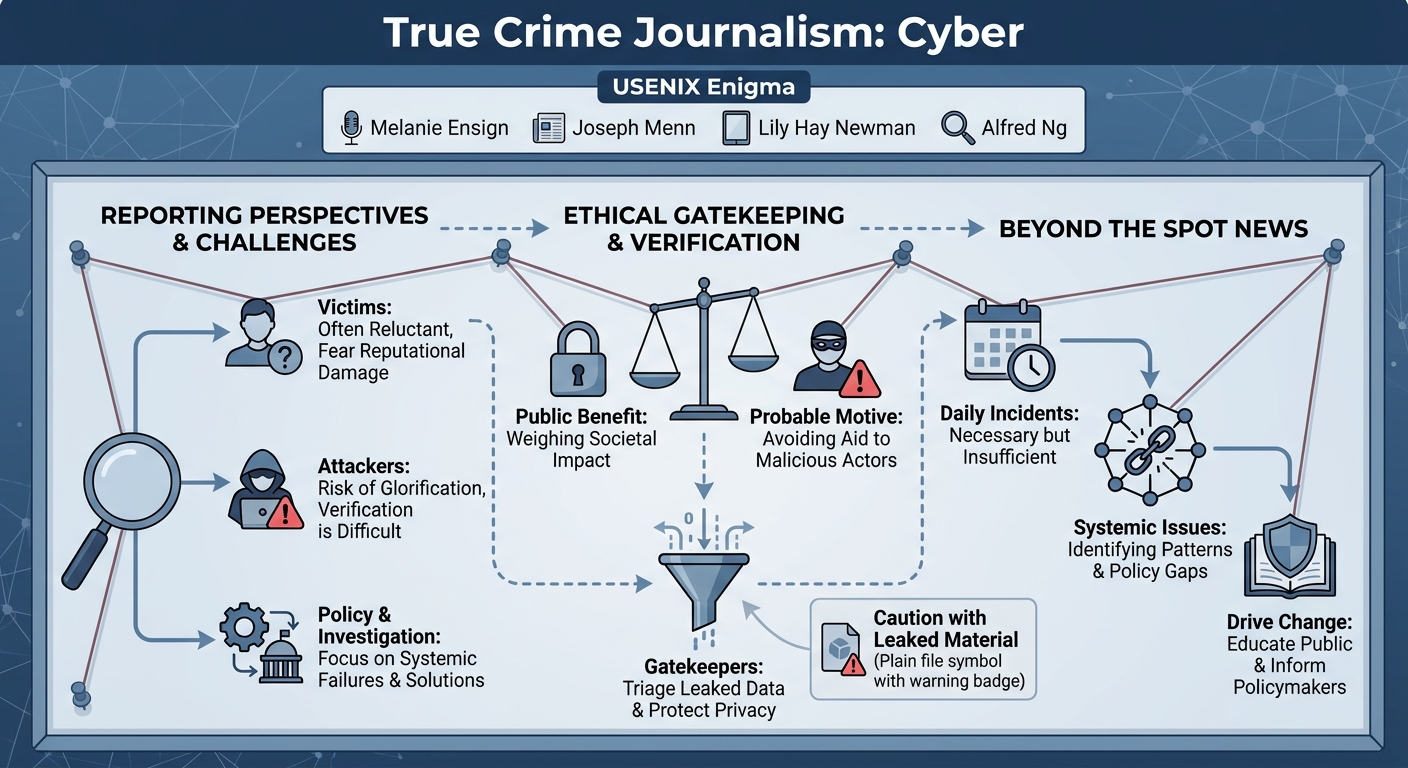
- 3:00 How journalists choose perspectives: victims, attackers, or investigators
- 7:00 Panelists share their most memorable cybercrime stories
- 13:30 Verifying and interpreting information from alleged attackers
- 17:30 Ethical considerations when publishing sensitive leaked data
- 24:00 Surprising aspects of covering cybercrime for the public
- 30:00 Balancing immediate news and long-term systemic issues
True Crime Journalism: Cyber
Speakers: Melanie Ensign (Moderator, Discernible), Joseph Menn (Panelist, Washington Post), Lily Hay Newman (Panelist, WIRED), Alfred Ng (Panelist, Politico)
Conference: USENIX Enigma
YouTube: https://www.youtube.com/watch?v=areFx-eAt3I
Overview
In an engaging panel discussion at USENIX Enigma, "True Crime Journalism: Cyber" brought together a distinguished group of security and privacy journalists to peel back the curtain on how cybercrime and security incidents are reported. Moderated by Melanie Ensign of Discernible, the panel featured Alfred Ng (Politico), Lily Hay Newman (WIRED), and Joseph Menn (Washington Post), offering a rare glimpse into the newsroom's perspective on covering an increasingly complex and impactful domain. The session, playfully framed through the lens of true crime, aimed to illuminate the intricate processes, ethical dilemmas, and strategic decisions involved in translating highly technical and often sensitive security events into compelling and comprehensible narratives for a broad audience.
The discussion served as a critical examination of the media's role in shaping public understanding and policy responses to cyber threats. From deciding which perspectives to highlight—victims, attackers, or investigators—to navigating the ethical tightrope of publishing sensitive information or dealing with malicious actors, the panelists provided invaluable insights. Their collective experience underscored the significant challenges inherent in reporting on cybercrime, including the reluctance of victims to come forward, the need to verify claims from anonymous or criminal sources, and the imperative to avoid glorifying perpetrators.
Ultimately, this talk transcended a mere recounting of past stories, evolving into a meta-analysis of the journalistic craft within the cybersecurity landscape. It highlighted why thoughtful, analytical, and ethically grounded reporting is not just beneficial but essential for educating the public, informing policymakers, and driving meaningful societal change in the face of persistent digital threats. For security professionals, the session offered a crucial perspective on how their work is perceived, interpreted, and communicated, providing a foundation for more effective engagement with the media.
Background
▶ Watch: Panel introduction: True Crime Journalism and Cyber (0:00)
The landscape of cybersecurity has evolved dramatically, transforming from a niche technical concern into a pervasive societal challenge that impacts individuals, businesses, and nation-states alike. This evolution has brought with it a corresponding increase in the complexity and frequency of cybercrime and security incidents, ranging from large-scale ransomware attacks to sophisticated nation-state espionage. The media plays a critical role in translating these often opaque and highly technical events into understandable narratives, but this task is fraught with challenges.
One significant problem is the inherent difficulty in reporting on incidents where victims are often unwilling to speak publicly due to fear of reputational damage, regulatory scrutiny, or further targeting. As Lily Hay Newman noted, "people don't want to talk about it and come forward and they don't want to be on the record," making it challenging to tell the "real human toll" of these events. This reluctance often leaves a void that can be filled by incomplete or speculative information, or worse, by the narratives pushed by the attackers themselves. Joseph Menn further highlighted the ethical tightrope reporters walk, emphasizing a policy of not wanting to "heroize the bad guys" or become an unwitting tool for their publicity or blackmail efforts, as was the case with the Sony hack or discussions with Guccifer 2.0.
The panel also touched upon the broader context of journalistic practice, distinguishing between "spot news" (day-to-day incidents) and deeper, more systemic investigations. Alfred Ng explained that while daily coverage is necessary, journalists are constantly looking for patterns and trends that can coalesce into larger, impactful stories about systemic failures or persistent problems, such as the ongoing struggle against ransomware. This distinction underscores a fundamental challenge: balancing the immediate need to inform about individual incidents with the long-term goal of educating the public and policymakers about underlying vulnerabilities and policy gaps. The talk implicitly argued that a deeper understanding of journalistic processes is crucial for both the public and security practitioners to better interpret and respond to the ongoing cyber threat landscape.
Key Findings
▶ Watch: Panelists share their most memorable cybercrime stories (7:00)
The panel discussion illuminated several key findings regarding the practice and ethics of cybercrime journalism:
- Diverse Reporting Perspectives are Essential but Challenging: Journalists consciously choose their focus—victims, attackers, investigators, or policy implications. Alfred Ng highlighted CNET's focus on victims to demonstrate the "harms of cybercrime," while Lily Hay Newman noted WIRED's similar aim, despite the difficulty of getting victims to speak on record. Joseph Menn, conversely, often focuses on the investigation and policy issues, explicitly avoiding glorifying attackers. The "Holy Grail" for Menn is a story that captures the entire chain from perpetrator to victim to policy impact, a rare feat exemplified by his book Fatal System Error.
- Ethical Gatekeeping is Paramount: A significant portion of the discussion revolved around the ethical responsibilities of journalists, particularly when dealing with sensitive, leaked, or stolen data. Panelists emphasized a "sliding scale" approach (Menn) when deciding whether to publish information from potentially malicious actors. This involves weighing the public benefit against the probable motive of the source and the potential for inadvertently aiding criminal or nation-state objectives. The consensus was strong against publishing private information of ordinary citizens unless there was clear, overriding public significance, as articulated by Alfred Ng and Lily Hay Newman.
- Verification and Discretion are Non-Negotiable: When approached by individuals claiming responsibility for attacks or offering leaked data, rigorous verification is critical. While Alfred Ng had not personally experienced this, Lily Hay Newman noted that such actors often engage with multiple reporters and researchers, reducing the sense of exclusive access. Joseph Menn detailed his cautious approach, including his decision not to publish information from Guccifer 2.0 after assessing it wasn't "worth it." The discussion also highlighted the role of security journalists as "gatekeepers" within newsrooms, helping to triage potentially newsworthy material from leaked data while protecting sensitive personal information.
- Cybercrime Reporting Mirrors General Crime Journalism: Alfred Ng pointed out that many skills from general crime reporting, such as understanding court documents and police statements, directly translate to covering cybercrime. This interdisciplinary nature was further emphasized by Joseph Menn, who described security as a fascinating blend of criminal justice, geopolitical, market failure, and market capture stories. This perspective helps demystify cybercrime reporting, grounding it in established journalistic practices rather than treating it as an entirely separate discipline.
- Focus on Systemic Issues Over Spot Incidents: While day-to-day incident reporting is necessary, the panelists stressed the importance of identifying and covering broader patterns and systemic problems. Alfred Ng explained how repeated ransomware attacks on cities naturally led to deeper investigations into systemic vulnerabilities. Joseph Menn articulated this as caring less about a "specific crime" and more about "why we haven't really done very much about ransomware," using individual incidents to illustrate larger societal and governmental failures. This highlights the desire to provide context and drive actionable understanding beyond mere event reporting.
Technical Deep Dive
▶ Watch: Verifying and interpreting information from alleged attackers (13:30)
This panel discussion, rather than delving into specific vulnerabilities or exploits, provided a deep dive into the mechanics and ethics of reporting on cybersecurity incidents. However, the conversation was rich with references to various technical phenomena and their journalistic implications, offering a unique perspective on how the media grapples with the complexities of the digital realm.
The panelists frequently referenced specific types of cyber incidents that underscore the technical challenges in reporting. Ransomware emerged as a central theme, discussed by Alfred Ng in the context of its impact on victims like schools and hospitals, and by Joseph Menn as a systemic failure ("why are we as a government as a society unable to get our act together and beat this?"). The technical aspects of ransomware, while often simplified for public consumption, involve understanding encryption mechanisms, initial access vectors (e.g., phishing, vulnerability exploitation), and the exfiltration of data. The challenge for journalists is to convey the devastating impact without getting bogged down in forensic detail, while still accurately representing the "how" of the attack.
Business Email Compromise (BEC) was highlighted by Lily Hay Newman as a significant, yet under-reported, type of cybercrime due to the immense financial losses and victim reluctance to disclose. While often seen as a social engineering attack, BEC relies on a blend of technical and human vulnerabilities, including email spoofing, domain impersonation, and sometimes account takeover through compromised credentials. The technical nuances here involve understanding email authentication protocols like SPF, DKIM, and DMARC, and how attackers bypass or exploit their absence to create convincing fraudulent communications.
Joseph Menn's examples provided insights into historical technical exploits and their broader implications. His book Fatal System Error detailed early DDoS (Distributed Denial of Service) attacks used for extortion against offshore gambling companies. DDoS, while conceptually simple (overwhelming a target with traffic), involves complex technical infrastructure like botnets, command-and-control servers, and various layer 3/4 (network/transport layer) or layer 7 (application layer) attack vectors. The theft of Sex.com illustrated a different kind of technical vulnerability: a flaw in domain name registration processes at Network Solutions in the early .com era, where a forged letter could transfer domain ownership, highlighting the importance of robust DNS security and domain registrar protocols.
The panel also touched upon the verification of claims from malicious actors. Joseph Menn's interaction with Guccifer 2.0, an alleged hacker associated with the 2016 Democratic National Committee breach, exemplified the need for journalists to verify technical claims and assess the potential motives behind leaks. This often involves consulting with security researchers or forensic experts to validate the authenticity of data or the methods described by attackers, as seen in the Washington Post's approach to the Hunter Biden laptop story, where top security experts were brought in to verify parts of the material.
Finally, the discussion implicitly acknowledged the tension between technical accuracy and public comprehensibility. While Lily Hay Newman noted WIRED's attempt to cover "the interesting technical nuances," Joseph Menn aimed to "educate people about important complicated stuff and write it in plain words." The example of Heartbleed, a critical OpenSSL vulnerability, being given a brand name and logo was cited as a successful, albeit rare, instance of simplifying a complex technical issue for widespread public understanding. This illustrates that for impactful cybercrime journalism, a deep understanding of the technical underpinnings is necessary, but the art lies in translating that into accessible language without losing critical context or accuracy.
Demo / Proof of Concept
▶ Watch: Surprising aspects of covering cybercrime for the public (24:00)
As a panel discussion focused on journalistic practices and ethics, this talk did not feature a traditional technical demonstration or proof of concept in the sense of showcasing code, exploits, or system vulnerabilities. Instead, the "proof of concept" was inherent in the panelists' shared experiences and the vivid anecdotes they provided, which collectively demonstrated the intricate, often challenging, reality of reporting on cybercrime. The discussion itself served as an extensive "case study" of how these stories are uncovered, vetted, and ultimately presented to the public. For instance, Alfred Ng's account of visiting a canine training academy to see dogs being trained to sniff out electronics (a technique used in the Jared Fogle case) offered a tangible, albeit non-digital, example of the investigative lengths journalists go to understand the technical aspects of cybercrime. Similarly, Joseph Menn's detailed recounting of the Sex.com theft and the Fatal System Error narrative provided compelling examples of complex cyber incidents translated into understandable, impactful stories.
Defensive Implications
▶ Watch: Balancing immediate news and long-term systemic issues (30:00)
The insights shared by these veteran journalists offer crucial defensive implications for security professionals, organizations, and policymakers. Understanding how cybercrime is reported can significantly influence how incidents are managed, communicated, and ultimately, how effective defensive strategies become.
Firstly, the discussion highlights the importance of transparency and proactive communication from victims. The panel noted the pervasive reluctance of organizations and individuals to speak about security incidents, often due to fear of reputational damage or legal repercussions. However, this silence often hinders broader understanding and prevents the aggregation of knowledge that could inform better defenses. Security leaders should consider strategic, controlled disclosures, perhaps through third-party experts or directly with trusted journalists, to contribute to the collective defense ecosystem. As Lily Hay Newman pointed out, the under-reporting of Business Email Compromise (BEC), despite its massive financial impact, means the public and even other organizations remain less aware of its prevalence and mechanisms.
Secondly, security professionals must understand the journalistic lens through which incidents are viewed. Journalists are not merely interested in the technical details of a breach but seek the human impact, the systemic failures, and the policy implications. When communicating with the media, framing incidents in terms of victim impact, broader trends (e.g., "why are we still struggling with ransomware?"), and proposed solutions can resonate more effectively. Joseph Menn's focus on systemic issues ("why we haven't really done very much about ransomware") rather than just individual crimes suggests that security professionals should be prepared to discuss the larger context and policy gaps surrounding incidents, not just the "breach of the day" (as Joe referred to it).
Thirdly, the ethical considerations discussed by the panelists provide a roadmap for how defenders should approach disclosures and interactions with the media. Journalists are acutely aware of being used to "launder" information or to further the aims of malicious actors. Therefore, security professionals should provide clear, verifiable information, focusing on public benefit and avoiding any appearance of using the media for personal gain or to unfairly target competitors. Understanding that journalists apply a "sliding scale" (Joseph Menn) to information from questionable sources means that verified, well-substantiated data from legitimate researchers or affected parties will always be prioritized.
Finally, the panel underscored the gatekeeper role of specialized security journalists within newsrooms. These reporters often act as the first line of defense against misinterpretations or the publication of sensitive, unverified information. Building relationships with these journalists can be invaluable. Security professionals can serve as trusted resources, helping reporters understand complex technical nuances and contextualizing incidents without dictating the narrative. This collaboration can lead to more accurate, impactful reporting that ultimately benefits public awareness and strengthens collective cybersecurity posture, moving beyond the "unproductive" Twitter debates between practitioners and journalists noted by Melanie Ensign. By understanding the media's motivations, ethical frameworks, and operational challenges, the security community can foster more productive engagements that elevate the discourse around cyber threats.
Key Takeaways
- Cybercrime journalism balances reporting on victims, attackers, and investigators, often prioritizing human impact and policy implications over glorifying perpetrators.
- Ethical reporting demands rigorous source verification, especially when dealing with anonymous or criminal actors, and a "sliding scale" approach to publishing sensitive or leaked data.
- Journalists act as crucial gatekeepers, translating complex technical incidents into accessible narratives while exercising discretion to protect private information and avoid aiding malicious motives.
- The most impactful cybercrime stories often illustrate systemic failures or persistent societal challenges (e.g., the ongoing struggle with ransomware), using individual incidents as illustrative case studies.
- Transparency from victims and a willingness to discuss broader implications, rather than just technical details, are vital for informing the public and driving policy change.
- "Words journalism" (print/text-based media) tends to offer a more analytical and less politically polarizing approach to cybercrime stories compared to other media forms.
About the Speaker(s)
Melanie Ensign served as the moderator for the "True Crime Journalism: Cyber" panel. As the founder of Discernible, she brings extensive experience in communication strategies, particularly within the security and privacy domains. Melanie openly shared her personal interest as a "True Crime Podcast Addict," highlighting her motivation for organizing a discussion that blends the intrigue of true crime with the critical field of cybersecurity reporting.
Alfred Ng is a privacy reporter at Politico. Prior to his role at Politico, he covered privacy at The Markup and specialized in cybersecurity and privacy for CNET from 2016 to 2020. His work has often focused on the impact of cybercrime on victims, such as schools and hospitals, aiming to highlight the real-world harms to a general audience.
Lily Hay Newman is a security and privacy reporter at WIRED, a prominent publication known for its in-depth technology coverage. Before joining WIRED, she worked as a general interest tech reporter at Slate. Lily's reporting often delves into the technical nuances of security incidents while also striving to cover the perspectives of victims, particularly in areas like Business Email Compromise.
Joseph Menn is a veteran tech security reporter currently with the Washington Post. His career in covering technology security began in 1999, with previous stints at the Los Angeles Times, the Financial Times, and Reuters. Menn is also an accomplished author, having written Fatal System Error, which explores the intersection of the Russian government and organized cybercrime, and The Dead Cow, a book about the hacker group Cult of the Dead Cow. His work often focuses on investigations, policy implications, and the broader systemic issues underpinning cyber threats.
Reviews
Dr. Zero (Offensive Security Researcher) — SOLID
This is a media panel, not a research drop. But if you're the one holding the bag during an incident response, understanding how the Washington Post processes a ransomware leak is actual defensive intel. It's solid operational security for your communications strategy, even if it doesn't pop a shell.
Heather Calloway (CISO) — SOLID
This panel is required viewing for your incident commanders, general counsel, and corporate communications leads. It maps exactly how major publications process, verify, and publish breach data. If you want to understand how your next crisis will play out in the press, watch this.