Myths and Lies in InfoSec
Adrian Sanabria (Tenchi Security)
USENIX Enigma Conference 2023 · Day 3 · Grand Ballroom
Overview
In his USENIX Enigma talk, "Myths and Lies in InfoSec," Adrian Sanabria of Tenchi Security delivers a compelling critique of the pervasive misinformation and exaggerated statistics that plague the cybersecurity industry. Sanabria argues that despite significant growth, increased budgets, and a burgeoning workforce, the field is rife with unsubstantiated claims and fear-mongering narratives. This presentation serves as a crucial call to action for security professionals to adopt a rigorous, data-driven approach, challenging commonly accepted "facts" that often lead to misdirected resources, poor strategic decisions, and damage to the industry’s overall credibility.
Key moments
- 0:00 Introduction: Why myths and lies exist in InfoSec
- 3:20 Psychological roots: confirmation bias and sunk cost fallacy
- 9:05 Exposing the 'trillions in cybercrime damages' myth
- 13:30 Debunking the '60% of small businesses fail' myth
- 14:30 Speaker's research: Only 23 companies failed due to cyber
- 18:00 Challenging common demotivational InfoSec maxims
- 20:10 Conclusion: Practical advice to combat myths and use data
Myths and Lies in InfoSec
Speakers: Adrian Sanabria, Tenchi Security
Conference: USENIX Enigma
YouTube: https://www.youtube.com/watch?v=Bvps1JdYYlE
Overview
In his USENIX Enigma talk, "Myths and Lies in InfoSec," Adrian Sanabria of Tenchi Security delivers a compelling critique of the pervasive misinformation and exaggerated statistics that plague the cybersecurity industry. Sanabria argues that despite significant growth, increased budgets, and a burgeoning workforce, the field is rife with unsubstantiated claims and fear-mongering narratives. This presentation serves as a crucial call to action for security professionals to adopt a rigorous, data-driven approach, challenging commonly accepted "facts" that often lead to misdirected resources, poor strategic decisions, and damage to the industry’s overall credibility.
Sanabria systematically dissects the origins and propagation of these myths, ranging from well-intentioned but misguided assumptions to outright deceptive marketing tactics. He highlights the detrimental effects of confirmation bias, the "fake it till you make it" startup culture, and the sheer difficulty of performing due diligence on complex, rapidly evolving threats. By exposing the mechanisms behind these fabrications, the talk empowers its audience to cultivate a healthy skepticism, demand transparency in reporting, and ultimately build a more honest and effective cybersecurity ecosystem. This is not merely an exercise in debunking; it's a foundational lesson in critical thinking for an industry that desperately needs it.
Background
▶ Watch: Introduction: Why myths and lies exist in InfoSec (0:00)
The cybersecurity industry, while young and rapidly expanding, faces unique challenges that foster an environment ripe for the propagation of myths and lies. Sanabria identifies several underlying reasons for this phenomenon, stemming from both human psychology and market pressures.
One primary driver is comfort and confirmation bias. Many individuals within the industry are deeply mission-oriented, driven by a desire to protect and secure. This noble intent can, however, lead them to readily accept and perpetuate narratives that align with their perceived mission, making them feel proud of their work. As Sanabria quotes from yourbias.is, it's healthier to "think of your ideas and beliefs as software you're actively trying to find problems with rather than things to be defended." This natural human tendency to defend one's beliefs, rather than scrutinize them, leaves individuals vulnerable to misinformation.
Another significant factor is the pervasive "fake it till you make it" culture, particularly prevalent in the startup world. With over 3,000 cybersecurity companies competing for investment and customers, there's immense pressure to project success and innovation. Sanabria draws parallels to high-profile startup failures like Theranos and WeWork, where exaggerated claims were used to secure funding and market share. In this environment, certain myths and lies become powerful tools for sales and investor relations, helping companies "land that next customer" or meet ambitious investor goals.
The inherent difficulty in due diligence further complicates matters. It's often challenging to isolate the true cause and effect of security incidents or the efficacy of solutions. Sanabria uses the analogy of nutrition: feeling great after a health shake, but unsure if it's the shake or other factors like more sleep. Similarly, attributing specific outcomes solely to cybersecurity measures or breaches can be ambiguous without rigorous data. This ambiguity allows unsubstantiated claims to persist because they are hard to definitively disprove at an individual level.
Finally, the sunk cost fallacy plays a critical role in transforming unintentional myths into deliberate lies. Sanabria suggests that many myths may start innocently—a misinterpretation of a statistic or a casual statement that gains traction. However, once individuals or companies have invested significant time, money, or reputation into promoting a particular narrative, admitting it's false becomes incredibly difficult. The ego, the fear of losing investment, or the reluctance to retract promises can lead to the conscious decision to continue using a debunked statistic, at which point "the myth becomes lie." As Sanabria notes, "lies travel much faster than the truth" because uncovering the truth requires time-consuming due diligence.
Challenging these myths and lies is not merely an academic exercise; it has practical, far-reaching implications for the entire industry. Firstly, it impacts the credibility of cybersecurity as a whole. As a relatively young but rapidly professionalizing field, maintaining trust with media, government, and corporate stakeholders is paramount. Perpetuating false narratives erodes this trust. Secondly, misinformation can misdirect efforts, leading organizations to invest resources in solving non-existent problems or employing ineffective solutions, ultimately leaving genuine vulnerabilities unaddressed. When "thought leaders" and vendors repeat bad stats, the damage can be substantial. Lastly, Sanabria argues that the truth is simply more interesting and ultimately more valuable. The process of tracking down accurate data often reveals deeper insights and more nuanced understandings than the superficial myths they replace.
Key Findings
▶ Watch: Exposing the 'trillions in cybercrime damages' myth (9:05)
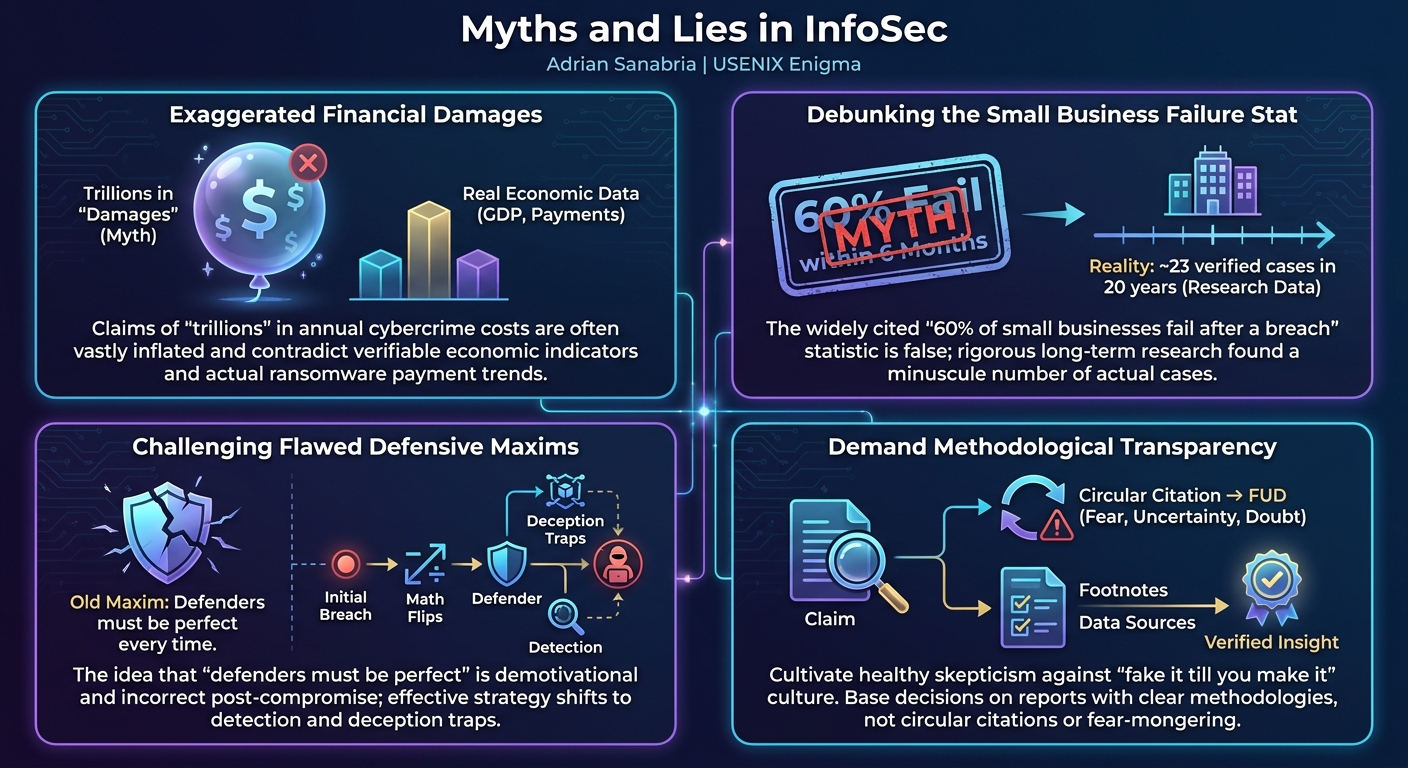
Adrian Sanabria's talk systematically dismantles several prominent myths and misleading statistics that have become entrenched in the cybersecurity discourse, revealing their origins and providing evidence-based counterarguments. A central, albeit unnamed, company is implicated as the primary source behind "most of the fake stats in infosec," a revelation that Sanabria found "fairly shocked to learn." This entity, he explains, has successfully infiltrated government, academia, and industry, with its figures quoted widely.
Among the most egregious examples of exaggerated claims are those concerning the financial impact of cybercrime:
- Cybercrime costs $2.9 billion per minute: Sanabria highlights this as an example of a stat so absurd it should immediately trigger skepticism, questioning if "maybe they meant to say million and they said billion." While the tweet containing this figure was eventually pulled down, its rapid spread demonstrated the potential for immediate and widespread damage.
- Trillions of dollars in cybercrime damages annually: This is perhaps the most infamous and persistent statistic. The purported figures include $6 trillion in 2021, projected to rise to $10.5 trillion by 2025. Sanabria contextualizes these staggering numbers by comparing them to global economic indicators: "Germany's GDP is indeed less than six trillion, and Global fraud numbers are less than six trillion." He further points out the glaring discrepancy with actual ransomware payments, which are a significant component of cybercrime but "never hit a billion dollars before it started going back down," decreasing by 40% last year. Such payments represent a minuscule fraction of the claimed trillions, leaving the vast majority of the "damages" entirely unaccounted for and unsupported by any verifiable data or methodology.
- Cybersecurity job numbers: Sanabria notes that the same problematic company is also behind many of the widely cited cybersecurity job shortage statistics. While he believes these are likely "off," he suggests they are "not quite as egregious" as the financial figures, meaning they are not off by orders of magnitude.
However, the most "prolific and long-lived" fake statistic, and one that personally inspired Sanabria's own research, is the claim that 60% of small businesses go out of business within six months of a data breach. This figure, Sanabria explains, always felt intuitively wrong due to its broad scope and the long timeframe. His extensive, five-year research project, involving hundreds of contributors and publicly available data, found dramatically different results: only 23 companies in the last 20 years have gone out of business as a direct effect of a cyber security incident or breach. The most prolific year was 2019, with six companies failing, four of which were due to ransomware.
Sanabria meticulously traced the origin of the 60% stat to a joint report by the National Cyber Security Alliance (NCSA) and Symantec. This report was quickly retracted, with both organizations issuing disclaimers acknowledging the lack of data behind the claim. Investigative journalist Joseph Marks from NexGov further tracked the quote to an individual who admitted to having "heard it from a cyber security expert at some point," with no memory of who, when, or any details. Despite its debunking, this statistic continues to be used by the original source, has been quoted by the SEC, and even influenced the passing of the Small Business Cyber Security Act.
Beyond specific statistics, Sanabria also challenges several motivational myths and maxims that he finds "demotivational" and often untrue:
- "Attackers only need to get it right once; Defenders have to get it right every time." Sanabria argues this is false. While it might apply to the initial compromise, "from that point the math flips," and the defender "only needs to catch the attacker once." Once inside, attackers must continually evade detection, while defenders can employ various strategies, including deception traps.
- "It's not if you get hacked, it's when." This maxim, often used to sell products, is numerically impossible. Sanabria contends there aren't enough cybercriminals to attack every business or individual, and even when attackers gain access to multiple networks, they often only choose to exploit a few due to limited resources.
- "Humans are the weakest link in security." Sanabria strongly refutes this, citing Lisa Plaggemier's observation that "humans are reliably unreliable." He argues that the true "weakest link is anybody designing systems without humans in mind for systems to be used by humans without humans in mind." The issue isn't humans themselves, but the failure to design secure systems that account for human behavior.
Technical Deep Dive
▶ Watch: Debunking the '60% of small businesses fail' myth (13:30)
While Adrian Sanabria's talk does not delve into specific code exploits or network architectures, it provides a crucial "technical deep dive" into the methodology of information integrity and statistical rigor within the cybersecurity domain. This involves understanding how misleading data is manufactured and propagated, and conversely, how to apply scientific principles to debunk it.
The process of creating fake statistics, as outlined by Sanabria, follows a disturbingly effective, albeit unethical, pattern:
- Fabrication: A statistic is simply "made up." There is no underlying research, data, or methodology.
- Repetition and Dissemination: This fabricated stat is then repeated "as much as possible in as many places as possible." This often involves leveraging media outlets that allow paid contributions or guest content, which can then appear official due to the domain name.
- Circular Citation: Once the stat has been published in enough places, the originators can then "cite it as if it's real research," creating a circular or recursive citation loop. A footnote might lead to another article, which then points back to the original source, giving the illusion of validation without any actual data. Sanabria emphasizes that "at first glance, you see a footnote, it looks like it's been properly cited until you try and track it down and find it, it goes nowhere."
This methodology highlights a fundamental lack of scientific rigor. Sanabria explicitly states that many reports propagating these myths lack "footnotes," a clear "methodology listed at the bottom of the report," or "appendices." He urges listeners to question, "Why would you trust it if there's no scientific rigor?"
Sanabria's own research into the "60% of small businesses fail after a breach" myth serves as a powerful practical demonstration of how to conduct proper due diligence. His five-year investigation involved:
- Extensive Data Collection: Actively seeking out real-world examples of companies that had gone out of business due to a cybersecurity incident.
- Community Curation: Creating an open, public dataset where "hundreds of people have helped me curate it over the years and have submitted possible candidates."
- Rigorous Verification: Personally investigating "each one" of these submissions to confirm a direct causal link between the cyber incident and the business failure. This meticulous process yielded only 23 such cases over two decades, starkly contrasting with the hundreds that would be expected if the 60% statistic were true.
The "technical deep dive" here is not into a protocol, but into the process of verification and validation. Sanabria stresses the importance of context and sanity checks. When faced with a statistic like $6 trillion in cybercrime damages, a quick comparison to Germany's GDP or global fraud figures immediately reveals its implausibility. The fact that ransomware payments, a highly visible component of cybercrime, represent a tiny fraction of this figure further underscores the lack of realism.
He advocates for leveraging existing reliable data sources and the expertise of the data science community. He notes that "data scientists tend to be very open and sharing" and that "there's a lot of open data sets out there," specifically mentioning the Verizon DBIR (Data Breach Investigations Report) team, who make their Veris data set available on their GitHub page. He praises their willingness to assist with custom queries and insights. Failing that, he encourages individuals to "start to gather the data yourself," emphasizing that collective effort can make this feasible, as demonstrated by his own research.
Ultimately, the technical deep dive in this talk is about fostering a culture of evidence-based decision-making in cybersecurity. It's about recognizing that "a statistic should be the tip of the iceberg of the conversation that you're going to have, not a blunt weapon" designed to instill fear. This approach demands a critical examination of information, an understanding of statistical methods, and a commitment to transparency, which are foundational "technical" skills for any security professional.
Demo / Proof of Concept
▶ Watch: Challenging common demotivational InfoSec maxims (18:00)
Adrian Sanabria's talk did not feature a traditional software or hardware demonstration. Instead, the most compelling "proof of concept" presented was Sanabria's own extensive five-year research project dedicated to debunking the widespread myth that "60% of small businesses go out of business within six months of a data breach."
This research served as a powerful, real-world demonstration of rigorous due diligence and data-driven investigation. Sanabria meticulously explained how he curated an open, public dataset, inviting contributions from hundreds of individuals over the years. Each submitted candidate company was then individually investigated to verify whether its failure could be directly attributed to a cybersecurity incident or breach. The stark finding—only 23 companies in the past two decades met this criterion—stood in direct opposition to the hundreds that would be expected if the 60% statistic were true.
In essence, Sanabria demonstrated how to apply scientific rigor to an industry often swayed by anecdote and exaggeration. His work provided a tangible example of how to:
- Identify a questionable statistic.
- Formulate a research hypothesis.
- Collect and curate data transparently.
- Analyze findings against existing claims.
- Present verifiable evidence to counter misinformation.
This methodological "demo" was arguably more impactful than a technical exploit, as it equipped the audience with the critical thinking framework necessary to challenge pervasive myths and build a more truthful understanding of cybersecurity risks.
Defensive Implications
▶ Watch: Conclusion: Practical advice to combat myths and use data (20:10)
The insights from Adrian Sanabria's talk carry profound defensive implications for individuals, organizations, and the cybersecurity industry as a whole. Adopting a mindset of healthy skepticism is paramount. Security professionals must critically evaluate every statistic, claim, and maxim they encounter, especially those lacking clear context, methodology, or verifiable data. Blindly accepting figures, particularly those designed to induce Fear, Uncertainty, and Doubt (FUD), can lead to misallocated resources and misguided strategies.
Organizations should prioritize data-driven decision-making. Instead of reacting to sensational headlines or exaggerated cybercrime figures, security investments and policy decisions should be based on credible, peer-reviewed research and internal telemetry. This involves actively seeking out robust data sources like the Verizon DBIR's Veris dataset and engaging with data scientists who can provide nuanced insights, rather than relying on reports without footnotes or appendices. Demand for transparency in vendor claims and industry reports will force a higher standard of evidence.
A key defensive strategy involves re-evaluating internal communications and marketing. Security teams should empower their marketing colleagues by helping them find accurate and contextualized statistics, rather than simply criticizing the use of bad ones. Providing context, such as the number of respondents to a survey or the specific scope of a study, transforms a blunt statistic into the "tip of the iceberg" for a productive conversation. This collaborative approach ensures that the organization's external messaging reflects reality, building trust rather than eroding it.
Furthermore, the debunking of pervasive maxims such as "Attackers only need to get it right once; Defenders have to get it right every time" and "It's not if you get hacked, it's when" encourages a more optimistic and proactive defensive posture. Recognizing that the "math flips" once an attacker is inside empowers defenders to implement deception traps and focus on detection and response capabilities, not just prevention. Shifting away from a fatalistic "when, not if" mentality allows for more strategic, resource-efficient planning, acknowledging that not every entity will be targeted, and resources should be prioritized effectively.
Finally, the re-evaluation of "humans are the weakest link" is a critical defensive shift. Instead of blaming users, organizations should focus on human-centric system design. This means building security solutions and processes that are intuitive, easy to use correctly, and designed with an understanding of human behavior and limitations. By designing systems "with humans in mind," organizations can turn their workforce into a strong line of defense, rather than a perceived vulnerability. This approach fosters a culture of security awareness and empowerment, moving beyond demotivating stereotypes.
In summary, the defensive implications revolve around fostering a culture of critical inquiry, evidence-based strategy, and human-centered design. By challenging myths and demanding truth, the industry can redirect its considerable resources towards solving actual problems with effective solutions, thereby enhancing overall security posture and restoring credibility.
Key Takeaways
- Cultivate Healthy Skepticism: Always question cybersecurity statistics, claims, and maxims, especially those that evoke fear or lack clear sourcing.
- Demand Methodological Transparency: Prioritize security reports and vendor claims that provide detailed methodologies, data sources, footnotes, and appendices. Reject those that don't.
- Beware of Circular Citation: Understand that many widely repeated statistics are propagated through a recursive citation loop with no original, verifiable data.
- Base Strategy on Truth, Not FUD: Make security investment and policy decisions based on verifiable data and realistic threat assessments, not exaggerated figures or demotivational sayings.
- Cybercrime Figures Are Often Exaggerated: Recognize that the financial impact of cybercrime is frequently inflated by orders of magnitude, leading to misdirected resources and an inaccurate perception of risk.
- Design for Humans, Don't Blame Them: Shift from viewing "humans as the weakest link" to designing intuitive, secure systems that account for human behavior, turning users into an asset rather than a liability.
About the Speaker(s)
Adrian Sanabria, representing Tenchi Security, is a prominent voice in the cybersecurity community, known for his analytical rigor and commitment to truth. His presentation at USENIX Enigma highlights his passion for data integrity and his investigative approach to challenging industry norms. Sanabria is not merely a critic; he is a practitioner of the principles he advocates, exemplified by his five-year research project to debunk the widely cited small business breach statistic. His work underscores a dedication to evidence-based understanding, urging the industry to move beyond sensationalism and towards a more honest, data-driven discourse.
Reviews
Dr. Zero (Offensive Security Researcher) — SOLID
Sanabria spent five years hunting down the source of the industry's favorite marketing lies and brought receipts. It's not a technical exploit, but watching him systematically dismantle the '60% of breached SMBs fail' bullshit is exactly the kind of hygiene this field desperately needs. A mandatory reality check for every CISO who justifies their budget with fake math.
Heather Calloway (CISO) — SOLID
Sanabria dismantles the fabricated statistics and vendor-driven FUD that plague our industry. For security leaders, this is a required lesson in data integrity and executive credibility. If you rely on these numbers to justify your budget, you are setting yourself up to lose the trust of your board.