The Slippery Slope of Cybersecurity Analogies
Josiah Dykstra
USENIX Enigma Conference 2023 · Day 3 · Grand Ballroom
Overview
In his USENIX Enigma talk, "The Slippery Slope of Cybersecurity Analogies," Josiah Dykstra delves into the pervasive, often indispensable, yet frequently perilous role of analogies and metaphors in cybersecurity discourse. Dykstra acknowledges that language is the fundamental tool for exchanging ideas in the field, and analogies have been employed for ages to simplify complex technical concepts for diverse audiences. From "computer viruses" to "firewalls" and "Trojan horses," these linguistic shortcuts are deeply embedded in how we understand and communicate about digital threats and defenses.
Key moments
- 0:00 Introduction: The slippery slope of cybersecurity analogies
- 3:20 Three reasons why analogies persist and help communication
- 5:25 Three ways analogies omit details, mislead, or normalize
- 7:20 Critique of the 'weakest link' analogy for users
- 10:00 Why 'castle defense' is an outdated cybersecurity analogy
- 12:45 Why 'cyber hygiene' is an effective analogy
- 13:10 Three ways to avoid misconceptions when using analogies
- 15:35 Conclusion: Be careful and deliberate with language
The Slippery Slope of Cybersecurity Analogies
Speakers: Josiah Dykstra
Conference: USENIX Enigma
YouTube: https://www.youtube.com/watch?v=9kWE2C8qpi8
Overview
In his USENIX Enigma talk, "The Slippery Slope of Cybersecurity Analogies," Josiah Dykstra delves into the pervasive, often indispensable, yet frequently perilous role of analogies and metaphors in cybersecurity discourse. Dykstra acknowledges that language is the fundamental tool for exchanging ideas in the field, and analogies have been employed for ages to simplify complex technical concepts for diverse audiences. From "computer viruses" to "firewalls" and "Trojan horses," these linguistic shortcuts are deeply embedded in how we understand and communicate about digital threats and defenses.
However, Dykstra's central thesis is that while analogies can be powerful aids for learning and connection, their oversimplification or misapplication can lead to significant misconceptions, flawed mental models, and even detrimental policy decisions. He meticulously dissects the mechanisms by which analogies both help and harm, urging cybersecurity professionals to exercise extreme caution and deliberation in their use. The talk serves as a critical examination of communication strategies, highlighting the profound impact of our chosen words on comprehension, behavior, and the very fabric of cybersecurity policy.
Background
▶ Watch: Introduction: The slippery slope of cybersecurity analogies (0:00)
The use of analogies in computing and cybersecurity predates the modern internet, with examples like the OSI model being taught since the 1970s. A pivotal moment arrived in 1984, when Fred Cohen coined the term "computer virus" for a program designed to spread by attaching itself to other software, establishing a biological metaphor that has persisted for decades. The subsequent explosion of the internet brought with it a torrent of new analogies, from the "information Super Highway" to "cyberspace," all attempting to contextualize a novel and abstract technological landscape.
Dykstra references the infamous "series of tubes" remark by Senator Ted Stevens in 2006, which, while widely mocked, underscored the challenge of explaining complex internet infrastructure to policymakers. While Stevens' analogy might have served its purpose for his immediate Senate colleagues debating net neutrality, Dykstra argues that such language, especially from influential figures, can have real-world impacts on laws and norms. This historical context sets the stage for Dykstra's exploration into why analogies are so prevalent in cybersecurity. He identifies three primary reasons:
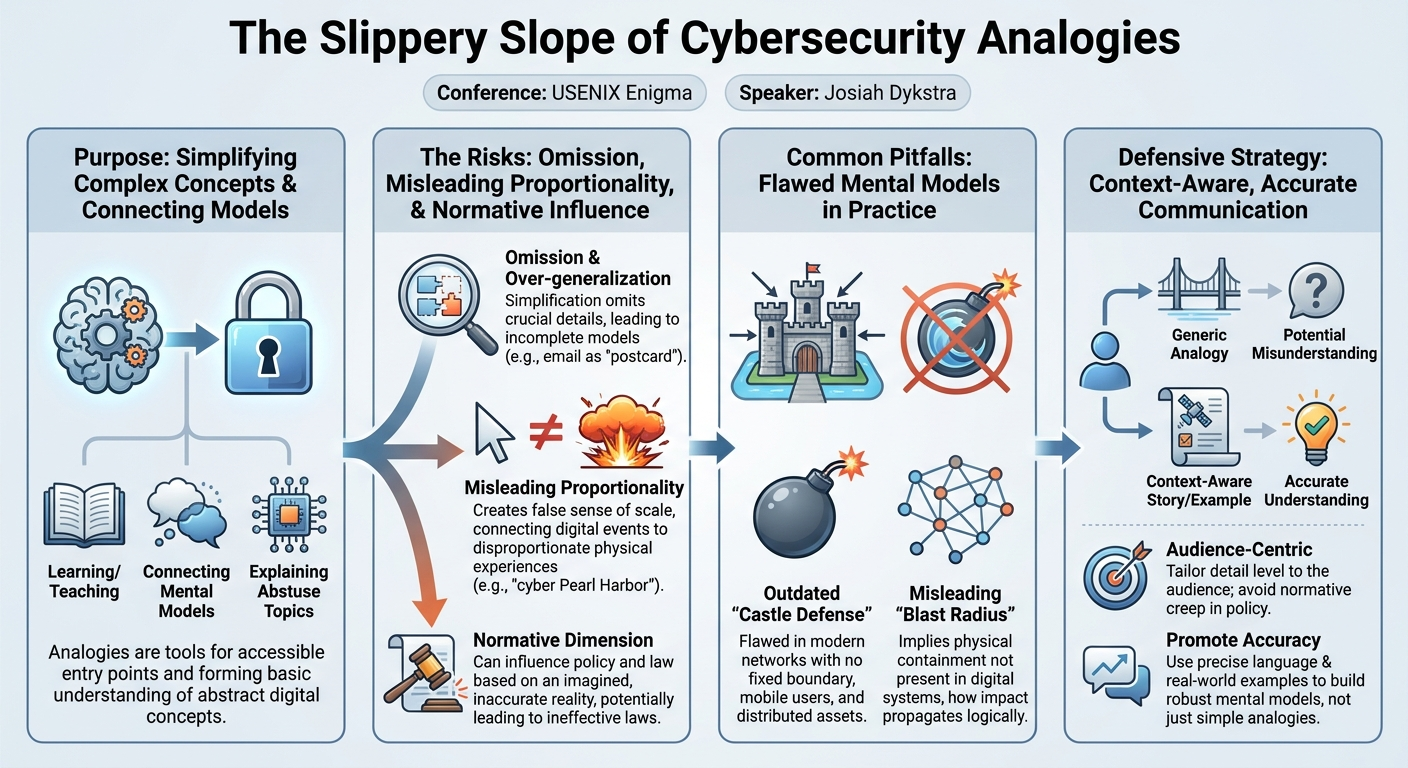
- Learning and Teaching: Analogies provide an accessible entry point to complex topics. For instance, comparing encryption to a "lock and key" offers an intuitive grasp before delving into the cryptographic intricacies.
- Connecting Mental Models: Analogies help individuals quickly form a basic understanding of a concept by linking it to familiar experiences. An "average user" instantly grasps the danger of a "Trojan horse" alert, even without understanding the malware's technical specifics.
- Explaining Complex Topics: Analogies can simplify otherwise abstruse concepts. Most people, for example, can broadly define a "firewall" as technology that blocks "bad things" from a network, drawing on the century-old concept of physical firewalls in buildings and cars.
Dykstra's work on this topic is informed by collaboration with Gene Spafford at Purdue and Leigh Metcalf at Carnegie Mellon, indicating a foundation in academic research and critical communication studies within the cybersecurity domain.
Key Findings
▶ Watch: Three ways analogies omit details, mislead, or normalize (5:25)
Dykstra's core findings revolve around the inherent dangers and specific pitfalls of relying too heavily or carelessly on cybersecurity analogies. While acknowledging their benefits, he meticulously outlines three critical ways analogies can fail:
- Omission and Over-generalization: Analogies, by their very nature, simplify. This simplification often omits crucial details that are essential for a complete understanding. For example, describing email as a "postcard going through the mail" helps illustrate privacy concerns but entirely misses the nuances of digital transmission, storage, and the multiple parties involved in handling data. In the media, short, "snappy headlines" often prioritize attention-grabbing analogies over accuracy, exacerbating this issue.
- Misleading Proportionality: Analogies can create a false sense of scale or consequence by connecting a digital event to a physical experience that is disproportionate. Dykstra highlights the use of terms like "cyber weapons" and phrases such as "cyber 9/11" or "cyber Pearl Harbor." He argues that no cyberattack has caused physical destruction comparable to kinetic weapons or the tragic human loss of these historical events. Such analogies inflate the reality of cyber incidents, potentially leading to exaggerated responses or misallocation of resources.
- Normative Dimension: In the worst-case scenario, analogies can influence policy and law, making an imagined reality concrete. If policymakers legislate based on an oversimplified or inaccurate analogy (like the "series of tubes"), the resulting laws could be poorly conceived and ineffective, or even harmful. While concrete examples of this specific outcome are rare, Dykstra expresses concern about its potential.
To further illustrate these points, Dykstra categorizes and analyzes four common types of cybersecurity analogies, detailing their respective pros and cons:
- Physical World Analogies:
- "Weakest link": Pro: Accurately conveys that security is a chain with many interdependent components (users, developers, code). Con: Labeling users as the "weakest link" is often a disservice, ignoring that users are frequently the target of sophisticated attacks and require robust defenses, rather than simply being blamed.
- "Castle defense": Pro: Historically used to explain perimeter defense. Con: Deeply flawed in modern networking, where there's no fixed boundary, users are mobile, valuable assets are distributed, and the perimeter is porous or non-existent.
- Medical/Biological Analogies:
- "Viruses": Pro: Widely understood concepts of health, contamination, and spread. Con: Digital defenses (like antivirus software) do not learn or adapt in the same biological manner as immune systems. Users who believe their computer will "learn through exposure" to protect itself against new threats will be less secure.
- Military Analogies:
- "Blast radius": Pro: Conveys a sense of scope and secondary effects, e.g., compromised credentials impacting multiple systems. Con: Implies a physical containment or spatial dimension that doesn't apply to digital systems, potentially creating a "broken mental model" for how digital impact propagates.
- "Cyber 9/11" / "Cyber Pearl Harbor": Con: As discussed, these are highly misleading due to the lack of comparable physical destruction and human toll.
- Legal Analogies:
- "Digital files as paper files," "trespassing": Pro: Allows existing legal frameworks to be applied to new technologies without constant legislative overhaul. Trespassing, for instance, can effectively describe unauthorized access whether physical or digital. Con: Courts struggle with the nuances; what constitutes "access" in the digital realm (e.g., browsing a public website)? When is digital access truly analogous to physical trespass, and when are the differences critical enough to warrant distinct legal interpretation?
Dykstra concludes that analogies are most effective when they are both truthful and helpful within a specific context. Conversely, they become problematic when they are inaccurate, incomplete, or inappropriate for the conversation at hand, with the negatives often outweighing any perceived benefits.
Technical Deep Dive
▶ Watch: Why 'castle defense' is an outdated cybersecurity analogy (10:00)
While "The Slippery Slope of Cybersecurity Analogies" doesn't delve into code or network protocols, its "technical deep dive" lies in the cognitive science and communication theory applied to the complex domain of cybersecurity. Dykstra's analysis is fundamentally about the mental models that analogies create and how these models either accurately map or profoundly distort the underlying technical realities of digital systems.
At its core, cybersecurity deals with abstract concepts: data flows, logical access controls, distributed systems, and ephemeral threats. Humans naturally attempt to understand the unknown by relating it to the known. Analogies serve as cognitive bridges, leveraging familiar schemas from the physical, biological, or social world to build initial mental models of digital phenomena.
Dykstra's critique highlights three critical cognitive pitfalls:
- Omission of Detail (Cognitive Simplification): Analogies inherently simplify. When explaining email privacy by comparing it to a "postcard," the analogy successfully maps the concept of public visibility. However, it entirely omits the complex technical layers: encryption at rest and in transit, server-side logging, metadata analysis, and the diverse attack vectors beyond casual observation. The "technical debt" of such a simplification is that the user's mental model remains incomplete, potentially leading to a false sense of security or misunderstanding of actual risks. A technical understanding of email requires grasping SMTP, PGP/S/MIME, TLS, and server architectures, none of which are conveyed by the postcard analogy.
- Misleading Proportionality (Schema Mismatch): This pitfall occurs when the source domain of the analogy (e.g., a physical bomb's blast radius) maps poorly to the target domain (e.g., the impact of a credential compromise). While both involve propagating effects, the mechanisms and constraints are entirely different. A physical blast radius is bound by physics, spatial dimensions, and energy dissipation. A digital "blast radius" from a compromised password, however, propagates through logical connections, shared services, identity management systems, and human behavior (e.g., password reuse). The mental model of a physical explosion might lead one to incorrectly assume spatial or temporal limits on digital damage that simply don't exist. This schema mismatch can lead to misjudgments in risk assessment and mitigation strategy, underestimating the lateral movement capabilities in a network.
- Normative Influence (Conceptual Metaphor Theory): Drawing on insights from Conceptual Metaphor Theory, Dykstra points out that analogies aren't just decorative; they actively shape our understanding and can become foundational for thought and action. If cybersecurity is consistently framed as "warfare" (e.g., "cyber weapons," "cyber 9/11"), it can normalize aggressive responses, influence defense spending priorities, and even shape international law in ways that might not be appropriate for the unique characteristics of cyberspace. The technical reality of a distributed denial-of-service (DDoS) attack, for instance, is a saturation of network resources, not a "bomb" falling on a server. The military analogy risks obscuring the technical mechanisms and legal implications, which are often closer to digital trespass or disruption of service.
Dykstra's analysis of specific analogy categories further elaborates on these cognitive challenges:
- "Castle Defense": This analogy is technically flawed because modern networks are not monolithic, hard-shelled perimeters. Concepts like zero trust architecture, microsegmentation, and cloud-native security fundamentally contradict the castle model. The "valuables" are distributed, users are mobile, and the "walls" are soft or non-existent, requiring a completely different security paradigm focused on identity, data, and continuous verification.
- Biological "Viruses": While useful for conveying spread, this analogy creates a false expectation of biological immunity. Unlike a human body that develops antibodies, a computer system doesn't "learn" to defend against novel malware purely through exposure. Antivirus software relies on signatures, heuristics, and behavioral analysis, requiring constant updates and explicit instruction. This highlights a critical technical difference: biological systems are inherently adaptive and self-healing in ways digital systems are not, a distinction crucial for user education.
The "technical deep dive" here is thus a deep dive into the architecture of understanding cybersecurity, revealing how linguistic tools can build robust or fragile cognitive structures, with profound implications for how we design, defend, and govern digital systems.
Demo / Proof of Concept
▶ Watch: Why 'cyber hygiene' is an effective analogy (12:45)
The talk "The Slippery Slope of Cybersecurity Analogies" by Josiah Dykstra is a conceptual and analytical presentation focusing on communication strategies and the impact of language. As such, it does not include a live demonstration or a proof of concept of any technical exploit or security tool. The content is entirely theoretical and illustrative, using examples from common cybersecurity discourse to support its arguments.
Defensive Implications
▶ Watch: Conclusion: Be careful and deliberate with language (15:35)
The insights from Josiah Dykstra's talk offer crucial defensive implications, not in the form of new tools or techniques, but in shaping how cybersecurity professionals communicate risks, vulnerabilities, and best practices. Effective communication is a foundational element of any robust defense strategy, especially given that many security incidents stem from human error or misunderstanding.
Defenders should adopt a highly context-aware communication strategy. When educating end-users, a simple analogy might be appropriate to convey a basic concept (e.g., cyber hygiene for routine security practices like checking links or strong passwords). Dykstra champions cyber hygiene as a positive analogy because it maps well to universally understood concepts of personal care and routine prevention, directly encouraging safe digital behavior. However, for technical teams, executives, or policymakers, the stakes are higher, and the need for precision outweighs the benefits of simplification.
Key defensive implications include:
- Audience-Centric Communication: Recognize that different audiences require different levels of detail and types of analogies. A casual conversation with friends might tolerate an imperfect analogy, but official communications, incident reports, or policy recommendations demand accuracy. Defenders must avoid the normative creep where casual analogies become ingrained and influence decision-making at critical levels.
- Refining the Message Beyond Analogies: Dykstra encourages defenders to leverage the full "language toolbox." Instead of relying solely on potentially misleading analogies, defenders should consider using stories and personal experiences to illustrate complex concepts. For example, instead of using the "blast radius" analogy, one could describe the real-world impact of the 2022 Viasat satellite modem attack during the invasion of Ukraine, which unintentionally cut internet access for tens of thousands of people in Europe. This specific narrative provides a concrete, relatable understanding of cascading effects without the cognitive baggage of a physical bomb.
- Respecting Influence and Avoiding Policy Restrictions: Cybersecurity experts hold significant influence. Their choice of language can inadvertently shape public perception and policy. Defenders must be careful not to propagate misleading terms like "cyber 9/11" or "cyber Pearl Harbor," which can lead to disproportionate responses or misdirected legislative efforts. Analogies that oversimplify can lead policymakers to create laws based on an incorrect mental model of cyberspace, potentially restricting defensive options or creating unintended legal loopholes.
- Promoting Accurate Mental Models: The ultimate goal of defensive communication should be to build accurate mental models of threats and defenses. This requires moving beyond simplistic analogies to explain the actual technical mechanisms where necessary. For instance, instead of just saying "viruses spread," explain that antivirus software relies on signatures and behavioral analysis and requires regular updates, thus empowering users with a more accurate understanding of their role in maintaining security.
- Critically Evaluating Existing Analogies: Defenders should actively question and challenge the analogies commonly used within their organizations or in public discourse. Is the "perimeter defense" model still valid for a cloud-first organization? Is labeling users as the "weakest link" productive, or does it shift blame away from systemic security failures? By critically evaluating these linguistic tools, security teams can foster a more precise and effective security culture.
In essence, the defensive implication is a call for greater linguistic discipline and strategic communication, recognizing that the way we talk about cybersecurity profoundly impacts our ability to defend against evolving threats.
Key Takeaways
- Cybersecurity analogies are powerful tools for learning and simplifying complex concepts but carry significant risks of miscommunication.
- Analogies can fail by omitting crucial details, misleading through disproportionate comparisons, or having an unintended normative impact on policy and perception.
- Common analogies like "weakest link," "castle defense," and "cyber blast radius" often create flawed mental models that do not align with the realities of modern digital systems.
- Defenders must be highly context-aware, tailoring their communication based on the audience and the stakes involved, prioritizing accuracy for critical discussions.
- Effective communication should leverage stories and specific examples over potentially misleading analogies to build more accurate and nuanced understanding.
- Security professionals have a responsibility to use language carefully, avoiding terms that could unintentionally restrict policy options or perpetuate inaccurate perceptions of cyber threats.
About the Speaker(s)
Josiah Dykstra is a cybersecurity expert whose work focuses on the critical intersection of technology and communication. His presentation at USENIX Enigma highlights his deep understanding of how language shapes our perception and understanding of complex technical domains. Dykstra's insights are informed by collaborations with prominent figures in the field, including Gene Spafford at Purdue and Leigh Metcalf at Carnegie Mellon, suggesting a background rooted in academic research and practical application within cybersecurity. His analytical approach underscores the importance of thoughtful and precise communication in advancing cybersecurity awareness and policy.
Reviews
Dr. Zero (Offensive Security Researcher) — SOLID
Dykstra spends a session explaining why 'Cyber Pearl Harbor' is a terrible phrase and the 'castle defense' is dead. He's not wrong, but security practitioners have been making this exact complaint at the bar since 2012. It's a perfectly competent USENIX Enigma presentation that desperately wanted to be a whitepaper.
Heather Calloway (CISO) — MUST SEE
This is required viewing for anyone who presents to a corporate board or risk committee. Dykstra systematically dismantles the sloppy metaphors we use to explain risk—like 'castle defense' and 'blast radius'—and shows how they lock executives into flawed mental models. If you want your CFO to fund a modern security program, you have to stop explaining it using analogies from 1995.