The Very Hungry Defender: Metamorphosing Security Decision-Making by Incorporating Opportunity Cost
Kelly Shortridge (Fastly, Inc.)
USENIX Enigma Conference 2023 · Day 3 · Grand Ballroom
Overview
In "The Very Hungry Defender," Kelly Shortridge of Fastly, Inc. challenges the conventional wisdom and prevalent practices in cybersecurity decision-making. She argues that the industry, much like "The Very Hungry Caterpillar," often consumes resources without fully understanding the broader implications of its choices, leading to suboptimal outcomes. The core thesis of her talk centers on the crucial, yet frequently overlooked, concept of opportunity cost. This economic principle, defined as the loss of potential gain from other alternatives when one alternative is chosen, is presented as a transformative lens through which security teams can re-evaluate their strategies, resource allocation, and overall effectiveness.
Key moments
- 0:00 Introduction: Defining opportunity cost in security
- 4:10 The spectrum of costs and effects in infosec
- 8:00 Understanding the null baseline and negative externalities
- 10:30 Considering time, cognition, and emotion as costs
- 14:40 Application security case study: Reframing the focal point
- 19:00 Summary and call to action for widespread inclusion
The Very Hungry Defender: Metamorphosing Security Decision-Making by Incorporating Opportunity Cost
Speakers: Kelly Shortridge, Head of Product and Design at Fastly, Inc.
Conference: USENIX Enigma
YouTube: https://www.youtube.com/watch?v=vkAvkinWT7Y
Overview
In "The Very Hungry Defender," Kelly Shortridge of Fastly, Inc. challenges the conventional wisdom and prevalent practices in cybersecurity decision-making. She argues that the industry, much like "The Very Hungry Caterpillar," often consumes resources without fully understanding the broader implications of its choices, leading to suboptimal outcomes. The core thesis of her talk centers on the crucial, yet frequently overlooked, concept of opportunity cost. This economic principle, defined as the loss of potential gain from other alternatives when one alternative is chosen, is presented as a transformative lens through which security teams can re-evaluate their strategies, resource allocation, and overall effectiveness.
Shortridge highlights that cybersecurity is fundamentally a business of balancing diverse costs – not just monetary ones – against defensive outcomes. Current decision-making processes often focus solely on the perceived value of a chosen path, neglecting the equally important "what might have been." By expending finite resources on one security measure, organizations inherently forgo the potential benefits of investing those same resources elsewhere. This oversight, she contends, results in missed opportunities for better security posture, increased productivity, and more resilient business operations.
The talk aims to provide a framework for security professionals to integrate opportunity cost into their daily decisions, thereby "metamorphosing" their defensive strategy. It delves into the multifaceted spectrum of costs and effects beyond mere financial considerations, explores the impact of decisions on various stakeholders, and introduces practical heuristics like the "null baseline" and reframing the "focal point" of problems. Ultimately, Shortridge advocates for a more holistic, economically informed approach that aligns security initiatives with the organization's fundamental purpose, ensuring that defensive efforts truly maximize success rather than inadvertently hindering it.
Background
▶ Watch: Introduction: Defining opportunity cost in security (0:00)
The problem addressed by Kelly Shortridge is rooted in the inherent scarcity of resources – time, money, and cognitive effort – that all organizations face, especially in the realm of cybersecurity. Despite this fundamental constraint, security decision-making frequently operates in a vacuum, focusing narrowly on immediate threats and perceived solutions without a comprehensive understanding of the broader ecosystem of costs and benefits. This leads to a reactive and often inefficient allocation of valuable resources.
The concept of opportunity cost, first coined by Frederick Von Wieser, provides the theoretical underpinning for Shortridge's argument. It posits that every choice entails a sacrifice: the value of the best alternative not chosen. In cybersecurity, this translates to the understanding that money spent on data backups cannot simultaneously be used for endpoint detection against ransomware, or that developer time spent fixing low-impact vulnerabilities could have been invested in building more resilient architectures. However, humans, particularly under pressure, rarely think about these alternatives. Factors such as time pressure, tunnel vision during crises, and information bias often derail critical thinking, causing security professionals to ignore the full spectrum of potential choices and their associated opportunity costs.
Traditional cybersecurity approaches often prioritize tangible, first-order monetary costs, such as the price of a security tool or the salary of a security engineer. This narrow view neglects a vast array of other critical factors. Shortridge emphasizes that costs extend far beyond direct financial outlays, encompassing intangible elements like employee time, cognitive overhead, emotional strain, and even delayed time to market. Similarly, benefits are often narrowly defined, overlooking gains in productivity, employee well-being, brand perception, and competitive advantage. The failure to consider these variegated costs and effects, coupled with an isolationist view of security decisions, prevents organizations from achieving optimal security outcomes and often leads to security initiatives that inadvertently harm business operations.
Key Findings
▶ Watch: Understanding the null baseline and negative externalities (8:00)
Shortridge's talk unveils several critical findings that challenge conventional cybersecurity decision-making:
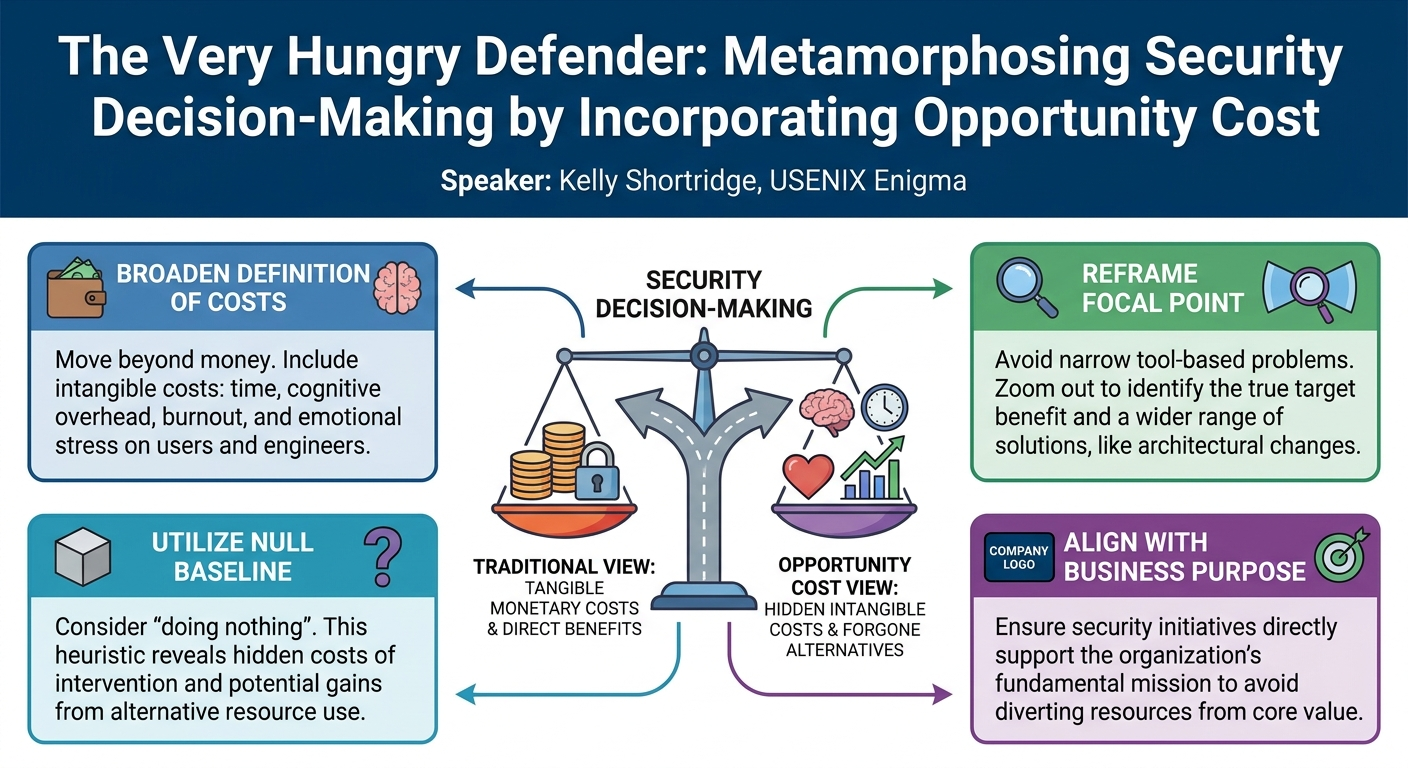
- The Spectrum of Costs and Effects: Security decisions involve a far broader array of costs and effects than typically considered. Beyond tangible costs (wages, hardware, outsourcing), there are significant intangible costs such as employee time, cognitive overhead, task switching, interruptions to flow, increased organizational conflicts, delayed time to market, and even increased consumer anxiety when security responsibilities are offloaded. Conversely, tangible benefits include revenue growth, customer renewals, faster software releases, and profitability, while intangible benefits span improved employee perception of efficacy, reduced burnout, better collaboration, reduced toil, emotional experiences (e.g., reduced anxiety), enhanced competitive advantage, and positive brand perception. Security teams often fail to consider the erosion of these benefits as a cost when evaluating investments.
- The Null Baseline Heuristic: A powerful tool for uncovering opportunity costs is to consider the null baseline – what is gained by not implementing a security solution. This heuristic prompts organizations to honestly assess the potential downsides of a security measure, such as reduced developer productivity or increased employee stress, which might otherwise remain unexplored. By evaluating the option of "doing nothing," a broader set of alternatives that could still uphold desired benefits, like software velocity, can emerge.
- Negative Externalities: Security decisions rarely exist in isolation; they impose costs and benefits on other entities, known as externalities. A classic economic example is pollution, where a firm's production costs don't account for environmental damage to the community. In cybersecurity, an application security tool might offer a positive return for the security team, but result in a negative externality of slower or fewer software releases, impacting development teams, the broader organization, and even customers through delayed features or reduced product quality. Understanding these spillover effects is crucial for a holistic cost assessment.
- The Shadow Price: Similar to complex domains like healthcare, cybersecurity decisions have a shadow price, which reflects the true opportunity cost for the economy, taking into account all externalities. This concept acknowledges that benefits and costs vary significantly across stakeholders – the security team, development teams, the organization, users, customers, and society. A benefit for one stakeholder might beget a cost for another. Shortridge urges organizations to question the shadow price of each security mitigation they implement.
- Beyond Monetary Resources: While money is a crucial resource, Shortridge identifies two other fundamental resources often neglected in opportunity cost calculations:
- Time: Security investments are often "profligate with time," requiring time for help desk calls, policy development, and, significantly, developers to fix thousands of vulnerabilities.
- Cognition and Emotion: Cognitive resources like attention, affect, and productivity are expended by humans in problem-solving. Furthermore, emotional experiences like anxiety, frustration, and confusion are often overlooked costs, despite their well-documented salience in human decision-making. Studies show that stress from time pressure can exacerbate user frustration with poorly usable security tools, making them more likely to bypass security requirements.
By recognizing this comprehensive spectrum of costs and effects, considering the null baseline, understanding negative externalities and shadow prices, and expanding the definition of resources beyond money, organizations can begin to make more informed and truly optimal security decisions.
Technical Deep Dive
▶ Watch: Considering time, cognition, and emotion as costs (10:30)
The technical deep dive in Shortridge's talk centers not on specific code or network protocols, but on the application of economic and psychological principles to the architecture of security decision-making itself. She introduces an illuminating analogy and a powerful framework for dissecting security problems.
The Thermodynamics of Security Programs
Shortridge draws an analogy to the laws of thermodynamics, specifically the principle that energy within a system cannot be created or destroyed but can be interchanged. She applies this to security programs, viewing them as components of an organization that can expend or absorb "energy." This "energy" represents the resources (time, cognition, emotion) discussed earlier.
For example, requiring organizational users to be vigilant against phishing threats means users expend their energy (attention, cognitive effort, emotional vigilance) on a security program. This energy is then "absorbed" by the security team, allowing them to expend their own energy elsewhere. Similarly, mandating software engineers to triage bugs discovered by vulnerability scanners means developers expend significant energy combing through findings and fixing them, effectively absorbing the energy the security team might otherwise expend on those tasks. This thermodynamic perspective helps to excavate opportunity costs by making visible where energy is being expended and absorbed, and by whom, across the organization. It highlights the distributed nature of security effort and its impact on non-security teams.
The Problem of the Focal Point in Application Security
A critical area where opportunity cost framing exposes inefficiencies is in application security (AppSec), particularly concerning the focal point of a problem. Shortridge argues that security problem definitions are often overly prescriptive and zoomed-in, dismissing potentially superior alternative solutions.
Consider the common question: "What Static Application Security Testing (SAST) tool is best?" This represents a very narrow focal point, as it immediately prescribes SAST tools as the only solution. Shortridge encourages asking "why" multiple times to zoom out:
- Initial (Narrow) Question: "What SAST tool is best?"
- First "Why?": "Why do we want SAST at all?" The answer likely leads to: "How can we minimize the number of security bugs developers introduce into code?" This is better, less tool-specific, and might introduce alternatives like security awareness training.
- Second "Why?": "Why do we want to minimize the number of bugs developers introduce into code?" The answer is typically: "Because we don't want them to be exploited in production and cause problems."
- Broadest (Optimal) Question: "How do we minimize the impact of security bugs in code running in production?"
This final, more expansive question unlocks a far broader list of potential opportunities and solutions because it focuses on the true target benefit – minimizing impact, not just bug count or tool selection. From this zoomed-out focal point, the finite pool of resources can be allocated to a diverse set of alternatives, including:
- SAST tools and developer training (the initial narrow focus).
- Ephemeral or immutable infrastructure, reducing the attack surface and making exploits less persistent.
- Standardizing libraries and patterns, so developers are less likely to introduce common mistakes.
- Architecting systems with strong isolation properties, limiting the blast radius of any exploited bug.
- Running security chaos experiments to proactively uncover how systems behave under adverse conditions, including exploitable bugs.
The core insight is that investing in standardized libraries, for example, means those exact resources cannot be invested in SAST tools. By broadening the focal point, organizations can identify which alternative truly maximizes success in achieving the ultimate goal, rather than just solving a narrowly defined sub-problem.
Identifying the True Target Benefit
Shortridge emphasizes that identifying the true target benefit requires drilling down several layers of "why." Humans have a default tendency to remain zoomed in (e.g., "Which resort is best for my vacation?" instead of "How can I reduce stress or generate wonder?"). For organizations, this means understanding their fundamental purpose. A retail corporation's primary mission is not to secure endpoints or networks; it's to sell goods and provide a resilient online store for e-commerce.
Any security work that doesn't directly support this fundamental purpose bears an opportunity cost, as it diverts time, cognition, attention, and budget from activities that would more directly fulfill the organizational mission. This perspective can even inform outsourcing decisions. A retail corporation lacking expertise in database management, ad delivery, or content delivery might outsource its online store to a platform service provider, an ad tech firm, or a Content Delivery Network (CDN). The opportunity cost of trying to build and operate this complex infrastructure internally would be substantial, diverting resources from core retail business logic that directly adds customer value. This is a cost many organizations pay daily, often without recognizing it.
Demo / Proof of Concept
▶ Watch: Application security case study: Reframing the focal point (14:40)
The talk "The Very Hungry Defender" is a conceptual and analytical presentation focused on a framework for decision-making rather than a demonstration of a specific tool or exploit. As such, it did not include a live demo or a technical proof of concept. The content was delivered through detailed explanations, examples, and analogies designed to illustrate complex economic principles in the context of cybersecurity.
Defensive Implications
▶ Watch: Summary and call to action for widespread inclusion (19:00)
Incorporating the principles of opportunity cost into cybersecurity decision-making offers profound defensive implications, enabling organizations to move beyond reactive, narrow approaches to a more strategic, holistic, and economically sound security posture.
- Holistic Resource Allocation: Defenders must shift their mindset from simply evaluating the cost-benefit of a single security investment to considering the opportunity cost of not pursuing alternative investments. This means actively asking: "If we spend resources on X, what valuable Y are we inherently sacrificing?" This forces a more strategic allocation of finite resources (money, time, cognitive effort, emotional capacity) across the entire security landscape.
- Quantify Intangibles: Security teams should develop mechanisms to identify and, where possible, quantify intangible costs and benefits. This includes measuring developer productivity impacts (e.g., slower software release cycles due to security gates), employee burnout, cognitive overhead from security tools, and the emotional toll of security incidents or overly cumbersome controls. Conversely, they should highlight gains in employee morale, collaboration, and reduced toil as significant benefits.
- Embrace the Null Baseline: Before implementing any new security measure, defenders should rigorously consider the null baseline. What are the potential gains, efficiencies, or positive externalities of not implementing the proposed solution? This exercise can reveal hidden costs of intervention and surface alternative, less disruptive, or more effective strategies. It pushes teams to justify interventions more thoroughly.
- Map Externalities and Shadow Prices: Security professionals must map out the negative externalities of their decisions across all stakeholders: security team, development teams, IT operations, business units, customers, and even society. Understanding that a security solution beneficial for one team might impose significant costs on another is critical. By attempting to calculate the shadow price of mitigations, organizations can gain a more accurate understanding of the true, enterprise-wide cost of their security choices.
- Reframe the Focal Point: Security leaders should actively challenge and broaden the focal point of security problems. Instead of asking "Which SAST tool is best?", they should ask "How do we minimize the impact of security bugs in production?" This "zoom-out" approach encourages brainstorming a wider array of solutions, including foundational architectural changes (e.g., strong isolation, immutable infrastructure), process improvements (e.g., standardized libraries, security chaos experiments), and developer enablement (e.g., better training, self-serve security patterns), rather than just tool acquisition.
- Integrate Time, Cognition, and Emotion: Defensive strategies must explicitly account for the time, cognitive load, and emotional impact on users and engineers. Security tools that are difficult to use or policies that are overly burdensome can lead to user frustration, bypasses, and burnout, effectively negating their intended security benefits. Prioritizing usability and reducing cognitive friction in security controls is a critical defensive posture.
- Align Security with Business Purpose: Security initiatives should be explicitly aligned with the organization's fundamental business purpose. If the core mission is e-commerce, security decisions should directly support a resilient online store, not just generic endpoint protection. This might involve strategically outsourcing non-core security functions (e.g., leveraging CDN security features) to allow internal teams to focus on security aspects most relevant to unique business logic, thereby minimizing opportunity costs.
By adopting these implications, defenders can evolve from being merely "hungry" for solutions to becoming "metamorphosed" decision-makers who optimize security outcomes by making choices that are truly beneficial across the entire organization.
Key Takeaways
- Opportunity cost is ever-present: Every cybersecurity decision, whether acknowledged or not, involves an opportunity cost—the value of the best alternative not chosen. Recognizing this is the first step toward better outcomes.
- Broaden the definition of costs and benefits: Move beyond purely monetary considerations to include intangible costs (e.g., employee time, cognitive overhead, burnout, delayed time to market, emotional stress) and intangible benefits (e.g., improved productivity, morale, collaboration, brand perception).
- Utilize the Null Baseline and understand Externalities: Actively consider "what is gained by doing nothing" to uncover hidden costs of interventions. Furthermore, always assess the negative externalities—the costs imposed on other teams or stakeholders—by security decisions.
- Reframe the problem's focal point: Avoid narrow, prescriptive problem definitions. Ask "why" multiple times to zoom out and identify the true target benefit, leading to a broader and potentially more effective range of solutions.
- Account for time, cognition, and emotion: Security decisions consume not just money, but also the precious resources of time, cognitive effort, and emotional capacity from individuals across the organization. Factor these into decision models to prevent unintended negative consequences like user frustration or burnout.
- Align security with core business purpose: Ensure security initiatives directly support the organization's fundamental mission. Any security work not contributing directly to this mission incurs an opportunity cost by diverting resources from higher-value activities.
About the Speaker(s)
Kelly Shortridge is the Head of Product and Design at Fastly, Inc., a leading edge cloud platform. She is known for her work at the intersection of cybersecurity, business strategy, and human behavior. Shortridge advocates for a more economically informed approach to security, challenging traditional industry thinking. She is also the author of a book, mentioned at the close of her talk, which delves deeper into these concepts, aiming to provide practical guidance for security decision-makers. Her insights encourage the cybersecurity community to adopt a more holistic and strategic perspective on defensive measures.
Reviews
Dr. Zero (Offensive Security Researcher) — SOLID
Shortridge takes a sledgehammer to the way security teams buy tools. It’s an economic reality check masquerading as a philosophy talk, forcing defenders to admit that every useless scanner they deploy costs them dev velocity they can't get back.
Heather Calloway (CISO) — MUST SEE
Kelly Shortridge delivers a much-needed course correction for security leaders who treat their budgets and developer time as infinite resources. By applying strict economic opportunity cost to security programs, this talk forces us to justify our footprint against the business's actual goals. It is required viewing for anyone preparing a budget or defending headcount to a CFO.